Three Days at the Portage – Day 1

Scarlet Tanager

The Memorial Day weekend this year offered three beautiful days of birding at the Portage. I had no desire to go anywhere else; rather, I was interested to see what different birds I might discover each day, enhanced by the fact that a lot of birds were finally on the move to their summer homes. Here are photographs from Saturday, May 23rd.

While I think this was the last day I saw the male Scarlet Tanagers, there were plenty of Indigo Buntings. I am not aware of Scarlet Tanagers breeding at the Portage, but the Indigo Buntings certainly are a presence now every year. I suspect some of them that return may have hatched at the Portage.

Indigo Bunting

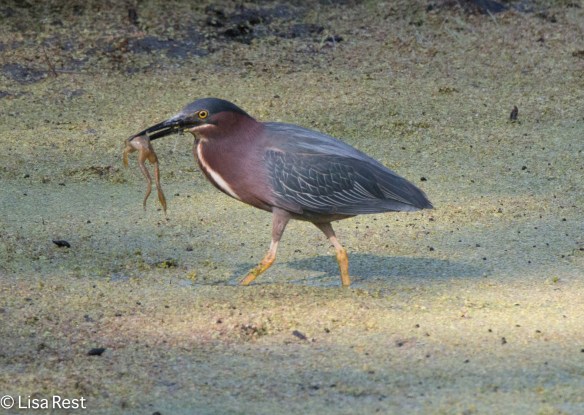
I don’t know where the Green Herons are hanging out – likely on the Des Plaines River or perhaps across the railroad tracks in the low-lying water-collecting areas of Ottawa Trail – but I still see them fly over nearly every visit. I was fortunate enough to capture this one in flight.

This Scarlet Tanager looks orange compared to the other one. I imagine it is a function of the intensity and angle of the light.

Not too many warblers left…

Goldfinches are everywhere but not as easy to see.

There were plenty of Baltimore Orioles and they looked like they were busy tending to their nesting sites.

I finally managed to capture a singing Song Sparrow.

The turtles never miss a sunny day.

Daisy Fleabane opening up now – I had some in my yard last year, hope it returns

I love this Common Grackle posing, capturing the epitome of grackleness.

I fear for Black-capped Chickadees. Lately I have seen only one at a time.

One of many House Wrens.

A slow-motion Blue-gray Gnatcatcher.

Gray Catbirds are more often heard than seen but I was fortunate enough to enjoy both with this one.

A questioning look from the Great-crested Flycatcher below.

Perhaps this European Starling had just taken a bath in the last photo.

I have seen more Eastern Wood-Pewee’s this year. There’s even one in my neighborhood.

Subsequent visits gave me much better views than the Red-Eyed Vireo below.

Another Indigo Bunting

Then, most exciting of all, as I was sitting down and contemplating leaving, I heard and then saw the Red-Headed Woodpecker below. I have been waiting to see this species for an entire year. I wonder if this is the same one that I have seen on rare occasions only.

I have no idea what kind of caterpillar this is but it was my last subject as I left for the day.

i will be back with Days 2 and 3 which were also quite birdy. My next visit to the Portage will likely be more challenging but I will continue visiting to keep track of the emerging families. I hope we humans find some peaceful solutions. The days are getting so very long now.

Back to the Portage

It’s all I can do to keep up with migration this spring, let alone the pictures I have taken…So I’m attempting to do this in chronological order but it won’t be easy. This past Saturday started out cool but sunny. I decided to start my walk in the opposite direction of what I normally do. Then I realized that I had forgotten to put my little portable stool in my backpack so I decided to walk back to the car to get it. As I walked, I heard the Great-Crested Flycatcher, and then saw him in one of the Redbud trees bordering the lawn behind the statue. The morning had promise.

Great-Crested Flycatcher
I have decided to photograph the statue every time I go to the Portage now to gauge the light conditions.

Last Saturday was a riot of colorful birds. I counted a dozen male Indigo Buntings. They were everywhere and they were not particularly shy, so I took advantage of their fearlessness. You can see how the light affects the hue of the blueness, when actually their feathers are all black.

I ventured out to the gravel road that runs along the MWRD property and found two male Scarlet Tanagers. They were trading songs.

But I discovered a glimpse at a Summer Tanager later in my pictures.

For all the male Baltimore Orioles singing and displaying these last few weeks, I have seen only one or two females so far. But that’s because they’re busy tending the nest.

Yellow Warblers may stay and breed at the Portage. Invariably I hear them but don’t always see them. So I was glad to capture this one.

White-Breasted Nuthatches are present all year, but are not seen or even heard frequently now.

The female Rose-Breasted Grosbeak below is the last one I have seen. I am not aware of any starting families at the Portage, but it could happen.

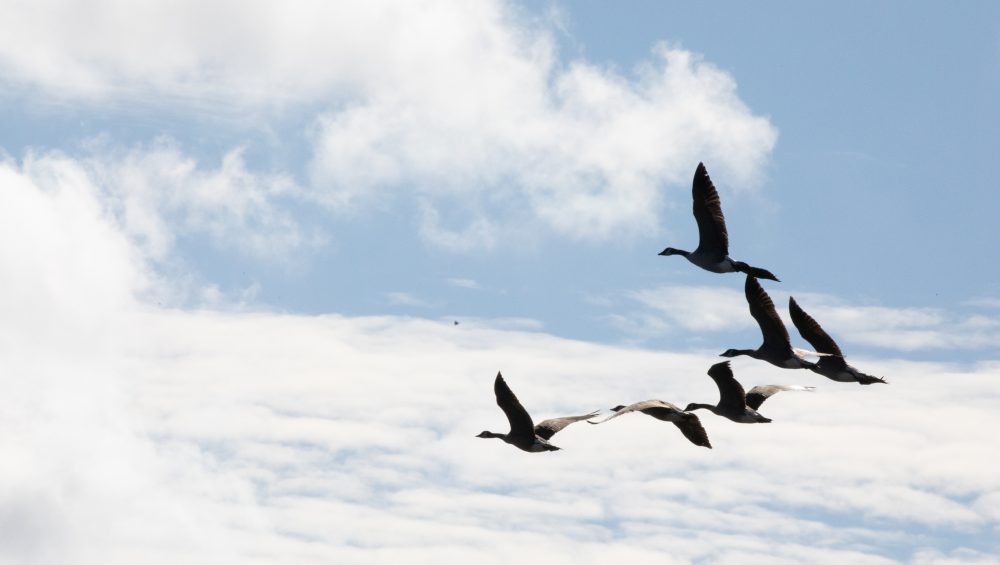
We have had a lot of rain, and even more after these pictures were taken. There were two Canada Geese trying out the newly flooded waters.

So this time of year of course I’m looking for warblers wherever I can find them. I just calculated that over the last couple of weeks I have seen 21 species total. I haven’t been able to photograph them all, but most, sometimes discovering them in my photographs. I will try to post as many as possible. They won’t always be textbook-looking photos. For example, the Golden-Winged below I barely captured but it was the details from the photographs that I was able to identify it as a likely female.

One more Magnolia Warbler

Then there are the flycatchers. They can be confusing. I have since seen the Eastern Wood-Pewee again in the same location looking more like himself so I am guessing he was having an off day (typically he would look more pointy-headed).

Eastern Wood-Pewee
I think this is a Willow Flycatcher…passing through.

On this day I saw this Turkey Vulture being escorted away by a Red-Winged Blackbird.

Song Sparrows are present, singing, and likely staying to raise families.

i keep hearing and sometimes seeing Chestnut-Sided Warblers every time I have been to the Portage since my first intimate encounter with one last Tuesday.

Chestnut-Sided Warbler

There’s a little rapids under the first bridge where the water runs out of the Portage. No water ever runs into the Portage, as far as I can tell, but It’s still nice to see the flow over the rocks.

More often heard than seen, Blue Jays are out and about but rarely available for photos, so it was nice to see this one.

I found this female Common Grackle to be attractive in her own way.

I had noticed this nest before but wasn’t sure anyone was using it until I managed to capture these two Goldfinches. You will probably have to click on the first photo to see the female poking her head out of it. I have since not been able to find the nest, which was not far from the trail, but it could still be there and hidden in all the plant growth that has occurred since.

Sadly, Black-Capped Chickadees are getting harder and harder to find. Long taken for granted, I am convinced they are in decline, at least locally. I caught this one in a hurry.

Here’s my Robin photo of the post.

As the leaves are finally coming out, it’s interesting to see how the spaces change.

Below is one of my favorite birds, a Blue-Headed Vireo. I have seen them a couple times this spring which is surprising to me, as I don’t think I have seen one for years.

Woodpeckers are busy everywhere.

Red-Bellied Woodpecker

And last for the moment, I finally was able to catch the male Eastern Bluebird in focus. He has a habit of posing in difficult places, but he sat long enough this time. And although I think I heard him this past week, I haven’t seen him since. I hope the pair is still nesting and I will be looking for baby bluebirds this summer.

I have been to the Portage four times since last Saturday! I am beginning to feel like I live there. Every time I have gone, there has been a different species or a special encounter with one I’ve seen so far this spring. As many people have remarked, the cool start has been difficult for the birds migrating to their breeding grounds. I can only hope those who have visited the Portage are finding what they need in this little hotspot and will survive and flourish on the rest of their journey.

I will be back with lots more. Thanks for checking in, and I hope you are safe, well, and able to get out and enjoy this spring.

May Migration Memories

Canada Warbler (female)

It’s hard to believe but spring passerine migration has come and gone again. I never made it to the lakefront, where I’m sure most of the migrants coming through the city were. The trees in the park near my office were late in leafing out, and I was beginning to wonder if I would ever see any warblers, and then, the last two days of May, there were a few pretty birds in that last push.

I took all these photographs trying out my new mirrorless camera. The purchase was inspired by the fact that one guide and one participant were using the Sony RX10 on the Texas trip, so I took that fact alone as a recommendation. I really haven’t had time to investigate all the features, but it’s more compact and easier to carry than my Canon 70D with the 300mm lens attached, so I have this now for situations when I don’t want to carry quite as much gear.

Eastern Towhee

After all the Hermit Thrushes that were in the park weeks before (not as many as last year, but I think I got pictures with the other camera…), I was surprised to see this Wood Thrush on May 30, after I had gone back to try to get a picture of the Eastern Towhee above who showed up on May 29 but eluded my efforts.

White-throated Sparrows were more prevalent in April – they seem to be all gone now

More shots of the Canada Warbler. She was in the park for two days. I often think that someone should name shades of yellow after particular warblers, but the steel-blue gray back of a Canada Warbler always stands out for me.

I adore Wilson’s Warblers – because they tend to move more slowly and deliberately in the trees! And I recognize Wilson’s Yellow, which is a good thing because I don’t always get to see that trademark skullcap.

It was especially challenging to get a photograph of this male Mourning Warbler. Usually they are closer to the ground, but this guy was up in the trees after their burst of foliage attracted just the bugs or worms he was looking for.

Mourning Warbler

Was surprised to see this flycatcher on May 30. Even more surprised to get a picture of it.

One of the last Ovenbirds – they were on the ground in the park for at least two weeks before the end of May

I don’t expect to see much along the Chicago River in the next month or two, save a Ring-Billed Gull or Herring Gull, or the occasional Mallard. Every once in a while there is a Black-Crowned Night-Heron making its way slowly along the river. But birds move and there’s always the possibility of a surprise somewhere.

I have many pictures I want to share from several Portage visits, and of course I will get back to the Texas adventure as soon as possible. Looking for more space in my non-blogging life. Survived the annual choir appreciation dinner and talent show Wednesday — the offerings from the choir members were outstanding and seem to get better and more varied every year. The “survival” part was debuting a flute-and-piano piece with my flutist extraordinaire friend Linda Rios, based on a melody I had written 50 (?) years ago to the lyrics of a Robert Frost poem, “The Vindictives.” Which has led me back to Frost and poetry in general. Looking for my next melody to show up sooner than another 50 years …And I hope to be back to this page soon!

Fall Migration Continues

RBNU Portage 9-29-18-1399

Red-Breasted Nuthatch

I think fall must be my favorite season at the Chicago Portage. The birds blend in with the autumn colors, the leaves start to fall from the trees and then every once in a while a bird takes a quick leaf-like descent as well. This past Saturday, after my morning commitment to Thatcher Woods where we had scores of Yellow-Rumped and Palm Warblers, I decided to see what was up at the Portage. Below are two of perhaps 100 Robins…

Directly below, two Common Yellowthroats at Thatcher Woods.

I always take a picture of the water, such as it is, at the Portage to document how it changes from season to season…

Portage 9-29-18-1268There is water enough to bathe in as this female Red-Winged Blackbird was finding out.

RWBL Portage 9-29-18-1577

Red-Winged Blackbird (male)

The Yellow-Rumped Warbler below was at Thatcher Woods…

And the Palm Warbler below was at the Portage.

PAWA Portage 9-29-18-1565Tennessee Warblers and Orange-Crowned Warblers often get confused in the spring but these two made it easier for me.

TEWA Portage 9-29-18-1279

Tennessee Warbler

Orange-Crowneds always looks to me like they have a slight eye-ring.

OCWA Portage 9-29-18-1591

Orange-Crowned Warbler

I missed seeing a flashy male Black-Throated Blue Warbler this year but I’m glad to have found a female of the species, wearing her muted fall clothes.

BTBL Portage 9-29-18-1473

Black-Throated Blue Warbler (female)

Blackpoll Warblers in their fall plumage are stamped permanently on my brain after a few years ago when there were many for several days at my old stomping grounds, Lake Shore East Park, so I was delighted to find this lovely individual.

At one point I encountered some workers who were taking down a tree. I spent some time talking to one while another was driving wedges into what was soon to be the stump. It turns out the trees were not birch but white poplar, which is an invasive species and that is why they were removing it. Come to think of it I don’t recall ever seeing a bird in those trees although they had become a landmark and I thought they were rather attractive. After I was given clearance to go beyond the workers, I grabbed two quick clicks in the distance as the tree fell.

For all the Robin activity there were only a few Cedar Waxwings…

My view from the first bridge at the Portage yielded a Mourning Dove and a House Wren.

MODO Portage 9-29-18-1265HOWR Portage 9-29-18-1255I almost thought I had missed all the Indigo Buntings but there were still a few youngsters left.

INBU Portage 9-29-18-1526

Indigo Bunting

NOCA Portage 9-29-18-1510

Northern Cardinal (female)

I was delighted to see a Swainson’s Thrush if only for a moment…

SWTH Portage 9-29-18-1417

Swainson’s Thrush

Eastern Phoebes…

Just starting to see Dark-Eyed Juncos, the harbinger of colder weather coming, I suppose. But after not seeing them all summer I am glad to have them back.

DEJU Portage 9-29-18-1454

Dark-Eyed Junco

Yellow-Bellied Sapsuckers are coming through as well.

YBSA Portage 9-29-18-1405

Yellow-Bellied Sapsucker

GREG Portage 9-29-18-1318The Des Plaines was so low, this Great Egret was wading out into it quite a ways from the shoreline.

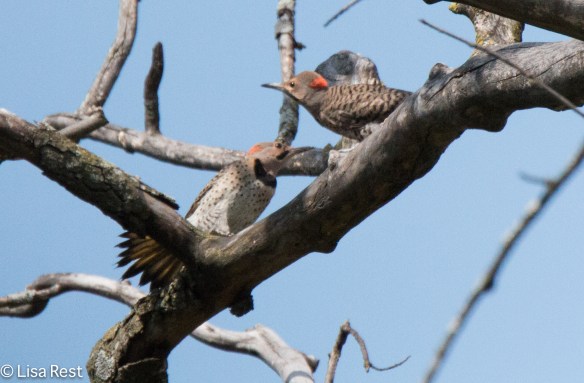
We had a lot of Northern Flickers at Thatcher Woods. Here’s one of them checking out a future home, perhaps.

YRWA Portage 9-29-18-1486

Yes I am a Yellow-Rumped Warbler

And Monarch Butterflies are still migrating. I love the way the Poke Weed looks this time of year. I knew the birds were attracted to it but I guess the Monarchs like it too.

Monarch Portage 9-29-18-1497After hearing and rarely seeing Eastern Wood-Pewees all summer, it was nice to get good looks at this one.

EAWP Portage 9-29-18-1395

Eastern Wood-Pewee

DOWP Portage 9-29-18-1550

This last photograph is of a Downy Woodpecker who was foraging low and obscured by the vegetation but I like the pastel colors.

More to come, I have three more Saturday bird walks, weather permitting. We seem to be entering a rainy spell but from the looks of the Des Plaines last week we can use it.

Portage Vacation Day

CEWA 8-31-18-8696

Cedar Waxwing

I took today off. It was a bit difficult getting up early this morning after swimming last night but I managed to get over to the Portage a little after 8:00 a.m. and took note of how deserted the place was on a weekday. No dog-walkers or cyclists. Only one runner, who was probably as amazed to see me as I was him.

img_2889img_2888A long shot of the duckweedy water above and just below it, an untrimmed path I decided not to take.

AMRO 8-31-18-8397The robins are back, and the waxwings are still numerous. Literally nobody in the mucky water. I was treated to American Redstarts and a couple Ruby-Throated Hummingbirds early on, which gave me hope to find a few more migrants.

AMRE 8-31-18-8409

American Redstart (First Year Male)

Ruby-Throated Hummers above, an adult male American Redstart below.

The only other warblers I could barely photograph were the Chestnut-Sided below left and the Black-Throated Green on the right. I missed the Ovenbird that landed briefly in  the tree I later found them in.

In the beginning with the immature male Redstarts was a chattering young House Wren.

Butterflies were out for the sunshine today. Red Admiral, Pearl Crescent and Monarch butterflies.

I saw a few White-Breasted Nuthatches too.

WBNU 8-31-18-8715I heard the Eastern Wood-Pewee long before I saw the one below.

EAWP 8-31-18-8745This time of year I expect to see lots of Indigo Bunting children and I did, but they were playing hard to get with the camera.

Yellow is the predominant color this time of year and I found a bumblebee and a goldfinch taking advantage of it.

One Eastern Kingbird…

EAKI 8-31-18-8640There was a lot of chatter from catbirds but I only barely saw the youngster below.

GRCA 8-31-18-8474A couple more Cedar Waxwings. The one on the left is an immature.

The last photograph I took was of this stunning little Silvery Checkerspot.

Silvery Checkerspot Butterfly 8-31-18-8756My walk tomorrow will take place if we are not totally rained out. Scattered thunderstorms are in the forecast. We shall see… This evening as I write this I have just heard the rumble of thunder. And now it is starting to pour.

By the way it feels nice to have the time to do a same-day blog post. Perhaps if I – no, let’s say when I retire – I will be up to the task more often.


Portage Summer Day

GRHE 7-28-18-7115I got out early last weekend to beat the heat which was nothing compared to what kept me indoors most of this weekend. Last Saturday was a beautiful day. And usually when the weather is good, the birds are out enjoying it too.

Summer is the time for confusing juveniles, and the first bird I saw, below, suggested to me that it was a juvenile Eastern Wood-Pewee…

EAWP 7-28-18-7095Not to be confused with the juvenile Eastern Phoebe I saw later, below.

EAPH 7-28-18-7100I couldn’t get this Downy Woodpecker kid to turn around and smile for the camera but it was good enough to see his adult feathers coming in…

DOWP 7-28-18-7126The House Wren below just has that newbie look about it.

The Red-Bellied Woodpecker kids were out and about. I was surprised to see no red at all on the head of the one below on the top right.

Robins always look like something else this time of year, but I am no longer fooled.

AMRO 7-28-18-7192I was beginning to wonder if all the Red-Bellied Woodpeckers were gone, but then I found a bunch of them hanging out on the bare limbs of a dead tree. They were all juveniles.

These two young Northern Flickers seemed to be practicing pairing up already.

NOFL 7-28-18-7350

Nothing going on, on the Des Plaines, which was looking low.

Not much in the way of butterflies. A Monarch here and there, and this one Red-Spotted Purple.

But the dragonflies were quite amazing.

Widow Skimmer 7-28-18-7252

Widow Skimmer

I’m going out on a limb with the ID below. I have a fancy book on dragonflies and damselflies but there are way too many choices.

Russet-tipped Clubtail female 7-28-18-7265

Russet-tipped Clubtail female

I’ll keep trying to figure this one out…

? Bluett 7-28-18-7272

Some kind of Bluet

I’m not confusing Twelve-Spotted Skimmers with Widow Skimmers anymore…

Twelve-Spotted Skimmer 7-28-18-7281

Twelve-Spotted Skimmer female

or with Common Whitetails.

Common Whitetail male 7-28-18-7322

Common Whitetail male

Then there was this beautiful Grasshopper that is likely a Differential, but I am absolutely ignorant about grasshoppers so I’m not guessing.

Unidentified Grasshopper 7-28-18-7298And if anybody knows the identity of the beautiful wasp below, please chime in. All my reference books have failed me.

Unknown Wasp 7-28-18-7166Back to the birds. The fruit-eaters were enjoying the mulberry tree. That’s a Cedar Waxwing on the left and an adult American Robin on the right.

This Eastern Kingbird looks mature, but looks can be deceiving.

EAKI 7-28-18-7312Some interesting things on the trail for the juvenile Song Sparrow below…

SOSP 7-28-18-7177and for a male House Sparrow. I rarely see House Sparrows at the Portage but there were these two.

HOSP 7-28-18-7392

Juvenile House Sparrow

Saturday mornings tend to be work days. There was some burning of invasive vegetation going on.

Controlled burn 7-28-18-7176Goldfinches are late breeders, so I haven’t seen many in my yard lately, but I did see this pair at the Portage briefly.

AMGO 7-28-18-7255Always happy to see a Great Blue blending in.

GBHE 7-28-18-7234And it was even pleasant enough for a couple cardinals to make an appearance.

NOCA 7-28-18-7291I heard more Indigo Buntings than I saw, but was finally rewarded by the adult male below.

INBU 7-28-18-7382For as much time as the Green Heron spent on this frog I am not sure he or she managed to eat it.

GRHE 7-28-18-7130I hope the heatwave ends in time for next weekend. In the meantime I guess I can’t complain about being stuck in an air-conditioned office this coming week.


In the Vicinity

BGGN 5-19-18-4246

Blue-Gray Gnatcatcher

The weather has turned suddenly hot and it’s hard not to wonder what effect that’s having on spring migration. I sense that to a large degree, no? pun intended, the heat wave has sent those who move farther north packing. I had hoped we would still see a few warblers yesterday on my second time leading a walk at the Portage, but we only heard a couple Yellow Warblers and never saw them. I’ll be back later with a few pictures from yesterday. But this is a more historical post, with a few pictures from the trip two weeks ago to the Portage, and a few more from a walk I took at Ottawa Trail just to see what was going on closer to the Des Plaines River.

Magnolia Warblers move predictably enough to photograph. This time the easiest bird to capture was a female; I caught only glimpses of a male.


One bird that I haven’t seen in quite a while appeared toward the end of our walk two weeks ago. It’s a Yellow-Throated Vireo.


It’s gotten so hot in the last few days it’s hard to believe that last weekend it was still cool enough to warrant layered clothing in the morning.

The Green Herons were both on site two weeks ago, and the turtles were starting to emerge to soak up what little sunlight was occasionally available.


I think this was my last Hermit Thrush of the season.

HETH 5-12-18-3785

Hermit Thrush

I likely won’t see another Lincoln’s Sparrow until fall either.

LISP 5-12-18-3749

Lincoln’s Sparrow

But it looks like I might be seeing a Great Egret from time to time at the Portage this year. We saw it a couple times yesterday.


The pictures below are hardly worth sharing, but this is my last Ruby-Crowned Kinglet.


I used to see shorebirds more frequently but in the last couple years they have been few and far between, so I was happy we had a Spotted Sandpiper on the left, and the Killdeer on the right. I usually hear or see Killdeer flying, but sandpipers have been generally absent.


House Wrens are here to stay for the summer.

HOWR 5-19-18-4292A female American Redstart below.


And more shots of a Blue-Gray Gnatcatcher. Yesterday we heard them constantly but didn’t see one.


Deer 5-19-18-4267

White-Tailed Deer at Ottawa Trail

It’s rare to see a Chipmunk sitting still but this one wasn’t self-conscious at all.

Chipmunk 5-19-18-4137Indigo Buntings, male and female.


And the surprise two weeks ago was an Orchard Oriole.


Often more heard than seen, the Northern Cardinal below, an Eastern Wood-Pewee, and a Song Sparrow, all at Ottawa Trail.


The heat may keep me indoors more than I’d like. That could mean more blog posts, however. For the moment it’s time to get out in the yard before the heat of the day takes over. Lots of work to do there. Happy Summer to All…

AMRO 5-19-18-4394

Lasting Impressions

WBNU Ottawa Trail 09-09-17-5295

White-Breasted Nuthatch

Somewhere the images I manage to capture of birds over the years accumulate in well-organized collages in my mind’s eye, and from those conglomerations comes empathy for the individuals of the any species and an appreciation for their irreplaceable contributions to life on the planet.

I haven’t seen many species of late, due  somewhat to my inability to frequent the lakefront parks, but when I revisit some of these photographs I took from weekends ago at the Chicago Portage and Ottawa Trail, I am reminded of how special birds surprisingly show up–because birds are creatures of flight, they can fly and land anywhere, and no ultralight aircraft will ever be a match for a bird–and I am lucky to be alive to see them. Like the Golden-Winged Warbler below that popped up at Ottawa Trail on September 9. I couldn’t get great pictures but I am grateful I got to see such a beautiful and sometimes rare bird.

The Red-Bellied Woodpecker below must be a youngster. Colors aren’t quite set yet, still has a fluffy, unfinished look about him.

I never tire of seeing a Magnolia Warbler. Below is either a female or a young male.

Flycatchers were still around during the first days of our heat wave, which is thankfully over except now we are approaching drought. The facing pictures of the Phoebe below were from the Portage and the one below them from Ottawa Trail.

EAPH McGinnis 09-17-17-8200

Eastern Phoebe

Usually I only hear Pewees but that day I got to see this one.

EAWP Portage 09-09-17-8013

Eastern Wood-Pewee

Swainson’s Thrushes were abundant but not always easy to see. After going back and forth I have decided the larger picture below is of a Gray-Cheeked Thrush.

SWTH Portage 09-09-17-7828

Gray-Cheeked Thrush

And the last of the young Indigo Buntings were preparing to leave the Portage.

INBU Portage 09-09-17-7785

Indigo Buntings

I have never seen a Chipmunk sit still long enough for me to point a camera lens at it. This is worth sharing.

Chipmunk Portage 09-09-17-7976

Eastern Chipmunk

More recent memories to come and if I see a few more migrants before the passerine migration is over, I will try to share them with you.

Burdock and Bellflowers

Burdock & Tall Bellflower Portage 07-29-17-6488This time of year I may not be seeing many birds but everything is in a state of growth and worth attention. I visited the Chicago Portage last Saturday because I wanted to go elsewhere on Sunday and still felt like I needed to keep track of whatever was going on there. I was surprised to see the fruits of some restoration efforts in the vegetation. There is a lot of Tall Bellflower I don’t recall seeing before, mixed in with the Burdock which is about to bloom. Last time the Common Burdock was in bloom, butterflies were everywhere, so I will have to go back soon to see if that happens again.

Burdock is an invasive species but for whatever reason it’s not considered a problem at the Portage. It could be that there is just too much of it to remove entirely but by planting more native species, the County is slowly making some headway against it. I don’t mind it so much because it supports wildlife. Still need to be careful not to get caught up in it.

I became captivated by the grass below but I cannot identify it…yet. Plants are starting to drive me crazy.

There is a lot of Pinnate Prairie Coneflower, below left, but I don’t remember seeing Blue Vervain before, which is on the right. I did see the same Vervain blooming elsewhere in Cook County over the weekend.

Of course there were birds, but not so easy to photograph. I became intrigued by young European Starlings though because now is when they start looking like their name for a brief period of time as their breasts break out in little white stars which you might be able to see if you click on the picture on the bottom left.

There were a lot of Cedar Waxwings too. Seems the group name is either “earful” or “museum” of waxwings… They are notorious fruit lovers and that made it hard to capture the berry-eater at the bottom.

Cedar Waxwing Portage 07-29-17-6466There have not been a lot of dragonfly species. It’s a female Common Whitetail Skimmer on the left below. I still don’t understand the attraction to gravel. On the right is a type of Spreadwing damselfly, but I am not able to identify it.

A long view of the water, such as it is, at the Portage, looking peaceful and baked in sunlight.

Portage 07-29-17-6490Some juvenile-appearing Flycatchers below: Eastern Kingbird, Eastern Phoebe and what I’m pretty sure is an Eastern Wood-Pewee.

EAKI Portage 07-29-17-6516

Eastern Kingbird

A couple Burdock closeups…

The yellow flower below looks different from the ratibida pinnata but I have no clue…tucked away in the shadows, a bunny and a young Robin.

The bracket fungus below is quite impressive. I don’t think I’ve seen it before.

Fungus Portage 07-29-17-6487Below is a Northern Flicker in the most popular tree bearing fruit. Now I’m realizing I was so busy following the birds in it, I didn’t bother to figure out the tree itself. More challenges ahead.

NOFL Portage 07-29-17-6441I fully intended to do a post encompassing all last weekend’s experiences but there’s too much so I will be back shortly with a couple more installments.

Breeding Birds

PRWA IDSP 05-29-2016-2349Passerine migration is over for all practical purposes. Birds have taken to their breeding grounds and are getting down to business. Here are some photos from the last couple weekends, starting with the Prothonotary Warbler above, seen at Indiana Dunes State Park.

Yellow Warblers are common summer residents around here. The one on the left above was hanging out at IDSP and the one on the right was the first bird I encountered at the Chicago Portage last Sunday on a late, gloomy morning.

Even with a lot more light going on at the Indiana location, backlighting was a constant challenge. Above, compare an adult male Scarlet Tanager on the left with what was determined to be a first-year male of the same species.

There were several Red-Headed Woodpeckers at IDSP. I don’t see them too often so they were a nice surprise.

Perhaps the most exciting find was the hardest to photograph. Above is a male Acadian Flycatcher, not far from where his mate is sitting on a cleverly positioned nest underneath a leaf.

Two looks at Eastern Wood-Pewees above.

We had two Pileated Woodpeckers, and the one above was in the best light but this species still eludes my camera, monster lens and all.

Cedar Waxwings above, at IDSP on the left and the other one from the Chicago Portage.

The Portage had at least four male Baltimore Orioles, and I was able to spot a female not entirely hidden on the right, above.

To add to my list of not-often-seen woodpeckers, I had a Hairy Woodpecker at the Portage. Usually I see Downies everywhere, but this was the only woodpecker that I was able to photograph.

Tree Swallows were abundant. And below, it was a good day for turtles at the Portage.

And for Mallard ducklings…looking almost full grown.

Below, a newly fledged American Robin and an adult.

One more look at the Red-Headed Woodpecker.

RHWP IDSP 5-29-2016-2453I’ve been busy writing silly songs, working, gardening and starting to get ready for a trip that will begin on July 1. I am now glad I inadvertently planned to be away before the Democratic National Convention. I’m growing weary of the daily drama and it will be good for my head to be totally oblivious to politics for a couple weeks.

I’ll try to get back to this page a few times before I go. Thanks for stopping by!