Well, the Spring Warbler Migration has been in some kind of full swing, in fits and starts, depending on the weather and, for me, my work schedule…
I have more photos of more birds to process but I wanted to share some images taken on various days in different places in and around the Chicago Loop. I think someone should come up with a set of colors named after these birds, like “Wilson’s Warbler Yellow” and “Canada Warbler Blue.”
The male American Redstarts below show a second-or-more year male (the bright orange, black and white guy) and a first year male who has only a hint of that orange going on his flank but was happy to confirm his Redstartness by flashing his tail.
I had to dig hard to get the pictures of the Canada Warbler below. He was buried well into this flowering tree in Lake Shore East Park but we managed to communicate through a tiny window. Click on the pictures to see them better.
Below, Black-and-White Warblers, male and female, both seen in Millennium Park on different days. The female is in the lower right photograph.
I adore Wilson’s Warblers with their little black caps. This guy was flitting about in the trees looking for insects at Lake Shore East Park on Monday afternoon.
I have seen several Ovenbirds but they have not been volunteering for pictures. I barely caught the one below off guard.
After all the Yellow-Rumped Warblers appear to have moved on, below is a female. You can make a comparison to the male below her.
Common as they are, Common Yellowthroats are still pretty.
I had too many pictures of this Magnolia Warbler to choose from, so here’s another.
I’ll be back with more Warblers and other birds of 2016 Spring Migration.
Here are some pictures from last Saturday’s Spring Bird Count. I did the morning half at McKee Marsh. I have yet to manage lasting long enough to do the afternoon half at Blackwell. It’s hard to get up at 3:00 AM on Saturday after working all week. Maybe next year I can take some vacation days to coincide with migration.
There was still not much going on with warblers, although the storms we have had since have caused considerable fallout along the lakefront and likely this area too.
It was a pleasant surprise to get to the observation deck over the largest portion of water and see a contented looking Bald Eagle, who later reappeared in flight.
Blue-Gray Gnatcatcher
Another Blue-Gray Gnatcatcher on yet another gray day. And there were more gray birds in and around the water…most everything was too far away to focus.
Tree Swallows were abundant.
And it’s always special to see the return of Bobolinks.
Red-Winged Blackbirds are getting down to business.
We were lucky to accomplish as much as we did in spite of periods of rain. The Song Sparrow below did not let the lack of sunshine dampen his song.
Except for brief warm spells, the weather is unseasonably cool, but the rain has caused the trees to leaf out in abundance, offering cover for many migrants while making them that much harder to see! I’ll be back soon with a small migration report from downtown Chicago.
Here are a few pictures taken at various times over the past few weeks, all in downtown Chicago…
Tennessee Warbler
Tennessee Warbler
I never manage to see enough of any one species to tire of them. Although Tennessee Warblers often appear abundant, they are not always easy to capture. For comparison with a species they resemble, I have an Orange-Crowned Warbler below.
Orange-Crowned Warbler
There seemed to be fewer birds altogether this year, but I don’t know if it is due to loss of habitat, weather patterns, being in the wrong place at the wrong time or a combination of all three.
Northern Waterthrush
I frequently see Northern Waterthrushes on the ground, but less often perched in trees.
Kentucky Warbler
The day I saw the Kentucky Warbler, there were so few birds altogether at Lake Shore East Park I wasn’t even aware I had seen this rarity until I checked my photographs later. The bird kept ducking in and out of hydrangeas planted near the east end of the park and I was consumed with trying to stop it long enough for a picture.
American Redstart
First-year male American Redstarts seem to be born exhibitionists, on the other hand.
Blackpoll Warbler
This Blackpoll was pretty cooperative too on the day I saw it.
Common Yellowthroat
And Common Yellowthroats, as difficult as they are to see on their breeding grounds…are frequent park visitors.
Hermit Thrush
A Hermit Thrush reminding me It’s The Food, Stupid.
Yellow-Bellied Sapsucker
At 155 N. Wacker there haven’t been very many birds, but last week there was this sapsucker scaling a wall.
White-Crowned Sparrow
And a White-Crowned Sparrow popped out last week at a new spot on the river that looks promising for future visits.
City Frog
Perhaps the strangest thing I saw this fall was a frog in the corner of one of these wrought-iron-encased planters on Randolph near Wacker. How it got there boggles the mind.
It’s time to say goodbye to the warblers until spring. But many more sparrows are likely to be showing up. I’m thankful for that because they tend to be easier to see! And at least I can always carry on a conversation with White-Throated Sparrows.
Yellow-Headed Blackbird, Goose Lake Conservation Area, McHenry County, Illinois
Somewhat ironically, shortly after I visited Goose Lake Prairie in Grundy County, the local list-serve was on fire about another Goose Lake Conservation Area in McHenry County, not far from the Wisconsin border, where Yellow-Headed Blackbirds and Black Terns were easy to find. Both species are rare in this area. Reading constant reports about it all last week while at work, I decided if the threat of rain was not severe I would just have to drive to this Goose Lake Natural Area on Sunday morning. I had several days to talk myself into getting up no later than 3:30 AM so I could leave the house by 6:00, seeing as how it would take me over an hour and a half to get there.
I plugged a theoretical address into the GPS on my car and got within striking distance. After that it was easy enough to find and I parked in a tiny parking lot that fits about three small cars. No sooner did I park than I was joined by another Prius driver. Diane had her camera with her too and we birded the trail together.
There is a Goose Lake on the map but as far as I can tell there is no public access. Thus I saw no lake and no geese. However there was more to explore (we perhaps went in 3/4 of a mile) on a 7-mile trail and some day I will have to make a return trip.
The Hebron Trail has been made from an abandoned railroad bed, specifically the Kenosha Division Railroad which made its last run in 1939. Just off the parking lot where the wide gravel trail starts is a wooded area that was brimming with hungry mosquitoes. We had been forewarned but it made stopping to look at anything we heard prohibitive. Perhaps after a quarter of a mile we were out of the woods and into the marshy area which was miraculously pretty bug-free. It was cloudy but it did not rain.
Ground Squirrel – I’m not sure I’ve seen these before!
There were at least a dozen Yellow-Headed Blackbirds, and when they became active they made dramatic displays.
The other species we were excited to see was Black Tern. Although not less visible, they were very difficult to photograph from far away, in the poor light, and they never sat still.
Black Tern
I never thought of Red-Winged Blackbirds as small before but compared to the Yellow-headed Blackbirds they are dainty looking.
Plenty going on with other breeders too. Like the Tree Swallow condominium tree below, and then when a Green Heron decided to sit on one of its branches the Tree Swallows started mobbing it.
Song Sparrows were singing everywhere. Also many Marsh Wrens but I did not get a picture of one suitable to post.
There were so many Common Yellowthroats they could have had a singing competition.
One Common Yellowthroat male was feeding its foster child, the Brown-Headed Cowbird juvenile below, but it was too hard to get the actual feeding shot with all the branches in the way.
My only regret is that the Yellow-Headed Blackbirds were not singing, because it would have been a wonderful sound to reproduce for you here. Maybe next year I can get up here when they’re setting up territories.
Yellow-Headed Blackbird
It’s hard to believe but the Red-Winged Blackbirds were nearly silent as well. Definitely the juveniles below had nothing to say.
It took me two hours to get back home. There is no easy way to get to this place, but I guess that’s what makes it a favorite for some birds we rarely see.
To celebrate my fourth year of this blog (my how time flies) I am publishing two posts today, which doesn’t hardly make up for my lack of posting lately but it’s good to be relaxed and sitting in the air conditioning and not afraid of falling asleep over a million photos.
Song Sparrow, Goose Lake Prairie
Juvenile Song Sparrow, Goose Lake Prairie
It took me a while to get to this point, I had two months of pictures to go through or remove from my hard drive just so I could download what’s been accumulating on the camera the past two weeks.
Eastern Meadowlark
I went to Goose Lake Prairie yesterday morning. I didn’t get there early enough to catch the Blue Grosbeak and Bald Eagle seen by another birder, but I was happy enough to find a cooperative Grasshopper Sparrow, lots of Henslow’s Sparrows that eluded my sight, let alone photographs, Sedge Wrens, and of course a plethora of Dickcissels.
Grasshopper Sparrow, Goose Lake Prairie
Sedge Wren, Goose Lake Prairie
Juvenile Red-Winged Blackbird, Goose Lake Prairie
I also believe I took really crummy photographs of an American Bittern flying but I am too shy to edit my ebird report seeing as how I would have to write it in. Maybe I’ll gain courage as the week goes on. Least Bittern is on the list for Goose Lake Prairie but for some reason American Bittern is not.
Juvenile Brown-Headed Cowbird
This is the time of year when the youngsters start to get a bit confusing. Like the Brown-Headed Cowbird above.
Common Yellowthroat, Goose Lake Prairie
Common Yellowthroats are always singing and you never see them, so I was happy to have one finally show himself. Ironically, the recording underneath the picture begins with his song, which gets fainter I suppose as he moved farther away, but a Henslow’s Sparrow can be heard clearly in front of him and these were the birds I couldn’t see anywhere. I must have heard five or six of them singing.
Female Dickcissel, Goose Lake Prairie
Eastern Phoebe, Goose Lake Prairie
Sedge Wren, Goose Lake Prairie
Eastern Bluebird, Goose Lake Prairie
The Sedge Wrens were vocal too but I didn’t get a recording of them. And ironically for all the Dickcissels I don’t seem to have them either. I think I just have to start out an hour earlier next time.
A pair of Dickcissels
Female or juvenile Dickcissel, Goose Lake Prairie
Below is that butterfly I was too lazy to take out my other camera that had the closeup lens attached to it.
Mourning Cloak, Goose Lake Prairie
On the way back I stopped at the Lake Renwick Heron Rookery, which I was surprised to find open to the public, if only for half an hour. There were three staff on hand to make sure no one lingered in the park, which is normally off limits entirely during the breeding season. I have seen it from the other side but never this view before. I will have to go back now that I know it’s sometimes accessible.
Lake Renwick Heron Rookery
Thanks to all who visit my blog and followers and friends! It’s been a fun four years and I hope to be back soon with many more observations inspired by my feathered friends.
Unexpected. There are reports of migrant warblers every now and then, here and there, but the warblers are, for all practical purposes, gone except for the few that stay to start families. But after reading every day about a Connecticut Warbler that continued to hang out, for over a week, in the parking lot of a Holiday Inn downtown, I finally got on the subway last Wednesday afternoon and went to see it for myself. It was not my first Connecticut Warbler, but its sheer persistence persuaded me.
Connecticut Warbler, Holiday Inn, Chicago parking lot
If I regret anything about my visit it was my failure to record his song, because he was a strong, adamant singer and he would knock off a few phrases every five minutes or so.
For those who are into identifying warblers by their undertail coverts…
For all I know the Connecticut could still be there, although there have been no reports since Saturday. Below is a handsome Gray Catbird that popped out at the Holiday Inn parking lot as well.
Gray Catbird
The stragglers I encountered almost every day the past two weeks were White-Throated Sparrows. Yesterday they were gone from 155 N. Wacker, but I still heard one singing, of all things, at Union Station. I tried to report it in ebird on my phone app but gave up when it kept challenging me. So much for citizen science.
A lingering White-Throated Sparrow
Perhaps my favorite late warbler in terms of chutzpah was the little Ovenbird below who made the berm by the bicycle rack at Union Station his territory. He was still singing last week. His habitat wasn’t all cigarette butts but I found it rather poignant that he could endure them.
Ovenbird at Union Station
Also last week, there was a Chestnut-Sided Warbler at 155 N. Wacker. That was a special treat, even if that space, always in the shadows, made him difficult to photograph.
Chestnut-Sided Warbler
There was a female Common Yellowthroat too: a furtive, not-always-so-common sight.
Common Yellowthroat
Below is my last first-year male American Redstart at 155 N. Wacker.
The Union Station Ovenbird was just a delight to hang out with. I miss his cheery song already.
I haven’t heard or seen him this week, so I hope he has moved on to better territory.
The forecast is for hot, rainy, muggy weather this week. I don’t know if I’m quite ready for the mosquito onslaught.
Apologies to all my followers for not posting sooner (and all those I follow for not showing up), but I have been busy with work and trying to spend every free moment paying attention to birds indoors and out, so by the time I get around to reviewing photos I fall asleep. So there have been about 10 potential blog posts running out of my head over the last two weeks before I could hang onto them.
American Redstart, 155 N. Wacker Drive
So before I fell asleep again last night as it was past my bed time, I decided to simply share with you some of my favorite subjects over the past week from a couple city parks and green spaces. Except for the Least Flycatcher, I have limited this post to warbler species.
Black-Throated Green Warbler, Union Station
Black-Throated Green Warbler, Union Station
The first day I found the Black-Throated Green Warbler at Union Station, there was also a Black-Throated Blue Warbler singing and a Baltimore Oriole singing as well. Actually it was the Baltimore Oriole’s song that drew my attention to the now-fenced-in-for-no-obvious-reason garden area. The fact that the garden area was inaccessible to me and the smokers who like to sit on the benches probably made it more attractive to the bugs and the birds who were eating them. I did not get a great picture of the Black-Throated Blue, but was glad to see him. The Oriole was coy but uncooperative.
Male Common Yellowthroat, Lake Shore East Park
Lake Shore East Park has been my most constant afternoon destination, and there were a couple good days, but it doesn’t seem as birdy as last year or the year before. The weather has been a factor all spring too, with alternating warm fronts and cold fronts confusing everything. We are presently about thirty degrees cooler than we were on Monday. Monday was hot.
Least Flycatcher, Lake Shore East Park
Least Flycatchers were fairly common for a couple days. Catbirds have been regular sightings in every nook and cranny.
Gray Catbird, Lake Shore East Park
Male American Redstarts come in two plumages. The first-year males still look a bit like the females, only orangey instead of a paler yellow. The after-first-year males are black and orange-red.
American Redstart
American Redstart, first-year male
Hardly a day has gone by that I have not seen or heard a Northern Waterthrush. I usually see them on the lawn, so it was nice to catch one resting on a branch.
Northern Waterthrush, Lake Shore East Park
Ovenbirds are still around, too.
Ovenbird, Millennium Park
Spring would not be spring without male Magnolia Warblers.
Magnolia Warbler, Millennium Park
Magnolia Warbler, Millennium Park
Redstarts are everywhere now. The adult males seem to like to show off.
Below is a first-year male, looking eager to start his first breeding season.
I hope to get another post or two in order over the Memorial Day weekend (thunderstorms are predicted for Memorial Day). As always I think I will be able to conquer my entire to-do list because I have an extra day. So far Saturday’s weather looks best, so that will be a birding day. Passerine migration is nearly over, but I need proof.
I don’t get out as often as I’d like to during the week, and there are fewer places to go, which should make it easier, I suppose, but it doesn’t. I have been spending most of my mid-afternoons in Lake Shore East Park. Although one morning a couple weeks ago I did get up an hour early and trekked before work through the north part of Jackson Park, Butler Field, and then Lurie Garden in Millennium Park, where the day before Dave Johnson had reported Cape May Warblers in droves. I was lucky to find them still there, foraging in the hazelnut trees.
Cape May Warbler, Lurie Garden, Millennium Park 9-25-14
There were also American Goldfinches plucking seeds from the grasses.
American Goldfinch, Lurie Garden
And an Orange-Crowned Warbler, which at first glance confused me, since I haven’t seem them for a while.
Orange-Crowned Warbler, Lurie Garden
Later that day, I saw a Ruby-Throated Hummingbird at Lake Shore East Park.
Ruby-Throated Hummingbird, Lake Shore East Park, 9-25-14
And Red-Winged Blackbirds enjoying someone’s discarded rice.
Red-Winged Blackbird Takeout, Lake Shore East Park
And a beautiful juvenile White-Crowned Sparrow.
Juvenile White-Crowned Sparrow, Lake Shore East Park
The day before, at Lake Shore East Park, there were several Ruby-Crowned Kinglets.
Ruby-Crowned Kinglet, Lake Shore East Park
And a Brown Thrasher trying to hide behind the branches and almost succeeding.
Brown Thrasher, Lake Shore East Park
This was the last Common Yellowthroat I found this fall.
Common Yellowthroat, Lake Shore East Park
And one of a few Dark-Eyed Juncos that arrived on September 22.
Dark-Eyed Junco, Lake Shore East Park
Also on September 22, the photographs below.
Adult White-Crowned Sparrow
A lingering Blackpoll Warbler.
As the days grow shorter and the weather gets cooler, a new crop of crows has emerged to entertain me with their peanut antics. A short Crow Post is on the way.
It’s been a long day, starting at precisely 3:08 AM, although I was semi-awake at 2:30 in anticipation of the alarm clock. I knew the indoor birds would be a bit confused by my poking around in the dark and I tried to let them sleep as long as possible, but I eventually left a light on a timer to go off after it got lighter. When I left at 5:30 it was just barely starting to get light, for the days are shortening. Following are pictures of a few of the species seen today on the Evanston North Shore Bird Club field trip led by Beau Schaefer.
The long drive north yielded four Red-Tailed Hawks perched on lamp posts by the highway, and a dense foggy dew that just began to lift when I reached my destination around 6:37 AM. I’m a little disappointed that I wasn’t early enough to capture the fog with the camera.
Wood Ducks
As it is, I didn’t realize until halfway through the walk that one reason why I was having a hard time capturing photos, other than the birds being pretty far away and often backlit, was that I had attached the wrong lens to the wrong camera (I’ve been getting better luck with the 100-400mm and the 5D, using the 7D for the macro lens – only I had them switched). So I guess the best scenario would have been to assemble the cameras and lenses last night before I went to bed, if I was a little bit more coherent than this morning. Unfortunately one never knows.
Lots of Common Yellowthroats – no surprise there. But the only one that perched in view was in the shadow of the cup plant.
Common Yellowthroat
One bird I was definitely counting on seeing at Rollins, as I have always seen them there, was a Sedge Wren. I was not disappointed. I had heard them at Goose Lake Prairie but never found one. However, as many Sedge Wrens as we heard this morning at Rollins, they weren’t all that easy to spot, until one finally sat up in a straddled fashion and sang his heart out for us. Below, a couple photographs and recordings.
Sedge Wren
Eastern Meadowlark
The first Eastern Meadowlark we saw appeared to have taken a bath. There were better views of another individual much later. We also had a few Bobolinks but none close enough for an image.
Rollins has various small bodies of water and depending on the depth, attracts water birds and shorebirds. I didn’t bother trying to take pictures of the shorebirds although we saw Short-Billed Dowitcher, Pectoral Sandpiper, Solitary Sandpiper, Spotted Sandpiper, Semi-palmated Sandpiper, Least Sandpiper, Lesser Yellowlegs and more Killdeer than we could count. This list is from memory and I may be leaving something out. Toward the end of the walk, the Great Egret below was visible through an opening, and so was a Great Blue Heron earlier, but I think I may have captured them both better in flight.
I was surprised to find the camera captured a Tree Swallow when I don’t even remember trying for it. I sometimes forget the camera has a mind of its own.
The last picture is perhaps the first bird we saw, an energetic Song Sparrow.
Song Sparrow with his back to us
In general it was a good day to be out, didn’t get too uncomfortably hot or buggy, and we were a good group of manageable size. Beau Schaefer led us at a fairly rapid pace, thus ensuring we got exercise. And I am grateful to now know where the additional parking lot is on the other side of the preserve, so next time I go, I will not feel overwhelmed about walking the entire trail. There are also a lot of cyclists to watch out for the later it gets, emphasizing the logic of starting out around 6:30 AM.
My car reports it is happy about all the extra driving we did today. I treated it to some cheaper gas and a car wash. Doesn’t get any better.
I don’t know what it is about Goose Lake Prairie, but I like going there, so that was my destination on the Fourth of July. I didn’t get out as early as planned but after the hour-plus drive I was walking the gravel trail from the Visitor’s Center around 7:45 AM. The Visitor’s Center is always closed on the Fourth of July. One of these days I’ll have to go when it’s open.
Pollen Orgy: Bee in the Bergamot
Not seeing a lot of bees these days so I try to pay attention when I do. This bee appears to be virtually bathed in pollen. I think it’s the little hairs on the flower petals that make it look that way. Click on the picture to see.
The first bird I managed to photograph was a Common Yellowthroat. From the coloring it looks like a juvenile.
Common Yellowthroat
But there were still plenty of males singing on territory, like the one below. A sample of his song is in the link between the pictures. You might also hear a Song Sparrow and an Eastern Meadowlark singing in the background of the recording: the Common Yellowthroat is the one singing in triplets.
Male Common Yellowthroat
plug
I also saw a male Northern Harrier soon after I started out, but only because it had been chased into and then out of a tree by a flock of Red-Winged Blackbirds. It was the only raptor I had until I saw a Turkey Vulture from the car as I was driving away.
Northern Harrier
Below, some of the many juvenile Red-Winged Blackbirds hanging out in groups.
Juvenile Red-Winged Blackbirds
The Tree Swallows below were probably too far away to photograph, but I like the tandem effect of this picture anyway.
Tree Swallows
For the record, here’s a juvenile Song Sparrow. I could not seem to locate the adults that were singing.
Juvenile Song Sparrow
This is the time of year when anything that flies catches my eye. One thing I’ve noticed is the different dragonflies as they occur in different habitats. Butterflies, anywhere, are entirely another matter; they seem to be scarce and do not like to be photographed except from far away.
Widow Skimmer Male
Female Twelve-Spotted Skimmer
Viceroy Butterfly
The other prominent singer yesterday was a Dickcissel. The bird below eventually tolerated my presence so I could get these pictures. One version of his song is in below his pictures.
Dickcissel
Although the weather was relatively cool starting out, the sun was hot and by 10:00 a.m. or so I felt I had probably seen all I was going to see. It’s not the kind of place you want to go off trail.
I decided to stop by Lake Renwick on the way back home, which has a heron rookery. There is a small viewing area at Copley Nature Park, accessible from Route 30 at the edge of Lake Renwick. Lake Renwick rookery itself is closed during the breeding season. This is another place I need to check out when it’s open for business.
A distant family of Great Blue Herons tempted me to shoot a few fuzzy pictures.
Great Blue Heron Nest, Lake Renwick
And birds flying by, like this Double-Crested Cormorant, with its distinctive silhouette.
Double-Crested Cormorant
Perhaps the most numerous species of the day besides Red-Winged Blackbird was Eastern Kingbird. There were many at Goose Lake and several at Copley Nature Park, this one being particularly cooperative.
In case I had any doubt about the heron rookery, this Great Egret flew overhead after I had been out of the car only a few minutes.
Oh well, one more early morning and then it’s back to business as usual. I’m joining Chicago Ornithological Society at Bartel Grassland in Tinley Park tomorrow. It’s an early start and an hour’s drive away, so I should be turning in very soon. After three days off I feel like I’m just beginning to get the hang of it. Being off, that is.
Today also marks my third year blogging with WordPress. I feel like I’m just beginning to get the hang of that too. Thanks to you all for making it fun! 🙂
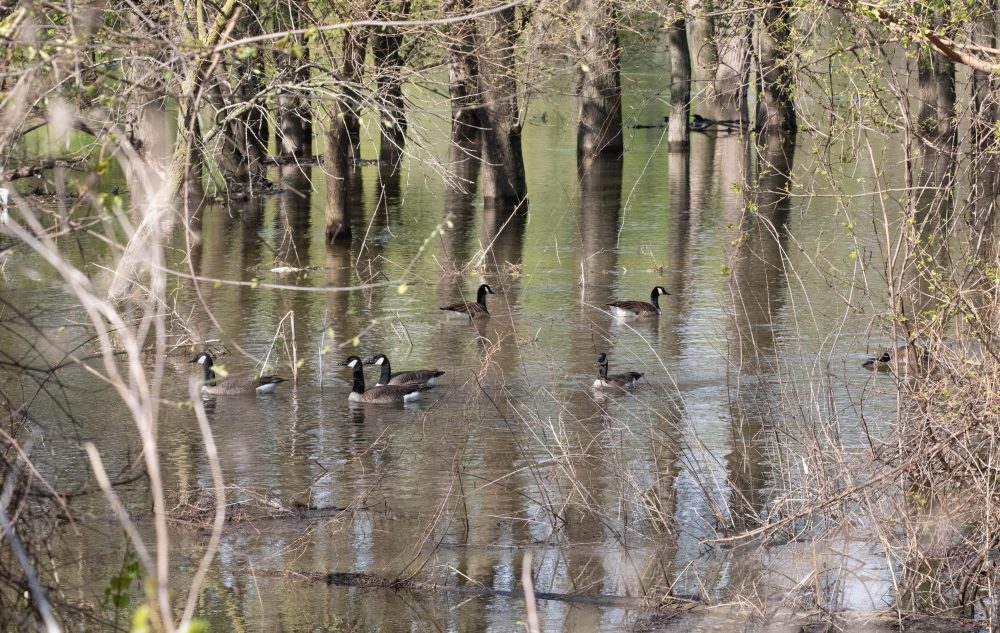

 After all the Yellow-Rumped Warblers appear to have moved on, below is a female. You can make a comparison to the male below her.
 Common as they are, Common Yellowthroats are still pretty.
 I’ll be back with more Warblers and other birds of 2016 Spring Migration.

 Except for brief warm spells, the weather is unseasonably cool, but the rain has caused the trees to leaf out in abundance, offering cover for many migrants while making them that much harder to see! I’ll be back soon with a small migration report from downtown Chicago.


