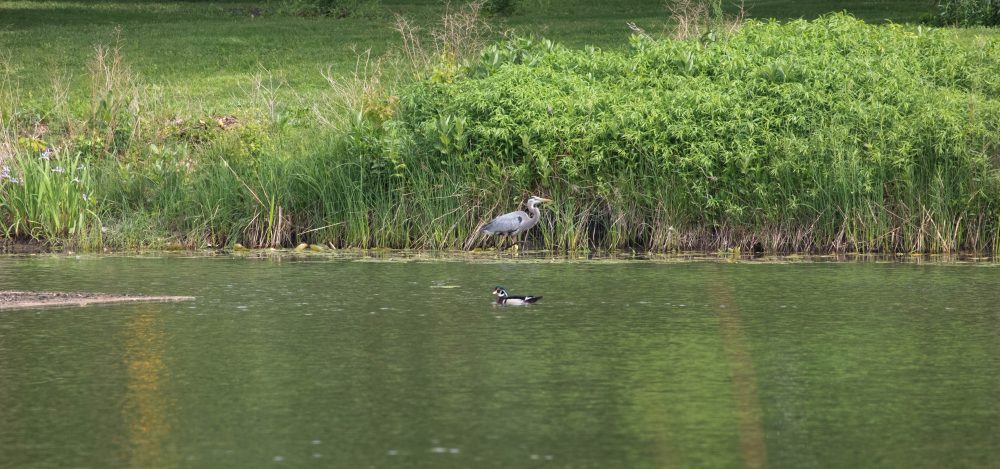
Paul Douglas Part II

Song Sparrow

Song Sparrow

No surprise there were many Song Sparrows singing on Sunday, so while I can’t be sure whether the recorded song belongs to the bird above, it could be.

Savannah Sparrow

Savannah Sparrow

There were several Savannah Sparrows too, but traffic noise made it difficult to record them singing. I managed to get a little song here.

Northern Rough-Winged Swallows

Northern Rough-Winged Swallows

Early into the walk, I saw these two Northern Rough-Winged Swallows resting.

Double-Crested Cormorant

Double-Crested Cormorant

While several Great Blue Herons and finally one Great Egret flew over, I liked this Double-Crested Cormorant, perhaps because it’s easier to get away with a silhouette and less detail.

Dragonfly

Dragonfly

I think the Dragonfly above is a Female Widow Skimmer, but I could be wrong, so if there are any dragonfly enthusiasts out there, please weigh in!

Cabbage White

Cabbage White

Cabbage Whites seem to be the dominant butterfly species of the week. Up until last week I seemed to be seeing Mourning Cloaks frequently.

Yellow Warbler

Yellow Warbler

This Yellow Warbler was singing but I didn’t manage to get a decent recording. I only have two hands, and while I sometimes try to balance the camera in one hand and the recorder in the other, it’s usually futile, not to mention I wind up recording a lot of shutter clicks. The warblers were moving fast, and they don’t sing continuously. The photo option won out.

Brown Thrasher

Brown Thrasher

As far as I can tell, the Brown Thrasher above is a juvenile bird.

Bobolink

Bobolink

Near the end of my walk, I ventured way down to the end of the parking lot to see if anything different was going on the opposite side of the marsh which I had walked past on the trail. It was getting hotter and later so I did not have much hope for anything new. Then, as I turned to go back toward my car, I realized I was hearing birds in the grassland directly beside me. So I stopped to listen, and heard the Bobolink above, a Meadowlark which I didn’t see until later, and what would prove to be a Grasshopper Sparrow.

Female Bobolink

Female Bobolink

I have not seen many Female Bobolinks and so was stumped for a while by the above image, but after a lengthy process of elimination it occurred to me who she was.

Eastern Meadowlark

Eastern Meadowlark

The Meadowlark finally showed up, although he would not come close enough for a good picture.

Grasshopper Sparrow

Grasshopper Sparrow

And here is my surprise bird, the Grasshopper Sparrow. I have longed to see this bird for years. They are endangered in Illinois, so it is always a thrill to find one. And to see one, who seemed to be so comfortable sitting out there…maybe he’s a youngster. Anyway, below is a recording of all three birds and probably a few more singing along.

Bobolink

Bobolink
Paul Douglas Forest Preserve – Part I (Apologia)

Indigo Bunting

Indigo Bunting

I have been thinking about visiting Paul Douglas Forest Preserve, which is way up northwest in Cook County, in Hoffman Estates, to be exact, for quite a while, and I finally managed to get up at 3:15 AM Sunday morning so I could get there before the heat became unbearable. It turned out to be a pleasant, sunny morning with quite a breeze going at times.

Cedar Waxwing

Cedar Waxwing

Paul Douglas is a huge preserve, surrounded by one continuous paved trail that extends 7.5 miles – and so it is a destination for runners and bike riders. Not an ideal birding situation, but it’s good for the birds because they can nest there relatively undisturbed. I did not perhaps prepare as I should have, I just figured out how to get there and went. I walked about a mile from the parking lot and at birding pace that took me almost two hours, so I walked back. I’ll see the rest of it some other time.

Tree Swallow nesr

Tree Swallow nesr

The target bird, if there was one, was Yellow-Headed Blackbird, but either because I didn’t find out specifically where they were located or else they were not present, I did not see or hear any. But I saw some beautiful birds anyway, even if most of them were too far away to get great photos. Often the best birds are when you least expect them, anyway.

My first bird was a Willow Flycatcher. The camera wasn’t ready for him but he cooperated anyway and I managed to get his song as well. His song is the sneezy little “fitz-pew” below the picture.

Willow Flycatcher

Willow Flycatcher

It turns out I’ve been trying to put this post together for days but always when I’m falling asleep at the end of the day, so it looks like it might take me at least one more installment. And now that one of the lights that’s on a timer has gone out, my indoor birds are telling me to go to sleep.Of course they’re right. Blogger guilt may be getting to me, but it’s been a busy week.

Common Yellowthroat

Common Yellowthroat

I will be back tomorrow with more notes from the field.

Thistle

Thistle

"Fledgling" Thistle

“Fledgling” Thistle

Filling in the Blanks

Green Heron

Green Heron

Somehow I managed to talk myself into getting up early both Saturday and Sunday this past weekend. Both days began on the cloudy side, with Saturday turning into rain by 10 a.m. But I finally saw some birds I had missed so far this season. Both Green Herons were at the Portage, for instance.

Flickr IMG_2961_1

Last weekend the woodpeckers eluded me, but this time I had the Northern Flicker above, in addition to Red-Bellied Woodpeckers, Downies and a Hairy.

Fledgling Robin IMG_2724_1

Juvenile Robin

Some juvenile Robins are starting to forage on their own. And there were at least four Gray Catbirds on territories. Below is one of them.

Gray Catbird IMG_2785_1

This juvenile Red-Winged Blackbird sitting on one of the foot bridges was scolded furiously by her dad as I approached.

RWBB Child IMG_2890_1

Wood Ducklings revealed…

Wood Ducklings IMG_2848_1

Wood Duck ducklings

Finally, the mirage I saw last weekend emerged. It was indeed a scurrying flotilla of Wood Ducklings. There are seven of them, and when they dart around en masse they look like a strange 7-headed creature.

Wood Duck IMG_2864_1

Above, mama Wood Duck.

Song Sparrow IMG_2828_1

Song Sparrow

Again, the same silent Song Sparrow. Maybe it’s a she.

Snapping Turtle IMG_3037_1

Still plenty of water on both sides of this path, when I caught the Snapping Turtle crossing.

Snapping Turtle IMG_3041_1

And a beaver going about his business.

Beaver IMG_3053_1

And Southwest Airlines flying over…

Southwest IMG_2820_1

Sunday it was grassland birds at Plum Creek Forest Preserve, way down at the southern tip of Cook County, organized by Chicago Ornithological Society. The birds were often too far away to photograph, but we were surrounded by Dickcissels and Henslow’s Sparrows.

Dickcissel IMG_3118_1

The Indigo Bunting below was interesting from the standpoint of his plumage. I don’t know if he was a juvenile or more likely somewhat leucistic, since his song sounded adult.

Indigo Bunting IMG_3100_1

Always a delight to see a Great Crested Flycatcher.

Great Crested Flycatcher IMG_3265_1

Great Crested Flycatcher

And the only Henslow’s Sparrow of the seven or eight we heard who dared show himself was still buried in the grasses, for all practical purposes. Others ventured closer to him but I chose to hang back; Henslows nest on the ground, and I didn’t want to disturb anybody.

Henslow IMG_3171_1

I leave you with a shrug from one of the Green Herons who had just about had enough of sitting still for so long.

Green Heron Stretch IMG_2939_1

I’ll try to shorten the space between posts. If I can stay awake long enough. 🙂

Walking Home

Black-Capped+Chickadee+Grant+Park+005_1

Little Chickadee
Following me home
Chatter, chatter, chick-a-dee-dee-dee
Sing your song
I answer
Your song, again
I whistle back
You improvise, a test
I follow you
To my door

Last night the weather was imminent, we had been warned all day of possible severe thunderstorms, hail, flooding – and none of it, despite the trains being delayed, had yet come to pass. I was a block and a half away from home when a Black-Capped Chickadee I never saw recognized me and started chattering. I answered him in the English transliteration which is really not very accurate, but he understood anyway. And then, as I reached the corner of my block, he continued by singing his “Hey, Sweetie” song. By now he was following me. I whistled back to him. He sang again, and I answered. In front of my house, from my neighhbor’s tree, he decided to see if he could trip me up by singing an alternate version of his song, in another key, going in another direction. I mimicked him again. Back to his old song, only this time in a higher key. He almost had me there, I can only whistle so high. But what an incredible exchange!

I hated to close the door on him, but after a while I had to go in. Although the weather did not “start” for at least another half hour.

I just felt like it was worth a post to commemorate this exchange with the Chickadee. He is very likely one who shows up at my feeders and chatters in my ear when I’m in the yard. He also knows that I listen to his song whenever he sings it, and I respond to him. This is not counter-singing, he knows I’m not another Chickadee on his territory. This is communication. Two musicians, hamming it up. He must think I’m pretty smart for being such a large, flightless creature. I am flattered to be included in his dialogue.

Apologies for the picture, it’s old and the wrong season, but it’s all I could find spur-of-the-moment.

Kirtland’s Warbler Tour

Kirtland's Warbler IMG_0518_1 - Copy

The Chicago Ornithological Society (COS) trip began on Saturday, May 25, with a guided tour by Michigan Audubon and Michigan Department of Natural Resources that departed from the Ramada Inn in Grayling, Michigan, to the managed, protected habitat of the Kirtland’s Warbler.

DNR Sign IMG_0691_1

The warbler, once nearly extinct, has made a tremendous comeback. We were fortunate enough to spend time with William Rapai whose recently published book on the Kirtland’s Warbler will tell you everything you always wanted to know but were afraid to ask.

Brown-Headed Cowbird, selected

Brown-Headed Cowbird, selected

Such as the capture and killing of certain numbers of Brown-Headed Cowbirds. So far, the Kirtland’s has not developed its own defense against cowbird predation.

IMG_1256

Kirtland's Management Sign IMG_1948_1

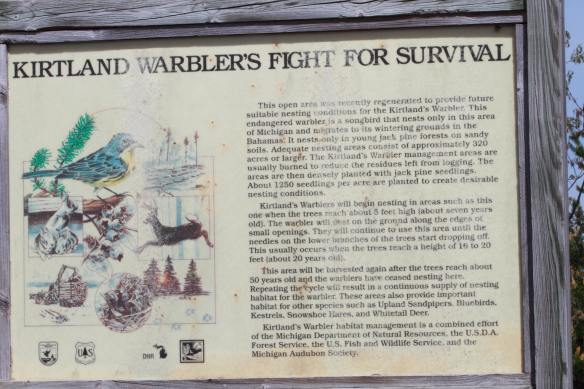
The above sign depicts how the land and the Jack Pine trees on it are managed for the Kirtland’s to breed. Kirtland’s breed only in stands of young Jack Pine trees. They build their nests on the ground between the low-lying branches of the young trees. When the trees mature enough to have lost their bottom needles, they are no longer suitable habitat for breeding Kirtland’s Warblers. Further, the only way for Jack Pines to reproduce is by fire; their seeds are designed to open and germinate only under the intense heat of a forest fire, which clears the land and gives the Jack Pines room to grow. Remember Smokey the Bear? He and his ilk unfortunately caused the Kirtland’s Warbler nearly to go extinct by preventing forest fires! This gives you a little idea about how specialized the Kirtland’s Warbler is, and why you can hardly see it anywhere else in the country.

Kirtland's Warbler IMG_0524_1 - Copy

We were fortunate enough to have at least 3 males sit up and sing for us. I also managed to record one of them. There’s a little background noise, but the unique song repeats here several times.

Kirtland's Warbler IMG_0502_1

There are many more photos from the weekend, several of which made it to my flickr page. I hope to update some of the information for those photographs soon.

The last photo for this post was taken at another protected area where new habitat has been created for the Kirtland’s Warbler. Build it, and they will come. And they have.

Kirtland's Endangered Sign IMG_1949_1

Skulkers and Flycatchers

Tennessee Warbler

Tennessee Warbler, Millennium Park

Still coming down from a weekend of intense but wonderful birding in Michigan. I might have managed a post Tuesday night were it not for a power outage around 8:00 p.m. that lasted three-plus hours. But it turned out to be an unexpected opportunity to catch up on some sleep, after whispering admonitions to the house birds to stay perched and sleep through the thunder and lightning.

Least Flycatcher

Least Flycatcher, Millennium Park

So I got up early yesterday morning and went to Millennium Park, dodging the imminent rain drops. Flycatchers were abundant, as reported from other lakefront locations.

Alder Flycatcher

Alder Flycatcher?

Anyway here are some birds I encountered yesterday morning and later in the afternoon at Lake Shore East Park. I think the bird above is an Alder Flycatcher, but he didn’t say anything, so technically I should call him “Empidonax Species.”

The real surprises, or I suppose you could say wish-list possibilities, appeared in Lake Shore East Park yesterday afternoon. I went back this morning and could not find them… One was the prized Connecticut Warbler, skulking around in dark places: I guess the photograph below will have to do for now.

Connecticut Warbler

Connecticut Warbler, Lake Shore East Park

Add a female Common Yellowthroat. Perhaps she is the mate of the male who was singing yesterday and again this morning. She is the least uncommon of the three birds here, but lovely nonetheless, and easy to confuse with the other two.

Female Common Yellowthroat

Female Common Yellowthroat

The female Mourning Warbler below…

Female Mourning Warbler

Female Mourning Warbler

and again here… is another less-commonly seen “skulker.”

Female Mourning Warbler

Female Mourning Warbler

Thus we have three skulkers who all look quite a bit alike, and in most field guides they’re not far from each other, so you can make the comparisons and note the differences or throw up your hands in total confusion.

Eastern Wood Pewee, Lake Shore East Park

Eastern Wood Pewee, Lake Shore East Park

Not to skimp on flycatchers, the one above is at least recognizable as a Pewee. He sang a bit, too – always nice to hear. If I run into a Pewee song soon I’ll update this post.

Crow with Bat

Crow with Bat

On my way out, I walked through the back of the Aon Building where I have seen birds on occasion, and encountered this crow with its prey: I suspect it’s a little brown bat.

Crow with Bat IMG_2273_1

The crow took off with its bat soon after I shot a few more photos. I’m sure it didn’t want me to draw attention to its prize.

My last momentary offering is a recording of Beniamino, one of my Zebra Finch males, singing his heart out from atop a microphone while I’m practicing the prelude to the F major English Suite by Bach (it may take me a year, but I’ll get through these suites – 2 more to go after this one). Travel time has taken its toll on playing for the birds but I plan to stay put for a few months and get some more music in my fingers.

Endless thanks to all who follow me and to those I follow – I have some catching up to do! I’ll be back soon with reports from Michigan and the Kirtland’s Warbler.

Spring Eclectic

Baltimore Oriole

Baltimore Oriole

I’m feeling the effects of too many trips. I haven’t changed time zones, and I thought going short distances would be a piece of cake, but it seems every time I leave, for all the last-minute preparations, I may as well be leaving the country.

I’m still combing through the photos of the past week, but thought I’d post a couple birds with songs from pictures I took this morning. I visited McLaughry Springs Woods and McGinnis Slough, both in the Palos region of southwest Cook County, Illinois. 

Baltimore Oriole - McLaughry Springs

Baltimore Oriole – McLaughry Springs

This Oriole was singing at McLaughry Springs, but he was camera-shy. It was a lot easier to take photos of the Oriole near the parking lot at McGinnis, as he was trying to distract me from finding his mate sitting on the nest.

Baltimore Oriole McGinnis IMG_0314_1

Then, while I was briefly in St. Louis, I took an early morning walk Friday through the park that spans either side of the Arch running along the river.

St Louis Arch IMG_7413_1

In the Arch park, there were at least four Warbling Vireos singing, although I saw only one briefly. There were not very many species present. Oddly enough, the only bird I managed to photograph was a female Baltimore Oriole.

Female Baltimore Oriole

Female Baltimore Oriole

In any event, below is the Warbling Vireo who posed for me at McGinnis. I didn’t manage to record his song, but have substituted one from the St. Louis birds. The busy-sounding vireo song is running alongside some chirps from a Robin in the foreground.

Warbling Vireo

Warbling Vireo

And for a last image, here is a real surprise. Just as I got out of my car and got my gear together at McGinnis, I saw a distant Yellow-Billed Cuckoo fly into a tree. The Cuckoo did its best to hide but I managed to get this picture before it gave up its perch to a Robin. This is a bird I rarely see.

Yellow-Billed Cuckoo

Yellow-Billed Cuckoo

I’ll try to manage another post before the Memorial Day weekend. 🙂

Black-Throated Green Warbler

Black-Throated Green Warbler

Black-Throated Green Warbler

There are so many beautiful warblers, it’s hard to pick a favorite, or even five or ten favorites, and yet the Black-Throated Green has to be on the list somewhere.

Black-Throated Green IMG_8933_1

I used to see these birds often, every spring, but the last couple of years they haven’t been so easy to come by, at least not wherever I was, so imagine my delight to happen upon maybe as many as ten yesterday afternoon at Ottawa Trail Woods.

Black-Throated Green IMG_8927_1

And I got lucky enough on the way out to record one singing. One mnemonic for this buzzy little melody is “trees, trees, beautiful trees.”

Black-Throated Green IMG_8925_1

Black-Throated Green IMG_9051_1

I’m still recovering from my early rise Saturday morning, but one thing is certain: the quest continues. As the days grow longer, with so much available light, it’s hard to think about anything else except looking for migrants. I believe the term is Migration Madness, a temporary but incurable condition.

Once upon a Wren

Carolina Wren

Carolina Wren

Actually this is thrice upon a wren. Last Sunday I visited the Chicago Portage, and although I did not see the Carolina Wren, it sang three beautiful songs for me that I was fortunate to capture. The picture above is from two weeks before, the last time I saw him. Here are his three songs (second clip has two songs):

Winter Wren

Winter Wren

I also was lucky enough to hear (and briefly see) a Winter Wren. This is a bird whose song I have wanted to hear for a long time. Now I can hardly wait to hear it again. The picture above is not the same winter wren, only the last picture of one I could find easily. It’s hard to believe such a tiny bird can make so much music.

House Wren

House Wren

Forward one week to yesterday. I could not access the Portage because of flooding, but I did manage to visit Ottawa Trail Woods North where I heard and saw this House Wren. Maybe he’d been up all night with the weather, but he managed to sing and show his face.

I have already noticed one thing in the field. When I stop to record, it’s as if I suddenly become part of the environment. The birds almost seem to lose their fear and start appearing from everywhere. I suppose the simple explanation is that I am not moving, but I can be very still without recording and it does not produce the same results. Maybe I am more relaxed than watchful, or attentive in a way that only birds could respond to. I suspect they know I am listening to them and they prefer that sort of attention to gawking at them! Whatever it is, it’s pretty amazing.

Sights and Sounds: Chicago Portage

Brown Creeper, Chicago Portage

Brown Creeper, Chicago Portage – a sign of spring

It’s been raining on more than off all week, so the farther I get from last Sunday’s excursion, the harder it is to visualize.

Portage IMG_4435_1

The Chicago Portage is still asleep but starting to wake up now with the rain and intermittent spells of warmer temperatures.

Turtle IMG_4516_1

Turtle sunning itself

Last week I purchased a Roland hand-held recorder to use in the field. I have had a Marantz with a very sensitive microphone for years, but it’s a lot to carry and I wanted something more portable. I figured by now technology had caught up with me. I’m still learning how to use it, but I managed to get a few sounds.

American Goldfinc

American Goldfinch

The picture above is not of the Goldfinch that is singing–albeit in the background overshadowed by a Red-Winged blackbird–in the clip below. The actual singer, although I did photograph him, was rather far away.

Goldfinch Portage IMG_4369_1This was our songster.

A bit later there was a wonderful Song Sparrow singing, and although he wouldn’t let me get the classic shot while he was performing, he did give me a nice picture anyway.

Song Sparrow

Song Sparrow

I will keep experimenting with the recorder and from time to time share the best songs with you.

Just to taunt me, two Great Blue Herons flew over, followed by three Monk Parakeets. I managed to get a fleeting picture of one Great Blue.

Great Blue Heron

Great Blue Heron

This huge fallen tree just next to the path that leads down to the Des Plaines River behind the Portage was recently dismantled. Part of its core looks diseased, making it easy prey for the strong winds.

Downed Tree IMG_4462_1

Not too hard to find a Red-Winged Blackbird here, singing his head off.

Red-Winged Blackbird

Red-Winged Blackbird

Fox Sparrows are still at the Portage.

Fox Sparrow

Fox Sparrow

And the Downies are busy as usual.

upside-down Downy Woodpecker

upside-down Downy Woodpecker

I have seen an Eastern Phoebe almost every day this week somewhere.

Eastern Phoebe

Eastern Phoebe

The water levels should be higher this week after all the rain. If we get another break in the clouds I’ll go back and check.

Canada Geese

Canada Geese

Portage IMG_4387_1