Oh how I wish I could still play for the wild birds! I’m getting ready to give a litte talk in a couple weeks and in the process I’ve been going through a few tapes, trying to get some of the earlier recordings when the windows were wide open and I was up in the trees.
In the spirit of spring, listen to this little clip from the third movement of Mozart’s Sonata No. 8 KV 311 in D Major. There’s a beautiful cardinal singing along!
I don’t chase birds, and it seems I have had fewer opportunities than I’d like lately to search for birds even in the most convenient places. So I try to make the most out of the chances I do get.
Wilson’s Warbler
Tuesday morning on the way back to work from the Labor Day weekend, I saw this Wilson’s Warbler at 155 N. Wacker.
American Redstart
The warblers in particular have been scarce in the city parks, if not in the “hot spots,” but I don’t like going back into the city on the weekend after migrating to and from it all week, so today I decided to get to the Chicago Portage early and then go to Palos.
Outside of American Redstarts at the Portage, I had a Connecticut Warbler and a male Black-Throated Blue, but neither of them wanted their pictures taken.
I got a little luckier at Palos, which holds a large area of contiguous forest preserves in southern Cook County. I parked in the south Swallow Cliff lot and took off on the yellow trail. I had looked it up before I went and knew it formed a continuous loop through several forest preserve areas. The entire loop is more than 8 miles. Without realizing the consequences of such a hike, I embarked upon the trek.
Blue Jay
The slowest part of my walk was in the beginning. There were Blue Jays and Eastern Wood=Pewees everywhere. I tend not to think of Blue Jays as migrants, but of course they are. To my delight, several jays sang over the course of my walk, and I always had to stop and listen. Not one song matched another.
Chestnut-Sided Warbler
It took quite a while to hit pockets of warblers and when I did it was sometimes difficult to identify them all. I didn’t get many pictures of them, but this Chestnut-Sided Warbler was most cooperative.
The Yellow Trail is frequented by runners, cyclists and horseback riders. Not necessarily the ideal birdwatching situation. But I got used to it after a while and figured the birds were pretty used to it too.
Red-Bellied Woodpecker
I’m pretty tired and sore from the trek. I know I will be sore tomorrow, but my four plus miles of walking to the train and back are less strenuous than today’s workout. It was good to see some birds.
Thanks to all who are following my blog and those who make the effort to like my posts. I wish I could respond to each and every one of you individually. Maybe someday I’ll get there (I’m even worse with facebook, ask anyone who has “friended” me). In the spirit of my disorganization, I am offering somewhat of a hodgepodge, smorgasbord post.
It’s been a busy Labor Day Weekend, or so it seems–difficult to let go of the last three-day weekend until the Big Holidays at the end of the year. I’ve been trying to let go of the work week as much as possible. Saturday morning was the only morning of the past three I woke up with work on my mind.
I heard this little clip of Beniamino, one of my six little male zebra finches, on Saturday when I was listening to a tape in the car. He has hopped right onto the microphone and started singing, and then calling. Pietro sings a moment later.
The juvenile Ruby-Throated Hummingbird left my yard sometime last week, but now I have an adult female coming to my feeders. She seems to know who fills the feeders, because when I went out yesterday afternoon to see if she would show up for a picture, she soon flew right over my head and to the closest feeder in front of me. And perched. She seems to like to relax and take her time about these things.
Female Ruby-Throated Hummingbird
Also have a few pictures from around the yard.
Young Male House Finches
I was trying out a new camera. I’m taking a trip in November and it seemed like time to get something a little more bird friendly. Actually it is more friendly from the standpoint of noise alone – the shutter click is a lovely sound compared to the tin-can clunk of my other cameras.
Male American Goldfinch
Here’s something else very exciting. Something made me decide to clean the cages tonight, which meant I got to listen to NPR in the basement, and there was a story about Wapapura, which takes recording sessions to the outdoors. This is what I have always dreamed of doing, but it’s hard to carry around an electric piano, or any piano for that matter. I would love to take a string quartet to the forest and record the birds’ contributions. I am thrilled to hear someone else believes music is for sharing with the universe.
I finally managed to go through the rest of my photographs from my visit to Goose Lake Prairie last weekend. I’d had no particular target species or agenda in mind. I had hoped to maybe see a Grasshopper Sparrow, but I can’t say I even heard one, that was my only disappointment. A bit ironically, I first heard about Goose Lake Prairie on Cornell’s “More Birding By Ear” CDs, for the recorded songs of birds found there.
The most common species last weekend was probably Eastern Meadowlark.They were no longer singing, but they were chattering everywhere.
This parched version of the prairie is different from the last time I visited maybe three years ago. Rattlesnake Master, one of my favorite native prairie plants, seemed to be the only thing that thrived on the hot, dry weather.
The Wild Bergamot was almost spindly.
Wild Bergamot
Song Sparrows were predictably common. And still singing.
Song Sparrow
I heard a few Field Sparrows before I finally saw one.
Field Sparrow
I walked a long way before I finally started hearing Henslow’s Sparrows and then it seemed like they were everywhere. But they were singing hidden in the tall grass, until finally I managed to see and hear one sitting up. They were more cooperative a few weeks ago at Springbrook Prairie, but I don’t think I have ever heard so many of them as I did at Goose Lake Prairie. I simply adore Henslow’s Sparrows. Once gravely endangered, they have been making a real comeback in Illinois, due in large part to prairie restoration.
Henslow’s Sparrow
There were not too many butterflies or dragonflies, maybe just a few of the more common species.
Monarch Butterfly
Common Whitetail
And of course my photographic nemesis, Indigo Bunting, made a brief appearance.
Indigo Bunting
Sometime after hanging out with the Northern Harrier that dominated a previous post, a Turkey Vulture came to take up the slack…
I rode with three friends to Hastings, Michigan last Thursday for Michigan Audubon’s Cerulean Warbler Weekend. The goal was to get good looks at Cerulean Warblers, and we did after several tries.
“Rainstart”
However, Friday’s weather was miserable. The rain was constant and temperature below normal. This shot of an American Redstart leaving was a typical view.
Cerulean Warbler
And here is a typical look at a Cerulean Warbler high up in the canopy. About all you can tell is that Ceruleans are white underneath. Fortunately, the looks would improve the next day when the weather did.
Red-Eyed Vireo
The rain never stopped the Red-eyed Vireos from singing. I stood under this bird’s tree and listened to him sing for a long time. In the background, my brain was playing the Bach I’m learning, and the Vireo’s song fit perfectly over it. I wished I could have played for him, we could have had a great jam session.
“Drowny” Woodpecker
This Downy Woodpecker was pretty well-soaked.
Saturday started out cloudy but when the sun came out around 11:00 a.m., the birds woke up and we started to get our first really good looks at Cerulean Warblers. Unfortunately I had few photo opportunities. The birds like to stay up high in the canopy, and just when you think you’re on them, they fly. Rather than stay in one area, they move from limb to limb or tree to tree. So my best shots turned out to be extremely backlit.
Cerulean Warbler
But now that I have had great looks, I plan to concentrate more on the photography next time.
This Chestnut-Sided Warbler was backlit too, but he had a bit more color to show.
Sunday morning we got up very early to take a bus tour of some birding hot spots of Barry County. I finally managed to get a few pictures.
Acadian on Nest
This Acadian Flycatcher was on her nest right by the road. Still pretty dark in the woods.
Turkey Vultures
Out in a field later, there were six Turkey Vultures in the sky at one point. Here’s two of them.
Eastern Phoebe
Eastern Phoebes win my award for This Spring’s Most Cooperative Bird.
Indigo Bunting
This Indigo Bunting was so busy singing, he sat still.
There were a lot more birds than pictures, but that’s okay. We had a good time.
You know you’re on a birding trip when everyone in the bus yells “Dickcissel!” simultaneously.
I dropped by the Portage early this morning trying to beat the heat – we went up to 97 degrees today. After I was greeted by this rabbit, I saw 39 species. Not remarkable, but not bad given the strange weather we’ve been having. There has been no rain lately, so the water level is way down at the Portage and the nearby Des Plaines River.
But breeding birds have returned, and I managed to get some pictures of a few. Almost from the very beginning I heard Red-Bellied Woodpeckers calling, so perhaps it was inevitable that one would be available for a photograph.
Red-Bellied Woodpecker
The House Wrens are back in full force too.
House Wren
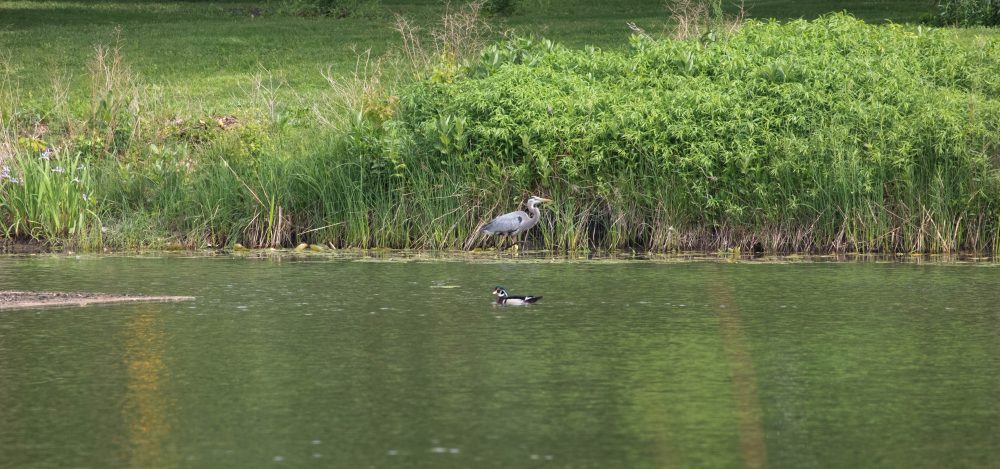
A female Wood Duck sat on a log with her seven ducklings. I imagine the youngest was staying closest to mama.
A Great Blue Heron flew over faster than I could get its likeness clearly. But down below, one of the two Green Herons that I have seen here every summer was trying to stay cool.
Green Heron
Indigo Buntings were singing everywhere, and doing their best to elude the camera. Here’s one not completely hidden.
Male Indigo Bunting
I have been awaiting the return of Cedar Waxwings.
Cedar Waxwings
Song Sparrows are on their territories, singing, of course.
Song Sparrow
It’s sad when I think of this beautiful Yellow Warbler…
Yellow Warbler
being a favorite prey species of the female Brown-Headed Cowbird. Cowbirds lay their eggs in other birds’ nests so the other birds can raise them, often at the peril of their own offspring. Note how this Cowbird matched the twig she’s behind so well, it looks like part of her.
Female Brown-Headed Cowbird
On my way out I stopped on the north bridge, where I saw the other Green Heron in the distance, but my attention was drawn to two Great-Crested Flycatchers setting up housekeeping. Look carefully and you can see the male sitting below left and the female hanging out from a cavity at the right of the frame.
Great-Crested Flycatchers
The male flycatcher remained on lookout while his mate investigated the cavity in the dead tree for nesting possibilities.
Birds are finally starting to arrive in numbers. Because of the early leafing out, it seems like we’ve been waiting forever. New songs and bright colors fill the air.
Yellow-Bellied Sapsucker
I could fill a book with photographs of Yellow-Bellied Sapsuckers. but I don’t think I’ve ever run into one with this much personality before.
Chipping Sparrow
I love Chipping Sparrows. They’re so dapper!
Hermit Thrushes have been here a couple weeks but it’s still nice to see them.
White-Throated Sparrow
White-Throated Sparrows didn’t all leave, but the migrants are everywhere now. And they’re singing their Old Sam Peabody-Peabody-Peabody tunes a lot.
I heard a wonderful White-Throated song Wednesday afternoon. The bird singing sang it in two parts. The first part went down, but the second part was a different tune, in that he turned it upside down, went up with it and then down a half step. Very original.
Northern Waterthrush
A surprise, a Northern Waterthrush in Millennium Park Monday afternoon! I have seen Northern Waterthrushes outside the tennis courts in Daley Bicentennial Plaza after a rain, but I have never seen one in Millennium Park. I wish I could have gotten closer for a sharper picture.
A couple female Red-Winged Blackbirds at the edge of a tennis court. You can just barely see that they have red feathers on their shoulders too.
This male Red-Winged Blackbird was singing for peanuts. I guess he figured he could afford to squander his song on me now that the girls have arrived.
This Northern Flicker must have found a very good ant swarm because all my picture-taking could not distract him.
A Brown Creeper showing off his creeping abilities.
An elusive Yellow-Rumped Warbler.
A rabbit, one of many seen regularly. There must be more rabbits this year! All that early vegetation gave them a boost.
Vincenzo, one of my male Zebra Finches, died Friday. Or at least that’s when I found him. He had been sick for perhaps a month or more. Confusing the issue was Fabrizio, the original Zebra Finch and if not Vincenzo’s father, his grandfather or even great-grandfather, who is also not feeling well, which I attribute to his age of more than 10 years. Fabrizio has started singing again, however feebly, but Vincenzo had been quiet for such a long time, I had all but forgotten about him.
That is, until I spent three hours in the dentist’s chair Saturday morning. Left with my mind to play Bach’s A Minor English Suite over and over again, I was also frustrated that Fabrizio was still singing and I had a dead Zebra Finch I had not identified. It was only under the clarity of local anesthesia and not being distracted by going anywhere that I suddenly realized the missing bird was indeed Vincenzo. I said “Oh!” and the dentist stopped whatever it was she was doing, asking me if I was in pain. No, not at all, I explained, I had just figured out that Vincenzo was dead.
I’m feeling terrible that I did not have the presence of mind over the last week to tune into his individual absence while he was still struggling to stay alive. One morning a few days ago he was flopping around on the floor, seemingly too weak to fly, and I picked him up and put him in the bottom of the first finch cage, so he could eat if he was so inclined, or if he was going to die, it was a “safe” place. When I came home later that day he was out of the cage. It’s possible he went off to die where I found him Friday night, tucked under the skirt of the futon cover…
Now I know the little ball of feathers I saw sitting tightly wound up into itself the last couple weeks was Vincenzo trying to stay warm. Only a few days ago he was huddled together with Fabrizio, as they took to caring for each other that way.
I managed to find a tape recorded January 14, 2012 with Vincenzo. I was just starting to revive Albeniz’s Tango, and he’s singing with it. Only he hadn’t been singing his entire song lately, just the first part of it. The whole song went, “I’m a Zebra Finch, and my name is Vince, Vincenzo, Cenzo, Zebra Finch.” Here he’s only singing the first part of it, over and over again, “I’m a Zebra Finch, and my name is Vince.” Adolfo is singing very loudly in the beginning of the piece, but the rest of the recording is Vincenzo’s. He is quieter, probably farther away from the microphone. He also solos a little bit after I stop playing.
Now my Zebra Finch population is now down to eight birds. Seven males and one female. The surviving males are Fabrizio, Adolfo, Beniamino, Pietro, Rodolfo, Zorro and Gregorio. They all still join in the dawn chorus, but it’s diminished considerably from the old days.
While going through the pictures I found a few songsters, so in keeping with the spirit of this blog, I’m including them here.
Cactus Wren
This Cactus Wren is a beautiful bird, a large-sized wren with striping/bands on its tail that are not visible in this picture, unfortunately.
I’m almost sorry I didn’t take my digital recorder with me to record these birds while they were singing for us, but most of them were called in by MP3 players, which is probably why they sat around long enough for me to take these photographs, as they were making sure we intruders knew it was their territory. There were times when the MP3 players fooled us too.
Juniper Titmouse
It took us a while to find a Juniper Titmouse but we got lucky with this one.
Rufous-Crowned Sparrow
This Rufous-Crowned Sparrow posed for a lot of stunning profile shots which showed off his extraordinary white eye-ring, but for singing, he faced us straight-on.
And last, for now, our friend the Cryssal-Thrasher, who put in his two cents.
It’s been an interesting week. I went to the lakefront Wednesday morning because it was the only day of guaranteed sunshine, before the snowstorm. It was cold but clear, making for a dramatic sunrise.
The reflection of the sun on the water in the harbor made interesting patterns…
as the ice floes started to settle in.
I startled some Common Mergansers hanging out in the open water.
But did not seem to bother this female fishing close to shore.
By Thursday afternoon when I looked out from the 42nd floor onto the lakefront there was only a rugged sheet of ice (sorry, no picture).
The Snow came on Friday, about 8 inches of it by Saturday morning, making the weekend a winter wonderland. This male cardinal caught me taking pictures of him through the porch window yesterday.
Male Northern Cardinal
I had all the feeders out and the yard was a very popular place. I counted 30 House Finches. Unfortunately by the time I went out in the yard everyone left, except for this sleeping female House Sparrow on the wire.
sleeping Female House Sparrow
Today there was no sunlight so I stayed indoors, eventually focusing on this Mourning Dove.
Mourning Dove on the feeder pole
The female cardinal was in the yard today. I finally managed to capture her here.
Female Northern Cardinal
And now for your listening pleasure, I’ve gone back in taped time to about nine or ten years ago when I was learning the Mozart K 333 in B-flat Major. First, a little sample of Hidalgo the Spice Finch coming in exactly in time with the music, not exactly on his first try but very quickly on his second, as he knows what’s coming (toward the end of a few bars in the first movement).
And then if you’re game for a longer recording, I was practicing the Adagio, which starts off with a lot of zebra finch calls, then Fabrizio, the granddaddy, who is barely singing these days, so it’s nice to hear him when he was young and feisty. He is joined briefly by his first hatched male offspring, Facondo, whose name means something like “squeaky” in Italian, if I can believe the translation I got trying to make up the word-name. At the time I didn’t realize these guys were actually singing complex songs. If you can stand to listen to the entire fumbled adagio with the repeats you’ll also hear some bright spice finch whistles, a little spice finch singing, and toward the end some trills from the male budgie of record (I can’t say for sure if Zeke had come on board yet but I think this might be him); he’s very trilly indeed. And the whole thing ends with one “mwa mwa” from Hidalgo. It was a very lively session, when at the time I had only a few birds. I played piano a lot earlier in those days, too. Now I don’t get around to practicing on the weekends until noon; by then half the birds are napping.