The weather wasn’t too bad for mid-February. The sun was shining and although it’s always colder by the lake, the wind chill wasn’t prohibitive. Indeed, it was quite easy to spend more time outside.
As in the past few previous years, the better the weather for humans, the fewer gulls come to this event. But this year was exceptionally pretty gull-less. With virtually no ice on the lake, there was no reason for the gulls to come to the shore. A lot of bread was thrown into the lake that day, but even the Canada Geese weren’t interested in it.
It was good to see some people I hadn’t seen in a long time, and the talk was interesting and informative. If I had stayed the entire day I might have seen a male Harlequin Duck that was reported being seen first over the Wisconsin border. But I had a busy evening and next day ahead and knew I would need a nap after the long drive back home.
Much of the time I spent outside was looking at some ducks. There were several Common Goldeneye.
It seemed most of the gulls were out on the ice beyond the yacht club. But as birders with scopes examined the flock, nothing unusual was reported to have been seen.
So I took a few token photos of the Herring Gulls that came in for bread early.
In addition to the Common Goldeneye there were some Lesser and Greater Scaup. When I managed to capture some of them in flight, I looked them up and discovered that the easiest way to tell them apart in flight is the white on the wing, which is a longer stripe on the Greater Scaup.
It was a beautiful day, and from time to time I took a few photos just to celebrate the blue horizon.
February is almost over. We’ve had a little more snow, a lot more rain, blustery cold and warmer temperatures. A bit more like March, perhaps, minus the longer days, but those are on the way too. And those increasingly longer days are calling some birds back to their breeding grounds already. I am starting to see American Robins here and there – individually, not in flocks. And Red-winged Blackbirds are proclaiming territories. Here’s a little sneak preview.
I woke up yesterday morning to no internet connection. After spending an hour or so on the phone with my service provider it was determined that I need a new gateway router. It was shipped this morning so with luck I will receive it soon.
I birded Riverside Lawn yesterday and this morning I was at the Chicago Portage. There were plenty of birds yesterday, but today at the Portage was exceptionally quiet. The entire focus switched to leaves. I met two fall enthusiasts on their way out and we admired leaf colors.
I will see if I can manage to finish what was to be my next post with my cellphone and if so, it will follow shortly. Alternatively I can do more work in the yard and maybe read a good book.
The Zebra Finch that was just singing perched on my head left when I tried to record a video of him so that’s out. Either way I hope to be back soon.
I am back from the land of afternoon naps with a short segment.
We’ve had two Saturday morning walks at Thatcher Woods in River Forest, and we will have our final fall migration walk there on October 8. It’s been pretty quiet the last few weeks, but I did manage some photographs of a few birds, so here they are.
Basically, the Red-tailed Hawk was the only bird I captured doing anything on September 10.
Then on our last visit on September 24, the first of season bird of the walk – and for several of us, first of the year – was this Yellow-bellied Sapsucker who was perched somewhat distantly in a tree. This was likely the best long look I will get this year so I took too many photographs. I have since seen a few more of this species but have not been able to photograph them. For me, the placement of white on the wing quickly distinguishes this bird from other woodpeckers.
I must have had a few long moments to photograph the Red-tailed Hawk.
Also notable on the 24th, but impossible to capture well with the camera, were 34 Northern Flickers foraging on the lawn. We didn’t dare bother them by getting any closer.
A murder of about 20 crows flew overhead, which was beautiful to see. I could only capture a few, but to me there is nothing like a crow in flight.
Here are a few more of the sapsucker.
On our last visit we saw some Yellow-rumped Warblers by the parking lot, and after the walk I stayed a moment to get a few photographs.
Here are a few more of the Red-tailed Hawk.
Our last walk at Columbus Park is tomorrow morning. I have much more to report, it’s just been a busy week and I’ve been too tired to sustain many thoughts. I will try harder to be “back” at least while there’s still some activity before winter sets in. Then the birds will be fewer but somewhat easier to see, perhaps. Best to expect the unexpected.
On Tuesday morning, I made it up to the Hebron Trail in a little over an hour and a half. I didn’t leave quite as early as planned; I woke up to some sort of a circuit-breaker issue in the kitchen which had disabled my Internet access but it was a temporary fix after all and it became more a matter of resetting clocks on the coffee pot and microwave and WFMT on the boombox.
As I started to write this yesterday, we were experiencing a lovely downpour. When I went to empty out places where rain accumulates later it looked like we got an inch in about 20 minutes.
Even though Goose Lake Natural Area has received more rain and is no longer considered in drought status, the water levels are still extremely low and that continues to make it really hard to see Yellow-headed Blackbirds. I walked the trail to the lookout, and stood there for maybe a half hour or so, not seeing too much of anything. I thought how nice it would be if a Yellow-headed Blackbird came close enough to the platform so that I could see it well enough, and then one did. It looks to be a molting adult male.
There are always plenty of Song Sparrows here and I recorded the one below singing.
Song Sparrow – Goose Lake Natural Area
Here are a few more Song Sparrow photos of various individuals.
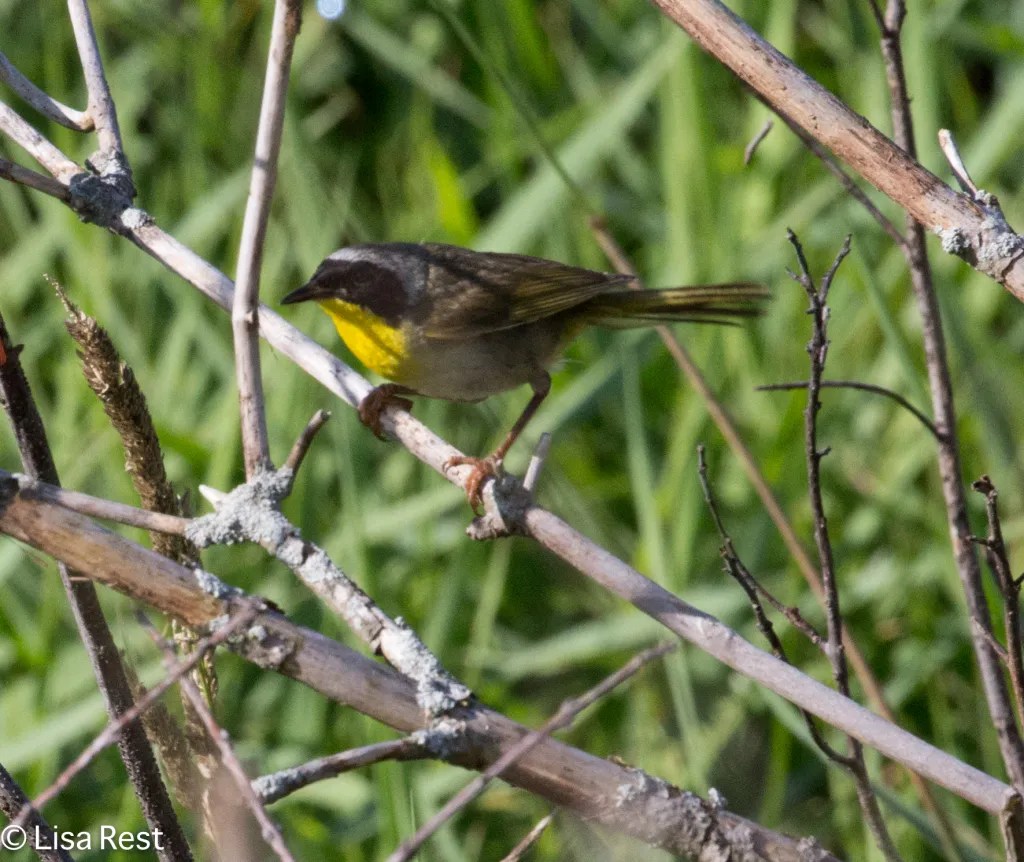
Also present were several Common Yellowthroats, starting with one on the trail.
A look at the trail as it stretches out into the open, and then a view of the marshy area with a verbascum thapsis, or Great Mullein, right by the trail.
There were a few Canada Geese which I did not bother with, and. below, some American Coots, but hardly enough water for much else. I did see a couple Great Egrets come in for a landing later but they were totally obscured by vegetation.
I encountered a tree full of Red-winged Blackbirds. There may have been a Yellow-headed Blackbird in this group too. But between the backlighting and the distance I took it for mostly Red-winged Blackbirds and juveniles at that.
I am always intrigued by the female Red-winged Blackbirds.
The female Red-winged Blackbird below was showing off her captured bug.
Below, the bird on the left is a Gray Catbird and the bird on the right, a male Red-winged Blackbird.
Red-winged Blackbirds in the Compass PlantsA likely juvenile Red-winged Blackbird
After hearing a Willow Flycatcher or two, I managed to photograph this one.
As I stood on the platform, suddenly six Sandhill Cranes flew overhead and into the marsh, where they disappeared into the tall grass.
On the way back to my car I saw this juvenile Northern Flicker.
And followed a Barn Swallow as it swooped around. Bothering with this exercise in futility attests to my desperation.
I did see a sitting Ruby-throated Hummingbird on my way back out. Actually, a friendly young cyclist with binoculars had stopped to talk with me and mentioned she had seen this bird. She also told me I could check out North Branch which was only a few minutes away.
Even though it was getting late in the day and almost 11:00 AM, I decided to go and check out the North Branch Conservation Area. Indeed it was only a few minutes away by car. As it turns out, were one to walk the entire length of the Hebron Trail, you could cross Keystone Road and continue on the gravel-paved trail that runs through North Branch. Although this is a fine plan on a bike, I doubt seriously I will ever do this as I have never even walked the entire 5.5 miles of the Hebron Trail and it is another 1.5 miles at the North Branch connection, making it a round-trip 14 miles. Perfect on a bike, but not on foot. But it’s good to know the two are connected and provide extensive habitat.
The first thing I noticed when I started walking the trail at North Branch was dramatic billowing clouds in the blue sky.
Below are a few scenes of the prairie at North Branch. The middle photo features Cupplant which looks a lot tamer than the towering monsters that have overtaken my backyard.
That late in the day I didn’t know what birds I might see. I definitely wasn’t hearing much at that hour. But there were a couple very busy Eastern Kingbirds.
I did find a Field Sparrow here.
And I was happy to see a male Orchard Oriole, if obscurely.
There was an Eastern Bluebird checking me out.
Below, a Cloudless Sulphur Butterfly, some Rattlesnake Master and Wild Bergamot with a bee.
I didn’t make it as far as the bridge going over the Nippersink Creek, which is what the “North Branch” refers to, and I’m sorry that I didn’t go that far but it was getting late and I had that long drive home to look forward to. So I will definitely stop back here again, I hope sooner than later.
A Monarch Butterfly attracted to my lens hood
There were plenty of Dickcissels here too, although I could not see them until I spotted this one atop a utility wire. I think years ago I saw my very first Dickcissel on a similar perch.
The clouds were just beautiful that day and I liked the distant Great Egret using them as a backdrop.
American Goldfinches are going to be easier to see now that there are plenty of plants with fresh seeds to eat.
Two more parting shots of an Eastern Kingbird…
The Compass Plant is one of several well-presented species here. I suspect much has been planted, which is fine. I confess I just read a great article in The Atlantic extolling the beneficial aspects of grasslands that are often overlooked in our conditioned preference for tree cover, and it reminded me of how valuable these areas are. It has the somewhat unfortunate title “Trees Are Overrated” but I suspect that is attention-getting strategy.
All that walking on Tuesday gave me permission to only swim on Wednesday, and today after early rain and gardening was for shopping. I plan to return to the Portage tomorrow morning to see if anything new shows up.
I began writing this post while I was sitting here with the sun pouring through the half-closed slats of the blinds, the curse of facing east in the morning, artificially cooled by the fans and air conditioning going more often than I’d like to maintain an inside temperature of 80 degrees. I paid the Chicago Portage a visit Monday and before that on Saturday, when the morning temperatures were much cooler, but decided to stay home yesterday, worked in the yard for brief periods, and gave my recuperating knee a rest. At least I have shade in the backyard. We are in the middle of a hot, dry spell again. The later-week predictions of rain have disappeared.
Oh – that beautiful male Eastern Towhee at the top of the post – I encountered him briefly right off the trail. It’s the second time I’ve seen him in the past couple weeks.
Monday as I was putting my camera and backpack in the hatch of the car, I looked up to see a female Ruby-throated Hummingbird first check the front yard, then zip over to the feeder on the porch and then over the roof toward the backyard where there are three more feeders. I haven’t seen a hummingbird for weeks, maybe months. That proved to be a good sign. When I got to the first bridge at the Portage, although very distant and the photos below are severely cropped, I did see a male Ruby-throat, perched on a dead tree over the water from where I stood.
I hoped to see a hummingbird again, perhaps in the Red Bee Balm that is in bloom, but did not.
Red Bee Balm at the Portage
After the hummingbird left, I spotted one American Goldfinch on the same tree.
Whereas on Saturday, I spotted five distant American Goldfinches trying to brighten up the gloom.
Monday was bright and sunshiny with most birds still at a distance. An American Robin and a Red-bellied Woodpecker share this frame.
The Prairie Coneflower, below left, is starting to bloom. It’s one of my favorites at the Portage. I still haven’t figured out the other yellow flower.
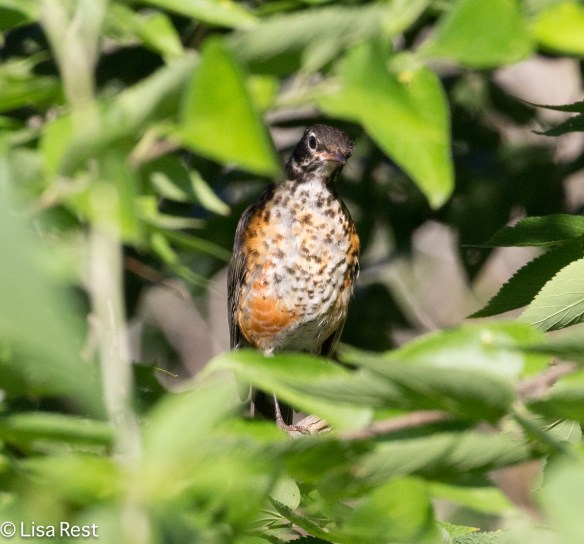
There are a lot of American Robins here even when you don’t see them. Below are two juveniles. The second photograph, taken in the mulberry tree, indicates the berries aren’t quite ready yet. I expect when they are ripe, flocks of Cedar Waxwings will join the Robins.
Here’s a Robin I managed to follow as it decided what to do with its catch.
There are quite a few Blue-fronted Dancer damselflies. I wish this one had chosen a better-looking place to rest.
I was intrigued by the new growth starting from a long-dead fragment of log poking out from the bottomlands through the fence.
Here’s what it looked like after the rain, back there on Sunday. I’m sure it’s all dried out now.
Sunday was not a great day to photograph Indigo Buntings but this one picked an interesting perch.
As a contrast, there was too much light on Monday.
The brightness did justice to two butterflies, a Silver-spotted Skipper and a Red Admiral.
I was surprised to see what had been an iconic dead tree by the second, or northernmost bridge, broken in half as it was a magnet for nesting Northern Flickers. I could not locate what happened to the rest of it.
The most interesting bird on Saturday was a Peregrine Falcon perched at quite a distance from where I stood across the water. When I got a bit closer to it, it fixed its gaze on me. Alas we grew bored with each other and I was looking elsewhere when it finally took off, missing a flight shot.
On Monday one Pearl Crescent became two.
I felt lucky to see an Eastern Wood-Pewee as I usually only hear him, but I didn’t manage to get him in great focus. Oh well.
Tadziu was on territory Monday.
I haven’t been able to find a Red-winged Blackbird anywhere at the Portage although I know they exist. So I had to settle Monday for a female Brown-headed Cowbird as a substitute blackbird.
A bucolic young rabbit with a couple Robins on the path.
Early Monday I encountered a very young deer.
It looks like the Elderberry is going to have ripe fruit soon too. Let the fun begin. I have just planted one of these in my backyard and I expect it won’t produce fruit for a while but I look forward to watching it grow.
A view of Tadziu’s bridge through the trees.
There is simply a lot of Tall Bellflower in bloom here.
One more of the Peregrine Falcon.
I’m not going out walking every day in this heat – more like every other day or so. There’s plenty to do around the house and in the yard. And there is that book. I had a revelation the other day while I was swimming, I think. Water has always inspired me, even doing dishes over the sink. That and sometimes while I’m playing piano for the birds. Anyway I think I fit some puzzle pieces together in my head so I am going to write a synopsis tonight and tomorrow which will give me a roadmap.
More to come. Still trying to fill up these longer days while we have them.
Even if the temperature doesn’t seem springlike lately, the trees are starting to leaf out, the birds are returning, and there is every other indication that spring is here. And now that the Spring Music Festival is over, I wonder if I will stop having occasional ancient dreams about performing because I have actually done so. It was good to be “back in the saddle again” to quote from our minister Emily’s opening monologue as she was the perfect emcee for the event. She actually played guitar and sang her own version of “Back in the Saddle Again” to reflect the novelty of a return to this tradition after a three-year pandemic-induced delay.
For the moment, we are experiencing a lot of rain, the complete antithesis to last year’s drought. I managed to visit Riverside Lawn yesterday but it’s likely I will not return immediately. In the back of my mind I anticipated flooding would happen eventually. Below is a portion of the trail I encountered.
Beyond that it’s been cloudy and chilly, so lack of light has been an issue especially focusing the camera with my old eyes. And I still manage to take too many photographs. This is a combined post of photos from yesterday and my visit on 4/29.
The most beautiful sight was at least 50 Chimney Swifts circling around the bend in the river. If you click on the photos below you might be able to see some of them – it was impossible to capture them all as they moved about quickly and then dispersed. I thought there were more than 50 but ebird pushed back on “60” and since I couldn’t possible count them individually for as quickly as they moved I settled on an acceptable number.
Green Herons have also returned to the area. I have seen two at the Chicago Portage in the last week but haven’t been able to photograph them well yet. With all this water I am confident I will see them again in sunnier and greener conditions. These photos are from the 29th.
On both days I saw a few Solitary Sandpipers in the fluddle close to the paved path in Riverside.
I know I said I was not going to bother with photographing Palm Warblers but with not much else standing out in the gloom, if they were close and still they became irresistible.
Great Blue Herons always manage to blend in, whatever the light conditions.
But then sometimes they take flight.
All this gray made paying attention to a lovely Yellow Warbler that much more attractive.
A few more soggy scenes from yesterday’s Riverside Lawn trail.
Ruby-crowned Kinglets are still present. With barely a hint at a ruby crown.
Blue-gray Gnatcatchers abound.
On the 29th, not far from the Hofmann Tower in Lyons, I spotted a Peregrine Falcon. At first it had its back toward me but then it turned around. I speculated later than the Hofmann Tower would be a perfect nesting spot with built-in pigeons to feed the chicks. But this could also explain why I haven’t seen a lot of pigeons up there lately.
It was time for a stretch before it took off.
After the Peregrine Falcon nothing seemed too exciting but I am out there to observe whoever shows up. Like a White-breasted Nuthatch.
Blue Jays rarely sit still, so when this one did…
I barely captured what appeared to be a bedraggled Swamp Sparrow.
A Chipping Sparrow also in hiding.
This Northern Cardinal needs no introduction.
The last time I saw the pair of Red-breasted Mergansers that have been in the river at this point was on the 29th.
I haven’t seen a House Sparrow scaling a wall in a while.
This Robin had a beautiful song. And yes, if you listen, there are some Canada Geese in the background.
American Robin singing
A Black-and-White Warbler was foraging low.
There are gong to be a lot of Red-winged Blackbirds if these females stick around.
All the rain has produced some interesting fungusThere’s still a pair of Blue-winged Teal.Male American Goldfinch
Apologies for the Long Post but I anticipate so many more photos to come – and I still have quite a few left from other recent outings – and what better way to spend part of a too rainy day? I hope to be back soon,
I saw some birds this week – in between practicing for the Spring Music Festival which will occur tonight. We had a rehearsal/run through last night and I survived. At least people like the song, so I guess that’s a good indication of something.
We canceled our scheduled walk at Columbus Park this morning because the weather was potentially threatening with the possibility of thunderstorms. We will more than likely have that kind of weather later tonight as we warm up to 70 degrees. But the overnight lows are still predicted to be in the 40’s for the coming week, which delays the yard cleanup even further.
These photos are from Monday at the Chicago Portage. I warn you, there are Way Too Many of them. The warm wave from the two days before brought migrants into the area. It was cooler on Monday so a lot of birds were foraging for food on the ground, like this Pine Warbler sampling seeds on the asphalt path.
Believe it or not these photos are of two separate individuals. I couldn’t capture them close enough to each other for a group photo.
The one Pine Warbler in the trees at first was not recognizable to me, but it turned out to be a Pine, albeit a drab one. The photo of the undertail helped me identify it.
A few more of this bird. Either way, it blends right in with the wood.
Palm Warblers have been all over the place in great numbers. it has gotten so that after taking all these pictures I haven’t bothered much with any of them the rest of the week.
I barely managed a few fuzzy photographs of the Black-and-White Warbler below.
it was delightful to see the return of a Yellow Warbler. One or two always stays the summer at the Portage so I expect to see this species again.
Warblers were not the only thing going on. There were lots of Chipping Sparrows, albeit most of them on the ugly asphalt.
There were a few group photo opportunities.
Palm Warbler and Chipping SparrowsChipping Sparrow and Field Sparrow
There were one or two Field Sparrows and then quite a number of White-throated Sparrows through the break in the fence.
Field SparrowWhite-throated Sparrow
I saw my first Baltimore Oriole of the year. My feeder will go up tomorrow. As you can see he wasn’t moving much.
Vocally and actively, the Blue-Gray Gnatcatchers are back. The lack of light emphasized the the Gray half of their name.
Here’s what the sky looked like that morning.
I had a cooperative White-breasted Nuthatch doing his thing.
Male Northern Cardinals are a little easier to photograph these days as they advertise their territories.
But the lack of light kept everything pretty cool-looking.
In her elusive stage, I managed half of a Red-bellied Woodpecker.
My volunteer American Robin. They are all over the Portage now.
The Yellow-rumped Warblers were the first to show up, but now their numbers are diminishing.
The return of water this year is making the place attractive to waterfowl again.
Blue-winged Teal and Canada Geese
It would have been nice to see the rest of the bird below, but I think after going back and forth between Hermit Thrush and Swainson’s Thrush, it’s the latter.
Northern Flickers are determined to not be seen and this one wasn’t any different.
The Great Egret stopped by to see if conditions were conducive to fishing. I can only assume the sight of me changed its mind. But it was back the next day, on the bank of the stream.
I can only imagine what these Mourning Doves were up to. If that’s the male on the right, his neck feathers are iridescent…
I think these are flowers of a Box-elder Maple Tree. I found them attractive.
So thanks to the canceled bird walk and my nap, I was able to finish this offering. If you made it all the way to the end of this post you are a rock star! I must go back to my chores and prepare for this evening’s performance. I hope to be back again sooner after all this. Thanks for checking in and Happy Spring!
We are rainy and still warm today so perhaps these photographs from Wednesday won’t look out of place. The forecast was similar to today’s, albeit almost twenty degrees cooler, but it didn’t rain while I was out. I nearly dashed out this morning when the sun broke through the clouds because spring migration is picking up, but I am not interested in playing chicken today with the forecast, and with predicted rain and storms there is wind that will eventually drive the temperatures back down to where they were when these pictures were taken.
The first thing I noticed looking over the river from the Lyons side was swallows. They were mostly Tree Swallows.
Except for a Northern Rough-winged Swallow I managed to capture, albeit blending in with the cloudy sky reflected by the water, which was moving rather briskly. I later tried to capture the “rapids” in the photo below the swallow.
For what it’s worth, there was also a Ring-billed Gull over the river at Lyons.
There were Yellow-rumped Warblers at the riverbank at Riverside, bugging in the mud.
Distantly perched, I barely managed to capture a Belted Kingfisher, a male this time.
Showing up for the count, so to speak, a female Brown-headed Cowbird was foraging in the lawn.
Over on the Riverside Lawn side of the Des Plaines things picked up a bit. There were numerous Ruby-crowned Kinglets. Ruby-crowned Kinglets are slightly larger than Golden-crowneds, which makes them appear huge by comparison when you are dealing with birds this size altogether.
“No, I am NOT going to show you my Ruby Crown”
There were plenty of Golden-crowned Kinglets as well, with these giving me some nice looks.
At one point while I stood wondering where the birds were, a Song Sparrow came and sat right in front of me for the longest time. Here’s only a few of perhaps 20 photographs. He wasn’t singing, he was pretty silent, but he wanted me to notice him. Maybe this is the same bird that gave me a recital weeks ago. The third photograph shows his feathers ruffled up a bit by a wind gust. I don’t think the temperature had reached 50 degrees yet.
This Northern Cardinal looks a bit chilly as well.
It’s always hard to tell whether you are seeing the same birds that were on the other side of the river because they tend to fly back and forth, but I suspect these Yellow-rumped Warblers were different individuals from the mud bunch.
And then out of the blue, so to speak, I saw the flash of a Northern Parula. This was a bird I had seen on the weekend before at Columbus Park – and I will try to be back shortly with that report as I managed to get better images in much better light. This warbler has been showing up in various locations around the Chicagoland area the past week and it was still early on Wednesday. I was about finished with my walk when I noticed the bird was working along the riverbank and I followed it until I managed to barely grab these images. This bird seemed to prefer foraging in old logs.
I am always good for a quick White-breasted Nuthatch.
Blue Jays are starting to show up again. I have heard them on occasion all winter but now I am just beginning to see them.
Beyond that, a couple Mallard drakes for good measure.
And one more of the Northern Parula.
I will try to be back soon as I try to keep space on the old hard drive free for inevitably more photographs. It’s going to be a rather busy week as I keep practicing for the Spring Music Festival so I am not making any promises, but a rainy morning forecast helps the blog efforts.
I would also like to dedicate this post to the memory of my former first-alto Alice Muciek who was a force for nature and music, in whose memorial service I will be singing with the Unity Temple Choir this afternoon.
On this first day of a four-day warm up not to be missed, I visited the Chicago Portage. I have been there several times in the past few weeks, alternating between the Portage and Riverside, but have not had a chance to do another post for over a week and I apologize. Things have just suddenly gotten so busy I have gone out in the morning when the weather has been tolerable, but have not been able to catch up with my photographs. I apologize for my temporary abandonment of this blog, but this is just a short post before I have to re-immerse myself into figuring out how to play and sing a somewhat complicated arrangement of a song for the Spring Music Festival next week. I spent hours and hours writing out the score just so I could identify where and what chord changes occur. It’s been about 40 years since I last did this sort of thing…
It started out a bit cloudy and cool but the sun emerged and with its warmth came the beautiful bright blue sky which I could not ignore.
Somewhat surprisingly, there was not a lot of new bird activity this morning. I heard far more birds than I saw. But we had some rain yesterday and there are likely storms ahead tomorrow, which just might encourage more birds to visit. I was most thrilled to see a Great Egret at the far end of the stream as I was walking in its direction. I proceeded as slowly as possible but knew that I would eventually be closer than it could tolerate, especially on such a quiet morning this early in the season. But this is the first Great Egret I have seen this year, which makes it likely to expect numbers of them on the Des Plaines River at Riverside where I have been looking out for them. And it’s so special to have a heron on the water at the Portage after last year’s drought made them so scarce. I am hoping for Green Herons to return.
As can be expected, Red-winged Blackbirds were going about their business.
Also on the water, there have been Blue-winged Teal for the past couple weeks. I counted 14 on April 19. Today there were two pair. I didn’t get great photos through the vegetation but at least this couple perched conveniently on a log. I promise more Blue-winged Teal photos when I start getting caught up with previous visits.
In the sparrow department I heard Song Sparrows but didn’t get on them with the camera. I did manage to record a couple Fox Sparrows though.
The Northern Flickers are doing everything they can right now to avoid my lens. It should be easier to capture them later.
With the sunshine, turtles emerged.
For what it’s worth I found some interesting white foliose lichen growing on a dead log.
For the most part there were a heck of a lot of American Robins. Everywhere. So I have to give them some credit, even if none of it is terribly interesting.
American Robin in flight
So, that’s it for my short post today. I hope to be back sooner than I think I can make it. If it rains as predicted tomorrow, maybe I can catch up a bit with some photos from other locations as some warblers are starting to arrive. Indeed I was a bit surprised I didn’t have any warblers this morning as I had several individuals yesterday in Riverside. So I guess I know what my next post should be!
I had planned on this post days if not a week ago… This could be my last ancient fall warbler photos post. Even though we will still have some cold weather to deal with, spring and the longer days are gaining attention from the birds. It won’t be long before the trees leaf out and warblers start to arrive. Red-winged Blackbirds have already started setting up territories as of March 1.
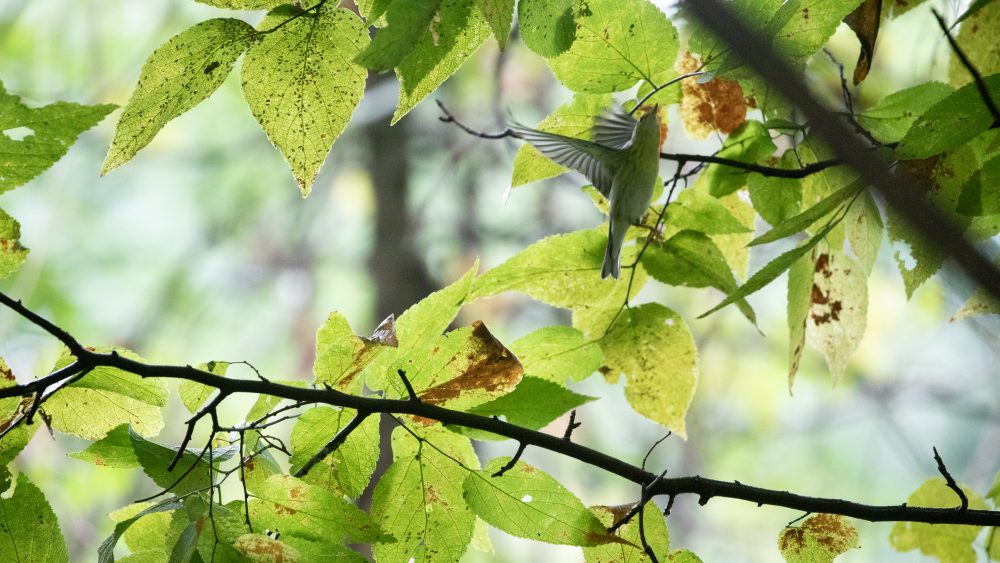
So here are a few reminders of what the warblers looked like in the fall. Below and at the top of the post is a Bay-breasted Warbler.
Below is one quick capture I managed of a Northern Parula.
Yellow-rumped Warblers like the ones below will look quite different in the spring.
Male Nashville Warblers have a tiny red spot sometimes visible at the crown. If you click on the first image below you might be able to see a hint of red on this one.
One sought-after warbler that I saw a few times but didn’t manage to photograph until a later visit in October was this male Black-throated Blue Warbler.
There were a lot of Black-throated Green Warblers this past fall.
And many Blackpoll Warblers were available for observation.
I will never tire of Magnolia Warblers although they were ubiquitous this past fall. I really think they like to flirt with the camera lens.
Not a warbler, but there was a very well seen Cooper’s Hawk that day.
Things are getting a bit more interesting as spring approaches and I will be back as soon as I can with more photos and reflections. Life goes on. Sometimes surprisingly so.
Oops, I almost forgot the obligatory American Redstart.