More Fall Scenes from the Chicago Portage

Here’s something a bit more current, even though I hardly went out for walks last week. I have started to get back into my regular routine. Anyway, here are some photos in reverse chronological order for a change. First are some from October 21st. A grey squirrel seemed to have perfected a walnut chin grip.

I managed to get a few barely passable photos of a rather cooperative Golden-crowned Kinglet. This is the same individual at the top of the post.

After that, I got some better views of a Ruby-crowned Kinglet.

Then I noticed a young Cooper’s Hawk in the distance.

On October 16, there were some American Goldfinches.

I saw a Rose-breasted Grosbeak.

The moon made an appearance.

A Golden-crowned Kinglet emerged, this one being a little easier to capture.

And I encountered a deer on the way out past the little bridge.

The camera caught a distant Tennessee Warbler.

Then back on October 14, I first saw a Hermit Thrush on the chain-link fence that separates the Chicago Portage from the Metropolitan Water Reclamation District property, and then agan later on a branch.

I found a Ruby-crowned Kinglet.

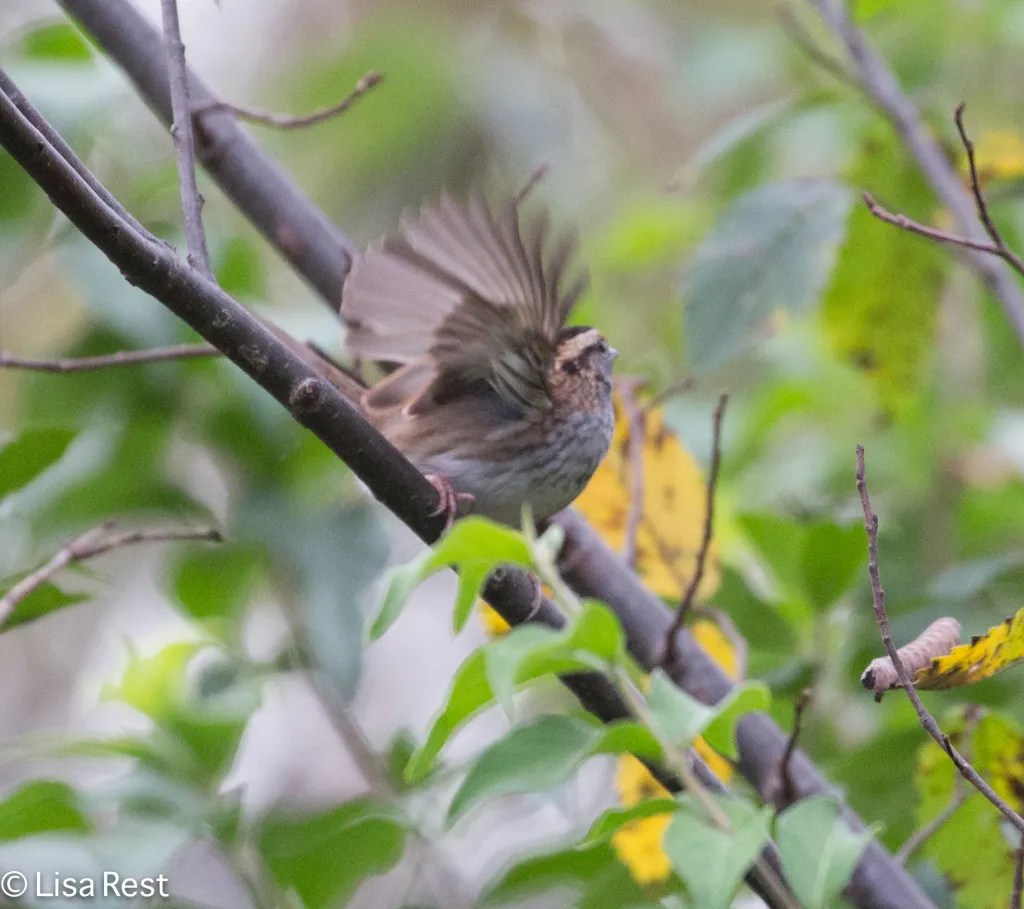
I caught a glimpse of a White-throated Sparrow.

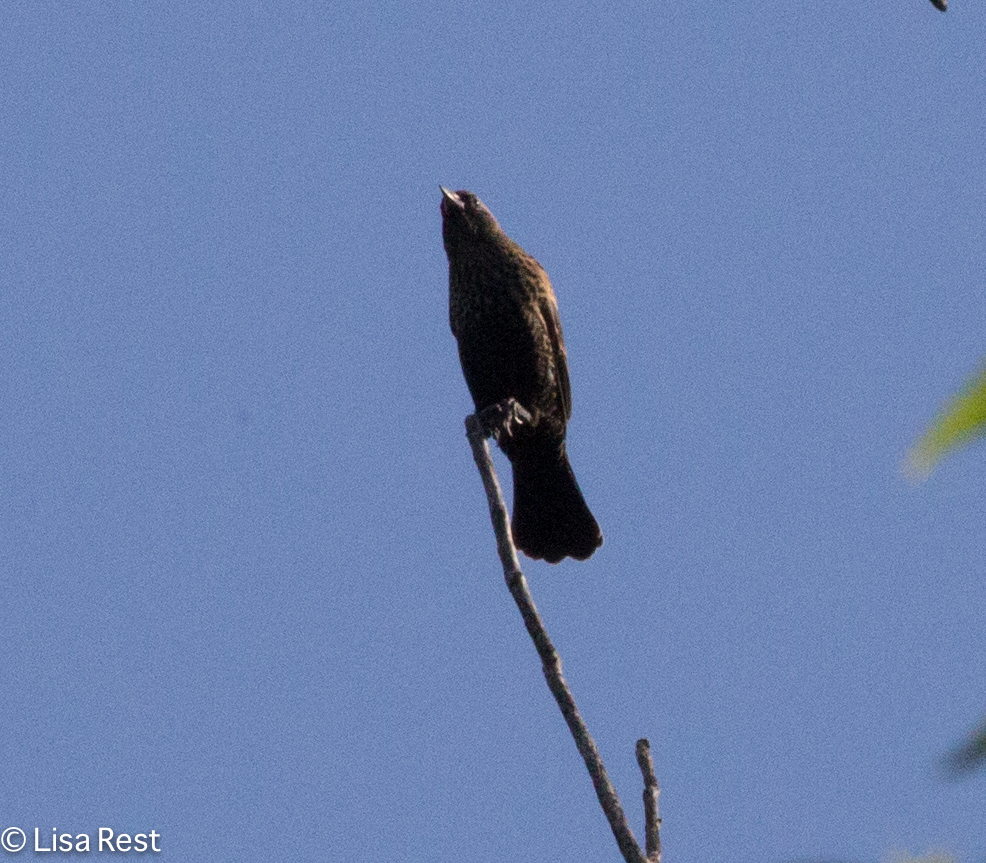
A Red-winged Blackbird flew overhead.

It was still easy to get a few looks at Yellow-rumped Warblers.

I took note of a pensive-looking American Goldfinch.

A female Downy Woodpecker was mining a large tree trunk, and then I saw a male Downy Woodpecker closer.

I found a Nashville Warbler irresistible.

And I also found a lingering Tennessee Warbler.

With my house guest gone Thursday, I have been trying to get my life back together. I wonder if it has been a bit more challenging as the days grow shorter and temperatures cooler. Luckily my indoor birds are here to remind me what needs to be done every day at a minimum.

For what it’s worth, on Saturday morning, I picked up and then unloaded a total of 510 pounds of birdseed, my annual stock-up-for-winter from the Chicago Bird Alliance (formerly Chicago Audubon Society) Annual Birdseed Sale. I began to muse, as I always do, about how much longer I will be physically able to do this task, but then, as if an immediate answer to my question, I soon discovered that all the lifting and carrying had somehow provided me with a rush of energy that was enough to continue doing the physical tasks of two big cleanups, first of the dining room, and then the living room, removing the indoor birds’ dirty curtains and huts and replacing with clean ones. In essence, I accomplished in one day what I would normally have scheduled to do in three, and I am none the worse for wear. Indoors, the birds seem to have accepted their fate of having to start all over again building nests in the huts, too. Now, if we can all just get used to the “earlier” evenings descending into darkness. The birds yelled at me last night when the dining room light, which is on a timer, went off. I had been napping after dinner on the futon. Their message was clear: It’s late and we want to go to sleep. Turn off the radio and the living room light and say goodnight.

Something Else from the Chicago Portage

I fully intended to do this post a week and a half ago, while we were still romancing the idea of a warm fall migration season. I’ll still be looking back, but I’ve been busy with the upcoming choir concert and the impending arrival of a house guest – something that doesn’t happen all that often when you live with birds, not that anything in their lives will change – and as life becomes evermore complicated, I find I have an intense determination to simplify things. I’m sorry that doesn’t seem to have made its way into my writing.

So here are some photos from the end of September at the Chicago Portage. The 28th and the 30th, to be exact. I almost wrote the end of December. Our weather has finally and suddenly taken a chilly turn.

There weren’t many birds on the 28th. Perhaps the least common was the Rose-breasted Grosbeak below.

Red-winged Blackbirds started to show up here and there in preparation for joining flocks moving south.

And Common Grackles were amusing themselves with the abundance of huge walnuts.

I caught a glimpse of an American Redstart. Actually, this is the most common view of this species in any season.

And on my way out, a White-tailed Deer crossed the path.

On September 30, I first noticed a Yellow-rumped Warbler on the bridge by Harlem.

Then as I looked out from the bring into the shallow stream covered in duckweed, I saw a Muskrat. I had somehow managed to get out of the house a bit earlier that morning, and I suspect that I might have been keeping Muskrat hours.

Another Yellow-rumped Warbler was in the duckweed.

Then, I caught a new view of a Rose-breasted Grosbeak. I have never seen the red under the wings before!

The camera found an Indigo Bunting or two.

I got lucky with Lincoln Sparrows and took far too many photos of them. This was the first individual I saw.

I saw a Song Sparrow across the water.

Then I found another interesting Song Sparrow that almost looked strongly striped like a Fox Sparrow, while its belly was unstreaked. It’s sometimes amazing to me how varied individuals in this species can be.

Yellow-rumped Warblers can look quite different too.

I found a Downy Woodpecker working hard on a tree limb. The first photo is blurred by how fast she was drumming.

Another Yellow-rumped Warbler was fading into the leaves.

Here’s the second Lincoln’s Sparrow. This might also be the same one at the top of the post. I was sitting on the picnic table close to the water when the sparrow popped up on a nearby log.

I watched a Red-bellied Woodpecker grab something to eat.

And then, when I returned to the bridge near Harlem, I found an Ovenbird foraging in the leaf litter. It was then joined by a Yellow-rumped Warbler.

I caught another view of the Ovenbird after that.

Palm Warblers have been somewhat scarce this fall. I was used to seeing them everywhere in previous years.

Here’s another Palm Warbler, and a Yellow-rumped Warbler below it. The Palm Warbler has yellow underneath its tail, and you can’t always see the yellow on the other’s rump.

Well, that’s about it for the moment. I have lots more to share, I just have to find the time and the mental space to do so. It feels good to be sitting here with some coffee after singing this morning in choir while the temperature fell and it rained steadily. It’s easier to be inside under those circumstances. It looks like we will be much cooler now than we have been, but not freezing yet. I am thankful for the rain on the new plants I put in the ground last week. And I’m looking forward to digging into a challenging week ahead, with rehearsals, arrivals, laughter, tears, more birds, more music, more reasons to keep going.

Looking Back a Bit

While I’ve been stuck inside, more or less, during the heat wave, it’s been almost refreshing to look back at photos from the end of April still on the laptop. Spring migration was starting, and even though many of the trees did not yet have leaves and the temperatures were chilly, birds were on the way.

But first, I found even more photos I didn’t know I still had, from April 17 at the Chicago Portage. Below, an American Robin sneaking nesting material, and a late American Tree Sparrow.

Northern Flickers were coming back.

An Osprey flew over.

A Song Sparrow was checking out the marshy area.

On April 21 in Riverside, Yellow-rumped Warblers were easy to find.

A Northern Cardinal, a Song Sparrow and a White-throated Sparrow made the cut.

On April 24 at the Chicago Portage, I found two American Robins preoccupied.

Yellow-rumped Warblers were easy to find.

I noted the return of a Green Heron.

Blue-winged Teal had been at the Chicago Portage for weeks.

Palm Warblers were showing up too.

Palm Warbler

On April 28 in Riverside, I saw an Eastern Bluebird. While they were setting up a territory, I saw the bluebirds quite frequently, but now that they are busy raising young I haven’t seen them lately at all.

An interesting fungus

Palm Warblers were showing up everywhere.

A pair of Northern Cardinals were enjoying the sunshine.

And a Great Blue Heron was in the river.

Then on April 29, back at the Chicago Portage, I had a Field Sparrow.

Warbling Vireos were arriving and claiming territories.

One of several Palm Warblers…

A Yellow Warbler was most likely heard first and then seen. There are at least two if not three breeding pairs at the Chicago Portage this year.

A Green Heron first appeared in a tree and then flew down to the water.

An Osprey flew over.

Then, the surprise bird at the top of this post, a beautiful male Rose-breasted Grosbeak. I don’t believe I have seen one since. If they are nesting here, they are extremely well hidden.

White-throated Sparrows didn’t seem to be as plentiful this spring.

Just before the leaves would make them nearly impossible to see, Warbling Vireos were singing and reminding me they were going to be everywhere.

I managed to go for a walk yesterday before the heat increased again. We did get some rain last night and we’ve cooled off a bit, so I will go for a soggy walk by the river and then immerse myself in the pool. I will be back with more current reports, and I still have a lot of notable leftovers from spring warbler migration to share.

Looking Back at Palos

I’m going back in time for a moment to two visits to the Palos area back in August when the pool where I swim was closed for cleaning. I could justify swimming in Orland Park if I went birding as well. I started with a visit to Swallow Cliffs on August 19. I stayed on the main trail with lots of cyclists, runners and dog-walkers; there weren’t a lot of birds to be seen. But I did see a number of young Rose-breasted Grosbeaks.

Beyond all the grosbeaks, I had a White-breasted Nuthatch.

Then on August 21, I went to McGinnis Slough. There were more birds there, but they were not always easy to see. However, it’s already been so long since we’ve seen some of them, I’m including several so-so photos that probably wouldn’t have made the cut back in August. But it’s nice to look back a bit, and discover and learn a couple things along the way.

The first bird photographed that day was a young-looking Gray Catbird.

Closer to the trail, I could not resist a Green-darner Dragonfly.

Great Egrets were numerous, but not necessarily easy to see. The one or two closest were behind vegetation, and except for one perched in a tree, those gathered out in the marsh were generally obscured as well.

Mallards galore sat in the shallow water where I usually expect to see Wood Ducks instead.

Then I noticed a Spotted Sandpiper. For a little while, I was seeing a few shorebirds.

Kildeer started flying around and making themselves heard while doing it.

Then I saw a Solitary Sandpiper fly in. I later captured it flying away, nearly out of the frame but providing a clearer shot of what this bird looks like in flight.

Here’s the closest Great Egret I managed to photograph.

I saw a frog, which I have now identified as a Northern Leopard Frog thanks to the Internet.

There were a few warblers that day too. I barely saw this Common Yellowthroat, which appears to be a juvenile.

I saw a juvenile or female Yellow Warbler.

And I found a Tennessee Warbler as well.

This was the perfect time to see juvenile birds exploring their world. Here’s a young Red-bellied Woodpecker.

I found a Blue-gray Gnatcatcher in the tangles.

Here’s the last photo of a Great Egret flying past the trees.

For what it’s worth, it may as well be August today. Our high temperatures are back in the 80’s. It’s very windy and dry. We will be cooling off in a couple days and there’s some rain in the forecast for Thursday and a lot more for the first few days of November. I have absolutely no idea where that is coming from, but I’ll be eager to see it. We haven’t had any overnight freezing temperatures yet and we won’t start flirting with them until well into November. My hope is that we will still have mental space for the weather by then.

I’ll try to be back before Halloween with more current captures…not too scary.

Fall Again

It’s going to take me a day or two to recover from yesterday’s Gull Frolic and make sense of those images, so in the meantime I am back with more from late September at the Chicago Portage where I spent the bulk of my time following warblers feeding in the Hackberry leaves. Although it has been nice to look at these birds in anticipation of their return. my goal this spring will be to publish daily if possible.

These photos were taken on September 24. There were even more respectable images from September 26 so I will be back with those too. My laptop hard drive appreciates your indulgence in these housekeeping matters.

Black-throated Green Warblers were good subjects this past fall.

Just as cooperative, maybe even more so, were Blackpoll Warblers.

This turned out to be a rather reclusive Tennessee Warbler.

Swainson’s Thrushes predominated.

Below is a female Red-bellied Woodpecker, since I have seen only males all winter…

A late-leaving Indigo Bunting undergoing transformation.

Magnolia Warblers were everywhere this past fall but not always easy to capture. They remain among my favorites (in no small part because it’s always easy to figure them out).

Can’t leave out the Downy Woodpecker,

A nice surprise was this female – or immature – Rose-breasted Grosbeak. As I recall I saw one or two for a couple days.

I see more Northern Flickers flying away so it’s nice when they sit still a moment.

Two Mallards resting in the duckweed stream.

As for real time, we warmed up today and there is bright sunshine, but the wind makes being outdoors difficult for the birds and possibly even walking. Oh maybe I’m just making excuses, but I am still sort of worn out after yesterday. I wish a peaceful Sunday and the coming week to you all, wherever you are. I will be back soon with more colorful birds.

Of Yellow-Rumpeds and Kinglets

Fall migration always seems to take a turn with the sudden arrival of scores of Yellow-rumped Warblers and Ruby-crowned and Golden-crowned Kinglets, the latter two species that were called “Old World Warblers.” It turns out that Old World refers to a genus that the kinglets shared with other birds of the world (the Sylviidae) before they got split off into Regulidae. But suddenly all new world warblers – the wood warblers, or Parulidae – you may have seen over the past few weeks are less commonly seen and these species are abundant. Not to confuse you – the Yellow-rumpeds are wood warblers and still being seen.

It was a cloudy morning, ahead of some significant rain in the forecast, and I went to the Portage last Tuesday to see if any birds were about. At first, due to the cloudiness, there were distant Red-Winged Blackbirds moving about and a couple Woodpecker species, but I really didn’t expect to see much of anything. And then, perhaps due to the still-warm temperatures and the sky brightening up a little bit, I found one of those Magic Trees, this time, through the break in the fence and on the trail leading toward the train tracks. Magic Trees host a flock of foragers, and this one was no exception. I should note that it was a Hackberry, as have most active trees been this season.

Anyway, I was delighted to find the three photographs below, taken in rapid succession, of a Golden-crowned Kinglet. I love his “ta-da” wingspread in the third photo.

Below are some Yellow-Rumped Warblers. I stole the picture of the one at the top of this post simply because the lighting was better when I took it and the one below was just a little too dark.

Sparrows are starting to come through. Below is a White-Throated Sparrow, often the first to show up.

Below are Ruby-crowned Kinglets. I seem to be seeing fewer of them than the Golden-crowned but it could just be the Golden-crowned getting more of my attention.

The lack of light didn’t do this Nashville Warbler any favors.

Magnolia Warblers have managed to show up the greatest length of time, from the very beginning until just a couple days ago.

Hanging out in the same spot where I found the kinglets this time was a very cooperative, and I guess hungry, juvenile Rose-breasted Grosbeak.

I am trying to remember what the bridges looked like years ago before these were installed, but I can’t seem to conjure images up in my brain. I know the path to them was not paved. Not sure I have squirreled away any photographs either. In any event, they got painted over this summer to cover up some graffiti. But they are still fairly attractive, even if it gets harder and harder for me to peer over them with the camera as I continue to shrink.

Some scenes of the Portage showing what I guess will be the fall colors…

Two more of the Grosbeak.

When I got home I found this bee enjoying the asters blooming in the front yard.

I am taking way too many pictures every day to keep up with this fall deluge of migrating birds, and as long as the weather is good, I will be going out and taking more. I figure I should go for as much sunshine and good weather as I can before the inevitable cold and snow. Maybe I will get caught up some snowy day.

Return to Riverside

I parked in Lyons on September 27th and got out of the car, assembled my gear, and started walking barely a few steps when I looked up and saw this juvenile Osprey perched in a dead tree right above me. That was an auspicious beginning to a nice walk.

I crossed the bridge after not seeing any other birds on that side of the river. A fellow blogger, Tootlepedal, has suggested my last mention of the bridge was illegal without a photograph of it, so I did my best to frame it, but between my big lens and no way to get far enough away to capture it at a distance, this was the best I could do. I will keep trying, but I haven’t found this bridge’s aesthetic value yet…

Right off the bridge there has been a Great Egret, this time on the rocks that have been exposed due to the lack of water in the Des Plaines River.

The Great Blue Heron close to it was in a much wetter-looking spot. Actually this is right around the spot where there once was the Hofmann Dam, which has been removed.

The Red-winged Blackbird below could barely keep his perch.

Magnolia Warblers were still visible and this one was posing.

A handsome Turkey Vulture flew over, enhanced by a clear sky.

Two different species with the same color palette: they were both in the pokeweed.

White-throated Sparrow
Rose-breasted Grosbeak (immature)

It’s somewhat comforting to know the water is still deep enough in a few places for Double-Crested Cormorants.

I was very happy to see a Golden-crowned Kinglet well. They usually don’t sit still for too long.

A couple more of the juvenile Osprey. There were actually two of them flying around but I didn’t get photos of the action.

I went back two days later and got more pictures that I still have to process. Migration is slowing down a little bit, but I’ve also had a lot of work to do. I will be back with another report soon.

I am happy to note that we are finally getting some rain. It’s not going to make much of a difference in the water levels of the river, but it’s appreciated nonetheless.

Leading Walks

I led two walks for the Unity Temple Unitarian Universality Congregation (UTUUC) auction again, on September 11 and September 25 this year. I didn’t take a lot of pictures, even though I was in much better shape than I was last time with the broken elbow. The pictures from the 11th are first and the ones from the 25th start with the Yellow-Rumped Warbler.

More than anything, it was good to get out with people from the congregation, most of whom I had not previously connected with, which was the whole point, beyond raising money, of offering a walk as an auction item. We had great conversations and the weather was good on both days, so I find myself looking forward to doing this again. And again.

Not quite the last Indigo Bunting (a juvenile).

I managed to capture this Chestnut-sided Warbler with a bug.

The Yellow Warbler below was deemed “rare” in that it was late to be seen on September 11, so perhaps I developed too many photos of it to prove I had seen it.

A Red-tailed Hawk flew over.

It was nice to see yet another Eastern Wood-Pewee.

I am always grateful to the bees that remind me the Canada Goldenrod, however strident in taking over spaces, is needed and appreciated by them.

A closeup of some galls that attach themselves to hackberry leaves.

Not a representative photograph at all, but below was my first of many Yellow-Rumped Warblers to come.

Below is a somewhat hard-to-see Blackpoll Warbler. You can always click on the image to see it better.

For a few days there was a juvenile Rose-breasted Grosbeak or two.

Finally started seeing some Ruby-crowned Kinglets on September 25th like the one below. I have since captured more – to follow eventually.

Magnolia Warblers just kept popping up all month.

One more of the delicately decorated Swamp Darner also at the top of the post. It was on its way somewhere on September 25th,

I led a walk this morning at Columbus Park – I was the only participant. I think I might return shortly with that adventure before I continue to plow through the accumulated backlog: for instance, I wound up going back to the Portage before and after the second walk and found it to be very birdy, so be forewarned.

Weekends at the Portage

I spent the mornings of July 4th and Sunday, June 28th, at the Chicago Portage, mainly to see how the birds that spend their breeding season there are doing. Fledglings are starting to show themselves. Sometimes they look so different from the adults it takes a moment or two to figure out exactly who they are.

American Goldfinch

A Green Heron occasionally stops by to see what’s happening, perhaps to see if the water it used to fish in has returned. I suspect the herons miss the water even more than I do. A frequent dog-walker I have exchanged conversation with for years told me that he heard the amount of water flowing into the Portage was being controlled to discourage beavers. That’s extremely disappointing to me, if true. I had read somewhere that efforts were being made to restore the habitat to its original state but I really don’t know how that could happen. I will keep trying to find out the true story. In the meantime the habitat change attracts other species that were absent before, but I miss the old “regulars.”

All that vegetation in the middle used to be water…

Something else: just as I was beginning to explore farther afield, the fence gate has been closed and locked. I am not surprised, with all the extra foot and bicycle traffic – I am sure it is a matter of liability between the water reclamation district and the railroad. Of course I would be able to crawl through the opening on the righthand side of the gate but I don’t think it’s worth doing now. It might be hard to resist during fall migration though. I guess it will depend on how many people are still using the trails.

So the stars of both visits were the male Indigo Buntings. There were plenty of them everywhere and quite a few volunteered for photographs. Since I always take too many pictures and have a hard time deciding which ones to use I have just piled them up here.

There seems to be a good number of Northern Flickers this year.

I am always happy to see a Monarch Butterfly. But sadly I haven’t seen more than two at a time.

Starting to see more dragonflies too.

European Starlings always look more interesting to me in their juvenile plumage.

I never know when I’m going to run into a deer.

Red-winged Blackbirds are less visible now that they’ve accomplished their mission of setting up territories and making babies. This may be the last time I will have seen a male singing.

I found the photos below confusing until I realized, upon closer inspection, that the breast is yellow and the tail has rufous coloration to it. Voila, this is a juvenile Great-crested Flycatcher. I don’t believe I’ve ever seen a juvenile before, so I am really happy I managed to capture it.

Another Indigo Bunting…

Here’s a Baltimore Oriole feeding his fledgling.

These are juvenile Red-winged Blackbirds checking out their surroundings.

This is the time of year when robins take on all kinds of plumage variations, particularly among the juveniles.

Downy Woodpecker (juvenile)

Below are photos of an adult Red-bellied Woodpecker and a juvenile, for comparison.

I was intrigued by the House Wren below who disappeared into the cavity in the tree…

The Blue-gray Gnatcatcher below seems to have a strange sort of tumorous growth on its back.

My lucky one-shot of a juvenile Rose-breasted Grosbeak. I haven’t seen any of this species otherwise for quite a while so it’s nice to know they are here.

Well it’s taken me almost two weeks to write this post… I will try to keep up with posting. Today was a gift in that there were clouds and thunderstorms to keep me inside and less tempted to go out. If it were up to me, I would have as many mornings as I wanted each week to do everything I like to do.

Back to the Portage

It’s all I can do to keep up with migration this spring, let alone the pictures I have taken…So I’m attempting to do this in chronological order but it won’t be easy. This past Saturday started out cool but sunny. I decided to start my walk in the opposite direction of what I normally do. Then I realized that I had forgotten to put my little portable stool in my backpack so I decided to walk back to the car to get it. As I walked, I heard the Great-Crested Flycatcher, and then saw him in one of the Redbud trees bordering the lawn behind the statue. The morning had promise.

Great-Crested Flycatcher
I have decided to photograph the statue every time I go to the Portage now to gauge the light conditions.

Last Saturday was a riot of colorful birds. I counted a dozen male Indigo Buntings. They were everywhere and they were not particularly shy, so I took advantage of their fearlessness. You can see how the light affects the hue of the blueness, when actually their feathers are all black.

I ventured out to the gravel road that runs along the MWRD property and found two male Scarlet Tanagers. They were trading songs.

But I discovered a glimpse at a Summer Tanager later in my pictures.

For all the male Baltimore Orioles singing and displaying these last few weeks, I have seen only one or two females so far. But that’s because they’re busy tending the nest.

Yellow Warblers may stay and breed at the Portage. Invariably I hear them but don’t always see them. So I was glad to capture this one.

White-Breasted Nuthatches are present all year, but are not seen or even heard frequently now.

The female Rose-Breasted Grosbeak below is the last one I have seen. I am not aware of any starting families at the Portage, but it could happen.

We have had a lot of rain, and even more after these pictures were taken. There were two Canada Geese trying out the newly flooded waters.

So this time of year of course I’m looking for warblers wherever I can find them. I just calculated that over the last couple of weeks I have seen 21 species total. I haven’t been able to photograph them all, but most, sometimes discovering them in my photographs. I will try to post as many as possible. They won’t always be textbook-looking photos. For example, the Golden-Winged below I barely captured but it was the details from the photographs that I was able to identify it as a likely female.

One more Magnolia Warbler

Then there are the flycatchers. They can be confusing. I have since seen the Eastern Wood-Pewee again in the same location looking more like himself so I am guessing he was having an off day (typically he would look more pointy-headed).

Eastern Wood-Pewee
I think this is a Willow Flycatcher…passing through.

On this day I saw this Turkey Vulture being escorted away by a Red-Winged Blackbird.

Song Sparrows are present, singing, and likely staying to raise families.

i keep hearing and sometimes seeing Chestnut-Sided Warblers every time I have been to the Portage since my first intimate encounter with one last Tuesday.

Chestnut-Sided Warbler

There’s a little rapids under the first bridge where the water runs out of the Portage. No water ever runs into the Portage, as far as I can tell, but It’s still nice to see the flow over the rocks.

More often heard than seen, Blue Jays are out and about but rarely available for photos, so it was nice to see this one.

I found this female Common Grackle to be attractive in her own way.

I had noticed this nest before but wasn’t sure anyone was using it until I managed to capture these two Goldfinches. You will probably have to click on the first photo to see the female poking her head out of it. I have since not been able to find the nest, which was not far from the trail, but it could still be there and hidden in all the plant growth that has occurred since.

Sadly, Black-Capped Chickadees are getting harder and harder to find. Long taken for granted, I am convinced they are in decline, at least locally. I caught this one in a hurry.

Here’s my Robin photo of the post.

As the leaves are finally coming out, it’s interesting to see how the spaces change.

Below is one of my favorite birds, a Blue-Headed Vireo. I have seen them a couple times this spring which is surprising to me, as I don’t think I have seen one for years.

Woodpeckers are busy everywhere.

Red-Bellied Woodpecker

And last for the moment, I finally was able to catch the male Eastern Bluebird in focus. He has a habit of posing in difficult places, but he sat long enough this time. And although I think I heard him this past week, I haven’t seen him since. I hope the pair is still nesting and I will be looking for baby bluebirds this summer.

I have been to the Portage four times since last Saturday! I am beginning to feel like I live there. Every time I have gone, there has been a different species or a special encounter with one I’ve seen so far this spring. As many people have remarked, the cool start has been difficult for the birds migrating to their breeding grounds. I can only hope those who have visited the Portage are finding what they need in this little hotspot and will survive and flourish on the rest of their journey.

I will be back with lots more. Thanks for checking in, and I hope you are safe, well, and able to get out and enjoy this spring.