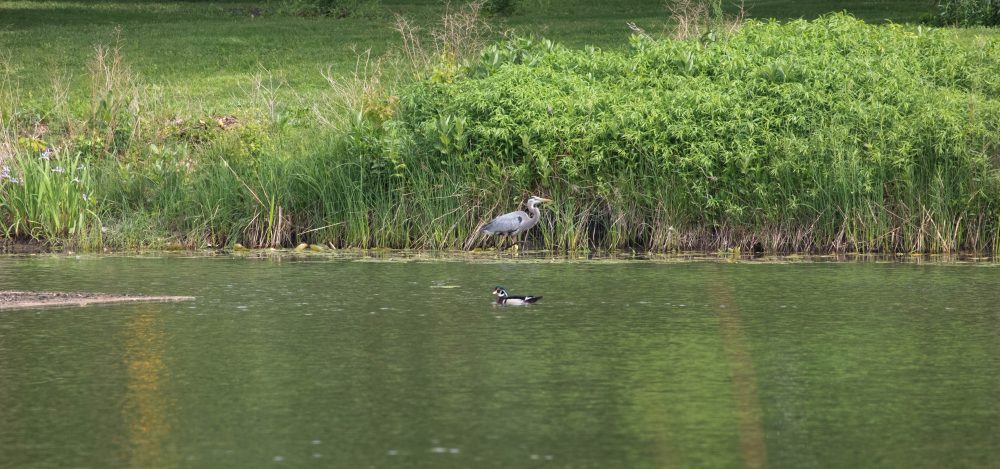
Two Visits to Riverside

My mother always used to call March the Adolescent Month. She must have been referring to the weather. It’s as if it is on the cusp of indecision – stay in winter or grow up into spring.

I went to Riverside on March 2 which was on the beginning of a brief warm front, and then back again on March 9. On the first visit it wasn’t particularly warm in the morning, but the winds were blowing from the south. I saw the Eastern Bluebird briefly.

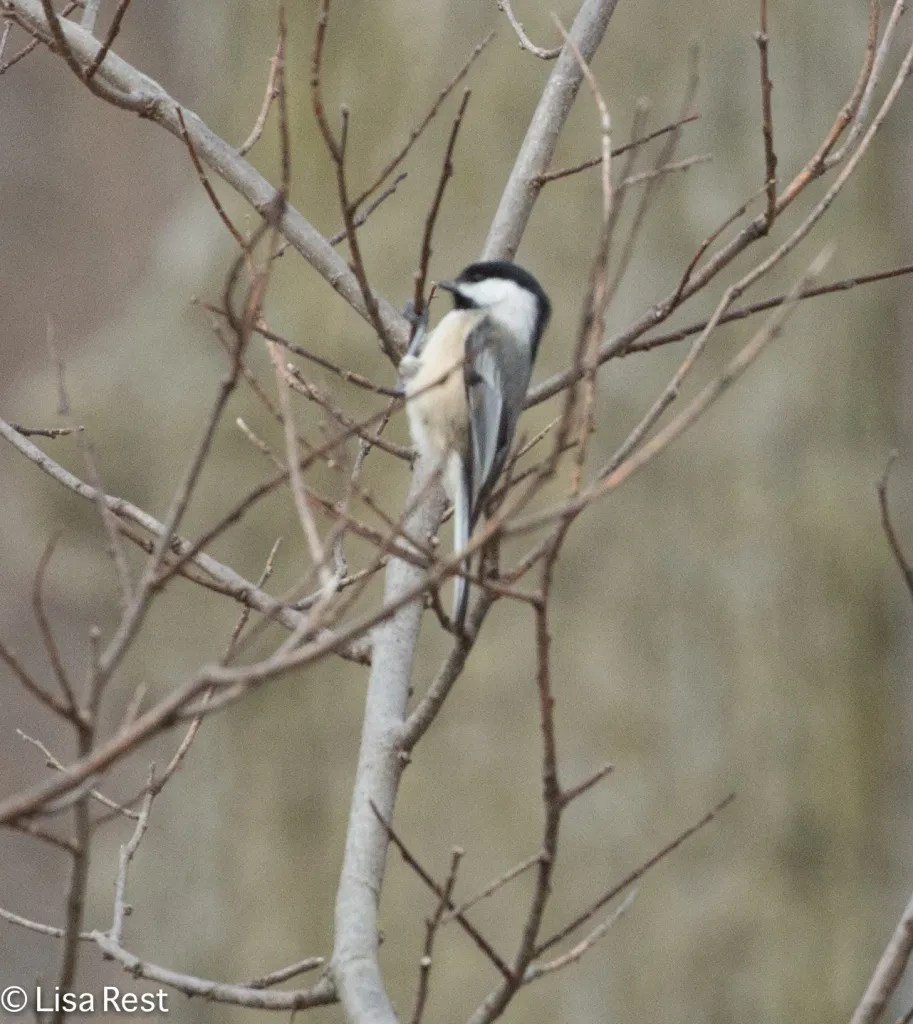
There’s nearly always a Black-capped Chickadee somewhere. This one was close enough to photograph.
The sky wasn’t too encouraging.

This Blue Jay tolerated me long enough to focus on those few parts of him that weren’t obscured.

The Des Plaines River is flowing again.

Waterfowl are here and there now, the large groups of Canada Geese and Mallards have dispersed. Below is a female Common Merganser.

With the strong shift in winds from the south, Sandhill Cranes were taking advantage of a free ride. I saw the larger flock when I came back to my car in the health club parking lot after swimming the same day.

When I went back on March 9, the skies were clearer but the temperature was colder.

This Red-bellied Woodpecker was showing off against the blue sky background.

I took note of a River Birch tree. There are several on the Riverside side by the paved trail. The bark fascinates me. They are logical trees for a flood plain.

The foot bridge was clear and clean-looking that day.

Here’s another Red-bellied Woodpecker on the Riverside Lawn side of the river.

My biggest treat this past Wednesday was the Song Sparrow singing, below. It took me a little while to locate him but he was facing me, singing away, when I did. After taking his picture and recording his song, he starting singing a different song, which I also recorded. You can hear both songs below the photographs. I have never witnessed this before. I know Song Sparrows have a reputation for singing a lot of songs but I don’t believe I have never heard the same bird sing two distinct songs. It’s as if he knew he had a good audience. It also reminds me of the Shanahan New Yorker cartoon below, which is my favorite cartoon as it seems to sum up my life.

Song Sparrow – First Song
Song Sparrow – Second Song

Mr. and Ms. Mallard were elegant on the water.

The clear blue sky provided a perfect backdrop for an adult Bald Eagle as well.

When I got back to my parking spot I was greeted by a Canada Goose standing on one foot.

But before I could get into my car, two Red-tailed Hawks started flying over, showing off. I didn’t manage to get them both in the same frame but a small sampling of the many photographs I took is below.

The last and most distant capture was of this hawk’s back against the sun.

Spring continues to push forward. We had some snow last night but it was a minimal accumulation. Even though it’s quite cold, the sun has by now removed all the snow from the sidewalks. As much as I am tempted to wonder what is the meaning of life these days, it seems to make as much sense, if not more, to just take note of as much of it as I can.

Mirrorless Outings

Even before I dropped the Canon zoom lens, I was starting to feel like at times it might be more comfortable to go out with the mirrorless camera I purchased a few years ago and had stopped using when I was no longer going downtown to the office. Also I had never really figured out how to get the mirrorless to focus on a bird, so it was a good time to start practicing. These photos are from December 1 and 3, at the Riverside Lawn Trail. I have just figured out that the wooded area across the foot bridge that the county reclaimed which has eventually become part of the forest preserves is called Riverside Lawn.

In spite of the lack of light, I managed to get some fairly decent pictures with this camera. Some well spaced-out starlings were actually all in focus individually. It has a very efficient zoom that managed to get quite clear pictures of the Red-tailed Hawk below from across the river. Invariably I have been seeing a Red-tailed Hawk around 10:00 AM both here and at the Portage.

It must have been windy that morning.

Standing on the first bridge, I noticed a flock of American Robins and the European Starlings hanging out in the shallows and bathing. The camera did a good job capturing the action.

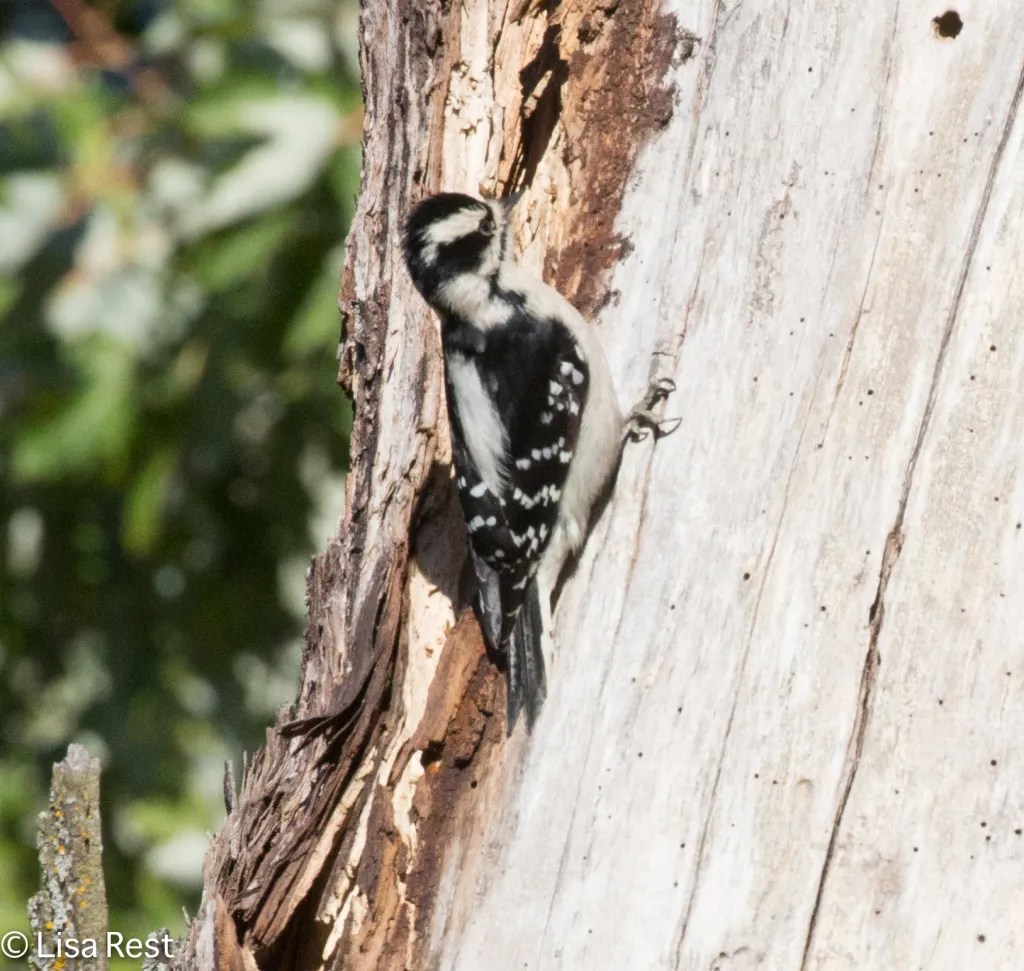
Below is a Hairy Woodpecker, which made four woodpecker species on the 3rd – I did not manage to get a picture of the Northern Flicker. A male Downy Woodpecker is in the second gallery, on the same pole.

And a female Downy Woodpecker.

Red-bellied Woodpecker

I don’t always see Mourning Doves. But on December 3rd, I was standing just hanging out with the mixed flock and a total of eight Mourning Doves eventually showed up.

There are always a lot of Northern Cardinals, and I was lucky enough to figure out the focus on a few of them after many tries.

A Fox Squirrel and a Gray Squirrel.

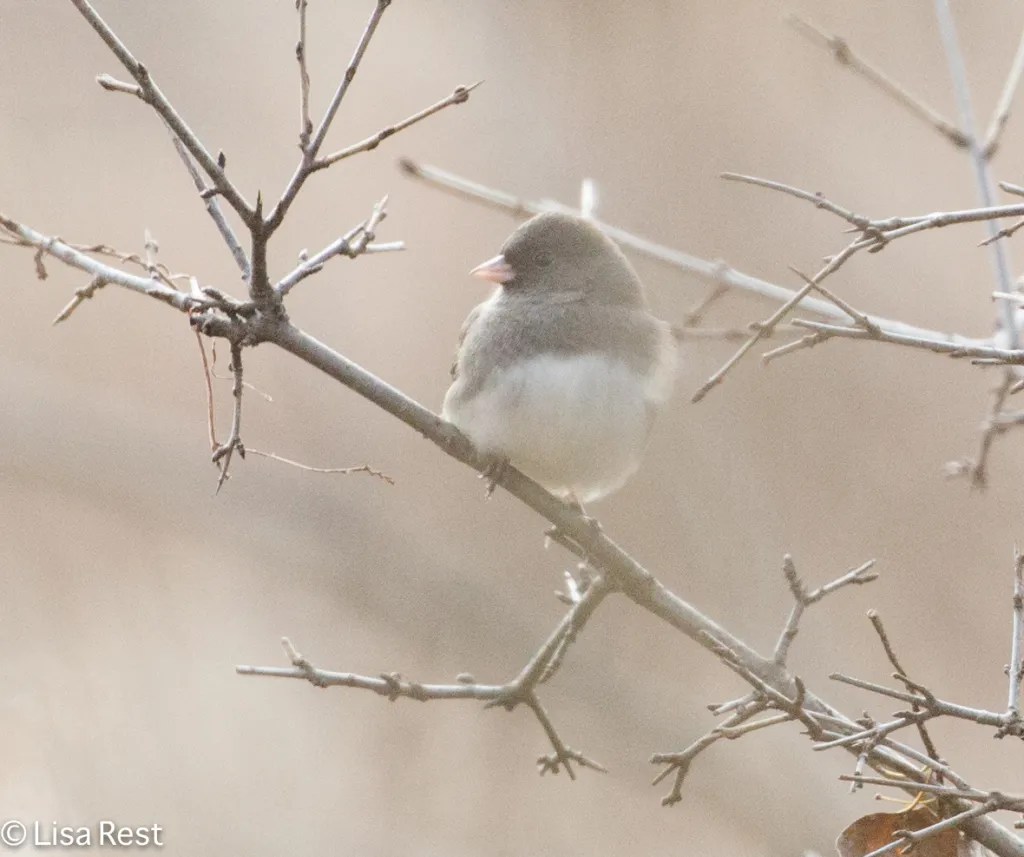
For as many Dark-eyed Juncos as I normally have seen – up to 30 or more – they are incredibly difficult to capture more often than not. On the ground, they blend right in.

I can always count on Mallards and sometimes Canada Geese.

More dreary views, and the Rock Pigeons that seem to congregate on top of the Riverside Town Hall or the Hofmann Tower.

When it focuses, this camera is great for some really crisp images, so I look forward to using it more often, especially in low light situations. I hope I can get better at focusing all my equipment since I think my ability to determine whether I have the manual focus sharp is diminishing. In this case I gladly welcome artificial intelligence. A wasp nest caught my eye, and I have frequently seen the fungus at the bottom of one tree, which looks like it has been eaten.

I’ll be back shortly with my last visit using my old 100-400mm lens. It’s already proving to be an interesting winter.

Two Chilly Portage Mornings

I’ve been to the Portage several times lately, and that includes a few times since these photographs which were taken November 26 and 28. I managed to get a few pictures of an American Tree Sparrow, which was my main motivation to go out into the cold the second day. I will likely see more of this species in the coming weeks.In fact I saw three this morning. But it’s also been relatively quiet at the Portage lately.

For whatever reason it was harder to get the bird posing below in focus than the one mired in the stalks.

The usual cast of characters were present on one or both days. I was fortunate enough to have four woodpecker species on the first day: Red-bellied, Downy, Northern Flicker and Hairy.

Red-bellied Woodpecker
Downy Woodpecker

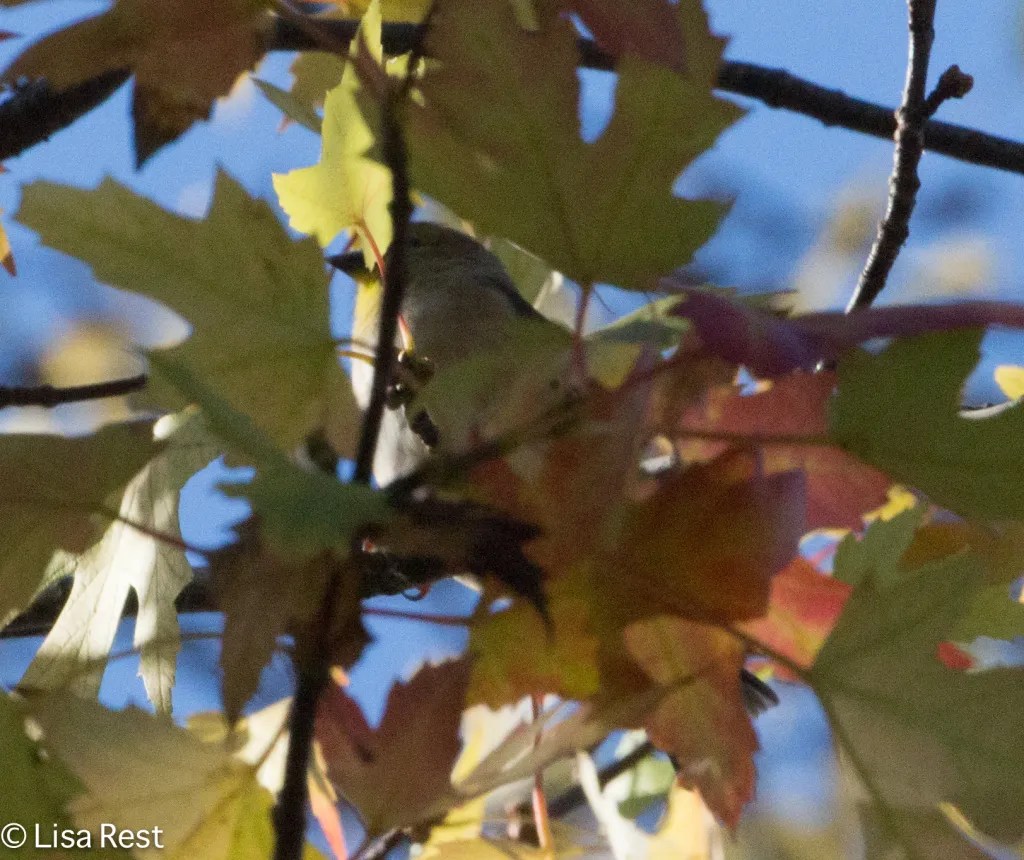
What’s really interesting about the photos below is that I didn’t realize until I started processing them that next to the Flicker on a separate branch was an Orange-Crowned Warbler. I enlarged the image of the warbler below.

This is Dark-eyed Junco season. I have been encountering flocks usually foraging on the path, along with Northern Cardinals.

There are still some American Goldfinches about all though not as many as I was seeing a couple weeks ago.

It’s always a nice surprise to see a Brown Creeper.

Here’s what the Portage was looking like on those cold, cloudy days.

I think the Fox Sparrow below is the last one I have seen.

There have been one or two Red-tailed Hawks every time I have gone to this location. Sometimes I only hear the hawk, but usually if I am still around by 10:00 I get to see one. This is a particularly dark-colored individual.

More washed-out Portage pics.

I usually see or hear at least one White-breasted Nuthatch.

Canada Geese on the Des Plaines River
Dark-eyed Junco

I hope to be back sooner than later. It’s getting harder and harder to pack a full day into the space of reduced daylight. I have been living with birds for a long time, but now that I spend even more time with them, the consequence could be thinking more and more like a bird!

Cloudy, Windy, Snow Later…

I was working on a post with photographs from last month yesterday…while indoors because of rain. This morning’s forecast was at least drier, but cloudy, windy, not promising for anything except the beginnings of snow, but what is definitely to be expected this time of year, so I went for a walk at the Portage just to see what I might find. Here are the clouds, fallen leaves, trees, a young buck and a couple birds I found. It was interesting nonetheless so I am bucking tradition here by posting in a more timely fashion…before I go back to history.

The clouds needed no enhancement as I imagined them full of cold, wet rain ready to turn into snow.

Leaves underfoot… and still many left on the trees.

Below is one of my favorite oaks exposed, having lost its leaves, but framed nicely by the golden-leafed tree behind it.

Much of the Portage looks less colorful.

There were perhaps 30-40 Canada Geese spread out in two groups.

I encountered this young-looking buck and we stared at each other for a while. The White-tailed Deer have not been at all skittish lately. Not that I want to get too friendly with them: apparently they have become carriers for the Covid-19 virus.

On my way out, a Red-tailed Hawk flew over the trees, identifying itself immediately with its call.

Earlier I encountered one very cold-looking Mourning Dove sitting on a branch high up in a tree by the water. Mainly this photograph is to illustrate how windy it was. For the most part, the other birds were in hiding. Even the woodpeckers. I heard a few but didn’t see any.

I will be back very soon with photographs from October… although there are plenty more from November. I hope you are adjusting well to the time change and the weather. Thanks for stopping by!

Early November at the Portage

I am sure I have heard a Tufted Titmouse at the Portage on occasion, but I have never seen one until, just as I was about to finish my walk on November 2nd, this one appeared. I had been hanging out with a Black-capped Chickadee and the titmouse insisted on having its picture taken instead.

Black-capped Chickadee

More photos of the Tufted Titmouse are below. In all there are way too any photographs in this post. I am trying to empty them off my hard drive so I can keep up with the present. And there are still pictures of the fall warblers from two months ago. Well. You get the picture.

Birds are moving in flocks now, which generally means you can go for a long time without seeing anything move and then encounter several individuals at once. Below is a flock of Cedar Waxwings.

The 1st was a bit sunnier than the second. Northern Cardinals are easier to see now than they were all summer. Even the females allow themselves to be photographed…as long as they are somewhat hidden and backlit.

Although there are lots of White-throated Sparrows, I don’t often see one well enough to get a picture. This one was a challenge.

Another White-throated Sparrow

One sparrow that has been showing up a lot since I took these first photos below is the Fox Sparrow. They are considerably larger than other sparrows and tend to just sit, so even though this one was behind branches, I could still capture it.

Black-capped Chickadee… and an American Goldfinch

House Finches blend right in to the browns and grays of fall.

Below is a Red-tailed Hawk.

I’ve been delighted to see White-breasted Nuthatches after hearing but rarely seeing them all summer.

Nearly every day I have seen a Brown Creeper.

Here’s about how far away the Brown Creeper was.

American Robins are in flocks too, but every once in a while I spot an individual.

Apologies for Downy Woodpecker overload – it is the start of Visible Woodpecker Season… I love to observe their behavior.

There is a barely-visible House Finch in the two photos below – just to get a feel for how well camouflaged birds can be this time of year.

More Northern Cardinals…

More Downy Woodpecker overload…

Speaking of flocks – Red-winged Blackbirds have been stopping by every day so far, in various-sized groupings.

Some scenes of the fall colors here… The water in the bottomlands has dried up by now, but this was fairly soon after we received a lot of well-needed rain.

Backlit House Finches don’t make very interesting photographs but I liked the surrounding vegetation…

One more Goldfinch…

Below is a well-preserved wasp nest.

This juvenile Red-tailed Hawk was sitting with its back toward me … until it took off.

The Des Plaines River
The Portage creek

Thank you for letting me get these off my plate. I will be back soon – either with something more historical or more recent. It’s been exciting for me to go out every day, either way.

Down by the River After the Rain

These photos are from two visits to the Riverside trail on October 20 and 27 – both after periods of some significant rain. Although the Des Plaines is nowhere near flood stage, it is good to see it looking more like a river.

Activity around the Hofmann Tower on 10-20 consisted of two flock bursts – the expected Rock Pigeons and also a flock of Blackbirds, mostly Red-Winged.

I saw an Orange-crowned Warbler on both occasions.

Below is a Nashville Warbler I saw on the 20th.

It was hard to get a good photo of this Double-Crested Cormorant through the trees but still nice to see on the 20th. I saw one flying a week later and wonder if it was the same bird…

It’s somewhat easier to get Northern Cardinals to sit still for a photo this time of year. As long as they feel somewhat shielded by a twig…

I saw Brown Creepers on both occasions, and was lucky to photograph this one on the 27th.

A Mallard here and there…

European Starlings are in groups, as usual.

One of those Red-winged Blackbirds still hanging around.

Below on the left is the sign posted at either end of the trail in Riverside that runs along the river. On the right is a sign opposite the western end of said trail, which denotes the Plank Road Meadow which features a boat launch.

House Finches are more visible now.

A tree full of Mourning Doves…

I expect to see more White-Throated Sparrows, but managed to capture only the one below.

I was going to simply add the photo directly below and call it a Tennessee Warbler – even though the face looked a little suspect to me. Then this morning when I flipped over the Audubon calendar hanging over the kitchen sink to November, the photograph of the bird on it looked like the one below, only it was identified as a Pine Warbler. So I took out The Warbler Guide to confirm – because now it was showing up as “rare” on my ebird checklist – and went to the bill shape again. That’s what made the face of this bird not look at all like a Tennessee.

Just to elaborate, I rescued the photos below from my external hard drive and found a few more clues to the Pine Warbler identification. There’s ever-so-slightly a hint of wing-bar showing on a couple photographs, but best of all is the one I brightened up a bit, where the bird is looking directly at me. That’s a Pine Warbler face if I ever saw one. I have to be more careful going through all these photos!

Below is a lovely little Song Sparrow.

The remaining Great Blue Heron is not as visible now from the bridge.

Catalpa tree seed pods on the left, and well-eaten Pokeweed on the right.

An American Robin for good measure…

Not sure whose web this is but I found it interesting.

I saw the Red-tailed Hawk flying below before it landed in the tree.

A few more scenes of this location as the late fall progresses.

We are flirting with overnight freezing temperatures. Indeed, this morning I had to scrape the frost off the windows of the car before I went for a walk at the Portage. Today I will be draining as much water as I can store into empty vinegar gallon bottles, to be used in the now-heated birdbaths all winter.

And as the days get shorter and I see fewer birds… take fewer photographs… maybe I can start revisiting the reason why I started this blog in the first place: my fascination with bird song and the birds’ reactions to music. For the moment, I would like to share with you a funny incident I happened to record way back on August 29th. I was playing piano – I have been revisiting Schumann’s “Kinderszenen” – and perhaps that day it had become a bit of drudgery – I was likely distracted by the fact that my effective retirement date was 2 days off. In any event, I struck a wrong chord while playing the 9th piece of it (“Ritter vom Steckenpferd”) and my indoor crowd IMMEDIATELY let me know that was not acceptable. Which not only proves they were right, but also that they are always listening! Below is the clip. Enjoy. 🙂

Great Blue Heron

Miller Meadows Hawk Fest

Way back on September 7 when I had just begun my new retirement protocol of birding every morning there was good weather, I decided to visit Miller Meadows which is directly across from the health club where I swim, with the idea that I could then go swimming afterwards. I had seen hawks flying on occasion from the health club parking lot, so I should not have been surprised by the number of hawks I saw that morning. It started off with an American Kestrel backlit in poor light. I don’t get to see Kestrels too often so I was happy to take some far-away pictures anyway.

Perhaps what I wasn’t prepared for was the degraded landscape. Invasive teasel has overtaken much of the meadow.

There were a few Palm Warblers trying to make something out of nothing. They were also the first I had seen this fall.

Hawks apparently found the landscape attractive for hunting. I saw several Red-tailed Hawks kiting over the open field, and was fascinated to observe this behavior. There was a Northern Harrier as well. The harrier photos are directly below, and all the rest are various Red-tailed Hawks. How I managed to capture enough detail at considerable distance still surprises me, but also encourages me to continue what otherwise sometimes seems a fruitless endeavor. These are all closely cropped, but if you click on the photos it’s kind of nice to see how the Red-tailed Hawks navigate the air.

The Northern Harrier is below.

i did see an Eastern Kingbird…closer to the ground!

A view of the paved path with phragmites, another invasive species, on the left.

I always try to appreciate at least one American Robin.

Back down on the ground in early September there were still butterflies.

And some interesting beetles… I found my Beetles book but I got even more confused trying to identify them so they will remain nameless – unless you can tell me who they are.

I will continue poring through the last two or three months’ outings for photographs as we are having some more of the rain we didn’t get in the spring. Cloudy, drizzly weather has its advantages, I guess. The disadvantage is lots of mud in the backyard…

More Portage Warblers and Friends

I’m taking advantage of the rainy forecast – we’re not getting much rain yet but it is quite cloudy and we could get more. I needed a morning off from birding anyway as my left foot was complaining about something of unknown origin yesterday. It’s better this morning, but I’ll defer the walking part of my day and swim a mile in the pool later this evening.

These photographs are from my second visit to the Portage now almost two weeks ago – on September 8th. The clear skies gave way to intense light which made for some interesting contrasts when I found a cooperative Black-throated Green Warbler.

I found it hard to resist taking one photo of my favorite shelf fungus which is conveniently located close to the trail.

Two-year male American Redstarts have been few and far between and avoiding me, but I sort of managed a furtive representation of this one. The first-year males have been plentiful, but I think that’s a female below as the flank color isn’t quite orangey enough.

Female American Redstart

I have seen a good number of Blackpoll Warblers this fall, like the one below.

Here’s one of my favorite combinations – Canada Goldenrod and Boneset seem to have an affinity for each other. A closeup of the Boneset is below.

Here’s a European Starling in the Pokeweed berries.

I had a nice look at a light morph Red-tailed Hawk.

Certain birds tend to stand out and the number of Eastern Wood-Pewees I have seen well fall into this category.

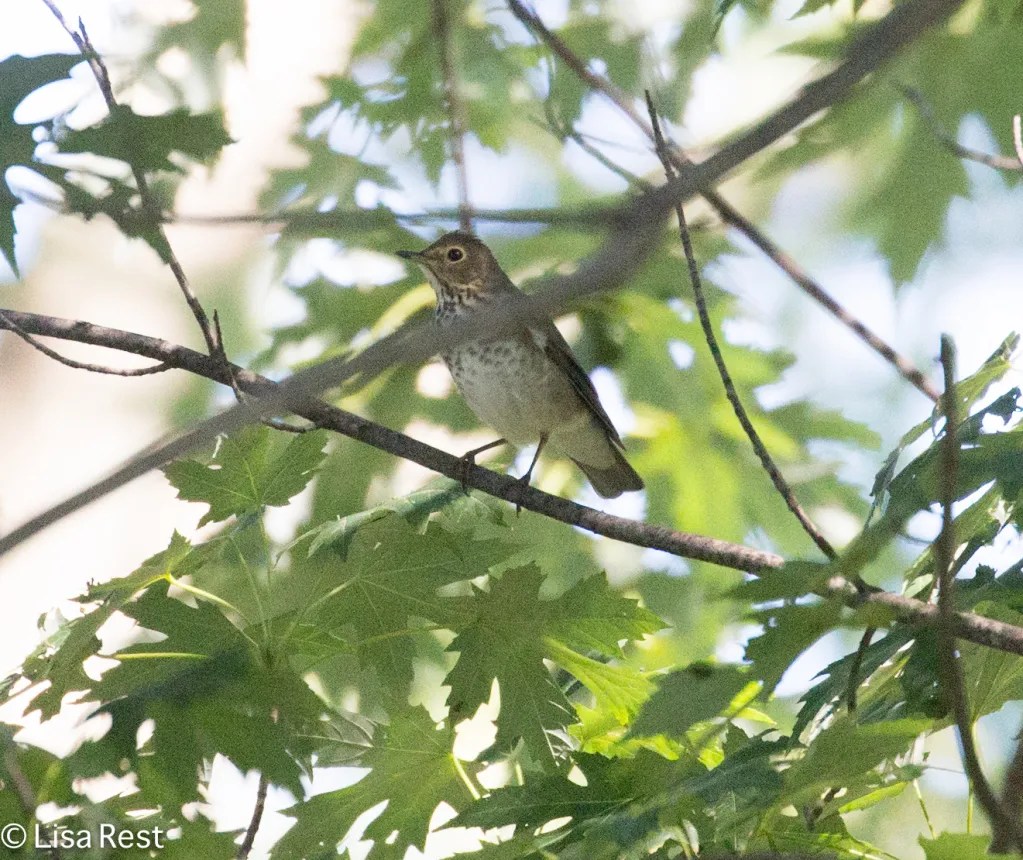
Swainson’s Thrushes have been everywhere. Period. But sometimes they look like Gray-Cheeked Thrushes and vice versa…

This looks like a Gray-Cheeked Thrush to me.

Here’s what the Des Plaines River looked like two weeks ago – it’s even lower now.

Red-eyed Vireos were abundant.

Maybe – just maybe – the bird below was a Wilson’s Warbler. Sadly, I have no other views of it. I am still trying to codify warbler colors. This looks like Wilson’s Warbler Yellow to me.

The Portage colors match the birds.

There was a Canada Warbler that day.

And American Robins are so ubiquitous that when one stands out, I sometimes have to capture it. The bird below looks to be very young and quite curious.

It’s been a rewarding fall migration season so far for me, albeit tucked away in my location limits. Eventually I will have to go down to the lakefront and other places a little more far-flung but for the moment I feel like I am enjoying my morning outings around here.

One more – Magnolia Warbler

Back to the Portage

But first, a Song Sparrow that somehow didn’t make it into the last post. I have heard Song Sparrows on occasion at the Portage but have not seen many this year.

This is my birthday weekend and if my memory serves me correctly, also the anniversary of this blog although I don’t remember how many years it has been and am too lazy to look it up. I did manage to visit the Portage on Saturday morning and will be back with that report later, but since I started this post two (?) weeks ago I feel obligated to finish it. I just checked. The photos below are from June 13. We were hot and dry. We have since had a lot of rain and flooding, but not quite enough to take us out of the “abnormally dry” category on the Illinois Drought Monitor.

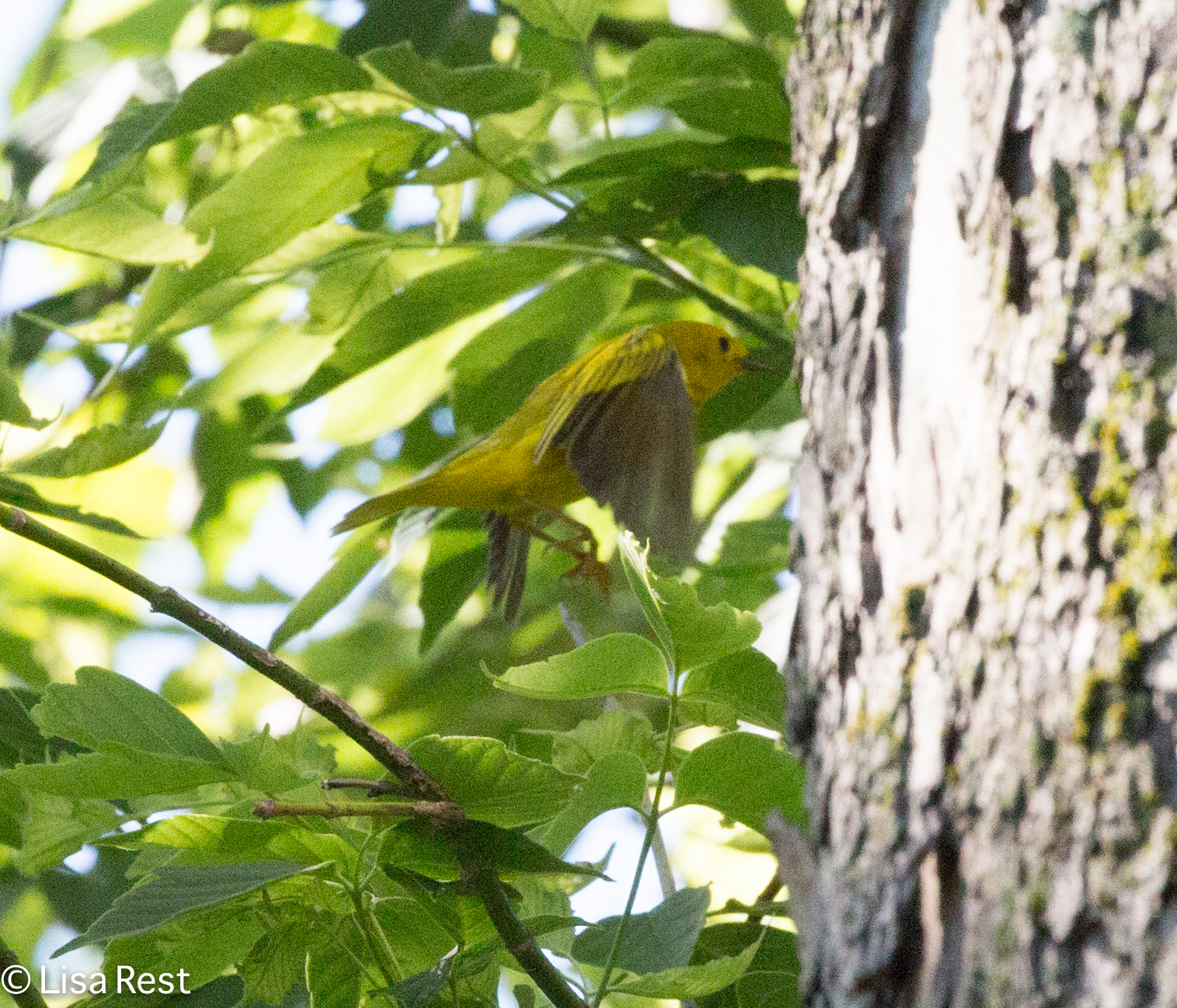
Yellow Warblers nest here and were pretty elusive but I did finally manage to capture this one.

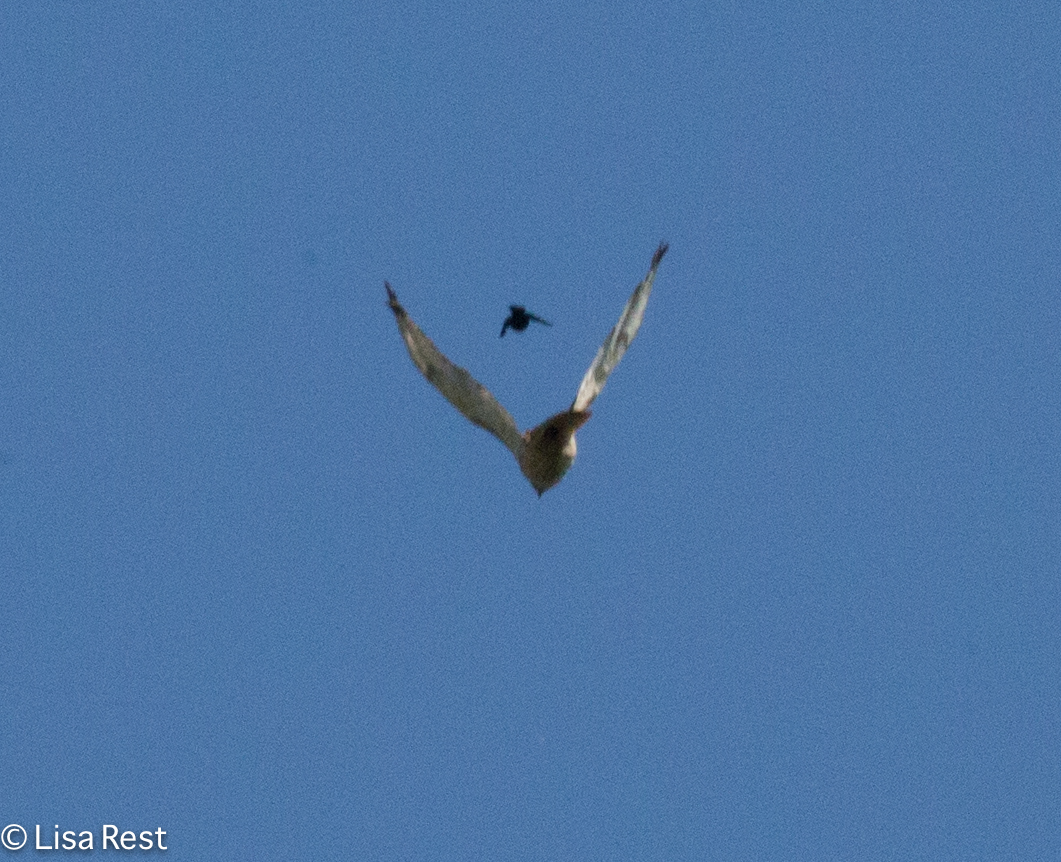
I am always intrigued by the sight of a Red-winged Blackbird chasing a Red-tailed Hawk…

Insects are sparse, which is not news, but makes the few individuals one sees that much more precious. I think I may have identified the two below. I haven’t had to resort to bug spray yet this year, although I do have a few bites I occasionally scratch to remind me it’s not over yet. The effect of insects being sparse, however, is bad news for the dragonflies and birds that eat them.

Hobomok Skipper
Likely a female Variable Dancer.

Cabbage White butterflies have been the most prevalent, and even they seem sparse. They are an introduced species.

For what it’s worth, the volunteers at the Portage have been busy reducing invasive plant species, and it is gratifying to see the natives return. Last time I saw them at work they were cutting away massive swaths of hemlock. Unfortunately it was in flower so it will likely return. But a lot of the burdock from years ago is gone. It’s a slow process.

Hemlock

More often heard than seen – a Blue Jay.

The male Brown-headed Cowbird below intrigued me by the light-colored throat feathers. It might just be a trick of the light.

Below is what I believe is a young Northern Flicker peering out of a nest hole.

The Indigo Buntings are still going strong with their songs and territories and it’s hard to resist them. I have to quit taking them for granted. They weren’t here in these numbers ten years ago.

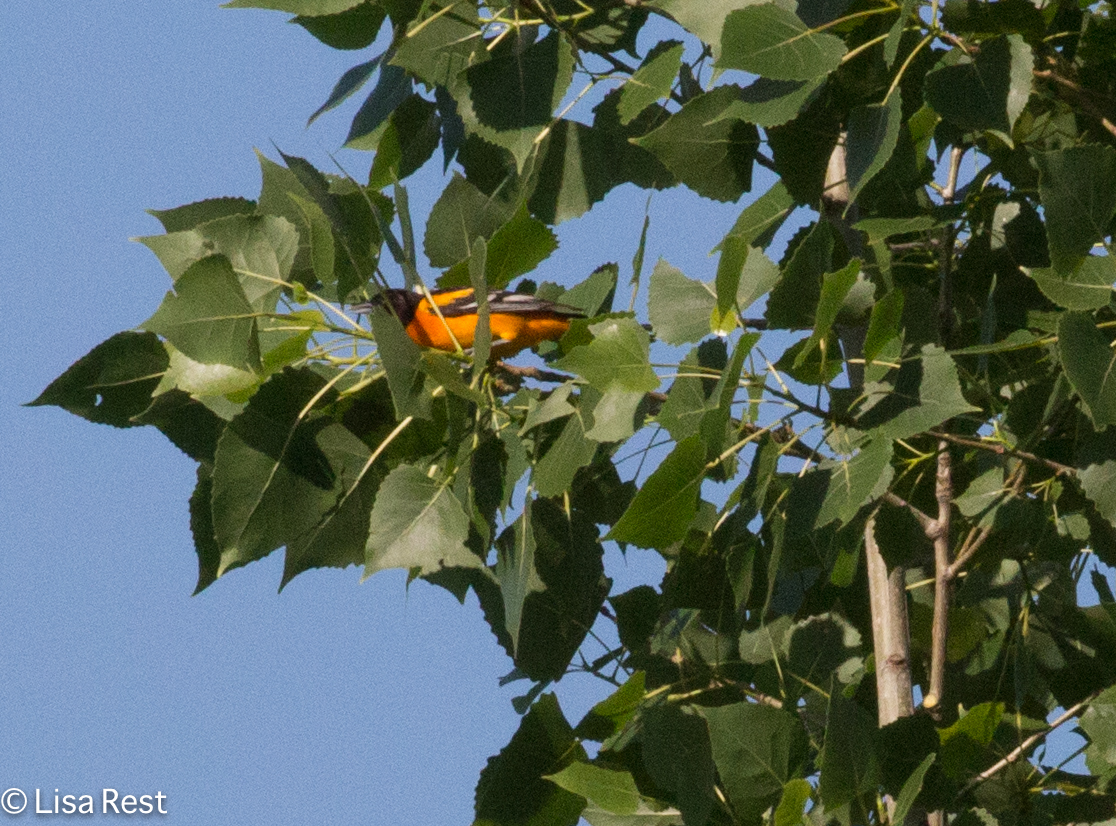
The Baltimore Orioles have been harder to spot as they tend to their broods, but I got lucky and watched this one as he visited the nest.

Baltimore Oriole nest

So I hope to be back later today with a little yard report. If I could have one thing on my birthday (while it’s still quiet and getting too hot to be outside for very long), it would be to have time to write another blog post.

My best friend from junior high is in town from California for her mother’s 100th birthday and has chosen to stay with me and the birds. Luckily there is a relatively comfortable finished attic – I call it my people space. I bought a new room air conditioner which seems to be keeping it cool enough up there. So I am foregoing my traditional visit to Goose Lake Prairie this year. Maybe I can take off for that grassland later in the month. Today I will enjoy hanging out with my friend and trying to be lazy.

McGinnis Magic

There wasn’t an awful lot going on at McGinnis on my last visit, but the sight of two Sandhill Cranes foraging in the lawn right off the parking lot automatically made it a special day.

I guess McGinnis is always good for a Great Blue Heron or two. But I’m surprised I haven’t seen any Great Egrets lately.

It’s really dry..

Not a lot of swallows that day but I managed to capture this Tree Swallow.

Not sure I have seen these Irises here before. Nice.

This Song Sparrow was almost completely hidden. We compromised.

Common Grackles are here and there.

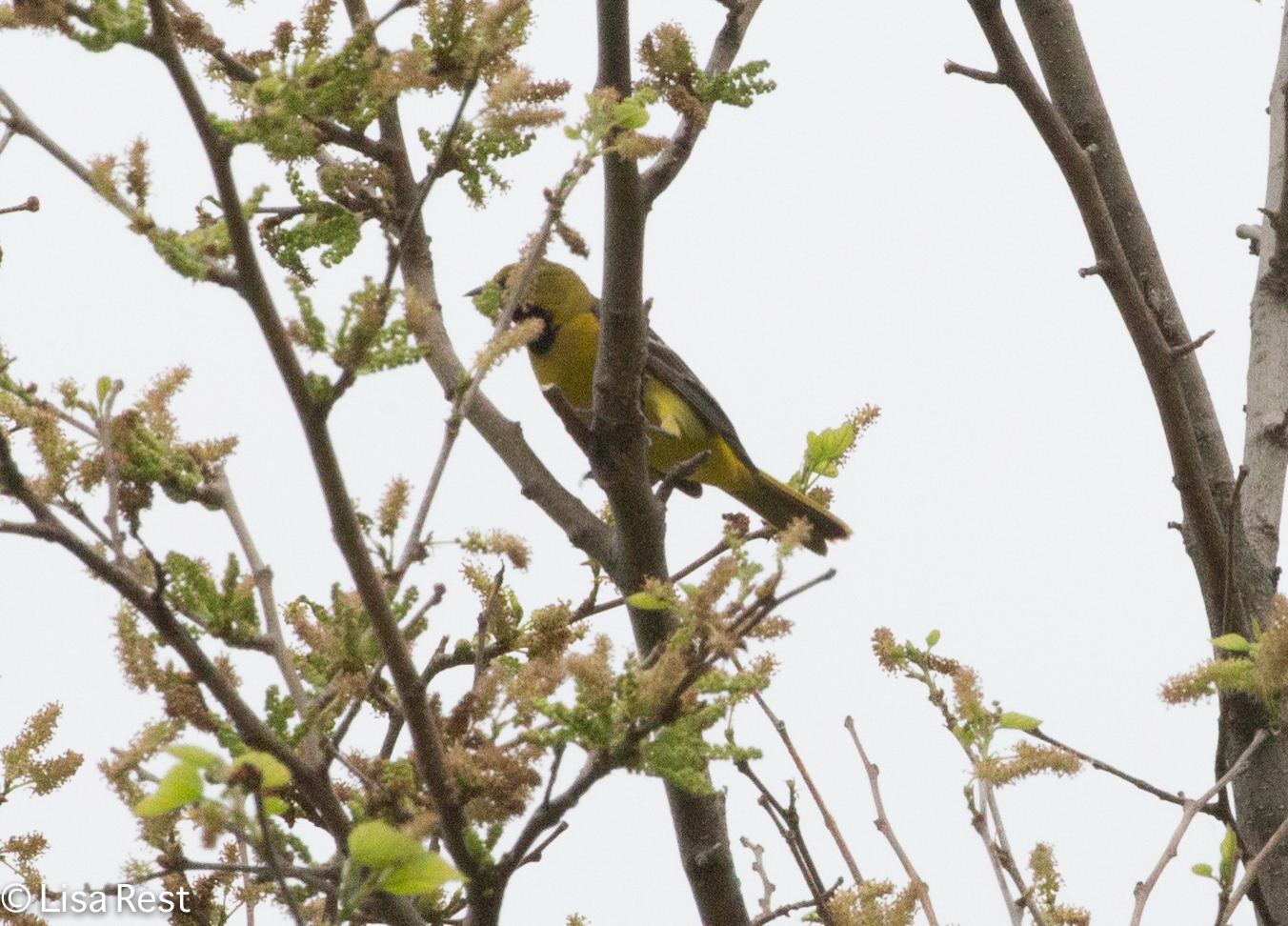
Perhaps the second nicest surprise was to see a first-year male Orchard Oriole right before I left.

The lack of light didn’t offer much contrast with these raptors flying overhead.

While I was kind of hoping to see a colt or two with the Sandhills, which I never have here, I did see two Canada Geese in the same spot as the Sandhills were earlier – and they were carefully watching one lone gosling.

Providing additional interest, a Red-Winged Blackbird trying to make sense of a piece of ice cream cone.

I am always impressed by a Robin taking a pose.

I haven’t been able to think about much besides work lately. That – and the burrowing rats in my yard. I just removed all the feeders except for the hummingbird and oriole feeders – for 10 days. The city has provided an exterminator to discourage the rats, and I can only hope for elimination as up until the pandemic, they were never around. But adding insult to injury is the drought. I take it personally, I don’t know why – but the thought of weather like Phoenix, Arizona has never been attractive to me. Nothing against anyone who loves hot, dry weather. It has its place. But not here.

Thanks for letting me rant. I do have more cheerful posts in store and what should be a fun event I will share with you in the next few weeks.