I hadn’t walked around Riverside for a while so I took a walk Monday while it was still comfortable to be outside. There were lots of Canada Geese and only a few Mallards but I was happy to see the hen below with her two ducklings. I admit I cropped dad out of the picture.
It was also nice to see herons on the water. There were two Great Egrets but they were quite distant, so I photographed only one. I also saw one Great Blue Heron. The water level is so low they are standing in the middle of the river.
I was reminded of the storm the week before, both by the paved walk and later on the Riverside Lawn trail where I had to negotiate three downed trees.
I love the spotty plumage on young American Robins like the one below.
The damselfly treat of the day was a Blue-fronted Dancer.
I often see Common Grackles in the rocks by the river. This is a female.
Almost two weeks earlier, on June 8, I visited Riverside and the first bird I saw was a Cliff Swallow sitting on the wire for quite a while. I don’t see this species very often.
It was a cloudy day. and it was much cooler as well. Again, a Common Grackle caught my eye, this time, a male.
It seemed unusual to see a feral Rock Pigeon on the riverbank.
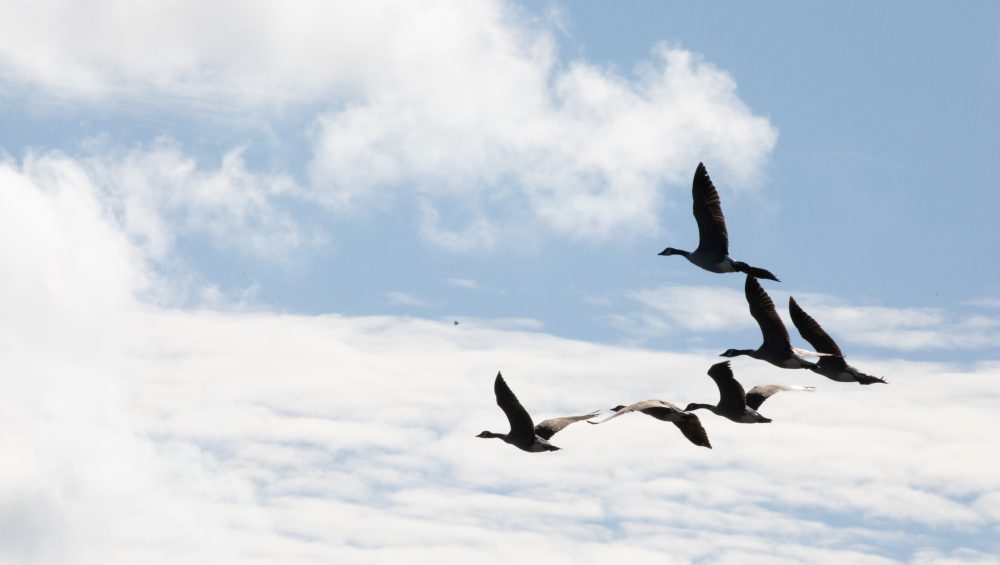
Canada Geese were in the river. Nothing unusual about that.
There was this little family taking a walk.
I struggled to see and photograph Killdeer that day. They blend in well with the rocks by the former Hoffman Dam.
Here are the first photos I took, literally just pointing the camera in the direction I was hearing the Killdeer.
At some point there was a Turkey Vulture being chased by a Red-winged Blackbird. I love to see the vultures in flight, they are so graceful. A series of several photos is below.
I managed to capture a Baltimore Oriole that day. The photo opportunities have decreased since nesting season has taken over everything.
Here’s one more of the Cliff Swallow.
There were a number of Variable Dancers on the Riverside Lawn trail. They are very tiny,
Summer is official now and hot weather is baked in, so to speak. I have a busy agenda this week and heading into July with the possibility of a house guest for a couple weeks, so my posts may be a little scattered or scatterbrained, but after all it is summertime. Hope you are enjoying the longer days and staying cool enough, wherever you are.
Two weeks after the last formal walk at Columbus Park on May 14, I joined the two Eds from those walks to see what was up after it seemed all the warblers were gone. Suffice it to say that the water birds made up for the lack of passerine diversity. In spite of an event going on at the park, two Great Blue Herons and two Black-crowned Night Herons tolerated all the noise and our attention and gave us some great looks.
There’s invariably a Great Blue Heron here but I’ve never seen one up in a tree like the one in the series below.
These photos are from April 16, May 14 and May 28 so the vegetation keeps changing.
On April 16 we were lucky to see an early Northern Parula.
Although I saw this species on a few other occasions these were the best looks I had all spring.
Also in the old reeds left over from last year was an American Tree Sparrow.
A Northern Rough-winged Swallow posed over the water
There was one little Field Sparrow back on the April visit.
There’s usually at least a pair of Wood Ducks but they don’t always offer such great photo opportunities.
Below from the last visit, a Wood Duck hen with six ducklings.
Once the Red-winged Blackbirds show up, they stay for the summer.
On the last visit there were some more grown up goslings than an on earlier visit.
Back in April, two Double-crested Cormorants swimming together.
The Black-crowned Night Herons are sometimes so well camouflaged.
Back in April I followed this Great Blue Heron in flight.
On May 14, there was a visible Red-eyed Vireo.
And on the last visit two weeks later, a Warbling Vireo made itself known.
Here’s an earlier photo of a Great Blue Heron.
The Black-crowned Night Herons are simply photogenic.
But I’ll let the Wood Duck have the last word.
A rainy forecast for today gave me the time to sit here and put this together. I’ll be back out on the trail tomorrow morning. There will likely be more photographs of dragonflies coming, like the female Eastern Forktail Damselfly below – if that is indeed what this is. I noticed it at Columbus Park on the last visit.
Yesterday morning was beautiful with clear skies and the promise of warm temperatures. I decided to visit Riverside because I wondered if perhaps I would see a returning Osprey or Great Egret as both as had reported in the Palos area. I did not see either of these yet, but there was a Great Blue Heron on the river.
The Des Plaines River from the Riverside Library grounds
The walk started out slow and uneventful. I found a Song Sparrow busier foraging instead of singing although I heard one earlier when I was on the other side of the river. I inadvertently flushed this individual when I advanced along the trail at Riverside Lawn.
There was a pair of Red-breasted Mergansers, and later a pair of Common Mergansers as well.
Dark-eyed Juncos are still around.
One Downy Woodpecker was available for a peek.
Although the landscape is still brown, there was a little moss and lichen color by the paved walk.
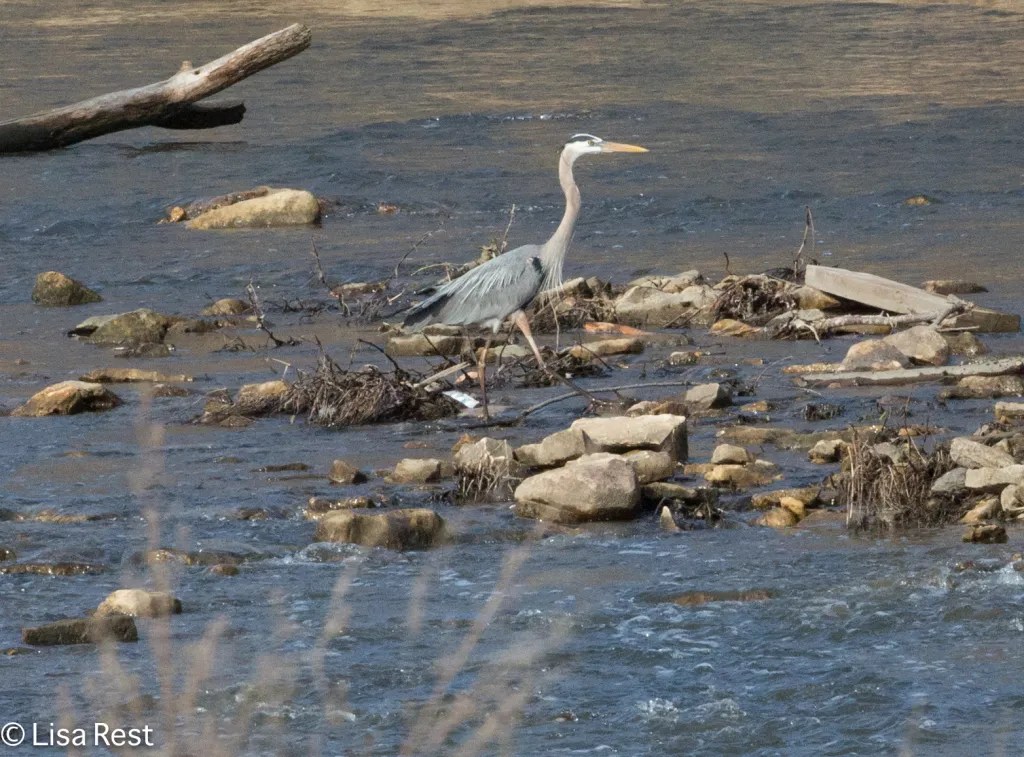
The most interesting part of my walk came at the end when I returned to my car parked by the Hofmann Dam and saw a Great Blue Heron farther up river. Some time after I got over to the Hofmann Tower, it started to walk across the river to the other side. I was at quite a distance, but the heron might have taken my presence and interest in it as further incentive to move. I try to be careful and keep this in mind, but it seems nearly unavoidable.
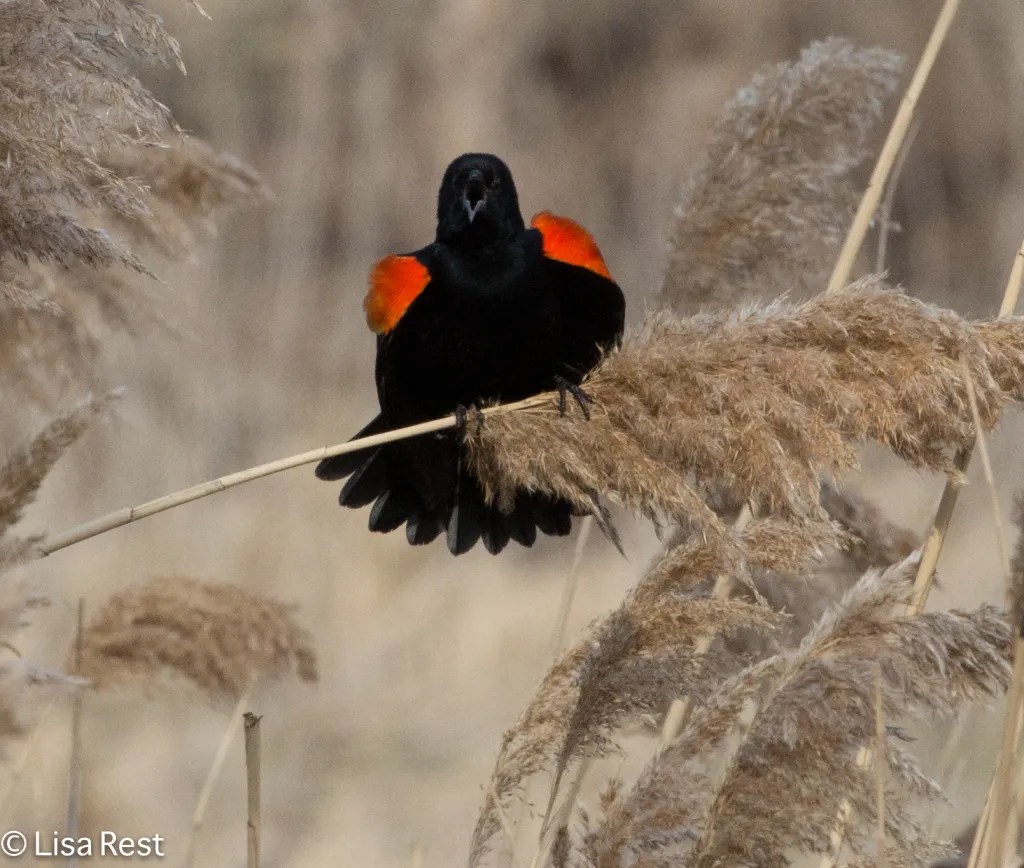
While I kept an eye on the heron, other birds caught my attention. A posing American Robin sat for me, and a flurry of Red-winged Blackbirds were likely beginning to pair up. The singing male was clinging to the phragmites stalk he sat on through a lot of gusty wind. I liked the way the group of Canada Geese in the river blended in with the rocks.
A Common Grackle flew by.
Then the Great Blue decided to try a different location altogether and flew downstream. I managed to capture its departure.
I will continue to monitor the presence of herons. I wonder if the same Great Blue and Great Egret that presided over the shallower rocky area where the geese were sitting will return to that spot. In the interim, here’s an extra of a female Red-winged Blackbird.
It was also time for a Red-tailed Hawk to fly over nearby.
Looking back to when the Common Mergansers were sitting on the ice… I am quite sure we are done with ice on the river now and I promise not to reminisce any further.
Although I heard a Belted Kingfisher the other day, I haven’t seen one here since December 30 when I managed these two photos.
We now have three days of gloom with wind and rain in the forecast. Every time I think about going out today I decide not to, even though today probably would have ranked as a good day a month or two ago.
Yesterday afternoon was quite pleasant for digging up Lesser Celandine in the backyard before it completely takes over. This is a futile pursuit, but I feel like I must take a stand anyway. I almost wish I could do a controlled burn. In any event, I heard Sandhill Cranes overhead although I could not see them. I was out even long enough for the yard birds to tolerate my presence somewhat but with muddy gloves on I did not engage in trying for any photo opportunities.
I am just content at this point to be slowly but surely adjusting to the disruption of the time change. Since I have to get up and feed the birds every morning, I am consigned to waking up in the dark and preparing the bird breakfasts long before sunrise. I have to keep working on it because next month with walks starting at 7:00 AM, even though the daylight will have increased in the morning, I will have to get up even earlier so I can leave the house by 6:30. Luckily those planned walks are only once a week. The reward will be the welcome sights of migrating birds.
After a summer of hardly seeing any Common Grackles, on September 29th of last year I probably saw at least 100. The other Bird of the Day was Osprey. I am looking forward to seeing Osprey on the Des Plaines River this year, along with all the other regular big birds – Great Egrets, Great Blue Herons, Double-Crested Cormorants…
Dry conditions last summer and fall
A frequent visitor to the Des Plaines River was an Osprey or two. I tried to capture the juvenile bird below going after something.
The Common Grackles were perched in the trees along the river, but later on my way back through Indian Gardens they were all over the lawn with Red-winged Blackbirds. It’s likely they were gathering for migration southward. I never really get over those shiny blue heads.
Here’s an adult Osprey I managed to capture flying over the river.
I will always see Rock Pigeons at this location, which attests to its urbanity.
I think this is a juvenile Song Sparrow trying very hard to look like a female House Sparrow…
There was still one Double-crested Cormorant around on that day.
A Mallard hen in the bright sunshine…
I look forward to the Great Blue Herons that will adorn the river this coming spring and summer. I suspect the Great Egrets had just left by this date, but I expect there will likely be quite a number of them too this summer.
Never to be turned down, no matter how bad the light – a cooperative Blue Jay.
I frequently heard Killdeer and sometimes saw them, got lucky with this one flying overhead.
Also never ignored by me, an American Crow flying. There is nothing like a Crow. Period.
Thanks for stopping by and helping me clean up some space on my hard drive. Larger posts are likely ahead with spring migration just around the…corner. As I start to post more often the hard drive glut will be less of an issue, or so I tell myself.
As the weather improves and I go out more, there will be fewer of these retrospective posts. In the meantime it’s nice to dream of the excitement seeing these birds again.
I have been out locally the past two weeks and there is much to post about, but I thought it might be time to take a historical break. These pictures are all from October 19th at the Portage. Only a little over a month ago, there was still more color among the birds than the leaves. I spent a lot of time with this Nashville Warbler.
Perhaps in the instance below the leaves outshone the bird – a pretty drab-looking American Goldfinch.
The other late fall warblers were on hand. Below is a Yellow-rumped Warbler.
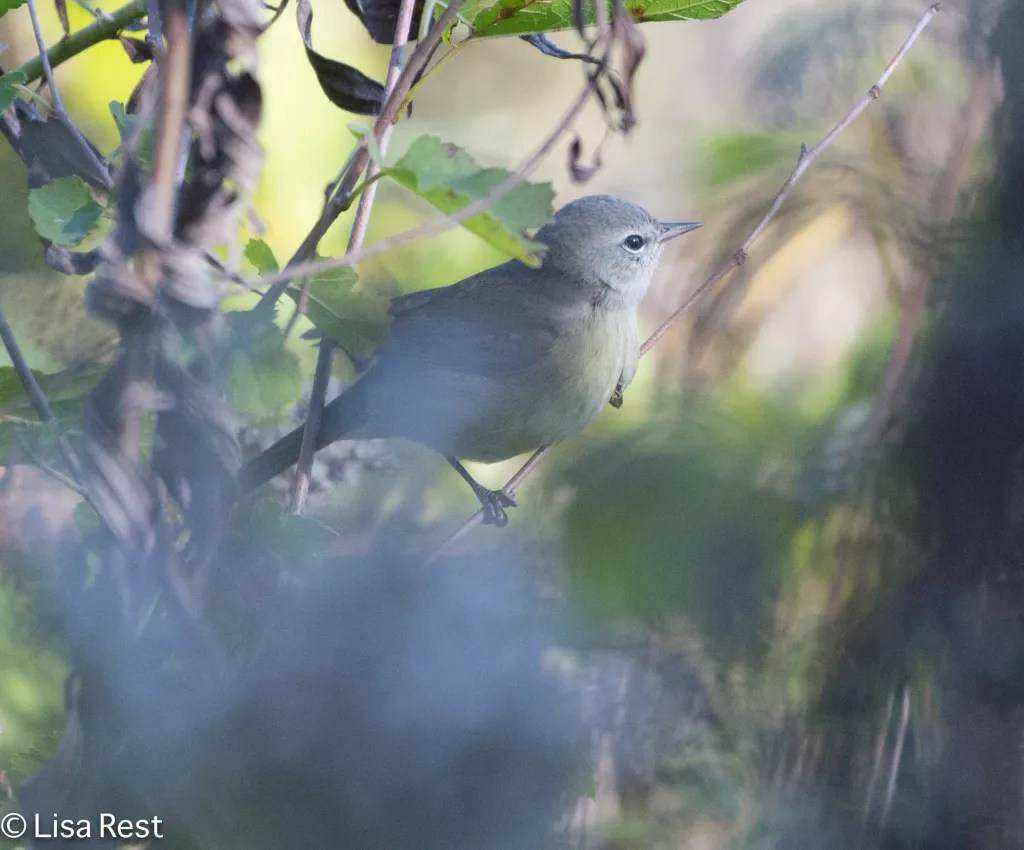
And the one I kept seeing later and later into the season, an Orange-crowned Warbler…
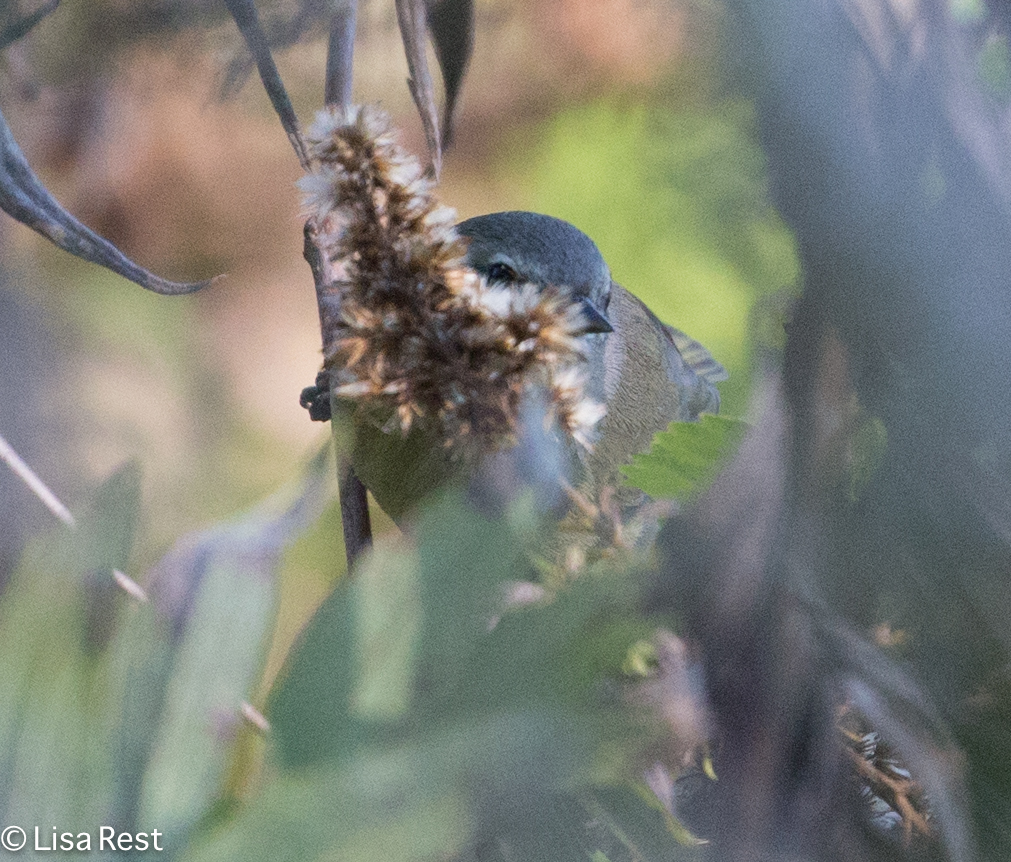
Barely visible but I would know that face anywhere (Orange-crowned Warbler)
Not a lot of sparrows on hand but I managed to capture these two.
White-throated SparrowLincoln’s Sparrow
And the Kinglets – Golden-crowned and Ruby-crowned…
A little Portage scenery
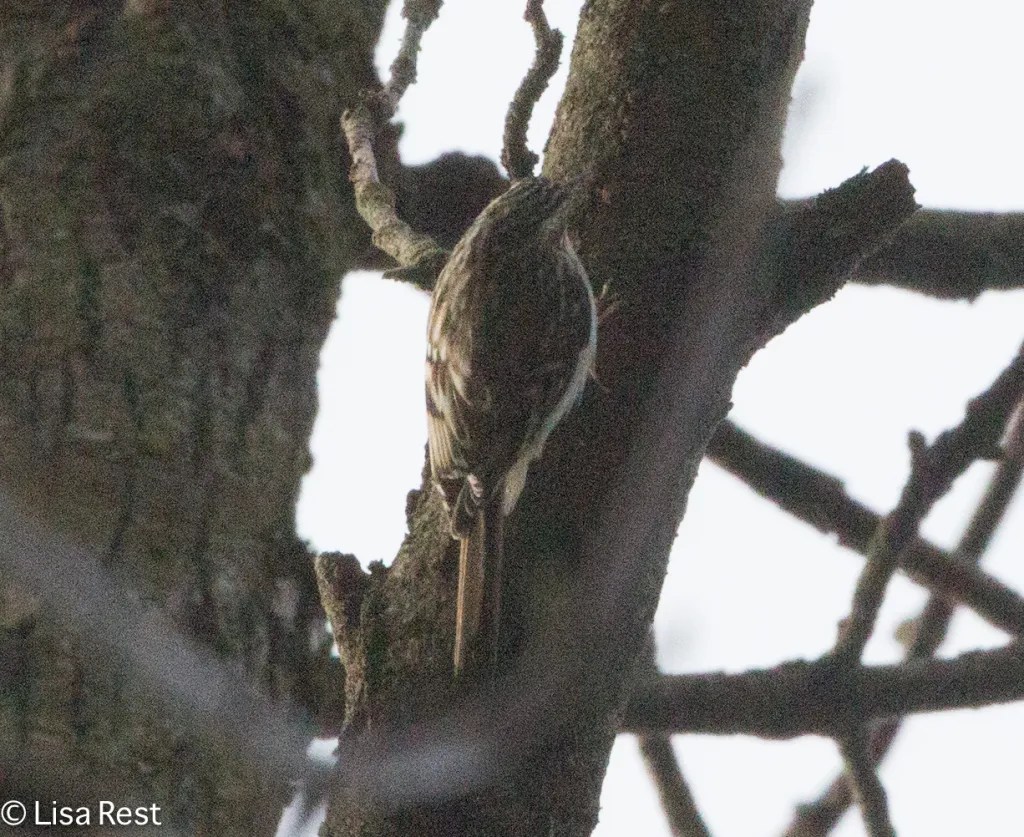
It’s been wonderful to see Brown Creepers on so many occasions.
Always glad to see a Black-capped Chickadee who seems to return the sentiment.
This could have been the only Great Blue Heron I saw here for months since the drought caused the water level to drop so drastically.
Not a wonderful place for a Hermit Thrush to pose but I was glad to see it.
It wasn’t quite woodpecker “season” yet but I managed to see this female Downy Woodpecker.
There are lots more historical visits to make sense of – indeed a flurry of fall warblers that I was so busy taking pictures of I barely have barely had time to go through them, so they may periodically provide a little visual warmup during the cold.
I am mourning the death of my beloved singer/songwriter/implacable musician Zebra Finch male to whom I gave the name of Arturo Toscanini. He died Thursday morning. I found him on his back, on the floor of the dining room by the windows. He was still warm when I picked him up. He had been singing a lot lately, and I think perhaps he had been telling me his time was coming because I found myself thinking about how old he had to be, even though he had no signs of aging or impairment, other than it seemed his little goatee was getting whiter and whiter. The blessing in all of this is that I have one of his offspring who is singing an abbreviated version of his Arpeggio Song and an even shorter memory of his TaTaTaTaTAH Song. Also, other birds have taken up the actual Toscanini Song that he used to sing a long time ago. And there are many more songs among them to catalogue and follow. At some point I hope to go through the years of recordings (I determined I must have gotten Arturo sometime in late 2014) to see if I can put together a timeline of his compositions. In the meantime, I am incredibly thankful for all the avian musicians I still have with me. Singing is their raison d’etre, and music is life.
Last week, I finally discovered the other side of the Joliet Avenue bridge in Riverside which everybody else, even my non-birder friends, has likely known about. By running a little later than I had planned, I magically encountered two very nice women that morning who offered some interesting history about the river communities. These photographs are from the 10th and the 16th, and I probably should have done two separate posts, again I have too many photographs.
Except for this past Tuesday. I have been trying to settle into somewhat of a Wednesday routine, going for a walk along the Des Plaines River, then on to the health club for a midday swim so I am free for choir rehearsal in the evening. The pool tends to be less crowded in the evenings, and I am accustomed to going at that time. I also like to see the night sky after I swim. But I digress. Below is a distant picture of the footbridge I had heard about that crosses the Des Plaines.
Instead of the lawn at Indian Gardens, on this side there is a paved path that follows the river from the other side of the bridge near where I park in Lyons. It goes all the way into the Village of Riverside where the library, town hall and police and fire station are all located. The bridge is just past the police and fire station. I encountered my first guide on this walk. She told me she grew up in the area and had moved away but was back to help with her parents. She said the paved path was new, had been installed perhaps only for a year. Among all her other comments, I remember her saying there was a Bald Eagle family on the river last year. I certainly hope to see some Bald Eagles here this winter.
Across from the river side of the path is a large floodplain area that sits well below street level where there are houses. There are steps leading down into it, which the first woman told me was left over from a historical toboggan slide, There’s a similar sort of structure at Swallow Cliffs in the Palos region. Tobogganing must have been popular in Cook County.
The Riverside Water Tower bears further investigation.
There were two Great Blue Herons on the river.
Some more views of the river, leaves and trees…
Struggling to get a picture of at least one Dark-eyed Junco, I took the one below. I hear them more often than I see them lately.
Here’s a House Sparrow near the paved path who caught my attention.
This were Red-bellied Woodpeckers both days. Below is the one on the 10th.
American Goldfinches are still making the best of seed remnants. They are blending in well.
The foot bridge across the river.
On the other side of the footbridge is a paved road that leads to more development, most of which has since been removed. I met a woman who was driving to her physical therapy appointment – she had stopped for me to finish taking the photograph below. She pointed out several overgrown lots where houses had been. The unincorporated area floods, being too low and so close to the river. If I remember what she said correctly, the government bought out the homeowners to return the area to its natural state as a flood plain. She said wildlife had come back in full force and she was thrilled to tell me she had heard two owls calling to each other the night before.
Whie-breasted Nuthatch with … a nut
On my second visit to this area after I crossed the bridge on the 16th and started on the trail along the river, I found a Brown Creeper and a White-breasted Nuthatch.
Brown CreeperWhite-breasted Nuthatch
I think this was the last time I saw a Creeper.
From the bridge, views of Canada Geese on the river.
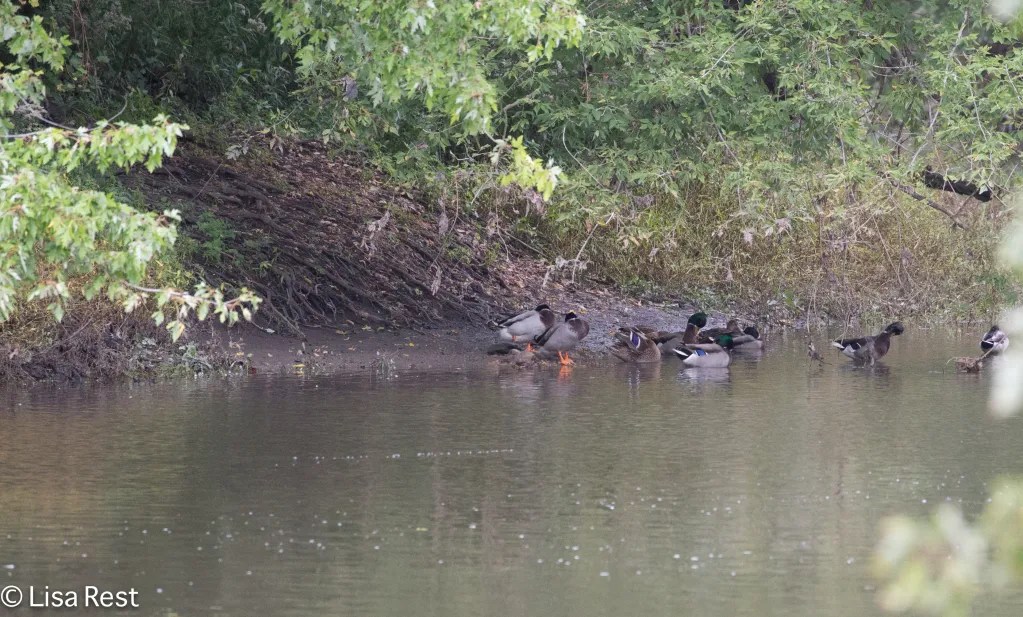
There were some Mallards on the river as well, but generally far away. I managed to capture these few that were closer to shore. I hope to see some other ducks soon.
After the flocks of American Robins a couple weeks ago, now it’s hard to find even one Robin. Sometimes I only hear one or two.
On the other hand, Northern Cardinals are more visible.
The unpaved path leading back to Joliet Avenue on the other side of the river.
This busy Red-bellied Woodpecker was in the same area of the reclaimed wild space as the Brown Creeper and White-bellied Nuthatch above.
Some more views of the returned-to-wild areas on either side of the river. I will get better at identifying them as I visit more often.
It’s been so dry, it’s hard to imagine what this area will look like when it floods, but I am sure I will find out eventually.
My start and finish point, the Hofmann Tower in Lyons.
Thanks for hanging in here with me. It’s been challenging to put this mess together in any sort of logical progression. But I did want to make a strong case for this place because I will be visiting it often. I have found my second birding home.
It’s been almost 3 months, which seems hard to believe, but this is a more historical account from McGinnis Slough for birds seen on September 19th, when the slough looked more like a marsh at best. Yet there was more bird activity and a couple less common sightings.
It started off inauspiciously with a European Starling.
But at some point I found a Northern Waterthrush, which is a warbler species I haven’t seen in a long time. They aren’t particularly rare but they don’t travel around in warbler flocks and are often close to water and the ground.
One of my first White-throated Sparrows of the season was in the grass.
Perhaps the bird of the day as far as offering itself up for photographs was Palm Warbler.
Among the land birds was this Swainson’s Thrush.
The Double-Crested Cormorant below gave me several expressions of its flight pattern.
More views of the faded-looking Spicebush Swallowtail butterfly at the top of the post.
I never know exactly where I can expect to see a Great Blue Heron here but I practically always do.
More flying birds to capture – a Great Egret and, of all things, a Blue Jay or two, which don’t normally make themselves so available.
Two warblers – a Nashville and then below, a female Common Yellowthroat.
I saw Gray Catbirds at this location more than once.
The light played interesting tricks on these two Wood Ducks flying through the marsh.
The rose mallow flowers seemed late and sparse but they prevailed.
A Yellow-rumped Warbler blending in below.
More flying birds. Cedar Waxwings directly below, and below them, the inevitable Canada Geese.
A couple views of the parched-looking slough.
And a closer-cropped view of the Great Egret seen in the flight sequence above, after it landed.
I have been seeing some amazing birds all week which has kept me more than busy. Even though migration has slowed down, there are still birds to be seen. I will be back as soon as possible with more recent sightings.
These photos are from two visits to the Riverside trail on October 20 and 27 – both after periods of some significant rain. Although the Des Plaines is nowhere near flood stage, it is good to see it looking more like a river.
Activity around the Hofmann Tower on 10-20 consisted of two flock bursts – the expected Rock Pigeons and also a flock of Blackbirds, mostly Red-Winged.
The bridge
A view from the bridge
I saw an Orange-crowned Warbler on both occasions.
Below is a Nashville Warbler I saw on the 20th.
It was hard to get a good photo of this Double-Crested Cormorant through the trees but still nice to see on the 20th. I saw one flying a week later and wonder if it was the same bird…
It’s somewhat easier to get Northern Cardinals to sit still for a photo this time of year. As long as they feel somewhat shielded by a twig…
I saw Brown Creepers on both occasions, and was lucky to photograph this one on the 27th.
A Mallard here and there…
European Starlings are in groups, as usual.
One of those Red-winged Blackbirds still hanging around.
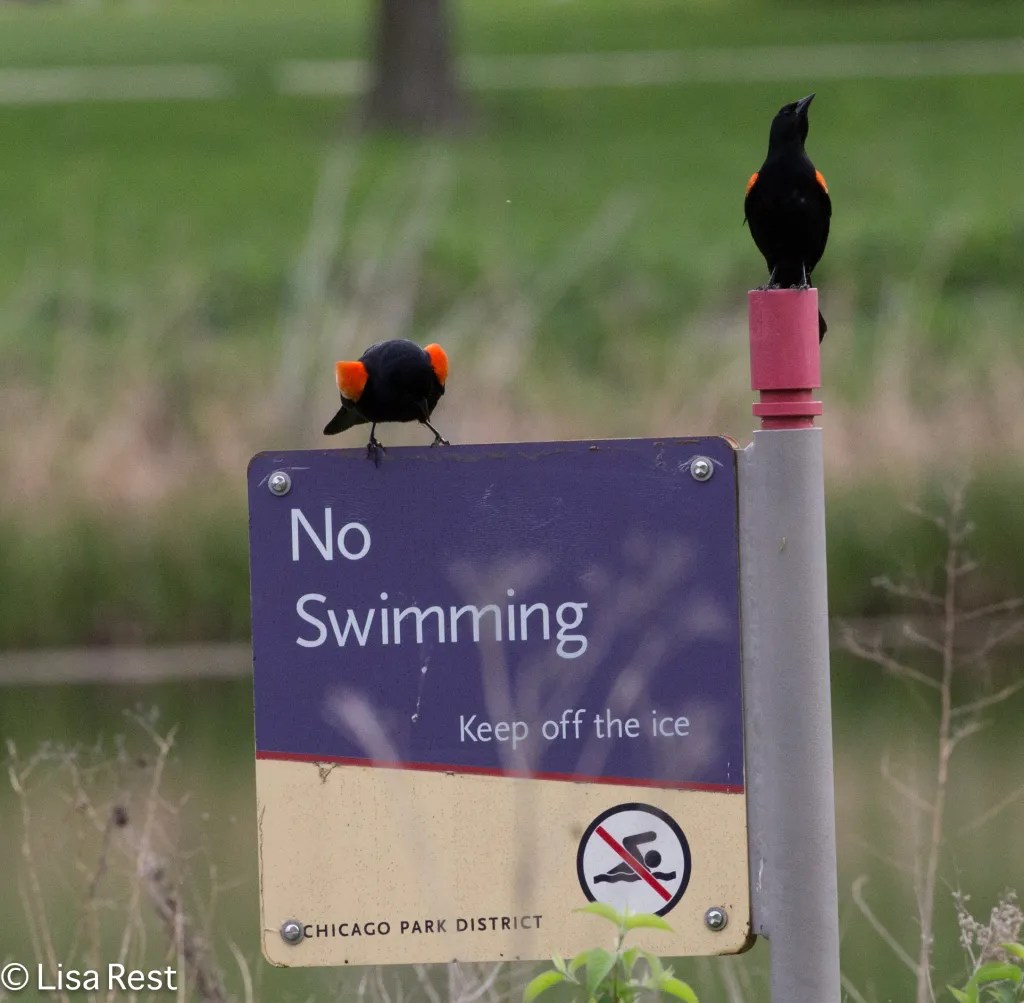
Below on the left is the sign posted at either end of the trail in Riverside that runs along the river. On the right is a sign opposite the western end of said trail, which denotes the Plank Road Meadow which features a boat launch.
House Finches are more visible now.
A tree full of Mourning Doves…
I expect to see more White-Throated Sparrows, but managed to capture only the one below.
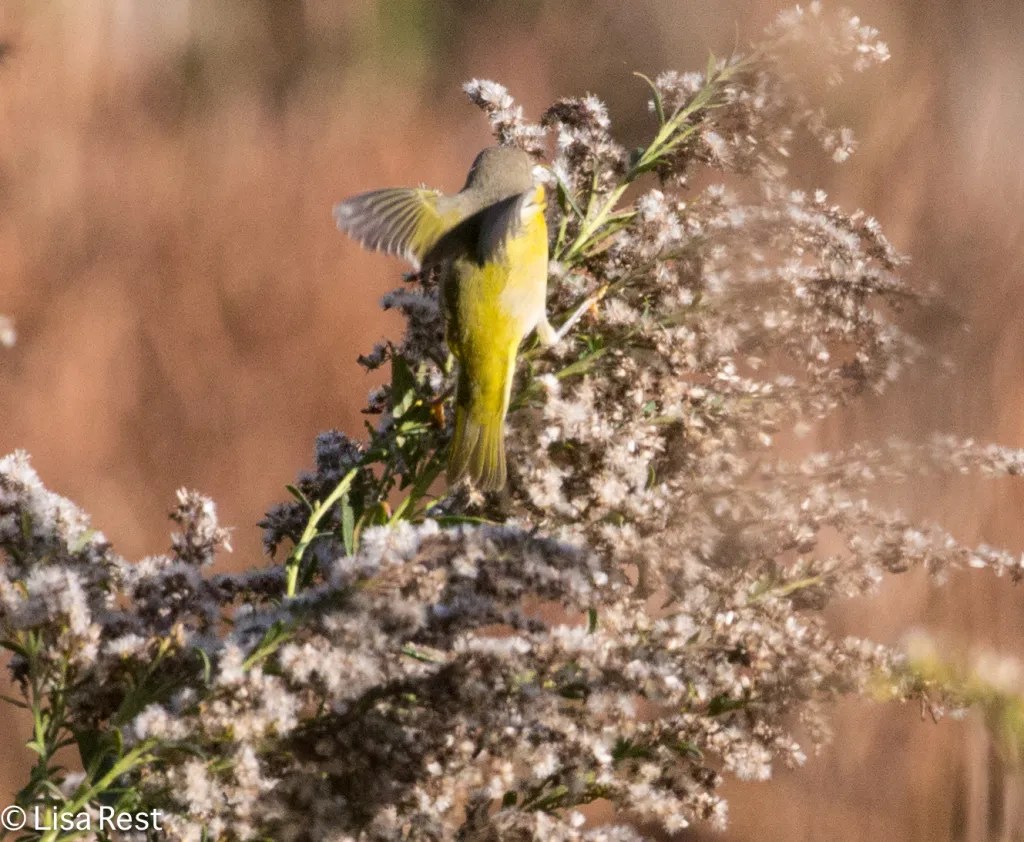
I was going to simply add the photo directly below and call it a Tennessee Warbler – even though the face looked a little suspect to me. Then this morning when I flipped over the Audubon calendar hanging over the kitchen sink to November, the photograph of the bird on it looked like the one below, only it was identified as a Pine Warbler. So I took out The Warbler Guide to confirm – because now it was showing up as “rare” on my ebird checklist – and went to the bill shape again. That’s what made the face of this bird not look at all like a Tennessee.
Just to elaborate, I rescued the photos below from my external hard drive and found a few more clues to the Pine Warbler identification. There’s ever-so-slightly a hint of wing-bar showing on a couple photographs, but best of all is the one I brightened up a bit, where the bird is looking directly at me. That’s a Pine Warbler face if I ever saw one. I have to be more careful going through all these photos!
Below is a lovely little Song Sparrow.
The remaining Great Blue Heron is not as visible now from the bridge.
Catalpa tree seed pods on the left, and well-eaten Pokeweed on the right.
An American Robin for good measure…
Not sure whose web this is but I found it interesting.
I saw the Red-tailed Hawk flying below before it landed in the tree.
A few more scenes of this location as the late fall progresses.
We are flirting with overnight freezing temperatures. Indeed, this morning I had to scrape the frost off the windows of the car before I went for a walk at the Portage. Today I will be draining as much water as I can store into empty vinegar gallon bottles, to be used in the now-heated birdbaths all winter.
And as the days get shorter and I see fewer birds… take fewer photographs… maybe I can start revisiting the reason why I started this blog in the first place: my fascination with bird song and the birds’ reactions to music. For the moment, I would like to share with you a funny incident I happened to record way back on August 29th. I was playing piano – I have been revisiting Schumann’s “Kinderszenen” – and perhaps that day it had become a bit of drudgery – I was likely distracted by the fact that my effective retirement date was 2 days off. In any event, I struck a wrong chord while playing the 9th piece of it (“Ritter vom Steckenpferd”) and my indoor crowd IMMEDIATELY let me know that was not acceptable. Which not only proves they were right, but also that they are always listening! Below is the clip. Enjoy. 🙂
I went to the Riverside trail on October 15. It was extremely cloudy and I had no idea what I could muster photographically under such conditions. I walked as far as I was going to go in one direction along the river and then turned back, and found a very green-looking warbler foraging low in front of me. When I got home to review my photographs, I could not for the life of me figure out what it was. I could only surmise what it wasn’t. The pale-looking eyebrow, the darker green primaries didn’t fit the Orange-crowned Warblers I was used to seeing.
After a good night’s sleep it occurred to me that perhaps the way to approach the bird’s identity was to look closely at the bill shape and size. Color and feather arrangement might seem changeable in a photograph but the bill shape would be constant. And that led me to thinking this was a Mourning Warbler.
As it turned out, when I opened my copy of The Warbler Guide, I found one small photograph that exactly matched my bird. She is a first-year female Mourning Warbler. I was excited as it has been years since I’ve seen a Mourning Warbler altogether. I added some of my photos to my ebird report and made the email-generated Cook County Rare Bird Alert (“RBA”) – I guess she’s a little late making her way south.
A distant Northern Flicker accented the cloudy background.
I have really become familiar with Orange-crowned Warblers this fall. And while I’m looking at bill size and shape, this species has a distinctly small, sharply-pointed bill. Some photos of an Orange-crowned Warbler are below.
For comparison, below are some more photographs of the Mourning Warbler.
Fall is a good time for woodpeckers.
Red-bellied WoodpeckerOrange-crowned Warbler
Fall is also a good time for squirrels and nuts…
A cloudy sky.
I have really enjoyed seeing Great Blue Herons here.
And Great Egrets were present too.
Only Mallards are showing up in the waterfowl department.
There are always some Northern Cardinals but this was not a good day to capture one.
The other bird that made the RBA was the Gray-cheeked Thrush below.
Golden-crowned Kinglets have been fun to follow the past couple weeks.
A fall tangle of leaves.
The river looks a little fuller than it did. I envision being unable to do this trail when we start getting a lot of rain…
Here are a few more photographs of the Orange-crowned Warbler who was my best model.
Below is a female House Finch.
I thought the Great Blue Heron against the clouds was worth capturing.
One more of a Northern Flicker…
I have been back to the Riverside trail twice since this cloudy day. We are finally starting to cool off. This morning the Great Egrets were all gone. To be continued… but now, I need to get ready for choir rehearsal.
There’s a huge park in Berwyn — it takes up several blocks! — that I always thought was much farther away than it actually is. I have not been walking as much as I used to the past five years, and definitely feel the need to get out and walk without having to drive somewhere first. So I walked over to Proksa Park a couple times last month and found a few birds to photograph. The round trip is about three-and-a-half miles which only half a mile less than the total mileage I used to walk every day when I worked closer to the lakefront.
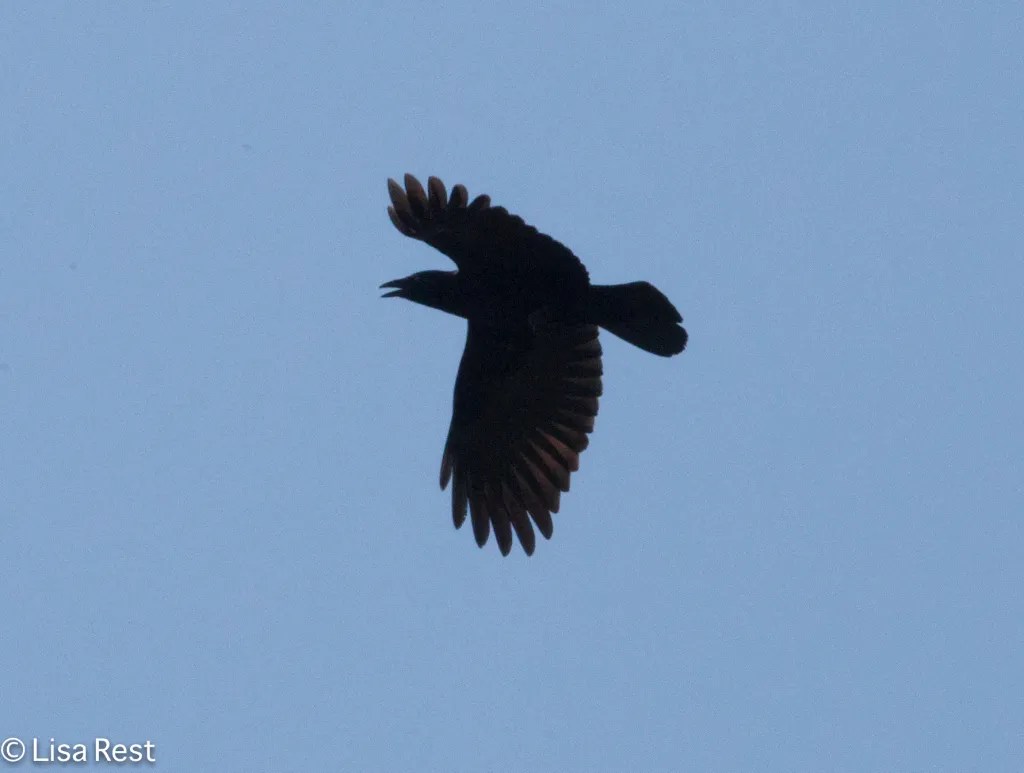
I was happy to see a crow flying over on my first visit. I keep hoping to see more crows at home.
There are a lot of native plants and you can always count on American Goldfinches to take advantage of them.
The park has some nice water features that attract Mallards.
And the occasional heron, like this Great Blue Heron in the distance on my first visit.
Spacious, paved paths for walking and running…
I saw a few Magnolia Warblers here as I did almost everywhere last month.
And an American Redstart or two.
Below is a Blackpoll Warbler.
I almost forgot this lovely Gray-Cheeked Thrush. I have corrected the identification thanks to Vera’s comment – I thought it was a Gray-Cheeked to begin with but it was late and I was tired (or that’s my excuse for now). The heavy spotting gives it away and I don’t think the eye-ring is Swainsony enough.
This is a very pleasant destination and I will be visiting off and on throughout the year when I feel like getting out for a good walk.
One more of a Magnolia Warbler.
We just had a downpour, with more rain to come. This is very welcome indeed since I have been removing plants and planting new ones around the yard and the house. We are long overdue for a good soaking. I’ll have to check the river later in the week and see if it made any difference.