The days are getting longer, but a lack of sunshine is a reminder that winter is not over yet. Birds have begun singing and setting up territories in what can be attributed to a purely hormonal response to the longer days. My juvenile crow friends aren’t mature enough to have those kinds of longings, but I imagine they share the same sense of promise and preparation, as our part of the planet begins to wake up from a long sleep.
Instead of complaining about the lack of color diminished sunlight affords, I decided to embrace it and see what the world looks like without color.
The crows willingly lent themselves to my experiment…
and instead of finding their images lacking, to some extent, less was more.
For instance, I can appreciate the arrangement of this crow’s feather tracts more clearly than with the distraction of color.
I wonder why this crow’s posture looks more serious to me…
and this crow’s intelligence demands my wonder and awe.
What can I say? The Grant Park juvenile crows are glad to have me back in town.
The Ring-Billed Gulls are beginning to assemble and they are the crows’ biggest competitors.
I used to feed gulls until the crows got curious enough to reason with me. When I switched to crows it involved a lot of hard thinking to keep the gulls at bay. The crows finally suggested I put hot dogs under the trees, because the gulls prefer wide open spaces. You can see why the crows like me; I’m trainable.
But the gulls are savvy city birds as well and can be seen careening through the glass and steel canyons of the Loop. Some of them aren’t cowed by a few stands of trees in a park, and it only takes one gull to start a riot.
It’s going to be an interesting summer for the juves who are still trying to figure out squirrels.
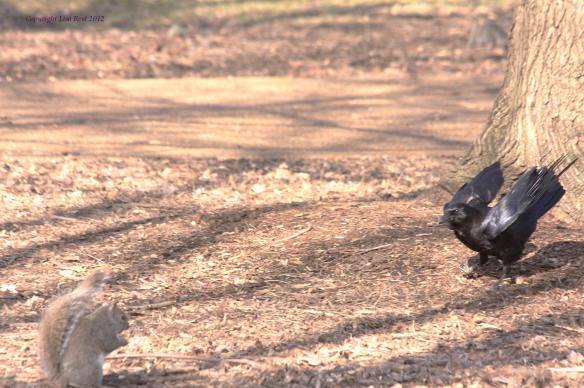
This squirrel isn’t reacting at all to White Wing’s threatening stance.
I finally made it through all the pictures from New Mexico last weekend and most of them are on my flickr page (here or link below).
Abert's Squirrel, Tres Pistolas
They weren’t all birds. We encountered this fascinating Abert’s Squirrel. Check out those ears!
Townsend's Solitaire
The last day I got lucky with this Townsend’s Solitaire sitting up. I didn’t notice the altitude on the trip until I became very aware that I was holding my breath whenever I took pictures, to steady the lens. I think I probably do this at sea level too, but not gasping for breath!
Black Rosy-Finch
A main focus of our trip was two visits to Sandia Peak, where all three subspecies of Rosy-Finches occur in the winter. Our incredible guide, Raymond Van Buskirk, has been banding these birds for seven years, to study the effects of climate change on the species.
Black Rosy-Finch
Here he’s showing off the beautiful color of a bird’s wing feathers.
Brown-Capped Rosy-Finch
There were several Brown Rosy-Finches too, but we only caught a glimpse of a Gray-Capped Rosy-Finch, the third subspecies… thus, no picture this time.
I can never really say goodbye to New Mexico. I’ll be back.
While going through the pictures I found a few songsters, so in keeping with the spirit of this blog, I’m including them here.
Cactus Wren
This Cactus Wren is a beautiful bird, a large-sized wren with striping/bands on its tail that are not visible in this picture, unfortunately.
I’m almost sorry I didn’t take my digital recorder with me to record these birds while they were singing for us, but most of them were called in by MP3 players, which is probably why they sat around long enough for me to take these photographs, as they were making sure we intruders knew it was their territory. There were times when the MP3 players fooled us too.
Juniper Titmouse
It took us a while to find a Juniper Titmouse but we got lucky with this one.
Rufous-Crowned Sparrow
This Rufous-Crowned Sparrow posed for a lot of stunning profile shots which showed off his extraordinary white eye-ring, but for singing, he faced us straight-on.
And last, for now, our friend the Cryssal-Thrasher, who put in his two cents.
I have been to New Mexico several times in my life but never as a birdwatcher. I was thrilled to see the Scrub Jays, which look and sound ever-so-different from the ones I was used to in California’s East Bay area.
Western Scrub Jay
I was fortunate to join the Evanston North Shore Bird Club trip to New Mexico last week for three and a half days in one of my favorite places on earth.
Cryssal Thrasher
The birds were quite cooperative once we found them, like this Cryssal Thrasher sitting up.
There’s much more to write and I have many, many more photos to go through but I will need a few more days to do so. Before I go, a few more photos. Here’s a beautiful Green-Tailed Towhee.
Green-Tailed Towhee
And a Canyon Towhee…
Canyon Towhee
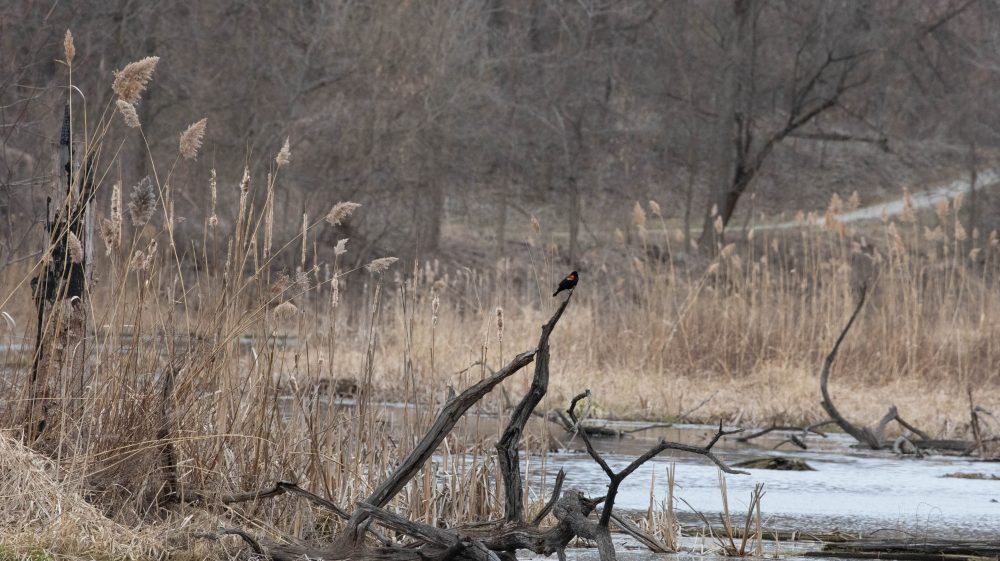
Goodnight for now. I leave you with this winter scene.
I’m out of town so I won’t be visiting the lakefront this week, but I have a few images from last week to share. In the back yard for starters…
Male Northern Cardinal
The male cardinal who visits frequently finally allowed me to take a picture of him through the porch window.
Dark-eyed Junco
And this Junco was in his element; we had just a little snow last week.
On Friday it was bitter cold and bright on the lakefront. These characters always tag along as I walk north looking for water fowl, and then they fly in front of me, frustrating me because I’m too late to capture them as I struggle to carry their treats and the camera. This time, I threw peanuts behind me and turned around in time, freezing them in a couple frames before I froze my fingers.
Lakefront crows
The water was like glass shimmering in the sunshine.
Common Merganser and Canada Goose
Waiting patiently on the dock for my next move, this Crow sits…
Dock Crow
Sunday I went to the Morton Arboretum with a friend to find birds, and got pictures of this white-morph Red-Tailed Hawk in flight.
Red-Tailed Hawk
The previous Sunday I went on an organized owl field trip with the DuPage Birding Club. I was fortunate enough to ride with three friends who graciously shared their expertise. They found five species of owls that day, but either the conditions were not conducive to taking photographs, or I hated to bother the birds when they should be sleeping. Mostly I was in awe of the owls when I could see them, as I feel like a voyeur in their presence. But come sundown, this Great Horned Owl had the last word.
Thursday, February 2nd, was my designated lakefront morning because the forecast was for sunshine. The sun did eventually show up, but not in time for the local groundhog, who did not see his shadow and therefore predicted an early spring for Illinois. Conversely, the official national groundhog, Punxsutawney Phil, saw his shadow and predicted six more weeks of winter. If it’s six more weeks of what has passed for winter around here, it may as well be spring.
Down at the lakefront, ’twas all foggy and clouded over. Last week’s ice was all but gone. There was just enough for the gulls to walk on.
Gulls on the ice...
The crow could not find his shadow.
The geese could not see their shadows either, but they saw their reflections.
a patch of ice just big enough for two...
The mallard didn’t see her shadow.
Here she is sans reflection or shadow.
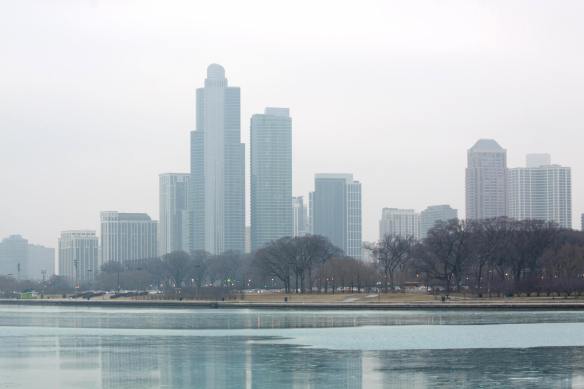
The skyline barely broke through the fog.
Let’s check back and see what winter looks like six weeks from now.
In the meantime, today was another cloudy day. I managed to get a picture of the local Cooper’s Hawk backlit against the grey sky.
This on-again, off-again winter, hurried down to the lakefront to see the ice before it melts away.
Birds gather farther away from the shoreline in the open water. I could make out the Canada Geese, Common Mergansers and Herring Gulls but missed the reported Scaup and Snowy Owl Friday morning.
The ice cover has a moonscape look to it.
The fissures create unusual patterns as the water laps up in between the seams, from smooth to jagged like broken glass.
A crow on the lakefront.
And White-Wing absconding with her hot dog reward.
Yesterday I visited Brookfield Zoo. There’s a little lake at the edges of the zoo grounds by the Salt Creek, where a portion of the water is kept open.
A Hooded Merganser.
The female Hooded Merganser. Female Mergansers in general always look like they were just at the hairdresser.
A Northern Shoveler barely stood out among the Mallards.
Adding the only musical note to this post, the Trumpeter Swan. And trumpet he did.
A Red-Bellied Woodpecker.
Away from the lake, but outdoors in the cement pond area, the preening American White Pelicans have the last word.
It’s been an interesting week. I went to the lakefront Wednesday morning because it was the only day of guaranteed sunshine, before the snowstorm. It was cold but clear, making for a dramatic sunrise.
The reflection of the sun on the water in the harbor made interesting patterns…
as the ice floes started to settle in.
I startled some Common Mergansers hanging out in the open water.
But did not seem to bother this female fishing close to shore.
By Thursday afternoon when I looked out from the 42nd floor onto the lakefront there was only a rugged sheet of ice (sorry, no picture).
The Snow came on Friday, about 8 inches of it by Saturday morning, making the weekend a winter wonderland. This male cardinal caught me taking pictures of him through the porch window yesterday.
Male Northern Cardinal
I had all the feeders out and the yard was a very popular place. I counted 30 House Finches. Unfortunately by the time I went out in the yard everyone left, except for this sleeping female House Sparrow on the wire.
sleeping Female House Sparrow
Today there was no sunlight so I stayed indoors, eventually focusing on this Mourning Dove.
Mourning Dove on the feeder pole
The female cardinal was in the yard today. I finally managed to capture her here.
Female Northern Cardinal
And now for your listening pleasure, I’ve gone back in taped time to about nine or ten years ago when I was learning the Mozart K 333 in B-flat Major. First, a little sample of Hidalgo the Spice Finch coming in exactly in time with the music, not exactly on his first try but very quickly on his second, as he knows what’s coming (toward the end of a few bars in the first movement).
And then if you’re game for a longer recording, I was practicing the Adagio, which starts off with a lot of zebra finch calls, then Fabrizio, the granddaddy, who is barely singing these days, so it’s nice to hear him when he was young and feisty. He is joined briefly by his first hatched male offspring, Facondo, whose name means something like “squeaky” in Italian, if I can believe the translation I got trying to make up the word-name. At the time I didn’t realize these guys were actually singing complex songs. If you can stand to listen to the entire fumbled adagio with the repeats you’ll also hear some bright spice finch whistles, a little spice finch singing, and toward the end some trills from the male budgie of record (I can’t say for sure if Zeke had come on board yet but I think this might be him); he’s very trilly indeed. And the whole thing ends with one “mwa mwa” from Hidalgo. It was a very lively session, when at the time I had only a few birds. I played piano a lot earlier in those days, too. Now I don’t get around to practicing on the weekends until noon; by then half the birds are napping.