Easter Sunday Birding

This morning was beautifully sunny and clear, although a brisk north wind kept things rather chilly most of the morning. I started out kind of late, around 9:00 a.m., and went to the Chicago Portage to see if anything had changed.

Tree Swallow

There were more Tree Swallows than a couple weeks ago, perhaps a dozen or so. But there were no new birds. I had hoped to see at least a Yellow-Rumped Warbler, and maybe a few different sparrows. Maybe the wind was blowing from the wrong direction to bring in new migrants. I managed to get a few nice photos of the current residents anyway.

A couple Canada Geese got into a disagreement which caused the water to fly.

A Northern Cardinal was singing to the right of the path.

I heard Song Sparrows singing and finally found one.

And of course there were a lot of robins.

Around midday it was much warmer but the wind picked up. I went to McGinnis Slough to see some different birds. There were several species shared between the two locations such as Red-Winged Blackbirds, Black-Capped Chickadees, American Robins, Tree Swallows, House Finches and Mallards. Generally McGinnis has more water birds, although for the most part they are hard to photograph because they are usually too far away.

On the other hand, this Red-Winged Blackbird was more cooperative than the ones at the Portage.

I got lucky with this Great Blue Heron, one of seven I saw fishing in various shallows.

Great Blue Heron

There were perhaps 250-275 American Coots. This one was swimming around with something wrapped around its body. Looks like a water plant pulled up from a dive.

There were 20 or more Pied-Billed Grebes but they were too far away to photograph. As it is this Horned Grebe eating a fish it had caught is barely recognizable.

This might be the year I figure out digiscoping. Or not. There will always be birds too far away.

Close Encounters of the Bird Kind

Aside

Crows, Grant Park, 4-13-2011

I started feeding birds so that I could observe them, get to know them, even try to imagine what it is like to be a bird, I suppose. Birds that possess the phenomenon of flight are wondrous for that alone. Their ability to fly symbolizes freedom, just as the horses I loved in my youth accomplished a land-based form of flight, enabled by power and speed.

Entrance to the bird world with food is common, of course. It’s about the only way you can get a bird’s attention long enough to bother with you. Who can blame birds for not being too curious about us? If anything, we have been creatures to fear. So when I have been feeding birds long enough that they come to trust me, I feel blessed that I am welcome to cross the barrier temporarily that must remain between us, however fleeting the moment. There is nothing more remarkable to me than the velvet sound of a crow’s wings passing close over my head.

Or the direct eye contact with a Robin who stands his ground as I acknowledge his presence.

As I was writing part of this, my zebra finch Pietro landed on my head to check out my hair. Was he only looking for nesting material, or does he sometimes entertain the thought of preening me?

I was wandering about the park on my lunch hour last week, looking for migrants even though it’s too early to expect them, almost having to remind myself to take photographs anyway, even if they were of the same birds I’ve been seeing all year. As I walked up the hill on my way back to work, a woman stopped to ask me if I was a birdwatcher or a photographer and I said a bit of both. That one sort of drives the other. We had a short conversation about my engagement and her lack thereof, I suppose, as I had inadvertently distracted her from her tennis game with my pursuit of birds. I apologized, only to have her thank me. Perhaps tennis was not her calling that day, but she was definitely aware following birds around was mine.

It doesn’t happen too often, but I have affected people before. Years ago when I used to feed the pigeons that followed me around like a train, it was when I was sitting hanging out with them as they clambered over each other to get at the bird seed or landed on my hand or my head (I never, ever got pooped on!) – from time to time a student from the Art Institute would come to draw me or take a picture. Pigeons were my easy entry into the bird world; they have accompanied human settlement for millennia. But they also taught me how to read expression that went beyond that pale orange eye. And I learned to recognize some of them by their distinctive coloring or behavior.

I have to say most of the people I work with who know I am interested in birds usually come to tell me about birds they have seen, and in this I feel as if I have made a contribution. If I have managed to get one more person to pay attention to something in nature that they otherwise would not have bothered, then I have done my job. This week, however, a superior ran into me leaving one afternoon in my usual garb: Chicago Audubon baseball cap, binoculars around my neck, camera slung on my shoulder. She said, “I suppose it’s a nice hobby.” I am sure she was trying to be nice or more like trying to find a way to deal with my get-up, but I took silent offense to the word “hobby” and her lack of curiosity. My obsession with birds, if you will, is more a way of life than a “hobby.” Being in nature is not a hobby. A hobby connotes something someone has taken up because they decide to do it, not necessarily because it picks them. Here’s the dictionary definition: “an activity or interest pursued for pleasure or relaxation and not as a main occupation.”

It’s true, I am not “paid” to pay attention to birds but I think of it as more of a main occupation than my paying job, so I guess it’s a matter of interpretation.

With birds, it has been more of a calling. At the start of my association with the avians, when the birds came to hear the music, they chose me to tell a part of their story no one else had told before. If it meant telling people they sang in key with the music, maybe that would let people know that birds had something in common with us. As I attempt to do justice to the birds’ story, I am always in discovery, never knowing where the next sentence is coming from.

White-Wing 4/4/12
Spring arrivals

FOY or FOS? I suppose it all depends on the distinction you want to make. FOY is First of Year, FOS is First of Season.

Yesterday in the park there were four new species of birds, first for my season or my year. Sneaking out of the office two afternoons in a row has paid off.

Yellow-Bellied Sapsucker

A Yellow-Bellied Sapsucker. No wait, I saw one a few days ago. Well, this one was new anyway.

Brown Creeper

A Brown Creeper.

Rusty Blackbird

A Rusty Blackbird. I was looking for these guys. There were about six of them yesterday, but today they were gone so I’m glad I got a chance to visit with them. I took so many pictures of this one he finally started singing, to break the monotony of his photo shoot.

Ruby-Crowned Kinglet

A Ruby-Crowned Kinglet. I saw another today who wouldn’t sit still long enough. Sometimes they’re very cooperative. Rarely do I see the Ruby Crown he’s named for.

Field Sparrow

and today, in addition to a better view of a Field Sparrow than that when I saw my first last week,

Chipping Sparrow

there was a beautiful Chipping Sparrow, as an added bonus. This was a FOY.

Red Admiral

The Red Admirals were big on sunshine today.

Song Sparrow

And although Song Sparrows have been around for weeks, you never know when you’re going to find a particularly handsome one.

More to come when I get a little less bogged down at work!

Chicago Portage, early spring

Chicago Portage

Spring and all things new again, at the Chicago Portage. We’ve had enough rain to add water to the ponds and streams that otherwise appear dead with overgrown algae in the summertime because no water flows directly into them. Creatures manage to make a living off this place anyway.

Painted Turtles

Lots of turtles sunning themselves. Yesterday was beautiful, cooler than it was last week but still quite warm in the sun.

Snapping Turtle

There is one place under the bridge closest to the south side that has moving water draining out of the Portage…

More birds heard than seen but when I arrived the Blue Jays were making a lot of racket, and I figured they’d be predictably hard to see. The butterflies were barely cooperative.

I think these are Cabbage Whites.

 This cardinal was singing.

And down at the north end, a pair of Canada Geese have arrived to choose a nesting spot,

and I guess you could say the same for the Mallards.

Northern Flicker, Yellow-Shafted

There were several Northern Flickers, for the most part flying away, but I managed to catch this one off guard.

And my reward at the end of my walk was a Blue Jay who didn’t seem to mind my presence as long as he could hide behind a twig.

Here he is a little less twiggy but not quite as blue.

A welcome cooldown…

We’ve had some well-needed rain. The cloud cover persisted all day except for a brief peek of sunshine late in the afternoon. No matter. Spring was going on in the yard full blast.

I planted two of these purchased from the Arboretum years ago and I can't remember what they are. I'll have to look them up, along with the weeds that are overtaking the yard already.

Courtship is a popular pastime. In the city, couples abound, holding hands, kissing on park benches. In my yard, this male house finch was trying to convince a female that he’s the right guy,

and she was listening for a while…

but then she was resisting…

and in the end seemed to have her doubts.

A robin grabbed a worm right out of the wet ground and then was not sure what he wanted to do with it.

A dark-eyed junco landed in the hawthorn without batting an eyelash. I’ve had one of those thorns go right through a heavy shoe sole. Juncos seemed a bit incongruous during last week’s string of 80-degree days since we associate juncos with winter around here, but they may not necessarily disappear completely until mid-May.

The flowering crab is already beyond full bloom and starting leaves.

A mourning dove forages on the ground under the feeder.

A lone common grackle hogged the sunflower seed feeder periodically and then checked out a bird bath.

The redbud here…

and there.

My little chickadee.

Even the scotch pine has spring fever.

Last year at this time

it was still seasonably chilly, the trees were bare. Hard to find color anywhere –

except maybe in the lake. It was full of Horned Grebes in their spring finery.

Horned Grebe

Here’s one living up to his name. These pictures were taken on March 28, 2011.

And here we are, barely a year later, and the trees are in full bloom

or leafing out. The grass is green, and we have had no rain.

Very few divers remain in the lake, mostly gulls among the buoys. Are the buoys out earlier this year?

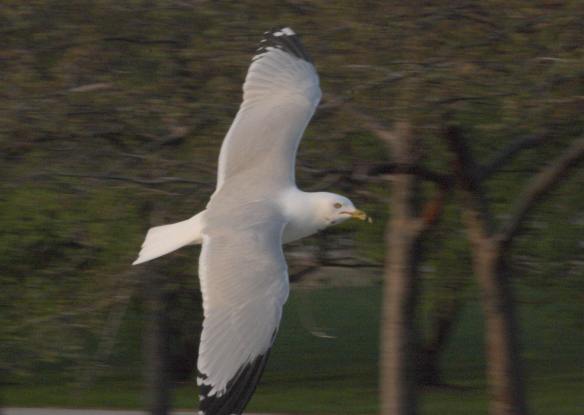
A Ring-Billed Gull this morning, coming in for a landing.

In the parks, there are lots of Common Grackles…

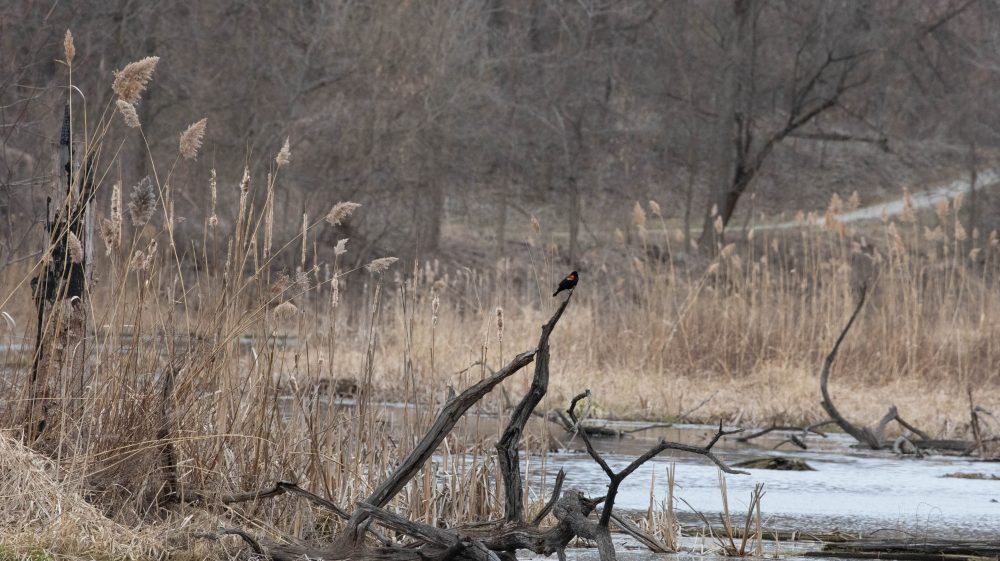
and Red-Winged Blackbirds,

but much of spring migration has not yet caught up with the weather and the flora. We have another month or more to go before we see the warblers.

Magnolia Warbler, Grant Park, May 22, 2011

Cape May Warbler, May 10, 2011

Trust your local groundhog

I’m looking for some way to get my head around the high temperatures we have had for the past 7 days. I’m sure there is a meteorological explanation, but even the weather forecasters seem to be surprised by a heatwave in March that feels more like June or July, so I’m going back to February 2 when the official groundhog, Punxsutawney Phil, predicted six more weeks of winter, but the Illinois groundhog predicted an early spring. We skipped spring, however, and went straight to summer.

Then I wonder if we are seeing what climatologists predicted if the planet continued to warm at its present rate: eight months of summer.

Of course this is Chicago and we could still have snow in April. But it doesn’t look like we’re going to get any more in March.

Downy Woodpecker in my yard - two weeks ago!

At this rate, the City can’t plant bald cypress fast enough.

With all this heat, we could really use some rain. I caught this American Robin refreshing himself in the birdbath this afternoon.

Last week, this crow was panting, even with a whole lake nearby.

About this time of year, the trees would be showing buds, but not bursting. From the looks of it, my flowering crabapple will be flowering tomorrow.

And my redbud is, well, budding.

And whatever this is that planted itself by the side of the house, it’s blooming.

It was nice to open the windows today, at least until it got too hot. I bought the last fan at the hardware store this afternoon. And two pairs of sandals online…


Gull Invasion

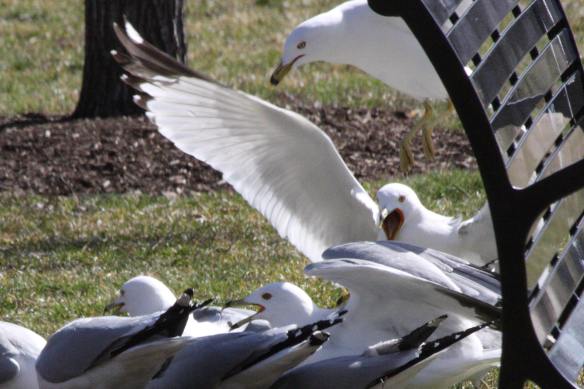
Spring comes to the lakefront in many forms, but none so noisily as the arrival of Ring-Billed Gulls. It’s an opportunity to teach the new crows a life lesson.

The juvenile crows thought they had everything figured out and the parks and the lakefront were theirs for the taking, but now these guys have arrived like gangsters.

This crow can't believe what's happening.

I had even gotten careless with these puny pieces of shelled peanuts: piled up, they were irresistible. The gulls descended upon them in less than a second.

It’s my theory that the gulls time their arrival for the festivals and parades, beginning with St. Patrick’s Day this weekend. The highlight of their visit will be the Taste of Chicago in July.

"How COULD you?"

A few peanuts won’t be missed, but the crows and I will have to be careful, especially when there’s hot dogs. The crows will learn to be silent instead of calling to each other when they see me, and they’ll stop following me around. Instead, they’ll meet stealthily at some predetermined location, their choice or mine: it doesn’t matter, we’ll put our heads together. Because if the crows attract any attention to me whatsoever, they’ll lose their monopoly over me. As it is, I hope the gulls have been distracted over the weekend, because they’ll remember me forever if they start associating me with food. And I gave up starting riots a long time ago.

Let my wings do the talking

White-Wing never speaks. Her peers caw incessantly, but she always arrives in silence and gets her point across with her presence.

So when all the cawing in the world didn’t seem to be pulling me away from trying to find migrants in the park yesterday…

Fox Sparrow foraging in the yews

as I finally turned to walk back toward the crows, White-Wing flew toward me and landed just a few feet away. Her body language conveyed, “don’t worry, I’ll get her attention.”

So why doesn’t she talk?

(a) She’s mute;

(b) She’s low in the hierarchy;

(c) She’s too cool;

(d) None of the above.

One thing’s for sure. She doesn’t mind the one-on-one, in fact, she invites it. But as soon as she’s ready to leave, she tries to beat the camera.

And she wins every time.

Ode to Vincenzo

Vincenzo, one of my male Zebra Finches, died Friday. Or at least that’s when I found him. He had been sick for perhaps a month or more. Confusing the issue was Fabrizio, the original Zebra Finch and if not Vincenzo’s father, his grandfather or even great-grandfather, who is also not feeling well, which I attribute to his age of more than 10 years. Fabrizio has started singing again, however feebly, but Vincenzo had been quiet for such a long time, I had all but forgotten about him.

That is, until I spent three hours in the dentist’s chair Saturday morning. Left with my mind to play Bach’s A Minor English Suite over and over again, I was also frustrated that Fabrizio was still singing and I had a dead Zebra Finch I had not identified. It was only under the clarity of local anesthesia and not being distracted by going anywhere that I suddenly realized the missing bird was indeed Vincenzo. I said “Oh!” and the dentist stopped whatever it was she was doing, asking me if I was in pain. No, not at all, I explained, I had just figured out that Vincenzo was dead.

I’m feeling terrible that I did not have the presence of mind over the last week to tune into his individual absence while he was still struggling to stay alive. One morning a few days ago he was flopping around on the floor, seemingly too weak to fly, and I picked him up and put him in the bottom of the first finch cage, so he could eat if he was so inclined, or if he was going to die, it was a “safe” place. When I came home later that day he was out of the cage. It’s possible he went off to die where I found him Friday night, tucked under the skirt of the futon cover…

Now I know the little ball of feathers I saw sitting tightly wound up into itself the last couple weeks was Vincenzo trying to stay warm. Only a few days ago he was huddled together with Fabrizio, as they took to caring for each other that way.

I managed to find a tape recorded January 14, 2012 with Vincenzo. I was just starting to revive Albeniz’s Tango, and he’s singing with it. Only he hadn’t been singing his entire song lately, just the first part of it. The whole song went, “I’m a Zebra Finch, and my name is Vince, Vincenzo, Cenzo, Zebra Finch.” Here he’s only singing the first part of it, over and over again, “I’m a Zebra Finch, and my name is Vince.” Adolfo is singing very loudly in the beginning of the piece, but the rest of the recording is Vincenzo’s. He is quieter, probably farther away from the microphone. He also solos a little bit after I stop playing.

Now my Zebra Finch population is now down to eight birds. Seven males and one female. The surviving males are Fabrizio, Adolfo, Beniamino, Pietro, Rodolfo, Zorro and Gregorio. They all still join in the dawn chorus, but it’s diminished considerably from the old days.