Introduction to the Galapagos

blue-footed-booby-7-10-2016-5194

Blue-Footed Booby

I never thought going through pictures I took two months ago would be so therapeutic, but it turns out after being away from them and the pressure hanging over my head to get through them when life got too much in the way, it’s feeling pretty good to go back to the Galapagos through these memories. These pictures are all from Day One.

Our first morning we flew from Quito to Guayaquil and then to Baltra Island. While waiting at the dock to be transported to the catamaran sailing vessel where we would spend 9 days visiting as many of the islands as possible, it became apparent that we might be seeing sea lions and marine iguanas virtually everywhere.

My entertainment included watching Brown Noddys following a Brown Pelican (Southern) who was trying to fish.

brown-pelican-7-10-2016-6308The predominant species of crab is the Sally Lightfoot Crab which delights me by its name almost as much as its appearance. The photograph on the right has a Galapagos Striated Heron in it, an endemic also referred to as the “Lava Heron.”

Magnificent Frigatebirds were so abundant I nearly forgot to pay attention to them later in the trip so I’m glad I managed to get some photographs the first day.

magnificent-frigatebird-7-10-2016-5095

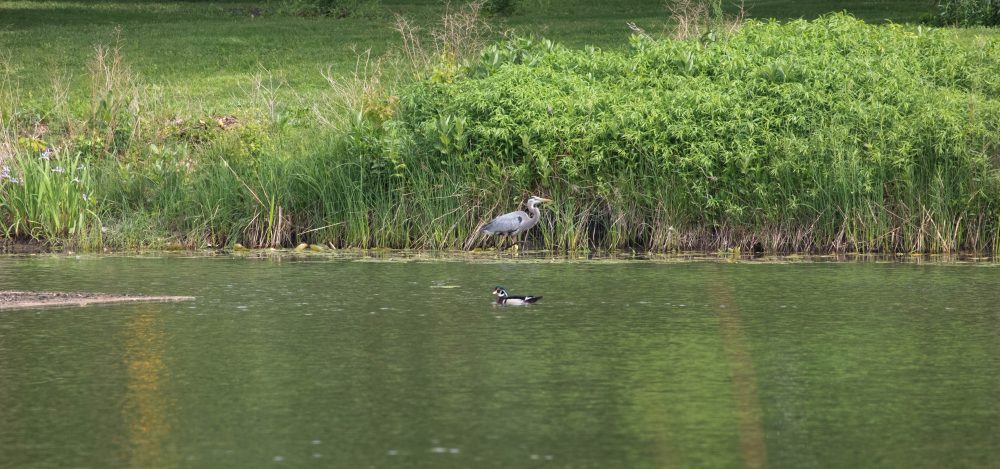
Great Blue Herons were seen on several of the islands.

great-blue-heron-7-10-2016-5201We got on and off the catamaran using a vessel I’m pretty sure was referred to as a “panga” and was designed with seating on the sides so you could throw your gear in the middle of the boat. I seem to have only this picture of the boat from a few days later, but I think the islet pictures must have been taken from it. Below the picture of the panga is a Whimbrel on the shore of an islet.

Panga 7-12-2016-0286.jpg

Also on the same little islet, the first and farthest views I would have of a Galapagos Mockingbird.

Brown Noddies…

Our first island stop on the afternoon of our arrival to the catamaran was at Santa Cruz Island. The catamaran sailed from island to island, set anchor and we were transported to the island in the panga. A word about our itinerary: the islands we would visit and when were determined by the authority of the Galapagos National Park to insure that not too many people were on any island at any one time. Some islands were off-limits altogether, but there was plenty left to see.

black-necked-stilt-7-10-2016-5311

Black-Necked Stilt

The Black-Necked Stilt above and the White-Cheeked Pintails below are not native to the Galapagos but still very nice to see.

The Marine Iguanas were irresistible.

Below, Blue-Footed Boobies in a flight pattern and a view of the beach where we landed to explore.

The Yellow Warbler below is a subspecies found in the Galapagos. This turned out to be a very common bird and easy to photograph.

The two finches below would be seen almost every day, but these were my introductory looks at them.

small-ground-finch-7-10-2016-5140

Small Ground Finch

Darwin’s Finches all evolved with different adaptations to their environment. For whatever reason these finches were named “ground” finches, I must admit that for the most part we did see them on the ground and not in trees or bushes.

medium-ground-finch-7-10-2016-5137

Medium Ground Finch

I have dreamed for years of getting decent looks at American Oystercatchers. They’re not rare or native to the Galapagos but it was such a delight to be able to get close enough to this pair.

Off the stern of the catamaran we often had seabirds following us. Elliott’s Storm-Petrels were the most common. The challenge was to sit and try to capture them as the boat swayed.

Back on board the Nemo III every evening for dinner, our chef prepared great food and a different fruit-and-vegetable sculpture. I may have to do a separate post featuring all of these.

dinner-sculpture-7-10-2016-0171One more look at an oystercatcher…

american-oystercatcher-7-10-2016-5424I’ll be back with so very much more, this trip was amazing. Although I can’t imagine going back and doing it all over again, in a way I wish I could. I guess that’s the reason for taking pictures. This time I’m really reliving an entire experience, not “just” the birds.

Right now I have to go clean up the tree mess in the alley. The Horse Chestnut is dying and losing its leaves early. I hope I won’t have to cut it down.


Double Vision…Deal With It!

wire-tailed-manakin-07-08-2016-5995

Wire-Tailed Manakin

I got so excited thinking about how much better I was going to see after cataract surgery, I completely forgot to ask about the length of time and inconveniences of recovery. My timing could have been better, perhaps, like after fall migration, not during. As it stands right now, my current prescription does not work with my right eye, so in between trying to figure out which eye to read with, I have been working on eye-hand coordination with my left eye behind the camera lens and my right index finger on the shutter button. I keep imagining headaches but I’m too lazy to indulge.

Beyond inconveniences like staring too long at name-tags trying to read them and place them with faces on Saturday night at my 50th high school reunion (well, if I had cataract surgery, you probably already deduced I’m not a spring chicken), I’m finding at least my distance vision is improved and I think I can still see with binoculars. After a visit to the eye doctor this morning, I go back for another checkup in two weeks and then I think I can get another right lens for my glasses which will fit with my new vision and then I will quit complaining about all this. “All the better to see you with, my dear.”

donacobius-07-09-2016-6158

Donacobius – If you saw my post from the Colombian Andes last year this bird might look familiar.

Luckily these pictures were all taken the last day and a half in the Ecuadoran Amazon when both eyes were working about the same. This completes my recap of the Amazon trip.

boardwalk-07-08-2016-0128

The Boardwalk

On the way to the Wire-Tailed Manakin, accessed by walking a boardwalk trail directly adjacent to our rooms at Sacha Lodge, we stopped by Mariposa Lodge, a butterfly house where butterflies are actually raised and shipped to butterfly enclosures all over the world. Below are a few I was able to photograph.

From the canoe, an Osprey and some Large-Billed Terns.

Also from the canoe, this Hoatzin, looking simply fabulous.

hoatzin-07-09-2016-6170

Hoatzin

Here are a few pictures from the boat down the Napo River as we were leaving the lodge. I was saddened by the fact that this once pristine wilderness is now, of course, exploited for oil. There aren’t too many places left on earth that have not been touched by drilling or fracking, I’m afraid. I was encouraged to hear the Amazonian Ecuadorans protesting further drilling at Yasuni National Park and I hope they succeed in stopping it. Ecuadorans have also joined the Standing Rock Sioux in North Dakota to protest the Dakota Access Pipeline and protect the Missouri River. The world is shrinking rapidly and we are all in this mess together.

On our last morning, we saw our last Trogon, the Collared Trogon below on the left, and after trying to find a White-Chinned Jacamar all week we finally did see one, on the right.

Below, an Oriole Blackbird and a Grayish Saltator. And two Blue-Grey Tanagers.

blue-gray-tanagers-07-08-2016-5900

Blue-Grey Tanagers

There were two of the Wire-Tailed Manakins, this is likely just another picture of the same one. They weren’t displaying or dancing but they’re still awfully cute.

wire-tailed-manakin-07-08-2016-5993

I think I just found a new profile picture for Facebook.

hoatzin-07-09-2016-6185

I’ll be back as soon as I can, in between eye drops.

View from the Top: The Metal Towers

Many-Banded Aracari 07-07-2016-5613

Many-Banded Aracari

On the morning of July 7 at Sacha Lodge in the Ecuadoran Amazon, we went up to the “metal towers” which are three towers strung together with canopy walkways in between. I don’t seem to have a picture of the first tower from the ground before we climbed up, but the view at the top was astounding.

Above, there are two Pied Puffbirds on one of the walkways between the towers, what the walkways look like and the platform on top of one of the towers. Below, I got a closer view of one of the Pied Puffbirds.

Pied Puffbird 07-07-2016-5508

Pied Puffbird

The Toucan below wasn’t as close as the Puffbird but large enough to capture, even if he thought he was hiding behind the limb that obstructs his bill.

White-Throated Toucan 07-07-2016-5310

White-Throated Toucan

The Ringed Woodpecker below was one of the first birds I tried to photograph, and although it was quite far away it stayed on that snag, working on a hole in it, for more pictures than I needed. I’m very bad at editing though, especially weeks later…

Below, a Palm Tanager and a Wing-Barred Piprites.

The Lanceolated Monklet was far away too, but too cute to pass up.

Lanceolated Monklet 07-07-2016-5622

Lanceolated Monklet

The Spangled Cotinga is definitely a canopy bird, always perched up high.

In the afternoon we were back in the canoe. There’s a little video from the canoe below to give you the feeling of it. At some point we saw the Gilded Barbet below but I think it might have been up at the tower. I may have to start taking notes while I’m taking pictures.

Gilded Barbet 07-07-2016-5554

Gilded Barbet

Two more classy woodpeckers to add to my list, the Chestnut and Cream-Colored.

Chestnut Woodpecker 07-07-2016-5720

Chestnut Woodpecker

I do remember the Cream-Colored Woodpeckers below were seen from the canoe.

Cream-Colored Woodpeckers 07-07-2016-5733

Cream-Colored Woodpeckers

Below, a short trip in the canoe. Don’t ask me what’s flying around, whether it’s a bird or a butterfly, before we stopped to see what Oscar, our guide at the front of the canoe, was pointing out.

The Duida Woodcreeper has been split from the Lineated Woodcreeper and I think this is it in the picture below.

Possible Duida Woodcreeper 07-07-2016-5585

I think this is a Duida Woodcreeper

From the ground, not the canoe, we saw these adorable Spix’s Night Monkeys peering out from their daytime hole.

Spix's Night Monkeys 07-07-2016-5704

Spix’s Night Monkeys

It was a great day for Aracaris and Toucans. The Ivory-Billed Aracari was up at the tower.

Ivory-Billed Aracari 07-07-2016-5564

Ivory-Billed Aracari

Likely I’ll be back with one more post from the last day and a half in the Amazon and then it’s on to the Galapagos.


Back to the Amazon

Gilded Barbet 7-5-2016-4578

Gilded Barbet

These pictures are from two days at Sacha Lodge in the Ecuadoran Amazon. The first day we spent time at the wooden tower. There were two towers available to us, the wooden and the metal. The wooden tower was the oldest and construction had already begun to replace it while we were there. The climb up the narrow steps all the way to the top was excellent physical therapy. This tower was built around a huge tree, part of which you can see in the pictures below. A canopy view is a mixed blessing sometimes. While you can see birds on the very tippy-tops of trees, they are often too far away to photograph well. So generally the more detailed photographs were taken on the ground either on the way to the tower or on the boardwalks. Below pictures are one of the entire tower from the bottom, and what it was like to be on the top.

I added two new parrot species to my life list that first day we spent at the wooden tower. Below, on the left is a Black-Headed Parrot, Scarlet-Shouldered Parrotlets on the right.

Here’s the only Attila of the trip.

Cinnamon Attila 7-5-2016-4493

Cinnamon Atrila

You never know who’s perched on a branch but in this case it was a lot easier to see the birds below: a Straight-Billed Hermit and a Russet-Backed Oropendola.

Trogons are so amazing. We saw both of these on the same day. I think a Two Trogon Day is exceptional.

Green-Backed Trogon 7-06-2016-5113

Green-Backed Trogon

Black-Throated Trogon 7-06-2016-5231

Black-Throated Trogon

We saw some other creatures too, of course, but the Squirrel Monkey was much more difficult to capture than the snake. Squirrel Monkey and Anaconda. Click on the picture to see the monkey a little better. I think our guide told us the Anaconda was a youngster…

The little bird below is a Slender-Footed Tyrannulet. Whatever possessed them to give it this name is beyond me. Slender-footed as compared to what? But it’s a lovely little bird. And you can see his feet.

I had an opportunity to try to capture the Black-Bellied Cuckoo below both days, first from the tower on the left, and the photo on the right was taken from a closer vantage point.

Below on the left is a Yellow-Tufted Woodpecker, and on the right, a Spot-Winged Antshrike.

It was very exciting to get a good look at a King Vulture, below. Although I think I have seen this bird before, I have never seen it so well.

King Vulture 7-5-2016-4871Tanagers were tough to get photos of on this trip. On the left, Silver-Beaked Tanagers which we saw almost daily, and on the right, a glimpse of a Paradise Tanager from the canopy tower.

You have to work a little bit at finding the bird below.

Speckled Chachalaca 7-5-2016-4961

Speckled Chachalaca

The bird below was not shy, and I am just now noticing how lovely his throat complements the fruit on his chosen plant perch.

Pink-Throated Becard 7-5-2016-4778

Pink-Throated Becard

Blue-Gray Tanagers look different in this part of the world, but they haven’t been split from the other I have been so used to seeing.

Blue-Gray Tanager 7-5-2016-4820

Blue-Gray Tanager

Birds by the water…the Blue-and-White Swallows that hung out around the restaurant by the Napo River and a Striated Heron.

Below is the female counterpart to the bird at the top of my post. She’s lovely too.

Gilded Barbet Female 7-5-2016-4770

Gilded Barbet (female)

I will be back soon with more from this trip! I still have some unidentified captures but none of them were great photos, so I can spare you the agony. 🙂

A Riot of Color

Long-Billed Woodcreeper 7-4-2016-4464

Long-Billed Woodcreeper

I have finally managed to get through all the Sacha Lodge/Amazon photographs, with only a few stragglers left, so as I comb back through them day by day I will try to share the best with you.

Finally settling down into these pictures has buoyed my spirit too, which was broken somewhat by a combination of events. I got sick the last two days of my second trip, which were travel days, basically, off the boat and back to the mainland (I wonder if it was reverse seasickness?), and it took me a week or so after I returned home before I felt like I could eat again. Zapped, everything became more of a chore than usual. And diving back into a cartoonish political sphere didn’t help my mood either. But I think I’m beginning to find some sort of balance again, at least for a while.

Maybe the best medicine was planning to take two short trips next year..something to look forward to.

We visited two clay/salt licks on July 4, where we saw lots of Dusky-Headed Parakeets (above, top) and Cobalt-Winged Parakeets (above, bottom). The Cobalt-Wingeds come to a lick in Yasuni National Park where there is a blind so you can wait for them to gather and witness the pandemonium. Click on the pictures for a better view.

Below, some parrots, which are notoriously difficult to see when in the trees.The Blue-Headed Parrots are in the top of the first picture, but I was lucky enough to get a better shot of two of them below. The Orange-Winged are the two in the lower right and the Mealy has its back to us. I am surprised I managed to get some color off the Chestnut-Fronted Macaws.

Blue-Headed, Orange-Winged and Mealy Parrots 7-4-2016-4160

Blue-Headed, Orange-Winged and Mealy Parrots

Blue-Headed Parrots 7-4-2016-4175

Blue-Headed Parrots

Chestnut-Fronted Macaws 07-04-2016-4457

Chestnut-Fronted Macaws

By the second day I was using the flash attachment… And it wasn’t all psittacines.

Scarlet-Crowned Barbet 7-4-2016-4238

Scarlet-Crowned Barbet

I don’t know if I ever saw the part of the bird below for which it was named, but Woodpeckers have a way of being named for miscellaneous field marks. There’s enough to identify the Spot-Breasted without seeing the spots on its breast.

Spot-Breasted Woodpecker 7-4-2016-3976

Spot-Breasted Woodpecker

A female Hook-Billed Kite on the left and a Gray-Headed Kite on the right, below.

A tarantula on someone’s door back at the lodge later…and a glimpse of an Oriole Blackbird, below.

Let us not forget the black birds. Yellow-Rumped Cacique and Black-Fronted Nunbird…

The picture below was shot from the boat, which is always a challenge for clarity. I begin to wonder how much of the image-stabilization really takes over for me.

Black Caracara 7-4-2016-4036

Black Caracara

Short-Crested Flycatcher and Gray-Breasted Sabrewing…

I think we had eight species of Woodcreeper on this trip and I added three to my life list. but I haven’t begun to figure out that yet.

Black-Banded Woodcreeper 07-04-2016-4197

Black-Banded Woodcreeper

What a wonderful owl, to be awake and visible during the day…There were actually two of them, but the other one was obscured by vegetation.

Crested Owl 7-4-2016-4277

Crested Owl

I’ll be back very soon with more from the tropics and beyond.

A Rainy Introduction

Rain at Sacha 7-3-2016-3902

Gray-Capped Flycatcher

What better way to experience the rainforest than to have a downpour? As I sit here in Chicago cooling off from the outside heat and we have no rain in our immediate forecast, maybe I can channel enough rain thoughts from the Amazon to send the clouds our way.

I am still trying to get caught up with a reality that seems to shape-shift daily, making the photo processing project one of fits and starts at best. But one must find a way to cope.

The first day we stragglers joined the rest of our group was for the latter part of the day, and it must have been rainy for the most part because that is all my pictures seem to reflect. There was a short hike and a boat ride. The only form of transportation to and from the lodge is by canoe.

You can see the clouds building in the photo above. At some point we passed a Cayman in the water.

Cayman 7-3-2016-3781

Coming or going, I’m not sure. But the little video below these pictures is of one of my favorite tropics occurrences – that of a procession of leaf-cutter ants busy at work through a gap in the boardwalk.

Not many bird pictures taken that day, but there were a few, like the very wet Hoatzin below.

Wet Hoatzin 7-3-2016-3879

And a Striated Heron.

Yellow-Crowned Night Heron 7-3-2016-3937

Wet flycatchers, like the Boat-Billed Flycatcher on the left and the Gray-Capped Flycatcher on the right.

The late afternoon produced the downpour which is documented in one of several videos below.

There was always a Blue-and-White Swallow or two perched on the railing around the fenced-off “swimming pool” in the Napo River, accessible from the daytime dining area.

Blue-and-White Swallow 7-3-2016-3847

Blue-and-White Swallow

It’s hard to leave even a rainy day in the Amazon but I will have to continue this later.

Yellow-Crowned Night Heron 7-3-2016-3940

Side Trip on the Way to the Amazon

Collared Inca 7-2-2016-3622

Collared Inca

I got back from my trip later than planned Tuesday night and went back to work Wednesday, so I find myself catching up with my home birds, having to postpone cleaning up the predictable big mess until yesterday and today. But in between I managed to clear off my hard drive and upload all the pictures from 17 days of picture-taking in Ecuador.

Guango Lodge's Hummers and Flowerpiercers 7-2-2016-3750

These images are a few taken at the feeders at Guango Lodge in San Isidro, Ecuador. The stop at San Isidro was not a planned part of the trip, but after my flight to Miami was canceled and I spent the night in the O’Hare Airport, by the time I managed to get a flight to Quito I met with two other participants for the Amazon trip whose flights had also been delayed. We were given the option of either staying in a hotel and then taking the internal flights and boats that would get us to the rest of our group, or we could drive to Coca, staying in San Isidro one night, birding along the way so to speak, and take the boat to Sacha Lodge. We opted for the car trip and the night in San Isidro as the better option, and so we got to see some birds along the way. The lodge at San Isidro was beautiful and I hope to return someday.

White-Bellied Woodstar 7-2-2016-3675

White-Bellied Woodstar (female)

I have not managed to begin going through the rest of the photos yet. I apologize if this is in any way confusing. Basically I had combined two trips, the first to Sacha Lodge in the Amazon, and the second to the Galapagos Islands. If I had to miss a flight it’s just as well it was for the first part of the trip because it would have been impossible to catch up with the Galapagos tour. In addition, to streamline packing for two trips, the second with a lot of connections, I decided not to take my laptop with me, so I have a lot of work to do after the futility of editing through photos on the camera!

Above, Tourmaline Sunangel. Light and focus are so important when trying to capture hummingbirds in particular as their gorgets change rapidly. I wish I could have gotten better shots of this bird.

Below, a Chestnut-Breasted Coronet.

I hope to be back soon with many more photos and even a couple videos. Although I plan to do the posts chronologically I may get distracted and go back and forth between the two trips. Please bear with me.

Below, a female Glowing Puffleg and a Sword-Billed Hummingbird. I had much better pictures of the Sword-Billed last year in Colombia but it’s always worth mentioning this incredible species.

There were a couple Flowerpiercers at the Guango Lodge feeders but I only managed to capture the Masked Flowerpiercer halfway decently.

Below, Buff-Winged Starfrontlet.

Buff-Winged Starfrontlet (female) 7-2-2016-3685

Buff-Winged Starfrontlet (female)

It was wonderful to go away. I hope I can go back to Ecuador, there is so much more to see. It was also blissful to be away from the entire political mania and I find myself reluctant to dip back into that fray. I may have to access the desert island in my head for a while yet.

Collared Inca (female) 7-2-2016-3621

Tourmaline Sunangel (Female)

I hope you are staying cool somewhere this summer!


Nicaragua V – This Is It

Now that I have run out of pictures I feel like I should go back to Nicaragua the next chance I get and take more.

The day before we were staying in Granada and it seemed both evenings over the square a large flock of Scissor-Tailed Flycatchers would come in to roost in the trees. I finally got a picture or two of one, albeit far away, on Ometepe.

White-Winged Doves are perhaps unspectacular but I don’t get to see them at home so I find them worth noting.

Our last day and a half was spent on Ometepe, a large volcanic island in Lake Nicaragua. The approach is by ferry. So some of these pictures were taken on the water and others were on land.

On the ferry…with a Laughing Gull or two…

Just as this Magnificent Frigatebird came into view, there was a rainbow.

More views of a Laughing Gull…and the beach, with waves, and a Great Egret below.

On land, and there’s nothing I love more than seeing Cattle Egrets, they always remind me of Edward Hicks’ Peaceable Kingdom.

Below, fruiting cashews, the sign at the entrance to Ometepe, and a fascinating petroglyph left by indigenous peoples.

Hoffmann’s Woodpecker…

Groove-Billed Anis hanging out on a fence…

and a Great-Tailed Grackle.

But perhaps no bird left a bigger impression on me than these White-Throated Magpie-Jays.

We finally have spring weather and I have already begun to see migrants, so stay tuned.

I have tried to reconstruct this post from the vestiges of its original version which were lost due to my overreaction to a software update.

Nicaragua IV

Tricolored Heron 02-25-2016-2830Springlike weather is still far enough away for me to feel like I can put myself back in Nicaragua with a few more pictures. But it’s getting harder and harder to go backward! One more of these posts and I’m going to have to move on to spring migration.

The bird above and in the pictures below is a Tri-Colored Heron. We took a boat ride around Lake Nicaragua and managed to see some really nice birds. And despite the rocking of the boat I managed to get some pictures.

I feel like this trip cemented the difference between Snowy Egrets (below) and Great Egrets in my brain so I don’t have to think about it anymore.

Below, Southern Lapwings.

Green Herons…

Caspian Terns…

We pulled up to an island in the lake that has been devoted to a habitat for monkeys. Below are pictures of one Howler Monkey, a Spider Monkey and a Capuchin Monkey.

Sadly we discovered that people were feeding these monkeys bad things like the lollipop the Spider Monkey on the left below is clutching in his hand. I couldn’t tell exactly what one woman was offering to the Capuchin but it appeared to be something like a potato chip.

Back out on the lake, among perched birds were an Osprey and a Black Vulture.

Below, a Northern Jacana.

We came upon a colony of nesting Montezuma’s Oropendolas. Their nests alone are fascinating.

Below is a Little Blue Heron.

Little Blue Heron 2-25-15-2996I will be back with one more post from Nicaragua. I hope soon!

Back from Nicaragua III

We left Reserva Montibelli for Granada, and paid a visit to the Volcan Mombacho, with a view of the cloud forest. There is an extensive canopy tour at the top, which we did not do, but there was plenty to look at on a trail closer to the bottom.

Three views of a Yellow Warbler foraging about in a beautiful tree. Unfortunately my brain is only big enough to handle a few bird species but I want to start paying more attention to the botanical elements, even if it’s in my next life…

Also in this beautiful tree were two Black-Headed Saltators.

Continuing with the magical atmosphere of the cloud forest…

It’s perhaps a good thing that the weather back home has been raw and rainy. Nothing (except maybe Bernie) is distracting me from paying attention to Nicaragua in my head.

I don’t seem to have many bird pictures from this day. Earlier in the morning before we left Montibelli, I guess I took pictures of a Melodious Blackbird bathing.

Melodious Blackbird 02-23-2016-4315

I’ll be back again with another short post. I have two more days’ worth of photographs to choose and then it will be time to pay attention to spring here.

One more photograph of the Yellow Warbler. 

I have tried to reconstruct this post as I lost much of the original.