About Lisa Rest

I became interested in birds through music. The birds have helped me discover more about music and more about listening to everything, and my association with birds has opened up new worlds I never knew existed.

Something Else from the Chicago Portage

I fully intended to do this post a week and a half ago, while we were still romancing the idea of a warm fall migration season. I’ll still be looking back, but I’ve been busy with the upcoming choir concert and the impending arrival of a house guest – something that doesn’t happen all that often when you live with birds, not that anything in their lives will change – and as life becomes evermore complicated, I find I have an intense determination to simplify things. I’m sorry that doesn’t seem to have made its way into my writing.

So here are some photos from the end of September at the Chicago Portage. The 28th and the 30th, to be exact. I almost wrote the end of December. Our weather has finally and suddenly taken a chilly turn.

There weren’t many birds on the 28th. Perhaps the least common was the Rose-breasted Grosbeak below.

Red-winged Blackbirds started to show up here and there in preparation for joining flocks moving south.

And Common Grackles were amusing themselves with the abundance of huge walnuts.

I caught a glimpse of an American Redstart. Actually, this is the most common view of this species in any season.

And on my way out, a White-tailed Deer crossed the path.

On September 30, I first noticed a Yellow-rumped Warbler on the bridge by Harlem.

Then as I looked out from the bring into the shallow stream covered in duckweed, I saw a Muskrat. I had somehow managed to get out of the house a bit earlier that morning, and I suspect that I might have been keeping Muskrat hours.

Another Yellow-rumped Warbler was in the duckweed.

Then, I caught a new view of a Rose-breasted Grosbeak. I have never seen the red under the wings before!

The camera found an Indigo Bunting or two.

I got lucky with Lincoln Sparrows and took far too many photos of them. This was the first individual I saw.

I saw a Song Sparrow across the water.

Then I found another interesting Song Sparrow that almost looked strongly striped like a Fox Sparrow, while its belly was unstreaked. It’s sometimes amazing to me how varied individuals in this species can be.

Yellow-rumped Warblers can look quite different too.

I found a Downy Woodpecker working hard on a tree limb. The first photo is blurred by how fast she was drumming.

Another Yellow-rumped Warbler was fading into the leaves.

Here’s the second Lincoln’s Sparrow. This might also be the same one at the top of the post. I was sitting on the picnic table close to the water when the sparrow popped up on a nearby log.

I watched a Red-bellied Woodpecker grab something to eat.

And then, when I returned to the bridge near Harlem, I found an Ovenbird foraging in the leaf litter. It was then joined by a Yellow-rumped Warbler.

I caught another view of the Ovenbird after that.

Palm Warblers have been somewhat scarce this fall. I was used to seeing them everywhere in previous years.

Here’s another Palm Warbler, and a Yellow-rumped Warbler below it. The Palm Warbler has yellow underneath its tail, and you can’t always see the yellow on the other’s rump.

Well, that’s about it for the moment. I have lots more to share, I just have to find the time and the mental space to do so. It feels good to be sitting here with some coffee after singing this morning in choir while the temperature fell and it rained steadily. It’s easier to be inside under those circumstances. It looks like we will be much cooler now than we have been, but not freezing yet. I am thankful for the rain on the new plants I put in the ground last week. And I’m looking forward to digging into a challenging week ahead, with rehearsals, arrivals, laughter, tears, more birds, more music, more reasons to keep going.

Fall Bird Walk Saturdays at Columbus Park

The Oak Park Migration Bird Walkers convened for three consecutive Saturday walks at Columbus Park this fall. It wasn’t the original plan, but that’s how it turned out when we canceled our scheduled walk at Thatcher Woods because a festival event promising lots of noise and people was planned for September 27, the same day some of us were also participating in a “Big Sit” sponsored the Illinois Audubon Society. Here are some photos from the three Saturday walks and some from my participation in the Big Sit, beginning with September 20.

I teamed up with an engaging Gray Catbird early on September 20. It’s usually impossible to get one of these birds to show off its fancy orange undertail, but this bird was not shy at all.

Northern Flickers were beginning to emerge everywhere.

There were still some flycatchers around, like this Eastern Wood-Pewee.

There were a couple Wood Ducks lurking in the shadows.

We always see one Great Blue Heron somewhere.

Yellow-rumped Warblers were starting to show up that week, heralding the beginning of the end of fall warbler migration.

We found a Black-crowned Night-heron perched in a tree.

On September 27, we started to see more Yellow-rumped Warblers.

Gray-cheeked Thrushes have been numerous this fall.

Palm Warblers are another later fall warbler species, and we have been seeing some of them.

Another Yellow-rumped Warbler…

We got good looks at a Red-breasted Nuthatch and I couldn’t decide between the two shots.

This time the Great Blue Heron was first seen sunning in a “flasher” pose, and later scratching an itch.

American Goldfinches love this time of year when the flowers have gone to seed.

I found a Bay-breasted Warbler.

I also managed to capture a Blackpoll Warbler.

After the walk, I joined the Big Sit participants and got some nice looks at a male Common Yellowthroat. This is the same bird at the top of the post.

A Ruby Meadowhawk dragonfly came to visit.

Another Gray-cheeked Thrush…

This time we saw a few more Wood Ducks.

The last walk was on October 4. We started seeing Ruby-crowned Kinglets.

Sparrows are starting to show up, like these juvenile White-crowned Sparrows.

As common as Yellow-rumped Warblers are, I am still glad to see them.

I found an Orange-crowned Warbler.

We got brief looks at White-throated Sparrows.

I am always up for a Red-bellied Woodpecker.

This might be the last Blackpoll Warbler I have seen this year.

We saw a young Cooper’s Hawk here and there.

I had brief views of a Tennessee Warbler in the leaves.

Here’s a couple more Yellow-rumped Warblers.

There were more birds, but this is a general overview. I am leaving the last word to the Great Blue Heron.

Oh one more thing – I should probably explain the “Big Sit” for those unfamiliar with the concept. Birders sign up to be in teams and pick a spot to sit and watch for birds over a 24-hour period. I think the teams were up to 5 people at any particular time. It’s another way to experience birdwatching. When I am out on a regular walk, I sometimes stop briefly to do what I guess you could call it a “Tiny Sit” – and let the birds come to me instead of trying to find them. It’s very peaceful, and often quite rewarding.

‘Round Riverside

Warblers have been coming in all the colors of the browning leaves. Here are some photos from Riverside from September 17 and September 22. Since then we have had a heat wave of sorts, but migration has been steady if slower. We had hardly any rain in September. On the 17th, the story was still primarily Great Egrets and Great Blue Herons.

On September 22, the Des Plaines River was even lower. Several Great Egrets were still gathering south of the Hofmann Tower.

When I got out of my car, I noticed a young Cooper’s Hawk hunting for house sparrows in the yews by the condominium complex.

I watched a Great Egret fishing in the shallows by the former dam.

Then, when I entered Riverside Lawn, I was greeted by a Hermit Thrush.

Warblers were next, starting with a Magnolia Warbler.

After a brief rain a day or two earlier, a Chicken of the Woods fungus sprung up on the log where I often sit.

I found a Blackpoll Warbler.

I have seen a lot of Gray-cheeked Thrushes this fall, and this day was no exception.

I got a brief look at a Ruby-throated Hummingbird in a small patch of Jewelweed (impatiens capensis), which also has the common name of Touch-Me-Not. Years ago, when the Chicago Portage had a lot of this stuff growing, it was a magnet for these hummingbirds in migration. I can remember walking in on the trail one day and seeing what must have been 100 hummingbirds.

I saw a Chestnut-sided Warbler on the 22nd. This is another species I have seen fairly frequently this fall.

American Redstarts were present. Below is a second-year-or-better male.

It has been good for seeing Cape May Warblers too. The one below is a different individual from the one at the top of the post.

I found a couple Tennessee Warblers.

Here is another Magnolia Warbler from that day. This one appears to be a female.

There was a more dramatic looking Chicken of the Woods mushroom on a tree stump. This is apparently edible. I could almost be tempted.

The Cape May Warbler below is the individual at the top of the post.

And here is yet another Blackpoll Warbler.

I saw a couple more American Redstarts.

The bird below is.a female American Redstart.

And for good measure, I saw a Rose-breasted Grosbeak. I think this is a first-winter male.

I have many more photos to share with you. I was not so optimistic a couple weeks ago, but now things have picked up again, and with a cold front coming in and rain (finally!) expected tomorrow night, I had better make more room on the hard drive.

For what it’s worth, I found some photos from August 20th when we must have been getting more rain. You can see the difference in the water level of the river. I also had one of the last male Indigo Buntings and about 40 European Starlings, some of which you can see in the bare tree against a cloudy sky.

Fall Migration at the Chicago Portage

For the most part, it’s been a sluggish fall migration season, but I have been glad to see the birds when they show up. Here are some photos from three September visits to the Chicago Portage: September 18, September 23 and September 25. I have been there thrice since. It’s a challenge to keep up with even this.

September 19 started out with a Song Sparrow, a Gray-cheeked Thrush and a Ruby-throated Hummingbird.

A look across the creek

I caught a Gray-cheeked Thrush in flight and stopped to check out some milkweed beetles. Then had one more look at the thrush,

A Downy Woodpecker caught my attention

And then a Black-and-White Warbler emerged. I grew hopeful.

Soon, I saw an American Redstart, and I had a brief look at a Rose-breasted Grosbeak.

Next, a Tennessee Warbler emerged, matching the green leaves.

Another, more yellow Tennessee warbler was also present.

A Blackpoll Warbler volunteered.

And another American Redstart that looks like a first-year male.

I had a brief encounter with a Red-eyed Vireo.

Here’s another American Redstart. This is the second-year or better male at the top of the post.

On 9-23, it was cloudy, but I took my chances. It actually started raining in earnest about an hour after I got there and I had to leave. That was the last time we had some rain. In any even, I first saw a Chestnut-sided Warbler.

I found a Cedar Waxwing and a Downy Woodpecker on the same twig.

I found another first-year male American Redstart.

I was happy to find an Ovenbird. I’ve seen these birds a few times over the past couple of weeks. I even had one briefly in my yard.

I got distant views of a Black-throated Green Warbler.

And as I gave in to the steady rain shower, I found a Box Elder Bug on Snakeroot.

On 9-25, things were quieter still, with a Gray-cheeked Thrush…

a Rose-breasted Grosbeak,,,

and a Yellow-rumped Warbler. The sight of a Yellow-rumped Warbler usually indicates we are nearing the close of fall warbler migration.

I found a Magnolia Warbler.

A Gray Catbird barely emerged from the foliage.

And my last photos were of an Eastern Wood-Pewee.

There’s still a lot more to report and I hope to get ahead of it soon. There are a lot of other things going on this month, but I will still be birding every morning that I can.

Following the River

I haven’t seen an Osprey lately, which makes me wonder if they have left. Despite the fact that it still feels like summer around here, the days are getting shorter and migrating birds have schedules to meet, even in confusing weather. While I have been obsessed with the short spurt of warbler migration we have had the past couple weeks, I am taking a little break from those sightings with this post from September 12 near Riverside.

I first saw a Great Egret dancing across from the Hofmann Tower, near the wall left by the old dam. The river has been getting lower and lower, and the forecast for rain over the next ten days is nearly nonexistent.

Also that day, I spotted a Killdeer on the rocks.

I took one more look at the Great Egret before I crossed the street to walk along the river.

On the paved trail, I took note of a spider web and a Monarch Butterfly on boneset

A Great Blue Heron was fishing nearby.

A Common Grackle stood out from his perch.

I encountered another Great Egret in the river.

And then, the Osprey came looking for a meal.

I took several shots as the Osprey soared backlit against the clouds, but I am publishing just these two. The one below marks that incredible 63-inch wing span.

Crossing the swinging bridge, I took the view gazing north around the bend in the river.

There’s always a Mourning Dove or two by the swinging bridge, but that day there were several.

In Riverside Lawn, I saw a Gray-cheeked Thrush.

A Chipmunk also posed for me.

And a flower I did not recognize – it may be a Wingstem. The leaf looks particularly unusual.

Without anything else of note happening in Riverside Lawn, I was back at the Hofmann Tower, talking to my friend Gregory who sometimes fishes there, when first I saw a juvenile Great Blue Heron.

And then, the Osprey came in for some wonderful acrobatics. This time, the light was perfect. Unfortunately for the Osprey, as much as I appreciated the show, there was nothing for it to catch.

I have seen an Osprey on the river once or twice since, but this one day when little else was happening was a real treat and I wanted to share it with you before I return to confusing fall warblers. I will be back in Riverside tomorrow morning, as much as I dread seeing the river as it ebbs even lower. Some people mention they have never seen it this low. At home, I am grateful for my rain barrels which allow me to water my chiles and refill the birdbaths two or three times a day.

Twice Upon a Time, Indian Gardens

I have gone birding twice at Indian Gardens in Riverside this year. It’s always a little tricky walking the unmanaged trail close to the river. I went on May 26, and then after feeling a bit bored with Riverside Lawn lately, I decided to visit Indian Gardens again last Friday, four months later. While I didn’t see an awful lot on either outing, I did see some interesting birds, like the Philadelphia Vireo at the top of this post. Philadelphias are much less common than Warbling Vireos, whom they resemble, but they are much more decidedly yellow on the breast and belly, and darker on the crown with a more pronounced eyeline. I saw this Philadelphia Vireo on Friday.

But let’s go back to May 26 first. I saw an Eastern Wood-Pewee or two.

Then, an Osprey flew overhead.

I got a good look at a Cedar Waxwing,

I had a more challenging look at a Great Blue Heron.

I saw a Warbling Vireo or two.

I had blurry looks at a Great-crested Flycatcher,

I found a Gray Catbird who looked a little surprised.

Fast-forward to this Friday, when I encountered a plethora of thrushes. While I heard a Swainson’s. I kept finding Gray-cheeked and I think a possible Hermit Thrush, although I did not get a definitive look at this bird below.

Next I found an Olive-sided Flycatcher. This species was showing up in various places the past week.

There were just a couple warblers that I could identify from my photos, but the images are not worth posting. I was, however, happy to see some American Crows fly over. I managed to capture one.

Then I saw the Philadelphia Vireo. It was quite distant, but it stood out against a plain background so I was able to get some decent photos.

Here are a few looks at Gray-cheeked Thrushes

I found a beautiful Red-bellied Woodpecker.

A Great Blue Heron was sitting in a tree.

And so was a Great Egret.

I walked the length of the grass when the unmanaged trail ran out, to see what was happening across from the Hofmann Tower. I found a young Great Blue Heron on the rocks. The river is incredibly low.

I went back to Riverside Lawn this morning, not expecting to see much of anything, but musing to myself that this is peak migration. And then, lo and behold, I encountered a decent flock of warblers. I had only 7 species that I could identify and none of them were new to me for the season, but it was great to see them in numbers – I estimated at least 10 American Redstarts – and I savored that more familiar fall warbler migration feeling. I am looking forward to visiting the Chicago Portage tomorrow morning to see if I encounter the same effect. Either way, I will be back soon with some more warbler photos. For the most part, the leaves aren’t colorful, but the warblers still are.

Fall Warblers at the Chicago Portage

I’ve had some luck with warblers at the Chicago Portage this fall migration season, and now that we should be in the middle of peak warbler migration, it seems only fitting to do this post. Here are warblers and a few others from September 9, and then a week later on the 16th. It’s been a matter of coming across a mixed flock. But sometimes one bird close to the trail will alert me to more activity down the road.

On September 9, I encountered this Blackpoll Warbler.

I caught a glimpse of a Black-throated Green Warbler.

Cape May Warblers were the Bird of the Day. You may occasionally see that they also have yellow on the rump, but they should not be confused with Yellow-rumped Warblers.

Another individual Cape May is below…

and yet another. This bird is at the top of the post.

I caught a distant glimpse of a Black-and-White Warbler behaving like a nuthatch, gleaning insects from the tree bark,

Below is an American Redstart which appears to be a female. I say that because sometimes they are confused with first-year males, but the shade of yellow is generally paler and less orangey on the female.

Other birds noted on the 9th – a European Starling and a Cedar Waxwing.

And I briefly saw a Rose-breasted Grosbeak. The first photo isn’t in focus but it includes the more representative field mark.

Then on September 16, I had a bird that defied description until I figured out it had to be a Pine Warbler. At first I thought it was a Blackpoll, but it didn’t quite fit and I could not find any photos with pinkish feet. Pine Warblers can be confused with just about anybody in the fall. In this case, the wing bars won me over.

I caught a glimpse of a Black-throated Green Warbler, again.

Bay–breasted Warblers came in several different options.

Here’s another individual.

I had a Blackpoll Warbler that day as well.

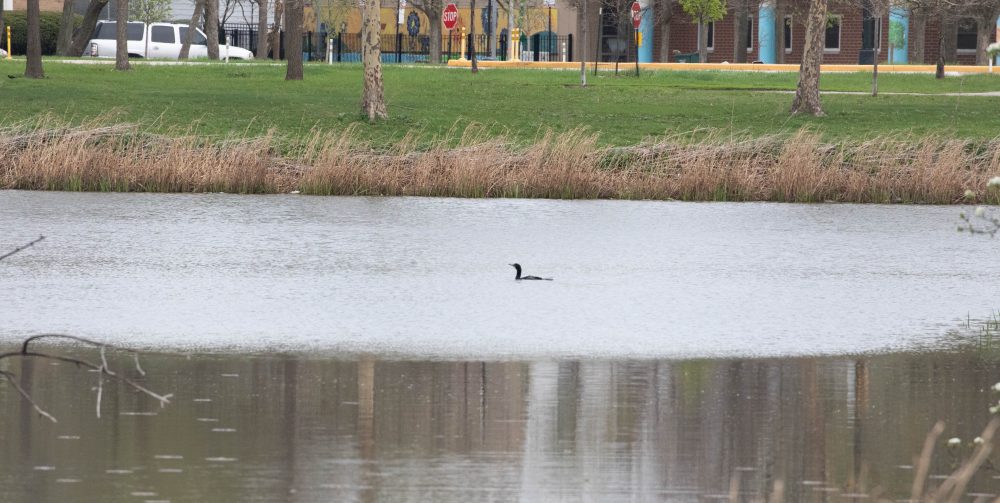
Other birds that day, nothing spectacular. An American Goldfinch, of which there are many this time of year, and a Double-crested Cormorant flying over the river in the distance.

I also had some unusual looks at the features of a Red-bellied Woodpecker. You can see the “red” belly in the second photo.

I will be back with more fall warbler photos among others, as we seem to be approaching the “now-or-never” part of fall warbler migration. Due in large part to unusual weather and dramatic temperature variations, it seems more birds have kept going than stopped to refuel, at least around here. But I read Bill Hilton’s post yesterday and he is experiencing the same lack of migrants in North Carolina, and even he is stumped by it. He suggests that it’s probably too early to draw any conclusions and to see how the migration patterns sort out in a few more years. Birding will always be looking for the next bird…

Fall Migration Bird Walk Highlights – So Far

While yesterday morning’s bird walk was canceled due to some well-needed thunderstorm activity, it seemed like a good opportunity to look at what we’ve seen so far since we started this season’s walks back on August 30.

On 8/30, we were at Thatcher Woods in River Forest,.The first bird I noticed was a Ruby-throated Hummingbird quite far away. It could very well be a young male with just a feather or two at the throat changing color and the absence of white on the tail.

A Green Heron was fishing in the lagoon by the museum,

A Merlin came into view.

And a Common Nighthawk flew overhead.

I caught glimpses of a Bay-breasted Warbler and a Black-throated Green Warbler.

We had looks at an American Kestrel.

On September 3, we met in Henry’s Alley. We saw a Ruby-throated Hummingbird here, too – this one is definitely a juvenile male with more red on the throat – and an American Redstart that appears to be a female.

We didn’t see too many more birds that morning, but this Cooper’s Hawk may be the reason why.

On September 6 at Columbus Park, we saw a Blackpoll Warbler. You can see the distinguishing orange feet well in the first photograph.

We had a Red-breasted Nuthatch.

I photographed an American Goldfinch and a Northern Cardinal, both in Fall Drab.

I’m sorry it’s not easy to see this Cape May Warbler. Try clicking on the photos to get a better view.

We also saw a Black-and-White Warbler.

There were a few Red-eyed Vireos, like the one below. I will spare you the flycatcher photos – there were almost too many, and they were often barely identifiable.

But there were one or two early Palm Warblers. This one was easiest to see.

On 9/10, we were back in Henry’s Alley, with a young Red-bellied Woodpecker.

We had another Red-breasted Nuthatch, which is also at top of this post.

And for comparison, a White-breasted Nuthatch.

We were excited to see an Olive-sided Flycatcher. This bird posed nicely for us.

We had another disheveled-looking Northern Cardinal.

And a fairly good look at a Downy Woodpecker.

That’s about it for now. I am relaxing after playing for two services at Unity Temple this morning. I was asked to fill in while our accompanist is taking time off and our music director is traveling. I have been practicing for the last two weeks and my indoor birds have been generally very supportive. They weren’t wild at first about the second hymn I was trying to learn and let me know when they all yelled at me, but I think they came to like it a bit more when I could play it more convincingly. Other than the service music, I chose to play the Gigue to the G Major French Suite by Bach for opening music, Oriental by Granados for the special music before the sermon, and Dr Gradus ad Parnassum from Debussy’s Children’s Corner Suite for the closing music. It was fun, and I am still trying to calibrate the balance of energy in the sanctuary. Since I play more often for birds than for people, it was an almost other-worldly experience.

Unexpected Leanings

On my visit to the Chicago Portage Thursday morning, I expected to see very little, and most of the walk, at first, met my expectations. I captured a Mourning Dove flying by.

A Ruby Meadowhawk posed for me on a hairy stem of something,

And then I saw a warbler very briefly, which turned out to be a Blue-winged Warbler.

I next photographed a juvenile Indigo Bunting.

Goldfinches were busy and perhaps too challenging to photograph. But I challenge you to find the American Goldfinch in this photo.

Here’s one more American Goldfinch, in flight.

I followed a yellow Tennessee Warbler. They come in two different colors, yellow and blue. I have only yellow ones in this post.

I could not help but notice a dead tree full of Northern Flickers. There are 9 of them in this photo,

I saw a nice Bay-breasted Warbler.

I was looking at some moving leaves near the trail, but I couldn’t see any birds in them. I looked up and saw that a Red Squirrel was causing the leaf action by dropping bits of chewed nut.

I heard and then caught a brief look at a Swainson’s Thrush.

Then, as if on cue, I started seeing some warblers foraging in low-growing vegetation, which made them easier to photograph. I first found a young male American Redstart.

And then there were one or two Magnolia Warblers.

A Nashville Warbler was in the mix.

Another Bay-breasted Warbler appeared.

Another American Redstart, Nashville Warbler and Tennessee Warbler below,

The American Redstart below is a female.

Here’s two more Bay-breasted Warblers. I included the first photo because it’s so different. I can’t recall ever studying the thighs of a Bay-breasted Warbler before. The last photo is a different individual.

Here’s one more lovely Tennessee Warbler.

I must have been in a trance when I started photographing the fascinating scene of action below, because I had no memory of seeing all these birds until I went through my photos later. Northern Flickers and American Kestrels were jockeying for position in the same tree. I apologize for the tiny images but it’s really the only way to show what was going on.

Always up for action, two Ruby-throated Hummingbirds got into it.

More action occurred when a Northern Flicker took after one of the American Kestrels.

Here’s a closer look at one of the kestrels. This is the same bird at the top of the post. The other Kestrel sat perched quietly in the tree the whole time.

And here are two Northern Flickers.

So that was my unexpectedly busy morning at the Chicago Portage. It probably didn’t hurt that there was plenty of sunshine and warmer temperatures. But we are getting really dry again. There’s a chance for rain tomorrow morning, which would interfere with a scheduled walk at Thatcher Woods, but personally I am hoping for rain.

Fall Warblers and Others

The fall warblers are trickling in. Here are a few warblers to get started with from morning walks in Riverside and the Chicago Portage. On August 27 in Riverside, I saw a female American Redstart.

Also present was a Cedar Waxwing. I included the middle photo because if you look closely at the yellow tip of the tail, it appears to have a serrated edge.

I caught a Chimney Swift and a Double-crested Cormorant in flight.

A Great Blue Heron and a Great Egret were available for long views.

On September 1 at the Chicago Portage, I briefly saw a Blackburnian Warbler.

I also had a Cape May Warbler, but only got a glimpse-and-a-half.

The next day, September 2, at the Chicago Portage, I had only a Nashville Warbler.

But I did get an interesting photo of a young Hairy Woodpecker.

And I made the acquaintance of a Chickweed Geometer Moth.

Back again on September 4 at the Chicago Portage, I had an American Redstart that could be a young male.

I then saw a Bay-breasted Warbler.

And I got some fair looks at a Magnolia Warbler or two.

I also had Tennessee Warblers.

I caught a glimpse of a Gray-cheeked Thrush.

And a Field Sparrow sat still for a moment.

Also that day, Bob and I saw a Broad-winged Hawk and a Cooper’s Hawk. They were both in the air at the same time, and then the Cooper’s Hawk made a return solo visit.

In Riverside on September 5, I saw the Chestnut-sided Warbler who is also at the top of this post.

I also had an American Redstart, again, a young male.

Great Egrets were here and there..

On my walk through Riverside Lawn, I came across a Green Heron perched by the river close to where I was walking.

And I heard and then saw a Northern Waterthrush.

I just had a very interesting morning at the Chicago Portage, so I think I will be back with that recap as soon as possible before I go back a little bit to the five days in between. Anything can happen during fall migration, even when it’s least expected.