Fall Sparrow-rama

Swamp Sparrow, McGinnis Slough

Now that the fall sparrows are all but gone, I’ve decided to pay tribute to them. Although I wasn’t lucky enough to photograph some less common species that made the front pages of the local list-serve, one or two which I even managed to see, I had some cooperative models nonetheless, and they’re all compelling to me in their subtle variety.

Dark-Eyed Junco

And for me, anyway, I need a break from the evening news.

White-Crowned Sparrow

I hope you are all safe and secure, wherever you are, as storms seem to be raging across the planet.

Lincoln’s Sparrow, Lurie Garden

As you might notice from the locations, the sparrows were plentiful in the Chicago lakefront parks and also in the marsh area of McGinnis Slough, a Cook County suburban forest preserve.

Clay-Colored Sparrow, Daley Bicentennial Plaza

When I first photographed the Clay-Colored above, it was such a cloudy, or as my mother used to say, “glismal” day that I thought perhaps he was a Chipping Sparrow. Imagine my delight upon developing the image to discover he was a Clay-Colored Sparrow! They are a bit similar but Clay-Colored are rather more unusual and I haven’t seen one in a while. The grayness of the day certainly contributes to his clay color!

Song Sparrow, McGinnis Slough

As common as Song Sparrows are when they breed here, they seem less so in migration.

White-Throated Sparrow, Daley

So many White-Throated Sparrows come through, often you can hear one or two singing, although usually they’re first-year tryouts.

Juvenile White-Crowned Sparrow, Daley

I like pictures that sometimes show just enough of the bird for identification…

Swamp Sparrow, Daley

Sometimes that’s all a bird’s going to show you.

Dark-Eyed Junco, Daley

Or in Daley, there are lots of sparrows in the grass but all too often the grass overshadows them.

Fox Sparrow, Daley

Fox Sparrows are another favorite of mine. There are four subspecies in North America; we get the red guys.

Savannah Sparrow, McGinnis

There’s more plumage variation among Savannah Sparrows.

White-Throated Sparrow, Daley

And even White-Throated Sparrows have two subspecies that intermingle. The bird above is the tan-striped variation, the earlier one is the white-striped.

House Sparrows, Daley

And then of course there are the House Sparrows. They aren’t really sparrows, they’re weaver finches. But don’t tell them that: they like to think they pass for sparrows and the city HOSPs, at least, don’t mingle with the other finches.

Daley’s Daily Changes

Don’t fence me in…

Daley Bicentennial is now preparing to be officially closed to everyone. The cement horses went up first, and now the chain-link fencing.

The fences are going up everywhere.

There is still access, the Segway Tours haven’t left yet, and as long as I can fit through an opening in the fence, I’m going in.

The construction equipment accumulates.

And accumulates.

Tools of Destruction

And accumulates.

The trees are going slowly to sleep, for the last time.

How to Be a Hawk

Every year it seems Grant Park gets a juvenile Cooper’s Hawk or two, and this year was no exception. If the crows have been even noisier than usual, most of the time it’s because Junior is in the area.

Toward the end of an afternoon walk I decided to check out a number of Juncos and White-Throated Sparrows feeding on the lawn to see if there was anybody unusual with them. The young Cooper’s Hawk decided to check them out as well…

He blew it.

Fortunately for me, while he was still pondering his mistake, he posed for a number of pictures. A bit less fortunately, the midday sun was strong behind him, but still I was quite close to him.

Maybe they’ll stay still next time…?

Where did they go?

This is frustrating…

Off to the next opportunity.

C’mon, Crows!

One of the first times I went down to the Daley homestead elms to see if I could get pictures of the warblers, I ran into Jerry Goldner with his amazing lens. You can check out his fantastic photos on his “Profiles of Nature” flickr page here.

I had been down earlier that morning on my weekly foray of the parks at dawn and had somehow managed to not unload all the hot dogs to the crows. The crows were too busy forming a “murder” which is the rather derogatory, scary name for a congregation or flock of them.

a subset of the “murder”

I counted roughly 40 crows flying over at one point, taking into account that ten years ago it was all I could do to find two or three. I was moved by the site of so many crows and feeling somewhat responsible for their comeback, but their carrying on seemed to have little to do with my presence, unless they were showing off to me their strength in numbers.

Not wanting to leave the hot dogs, which I always store in used quart yogurt containers, in the office refrigerator, I was eager to distribute them to their intended recipients when I went on my lunch break (I can hear those unaware of my crow connection, if there are any such people left on the planet, talking now: “She always eats so healthy, I can’t believe she’s secretly eating hot dogs!”). So when the crows started following me around and making noise while Jerry and I were trying to see the warbler action, I did something I’ve never done before. And will probably always live to regret. I walked away from the action toward the south end of the park and called “C’mon Crows!” And wouldn’t you know, they followed me immediately as if they had been waiting for this day their entire lives.

The downside of bringing the crows back from the brink is that as they increase in numbers, it gets harder to train them, if you will, to be quiet and tread lightly while I’m stalking migrant visitors.

Bench Crow

At least I got rid of the hot dogs that day, which is usually not a problem…

when earlier that day, the first crows of dawn met me on the bridge that goes over the train tracks between Michigan and Columbus avenues…

Bridge Crows

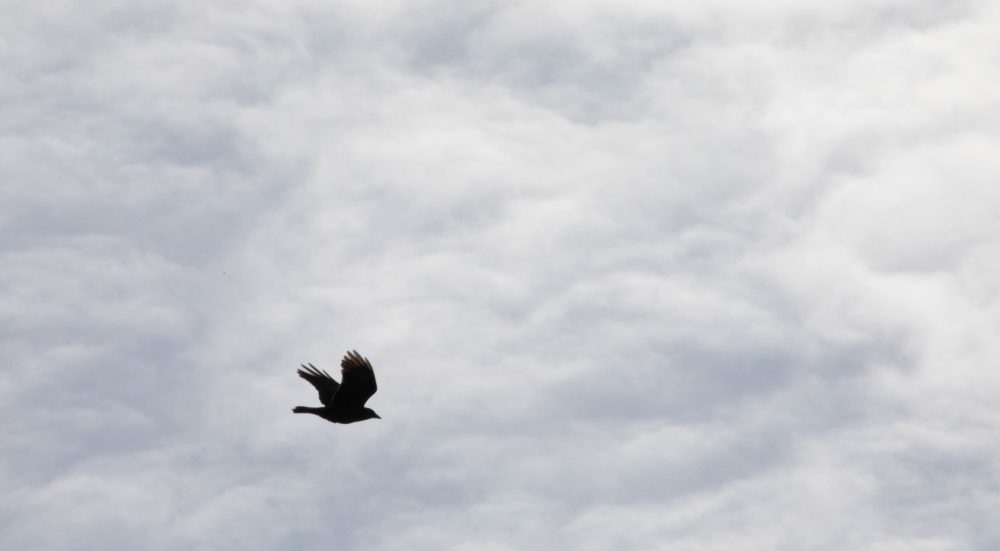
Best to let my body language dictate the protocol, I guess. I did manage to get a few crows to follow me around slowly and quietly Friday afternoon, much like this pensive crow.

Pensive Crow

And soon as the migrants are gone, the crows will have me all to themselves again, to spoil them rotten with treats throughout the winter cold.

I know I will too, especially when I come back from my vacation (which is barely two and a half weeks away), tropical birds in my head, but guilt over leaving my crows and pride over the expected greeting they will give me upon my return.


Follow the Sap…suckers

Juvenile Yellow-Bellied Sapsucker

The last couple weeks of fall migration, warblers and others have been following the sapsuckers as they drilled holes in the rows of homestead elms lining either side of the center “naturally planted” section of Daley Bicentennial Plaza. The birds are drinking sap from the wells drilled by the woodpeckers.

Orange-Crowned Warbler

We are still seeing Orange-Crowned Warblers and Yellow-Rumped Warblers. The Yellow-Rump below was putting on quite a show when I took this picture last week: he kept hovering around his favorite saphole like a hummingbird.

Yellow-Rumped Warbler

The Tennessee Warblers like the one below are sometimes confused with Orange-Crowned, especially this time of year.

Tennessee Warbler

There have been a lot of Red-Breasted Nuthatches this fall, and the one below, drinking sap, is no exception.

Red-Breasted Nuthatch

Some of the first warblers noticed were Black-Throated Blues. Here’s a female, and below her, a male – although I did not get a picture of him drinking, it’s almost a wonder he let me photograph him at all. He behaved like a celebrity tired of paparazzi.

Female Black-Throated Blue Warbler

Male Black-Throated Blue Warbler

Cape Mays aren’t always cooperative either.

Cape May Warbler

I took several pictures of this Ruby-Crowned Kinglet yesterday, but the midday sun was brutal and I discarded most of them.

Ruby-Crowned Kinglet

There could still be a lot of sapsuckers coming through…and following them, their fans of many colors and configurations.

Yellow-Bellied Sapsucker

But as the leaves disappear…so will these migrants.

House Sparrows?

Nobody likes these guys but even they can be interesting at times. There’s a restaurant with tables on the sidewalk I pass by on my way to the park on my lunch hour, and the city sparrows hang out, on clean-up detail. But they also apparently scale the stucco wall and break off little pieces to add grit to their diet. Reminds me a little of parrots and clay licks…

Confusing Fall Warbler

Mystery Bird

I went downtown early yesterday to see what the wind blew in. There were predictably a lot of sparrows, although most evaded my lens. However I ran into this warbler at the Lurie Gardens in Millennium Park and took several pictures without really thinking about it until I downloaded them and started getting confused. So I drag out the books: The Sibley Guide to Birds, Warblers of the Americas, the Peterson Field Guides Warblers.  There is such a thing as too much information.

There are a lot of drab-looking birds with yellow on the vent and throat this time of year. Well, at least a few came to mind. Could this be a female Common Yellowthroat?

Or even a juvenile Yellow Warbler? Wait, brownish maybe, but not all the feathers are edged in yellow…

Too much of an eye-ring for a Yellow. But it doesn’t look like a Nashville either… and then, the bird gave me my best clue in a subsequent frame.

The only warbler with yellow in the tail is…a Redstart. This is a first year Female American Redstart. I’ve never seen one with hardly any color on the wing before. Wow. Learn something every time I go out. I think I’ve been paying closer attention this fall.

First-year Female American Redstart

Now that smirky little face makes sense to me…I recognize that look. How could I ever forget this is a Redstart? The gizz starts to fill in immediately. But just in case I forget, she reminded me one more time.

The Decimation of Daley Bicentennial Plaza

The decimation of my favorite stomping ground has begun. No trees have been uprooted yet, but holes are being dug.

The crows must find the overturned earth interesting. I first found them foraging for grubs and other delicacies.

Yellow-Rumped Warbler

The weather has changed, progressing into autumn with a push of colder air and rapidly shortened days. Warbler migration is all but over now, save a few Yellow-Rumps.

Swamp Sparrow

Sparrow migration is here. A beautiful Swamp Sparrow flew into the native plant area in the middle of the park. Then I found the first-year White-Crowned Sparrow below, hiding behind the cage that still protects a young tree in the park, although it seems ironic now. The tree will soon be gone.

Juvenile White-Crowned Sparrow

Destruction crew

The crows have seen this as an opportunity to reclaim the park, and me, at least for a short period of time. I ran out of peanuts too quickly this afternoon but it didn’t matter how often I showed them the empty bag, they still followed me almost everywhere.

So I snuck off to Peanut Park, the lower-elevation area that runs between Daley and a portion of Lake Shore Drive, and found a first-year Hermit Thrush among several others.

First Year Hermit Thrush

When I came back up the stairs the crows were waiting for me. I promised to bring more peanuts tomorrow. They still think I have the power to produce food for them at will.

We are going to miss the trees. What next?