Portage Potpourri

It’s time to go back and sift through the summer’s photographs so I can start making room for the always anticipated overload of fall migration. As usual I find I have way too many photos that I had forgotten about. The ones in this short post go all the way back to June 4 and June 9 which don’t even qualify for summer yet, but the breeding birds had already been busy.

So this is a female Indigo Bunting. I love her delicate colors. And below her photo is a male, possibly my friend I have named Tadziu.

One bird I haven’t seen all summer, although they typically breed at the Chicago Portage, is the Yellow Warbler. I expect to see some in the next few weeks during fall migration. If I was seeing them so regularly in June they must have been nearby all summer.

I found this little bird’s photos and had to think for a moment what it was. I’ve concluded (with the help of other photographs online) that it can only be a very young Warbling Vireo.

For a short period of time, Gray Catbirds were making themselves available for photos until they disappeared later like nearly everybody else.

I’m beginning to realize this was an absurd idea because more recent photos are starting to accumulate quickly on my hard drive and I won’t be able to review older ones much longer.

Yes, a Chipmunk

House Wrens have been abundant all summer, but not always easy to see.

And every once in a while, an Eastern Phoebe would pose.

I am grateful for the many times I have seen Eastern Kingbirds.

Red-winged Blackbirds are due to start showing up in huge flocks before they take to their more southern destinations. They have disappeared from their breeding grounds. I suspect they have been busy educating the youngsters about self-reliance and survival.

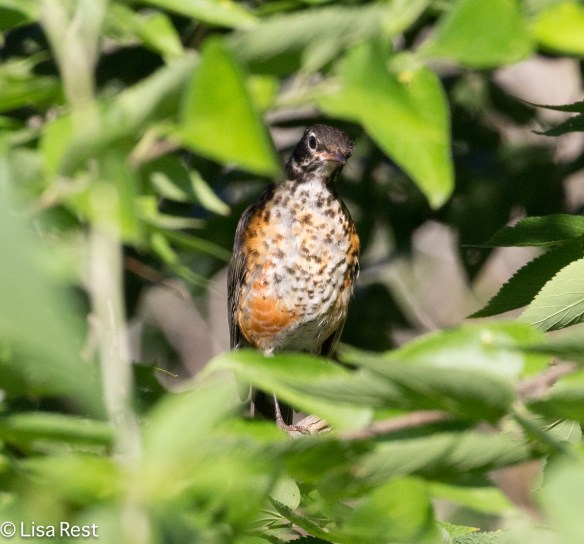
American Robins are perhaps the most adaptable birds, thriving in and out of the human disturbance.

I was intrigued by the capture below – it looks like a very young Red-winged Blackbird.

Baltimore Orioles have been much harder to see long enough to capture lately.

I saw a Daddy Long Legs only once… and my favorite grass, the Squirrel Tail Grass, doesn’t look like this anymore, indeed, I haven’t noticed it at all lately.

Also well-adapted to us humans are American Goldfinches. They always seem so cheerful.

I don’t know what happened to the Song Sparrows at the Portage. I am not sure if any stayed to raise families.

The White-tailed Deer are making less frequent visits than they were earlier.

Another American Robin

Here are two quick and slightly blurry photos of a Blue-gray Gnatcatcher.

I have never seen this yellow iris before…or since.

Here’s what the cottonwood seeds looked like in the beginning of June.

As if to prove my earlier point about adaptability, one American Robin built a nest on the edge of the shelter in spite of the spikes to deter such activities.

I have so much going on right now I can’t say when or with what I will return. But I figured as long as I started this post a couple days ago I may as well finish it.

We had our first choir rehearsal last night, and we are singing this Sunday. I was a bit surprised at how good it felt to stand together and sing, albeit still masked. And so we take the plunge into another year. And I will have to start getting up earlier – in the dark – as the fall bird walks start again next week.

End of July Tidbits

Here’s what was going on at the Chicago Portage the mornings of July 29 and 31. Pretty much what can be expected mid-summer. Feeding fledglings and molting. A busy time for the birds.

On July 31st there was what appeared to be a family of Eastern Kingbirds.

I didn’t manage to get them all in one photograph but there were four Eastern Kingbirds total.

I can expect to see an American Goldfinch in the duckweed this time of year, and I can never entirely resist documenting its presence.

Blue-gray Gnatcatchers were here and there, if not always easy to see. But then they hardly ever are. The bird in the tiled series looks to be a juvenile.

After barely seeing a Downy Woodpecker out in the open for a few months, it was nice to see this one out and about. It looks to be a young bird as well.

Tadziu the famous Indigo Bunting was busy with his feather upkeep, on a fallen log close to his bridge.

The distant Indigo Bunting below was more disheveled.

A young-looking Marsh Wren was investigating this fallen log.

A young American Robin was curious about the camera attention.

The American Robins below appeared to be sunbathing on the gravel path. I tried not to disturb them for as long as I could.

An juvenile American Robin caught in flight, below.

It’s not often that I catch a Northern Flicker still for a moment.

Below, two Red-bellied Woodpeckers. The first appears to be a juvenile.

The bottomlands near the Des Plaines were flooded both days. A little less on the 31st than the 29th.

My “first” bridge is the southernmost one, and here’s the view I’m getting these days from it.

In the photos below, first a Blue Dasher Dragonfly visible from the bridge on July 31. I saw the turtle covered in duckweed later after I set out on the path after crossing the bridge.

The Hobomok Skipper Butterfly was available for photos on July 29. You can get an idea of how small this creature is by the leaves it’s on.

It seems lately I have been seeing one female Brown-headed Cowbird on every visit. This was her best photograph.

The trees that darken the path over on the north side are such a contrast to the open areas of the preserve. Some are purportedly hundreds of years old.

Here’s another profile of the Eastern Kingbird who was featured at the top of the post.

I was in Riverside yesterday morning and I will have a post soon with what’s going on down by the river there. I had planned to go elsewhere this morning, but I am temporarily catering to the complaints of my right knee which caused me to wear the brace again and venture no farther than the grocery stores. If I can walk well enough tomorrow morning I will go out again.

More Summer Portage Passages

We have threats of thunderstorms this morning and perhaps later in the afternoon, but like yesterday so far it seems to be a waiting game with periods of drizzle.

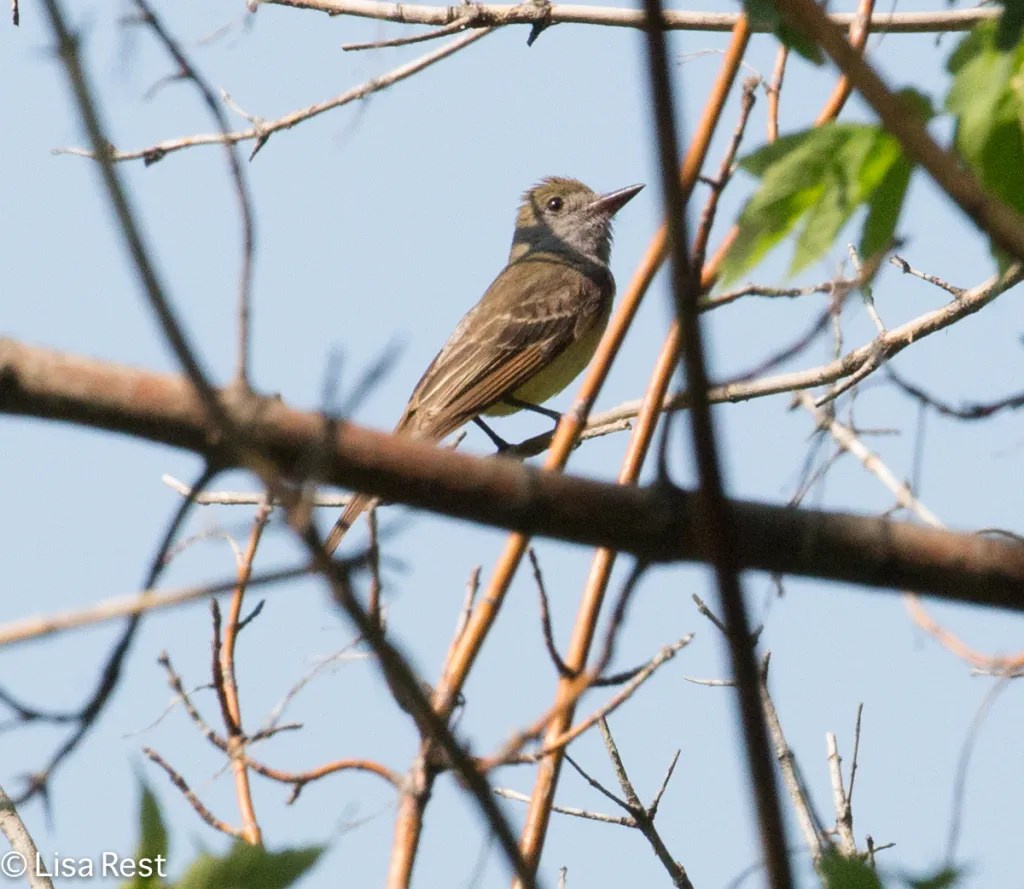
The last time I saw a Great-crested Flycatcher at the Chicago Portage was on July 22nd. I imagine they’re still around but I am not sure I have heard them lately either. This one was just close enough to capture with the 400mm lens.

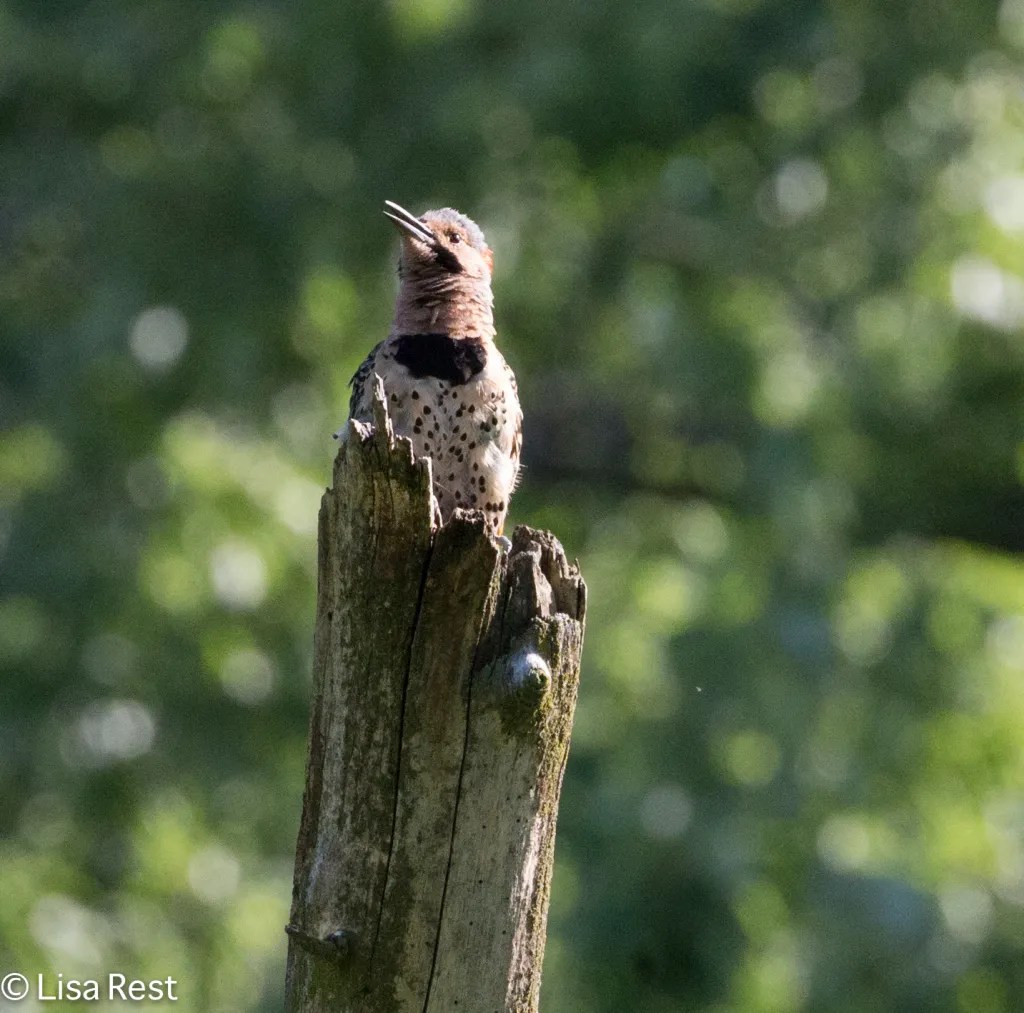
I managed to focus for a while on a disheveled-looking Northern Flicker. I waited and waited for him to take off, hoping to capture him in flight, but he beat me to it.

A Spicebush Swallowtail was present both days.

You might expect the beetle below to be named after its vibrant color but instead it’s named after six tiny little white spots which might be more visible in the second photograph.

Whatever the attraction is to the dirt path, this female Powdered Dancer damselfly stayed there long enough.

Tadziu the Indigo Bunting is just as fond of his sunshine perch as he is of the other one across the bridge in the shade.

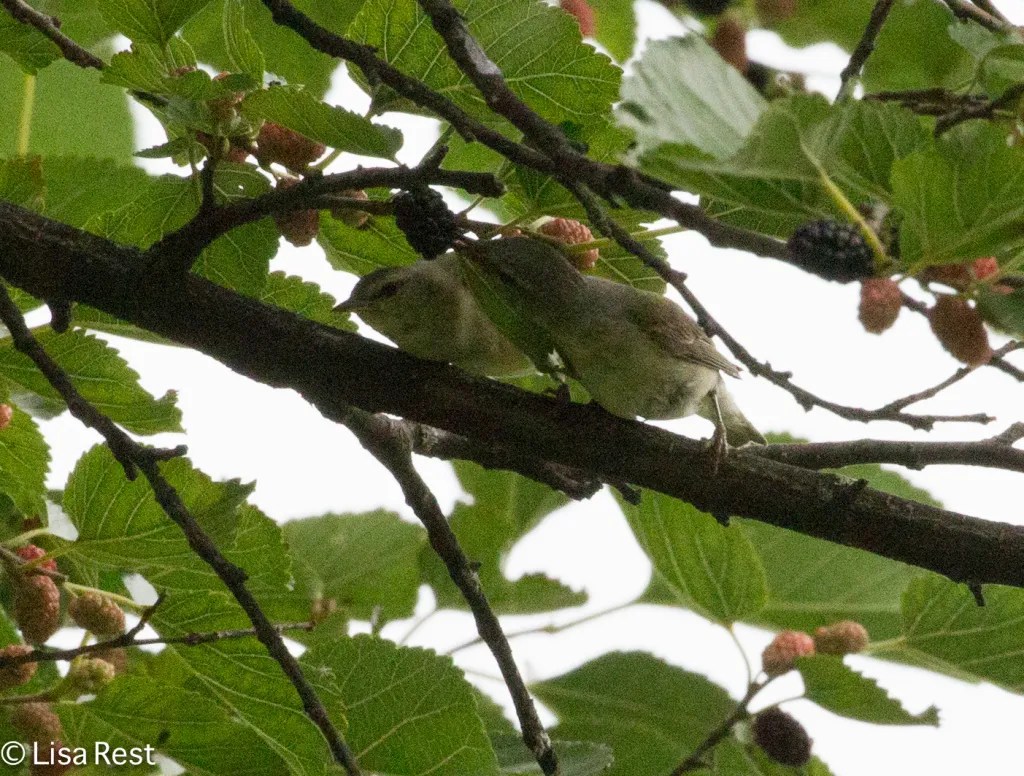
When there isn’t a lot going on to distract me, I tend to focus on whatever activity exists. Starved for action, I could not resist taking pictures of two young-looking Warbling Vireos who were busy in the mulberries. Berries require less work for them than bugs, I imagine. And as for me, it’s only a matter of time before I get to apply these skills to fall warblers.

The contrast between July 22 and July 25 before and after some rain is evident in the photos below of the bottomlands by the Des Plaines River.

It’s usually easier to get a decent photograph of a female Twelve-Spotted Skimmer.

Female Twelve-Spotted Skimmer

This is pretty much how the water looks at the Portage these days. A sea of green.

I have some photos from two more visits at the very end of July, and then it’s looking for signs of more activity in August as fledglings turn into juveniles and thoughts of fall migration start to emerge.

In the meantime, sitting on my front porch yesterday afternoon, I had a brief visit from a female Ruby-throated Hummingbird sitting in the apple tree. I hope to eventually get a few photos of her in action at the flowers or the feeders.

Summer Passages at the Chicago Portage

Although I’ve been to the Chicago Portage more recently, I’m posting some photographs and a couple recordings from last month that hadn’t made it into posts anywhere near the days I took them. These are some views of likely suspects from visits made on July 6 and July 10. I then plan to be back with two or three subsequent installments after I process four more recent July days’ worth of photographs. Depending on what happens, I could sneak in another location here and there…

For the record, the male Indigo Buntings that were everywhere singing last month are still singing but not as much and they’re less visible than the one below, taken on July 6.

Tadziu the Indigo Bunting was available on July 10 for photographs and additions to his Greatest Hits, but the lighting was poor for the former. However, I feel obligated to share his portrait anyway.

And here are the last recordings I made of my celebrity.

Tadziu with American Robin and House Wren in the background
Tadziu with Northern Cardinal, House Wren and Warbling Vireo

American Goldfinches have been busy in the duckweed.

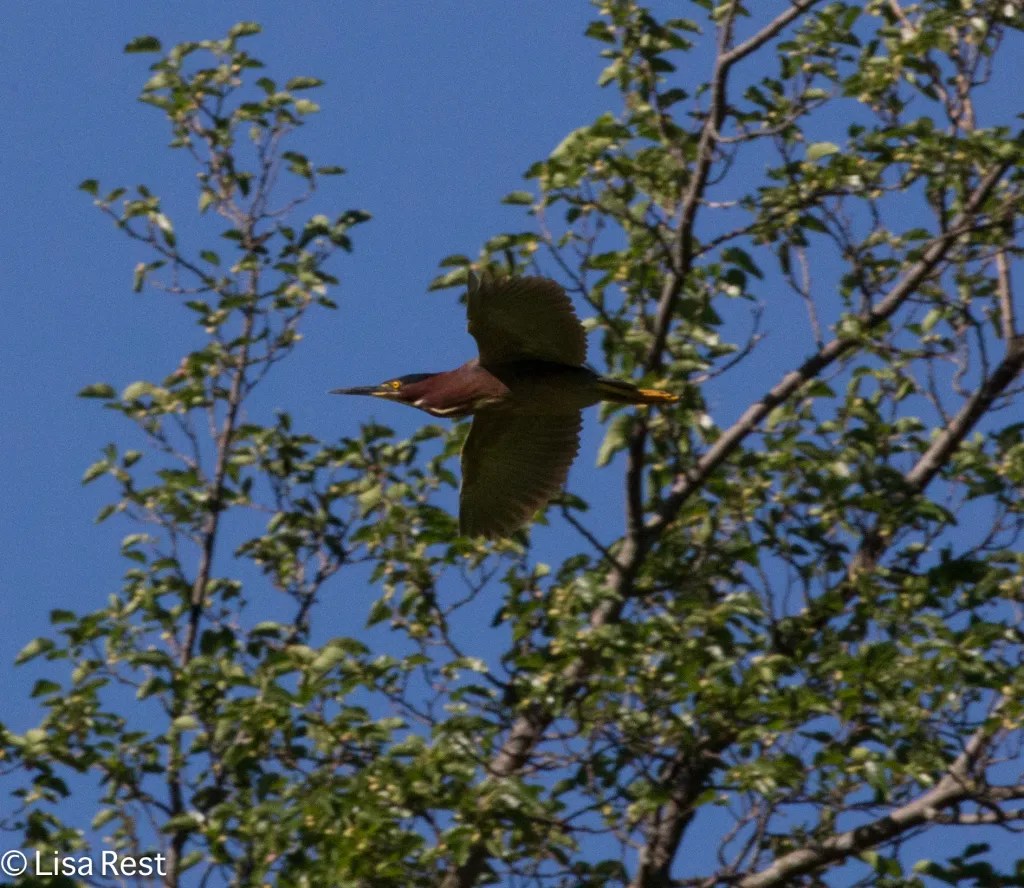
Perched over the water and then taking off for better prospects, a Green Heron was distantly available on July 10.

Just by chance I happened on an Eastern Towhee family. You have to look at the second photo below to see the juvenile which is somewhat obscured by the female in the first photo. I heard the male Eastern Towhee singing this past Tuesday, but did not see him. It would be nice to see the family again before the end of the summer.

It was still hard to resist photographing the Prairie Coneflower and whatever the second yellow flower is, that I see blooming upon first entering the woods from the south paved trail.

I got lucky on the 10th and managed a few photographs of a Warbling Vireo. They are still around but not as vocal as they were, so these days it’s hard to tell how many might be present.

Another species becoming more visible lately is Blue-Gray Gnatcatcher.

I have barely heard or seen a White-breasted Nuthatch. This one was on the 6th.

Also on July 6th the House Wren below was flying out of my frame.

The Brown-headed Cowbirds were still all over the place too, on July 6.

The Northern Flicker below wasn’t too easy to see, but I was intrigued enough by all the colors on him, popping out from behind the leaves.

Below is an unusually visible Gray Catbird, and below it, an Eastern Wood-Pewee.

And American Robins are always up to something.

I will be back with more composite posts from the Chicago Portage. In another week or two I expect to see more birds, with the added confusion of molting and juvenile plumages.

A Visit to Goose Lake Prairie

On July 9, I went to Goose Lake Prairie for my annual summertime visit. There were not a lot of birds available for viewing, but enough of the usual suspects were present for the most part and I had a good time observing a few individuals.

Song Sparrow

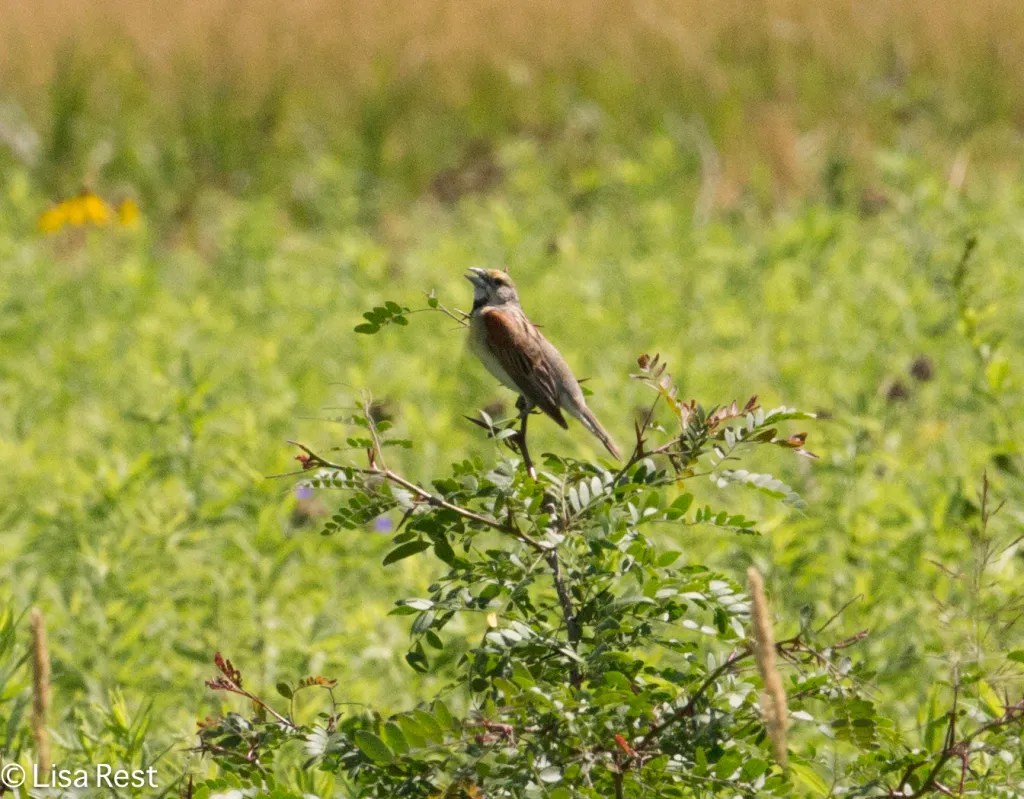
It was hard to find a Dickcissel close enough to the trail until I had walked quite a ways and meandered farther. The bird in the middle photograph below is a female.

The wind sweeping over the prairie made it difficult to get clean recordings, but below is a sample of a Dickcissel song.

Dickcissel

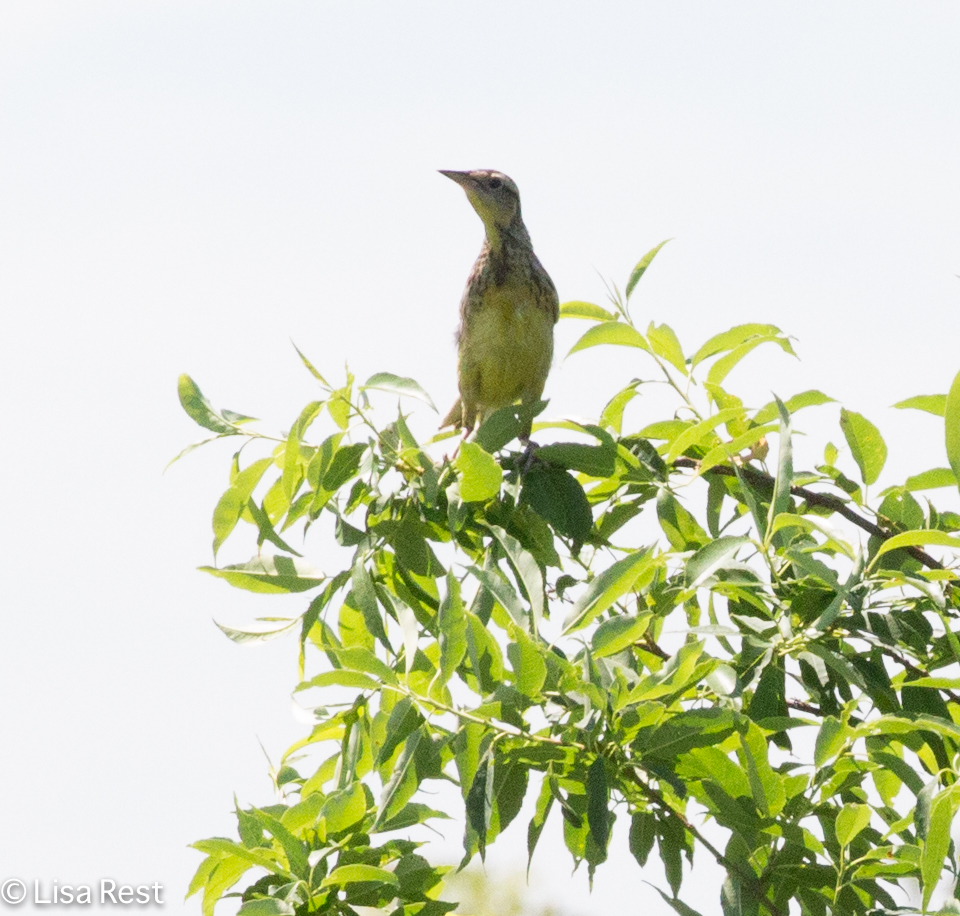
I was stumped by this Meadowlark – and wondered if perhaps it was a Western instead of a more likely Eastern – but I remain stumped and have decided whatever it is, it is a juvenile. I took way too many photographs of it but none have clarified the identification.

I am always happy to see – and hear – Field Sparrows. Unfortunately the only recording I got was very faint and far away.

Field Sparrow

There were plenty of Song Sparrows…but I did not attempt to record any. There was always one singing somewhere.

I was a bit disappointed that the parking lot Killdeer refused to turn around.

This bedraggled looking bird must be a young Indigo Bunting.

Here are some more poses from the Indigo Bunting at the top of the post.

It was a bright, sunny, cloudless day.

There were turtles on the rock in the water by the Cragg Cabin.

A male Northern Cardinal stood out against this background.

There were a lot of Common Yellowthroats but they were quite far away when visible at all.

Common Yellowthroat

Red-winged Blackbirds were predictably present.

Somehow I got lucky with this Black Swallowtail Butterfly.

I would have liked to have at least heard a Sedge Wren, but instead there seemed to be plenty of House Wrens.

The Purple Loosestrife below stood out. Luckily there wasn’t a lot of it but still it’s considered invasive.

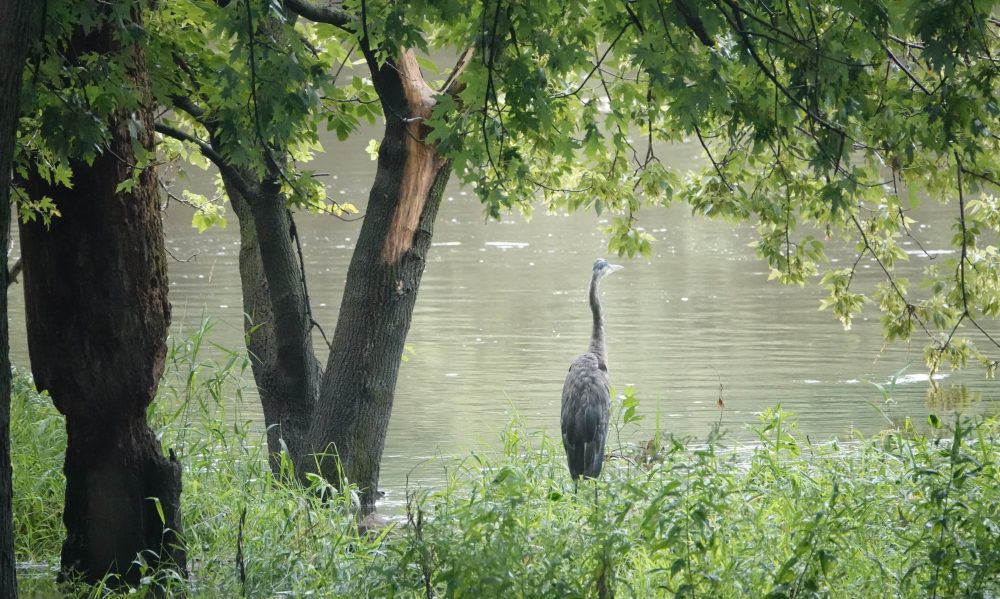
There was one Great Egret at the water by Cragg Cabin, but it took flight when I tried to walk by quietly.

I like the colors of this rather distant Cedar Waxwing.

I made it all the way back to the lake, as it were, but the vegetation made it impossible to see the water and when I entered the blind and looked through the dirty cloudy windows, I didn’t see anything in the water.

I will have to try visiting this place a bit more often than once a year. Tomorrow I am getting up very early to go all the way up to the other Goose Lake in McHenry County, where I think they have had more rain and it is a few degrees cooler. I hope to get a better look at the Yellow-headed Blackbirds, but whatever I see, it should be a beautiful morning. The abundance of summer continues.

Summer Surprises at the Chicago Portage

I began writing this post while I was sitting here with the sun pouring through the half-closed slats of the blinds, the curse of facing east in the morning, artificially cooled by the fans and air conditioning going more often than I’d like to maintain an inside temperature of 80 degrees. I paid the Chicago Portage a visit Monday and before that on Saturday, when the morning temperatures were much cooler, but decided to stay home yesterday, worked in the yard for brief periods, and gave my recuperating knee a rest. At least I have shade in the backyard. We are in the middle of a hot, dry spell again. The later-week predictions of rain have disappeared.

Oh – that beautiful male Eastern Towhee at the top of the post – I encountered him briefly right off the trail. It’s the second time I’ve seen him in the past couple weeks.

Monday as I was putting my camera and backpack in the hatch of the car, I looked up to see a female Ruby-throated Hummingbird first check the front yard, then zip over to the feeder on the porch and then over the roof toward the backyard where there are three more feeders. I haven’t seen a hummingbird for weeks, maybe months. That proved to be a good sign. When I got to the first bridge at the Portage, although very distant and the photos below are severely cropped, I did see a male Ruby-throat, perched on a dead tree over the water from where I stood.

I hoped to see a hummingbird again, perhaps in the Red Bee Balm that is in bloom, but did not.

Red Bee Balm at the Portage

After the hummingbird left, I spotted one American Goldfinch on the same tree.

Whereas on Saturday, I spotted five distant American Goldfinches trying to brighten up the gloom.

Monday was bright and sunshiny with most birds still at a distance. An American Robin and a Red-bellied Woodpecker share this frame.

The Prairie Coneflower, below left, is starting to bloom. It’s one of my favorites at the Portage. I still haven’t figured out the other yellow flower.

There are a lot of American Robins here even when you don’t see them. Below are two juveniles. The second photograph, taken in the mulberry tree, indicates the berries aren’t quite ready yet. I expect when they are ripe, flocks of Cedar Waxwings will join the Robins.

Here’s a Robin I managed to follow as it decided what to do with its catch.

There are quite a few Blue-fronted Dancer damselflies. I wish this one had chosen a better-looking place to rest.

I was intrigued by the new growth starting from a long-dead fragment of log poking out from the bottomlands through the fence.

Here’s what it looked like after the rain, back there on Sunday. I’m sure it’s all dried out now.

Sunday was not a great day to photograph Indigo Buntings but this one picked an interesting perch.

As a contrast, there was too much light on Monday.

The brightness did justice to two butterflies, a Silver-spotted Skipper and a Red Admiral.

I was surprised to see what had been an iconic dead tree by the second, or northernmost bridge, broken in half as it was a magnet for nesting Northern Flickers. I could not locate what happened to the rest of it.

The most interesting bird on Saturday was a Peregrine Falcon perched at quite a distance from where I stood across the water. When I got a bit closer to it, it fixed its gaze on me. Alas we grew bored with each other and I was looking elsewhere when it finally took off, missing a flight shot.

On Monday one Pearl Crescent became two.

I felt lucky to see an Eastern Wood-Pewee as I usually only hear him, but I didn’t manage to get him in great focus. Oh well.

Tadziu was on territory Monday.

I haven’t been able to find a Red-winged Blackbird anywhere at the Portage although I know they exist. So I had to settle Monday for a female Brown-headed Cowbird as a substitute blackbird.

A bucolic young rabbit with a couple Robins on the path.

Early Monday I encountered a very young deer.

It looks like the Elderberry is going to have ripe fruit soon too. Let the fun begin. I have just planted one of these in my backyard and I expect it won’t produce fruit for a while but I look forward to watching it grow.

A view of Tadziu’s bridge through the trees.

There is simply a lot of Tall Bellflower in bloom here.

One more of the Peregrine Falcon.

I’m not going out walking every day in this heat – more like every other day or so. There’s plenty to do around the house and in the yard. And there is that book. I had a revelation the other day while I was swimming, I think. Water has always inspired me, even doing dishes over the sink. That and sometimes while I’m playing piano for the birds. Anyway I think I fit some puzzle pieces together in my head so I am going to write a synopsis tonight and tomorrow which will give me a roadmap.

More to come. Still trying to fill up these longer days while we have them.

Summertime at the Portage

I haven’t been out birding since Sunday morning and I likely will not get to do so until the middle of next week, but that’s okay, I am having a wonderful visit with Linda G., my closest friend since we met in junior high. Birds are occupied with their most important breeding activities which tend to make them hard to see anyway: we might get around to a walk but don’t count on it. But that’s okay, I have a backlog of photos from outings last week and before. These photographs are from last Thursday, June 23.

The forecast was for partly sunny, but this was plenty of sun for me. The temperature was not too hot so I think the birds were enjoying it too.

Baltimore Orioles were in the mulberries. The photograph in the upper left corner of the panel below is of a female.

I was following a bird later that was down low in the grasses and it turned out to be a female Orchard Oriole. You can see how she appears “greenish” compared to the female Baltimore Oriole in the previous panel. I am so happy to know Orchard Orioles are breeding at the Portage.

Indigo Buntings are everywhere – at least the males are still easy to spot. I haven’t seen a female that I could capture lately, but as the summer continues I should start seeing them and the juveniles. I have been seeing Tadziu on both sides of the bridge lately. Here he is perched in his original spot.

And now he also likes the very tippy-top of a tree on the other side. I confess I recorded him three times. He basically sang the same song in all three recordings but I just couldn’t help myself. I can recognize his song from a distance as I approach his territory.

So below are Tadziu’s greatest hits.

The Indigo Bunting below is an entirely different individual. He wasn’t singing for me so I couldn’t record him to compare, but he’s beautiful. I love the way the light plays with these guys.

There isn’t a lot of Squirrel-Tail Grass and I suspect it doesn’t last very long but it was looking good that day.

Below is some variety of sedge I have never seen before and cannot identify, so I welcome any suggestions. At least I think it’s a sedge.

When I got across the south bridge as I walked in, I noticed workers applying herbicides. I had seen what I think was a Forest Preserves truck in the parking lot. I asked one young woman if they were going to tackle the poison hemlock, and she said she didn’t know about that yet, but that they were discouraging Mugwort, which is in the photo below right. Apparently it’s considered an herbal remedy by some but it’s also very invasive, native to Europe and Asia. I think the strategy is to prevent it from flowering and producing seeds, which apparently can be as many as 200 seeds per plant, but it also has a rhizome root system, so stopping seed propagation is only one step in control. I didn’t dare ask what herbicide they were using, but if I see them working again I will get over my prejudices temporarily and try to be a better reporter.

I encountered a young rabbit that day.

I haven’t been able to identify this yellow flower yet but it seems to be a new one at the Portage. I will pay closer attention to the foliage on my next visit and see if I can figure out what it is. It’s so easy to be lazy…

This Chipmunk was nibbling on something.

Downy Woodpeckers are becoming a little bit more visible lately although they are still pretty quiet.

I haven’t seen a lot of European Starlings but these two youngsters were present.

House Wrens are ubiquitous but not always easy to see. I caught this one in a rare moment of silence.

Sometimes I get lucky with swallows, and this day had a few Barn Swallows swooping low over the duckweed.

American Goldfinches are also fond of the duckweed-covered stream and I think it’s a perfect background for this female.

Red-winged Blackbirds are harder to see, but this one was sitting so still I had to commemorate the occasion.

I will try to get back sooner than later but Linda will be staying with me several more days and we have a lot of catching up to do.

Cool and Cloudy at the Portage

In case you didn’t get to meet this Indigo Bunting last year, allow me to introduce Tadziu – I have given him the name that is pasted on the back of the “Bike Path” sign on which he sits in this photograph – as yesterday morning he sat and sang and posed for me. Last year I often saw him singing from the tree that hangs over the entrance to the bridge which facilitates the bike path referred to in this sign. I would also see him sitting on the bridge itself and singing, as well as on the sign. He is the most enthusiastic advocate for a territory I have ever seen.

A snippet of his song is below. I recorded it last week. I realized yesterday that although all Indigo Buntings basically sing the “same” song, it seemed I could distinguish his when he sang it. Or it may just be that I know where to expect to hear him. Either way, he always sings in my presence and we are friends.

Indigo Bunting

Here’s a few more of Tadziu being a ham.

I was very happy to see a male Orchard Oriole, however briefly. I saw another later but did not manage to photograph it. I hope this means they are nesting at the Portage. I have seen them only occasionally every year. But I have to keep reminding myself that the more I go out, likely the more I will see.

Here’s how the Chicago Portage looks now.

I expect to hear Yellow Warblers but I don’t always see them. I waited for this one to emerge because I could hear him quite clearly. If you’re hopping around in the treetops and you’re bright yellow, eventually you will be seen.

Also seen, but silent, was a Downy Woodpecker exploring a beautiful round hole.

Just as I saw a Green Heron perched over the water, it flew and I followed it with the camera, then found it again later where it was sitting.

I walked back along the gravel road by the MWRD for a bit to see what was going on there.

I found a Cedar Waxwing with its back toward me and managed to get it to turn around slightly.

There was a pair of Eastern Kingbirds sallying about for insects.

There’s a lot – a terrible, horrific lot – of Poison Hemlock growing in several spots and it stinks to walk through. One does not have to touch it and I certainly don’t for obvious reasons. But another plant that takes over the wetter areas – Butterweed – is a more welcome sight.

I found this Indigo Bunting in the hemlock of all places.

Another invasive that has been battled for years is Burdock. This tiny, colorful fly looked even tinier on a huge leaf.

Young American Robins are starting to show up on their own while adults keep a watchful eye.

Another view – this of the “island”.

Here are two more photos of the Yellow Warbler who, with Tadziu, brightened up my morning.

We are still cool with lows in the 50’s, which is very comfortable to me, but it looks like temperatures will start to heat up next week. We have been getting some rain, but I wonder how much we will get later. I think we are still making up for last year’s drought. I’ll be back.

More and More Still

Spring passerine migration may be over, but I still have a lot of photographs left so maybe we can hang on to the memory of it a little while longer.

These are all from the Chicago Portage on May 12. I wonder if any of these Bay-breasted Warblers were the same individuals who looked quite different in the fall.

It was definitely nice to see them so well in their spring feathers.

Female Bay-breasted Warbler

There didn’t seem to be as many Black-throated Green Warblers as there were in the fall. But they are always special for me. They pose nicely, for example.

On the other hand, Chestnut-sided Warblers were early and everywhere.

I don’t want to take Yellow Warblers for granted, even though a few individuals remain at the Portage all summer. They are still lovely.

All it would have taken was a few more leaves and I would not have these photographs.

I got lucky with an action shot.

Below is a Veery. I’ve included the long view which shows how I first focused on the bird from afar. This is a less-often-seen thrush species so I was very happy to find it.

I probably took too many photographs of the male Eastern Bluebird but I am always so delighted to see him. I haven’t seen him in over a week, so I hope he is just busy but still on site.

The female Blue Grosbeak below turned out to be rare for this date. A week later, the same bird was no longer considered unusual. I sure would like to see a male here. It’s been a few years.

I don’t think I will ever get enough of Magnolia Warblers.

The bird below had me stumped – for a while. I determined it had to be a female Black-throated Blue Warbler. I later checked my bound copy of The Warbler Guide and sure enough, I was correct. Since I didn’t have a complete side view, it was a bit difficult, but her face spoke to me.

Baltimore Orioles are still around and will be all summer. This looks like a younger bird perhaps.

First-year male American Redstarts can be confused with females…

There was a Green Heron in flight that day.

Indigo Buntings are here to stay for the summer. I won’t get tired of them either.

Here’s how the Portage looked on that day. Now you can barely see the bridge through the growth.

I suspect there’s a lot more mossy stuff going on way off trail. I zoomed in on this with the telephoto lens.

There are a lot of Brown-headed Cowbirds at the Portage this spring. I usually see gangs of males following one or two females. This girl was on her own.

One more of the muted-looking Baltimore Oriole. I will be back with many more birds – now that I have a little more wiggle room on the laptop. Tonight I am happy to be attending the end-of-season choir party. I really missed singing a couple weeks ago for our last service, but it will be good to see everybody again before the summer break. We will return to rehearsals in mid-August. Wow, it’s June already.

Beauty Beyond Warblers

The big push of migrants that began a couple weeks ago just as the leaves were finally starting to emerge on the trees brought some lovely birds to the Chicago Portage along with the anticipated warblers. These photographs are mostly selected from May 9 and May 12 visits.

There’s nothing quite like the sight of a Scarlet Tanager. Below are photos of both sexes.

The trees were still just beginning to get heir leaves, which made seeing the first migrants a lot easier. Below is a Great-crested Flycatcher that just sat while I clicked away.

I saw a female Eastern Towhee at a distance on May 8, four days before I saw a male.

The male Eastern Towhee was quite striking.

A Swainson’s Thrush barely stands out against a muddy-looking background.

It was about the last time I was going to see a Blue-Gray Gnatcatcher well. They are still around but busy nesting.

I can almost count on seeing male Baltimore Orioles but the females are less visible, so it was nice to capture this one.

Yellow Warblers are still around, those that stay to breed here, but now that they have established their territories they have all but vanished.

Indigo Buntings, the summer show-offs at the Portage are back in good number. I will have a lot more photos of these guys.

Most rewarding has been the return of Green Herons now that there’s some water.

Northern Flickers aren’t always easy to see.

Here’s one more of this stunning male Scarlet Tanager.

I am pretty much over my breakthrough Covid infection, but even though it was fairly mild, it’s not something I want to repeat, so I am not considering myself invincible from this latest “booster”. I am more determined than ever to wear a mask in any indoor setting.

It’s raining this morning and cool. But we will be heating up just in time for the Memorial Day holiday. I still have a lot of photos from the last couple of weeks to share and I hope to be back soon.