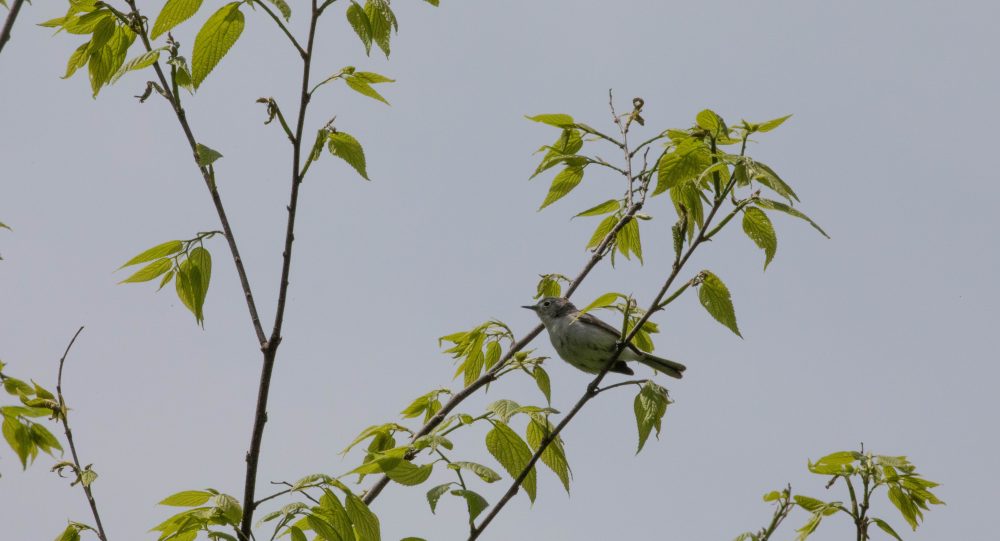
A Sneak Preview of Fall Passerine Migration

Last weekend I tagged along with Joann and Steve to two locations in Chicago. Saturday morning we went on an organized walk in Horner Park. Sunday, we visited LaBagh Woods, a place I have been to before, but not for a long time. There were hints of fall passerine migration all around us.

Horner Park is a huge space, the birdiest spots being along a walk that follows the Chicago River. We had a flock of Cedar Waxwings early.

I noticed a pair of European Starlings in the same tree the waxwings had just left. They are not fall migrants per se, but I thought they looked interesting.

Then I spotted a Chestnut-sided Warbler. Unfortunately, it was really hard to get a decent photo as the bird was quite far away.

But soon, there was a lot of excitement about a very bright male Blackburnian Warbler that did not appear to be out of breeding plumage. My clearest shot of this bird did not show his orange breast all that well, but you can use your imagination.

More excitement occurred when we found a Red-breasted Nuthatch. This bird was close enough to see and photograph very well.

A Downy Woodpecker and a White-breasted Nuthatch were trading places in another tree.

I found a Yellow-bellied Flycatcher.

Then later, I found a mysterious bird in my photos. I didn’t report it because neither I nor Merlin had any clear idea what it was. It has a very large beak, too large for a House Finch which was my first thought because it was brown and streaky. But it wasn’t a Rose-breasted Grosbeak. It’s been haunting me for days. Then I started to think maybe it was a juvenile Blue Grosbeak. Here are a couple photos. The bird was distant and lighting wasn’t perfect for detail. But that beak, that profile…

I took note of an Orange Sulphur Butterfly.

There was a female Ruby-throated Hummingbird perched distantly in front of us.

Then I started following a yellow bird that turned out to be another Blackburnian Warbler. This individual is also at the top of the post.

On to LaBagh Woods on Sunday. An Eastern Wood-Pewee was the first bird we saw.

There was a young Gray Catbird nearby,

Then one of several Ruby-throated Hummingbirds we saw that morning started flying around. We saw only females.

A Hairy Woodpecker showed up. Not a migrant, but less frequently seen.

A young-looking American Redstart made a brief appearance.

A Red-bellied Woodpecker is always nice to see.

I thought I saw a Philadelphia Vireo in a vireo cluster, but they all turned out to be Warbling Vireos.

There were several Red-eyed Vireos as well.

We saw a couple Bay-breasted Warblers. Here’s the first one I captured.

We determined the bird in the photos below to be a Yellow-rumped Warbler, based a lot on its undertail. I have to get a “Yellow-rumped” face back in my head as well.

We saw a couple Tennessee Warblers.

Here’s another Bay-breasted Warbler.

I thought this was an interesting look at a Northern Flicker from the back.

We had one or two Nashville Warblers.

Another Red-bellied Woodpecker. This looks like a juvenile.

And we saw another Yellow-bellied Flycatcher.

The Indigo Bunting below appears to be a juvenile.

We caught a glimpse of a Great-crested Flycatcher. I have missed seeing enough of these birds this summer.

Here’s another Tennessee Warbler in too much light.

Tomorrow is August 30, it’s a Saturday, and the start of the Oak Park Migration Bird Walks for this fall season. We will be at Thatcher Woods in River Forest. The event has been publicized so well I almost tend to think we will have more people than birds, but I hope we get to see some migrants and some interesting behavior. The early fall-like weather is a plus,

More Birds at the Chicago Portage

In my usual fashion, I have been trying to write this post for a few days. I haven’t even gone out every morning for more observations as I was either cowed by the weather (wind, possible rain) or the complaints of my right knee. The rainy forecasts weren’t panning out so much, but the wind gusts have been awful. My knee is better as I took refuge in the swimming pool and managed my mile, which helped a lot. If by some chance we don’t get drenched by the current forecast, I look forward to walking tomorrow and Tuesday, if for no other reason than to escape screens.

These photos are from October 26th and 27th at the Chicago Portage. Just about a week ago, but it already seems far away now that we’ve set our clocks back.

A glimpse of the statue this fall season

I have been seeing deer lately close to the trail.

For some unknown reason, House Finches appear more often in fall, here and there. This one’s a female.

Song Sparrows are blending in with the browns of fall. A few younger birds try singing.

it’s a challenge to focus on the birds foraging in the dried stalks, but I managed to catch glimpses of one or two Orange-crowned Warblers, which always tend to show up toward the ends of each warbler migration. Don’t be fooled by the common name as it is no clue to what the bird looks like.

Here and there, I saw a Ruby-crowned Kinglet.

I even saw parts of a Nashville Warbler that day.

I think this was my first American Tree Sparrow of the season. If past years are any indication I will see many more of them throughout the fall and winter.

Black-capped Chickadees are around all year and now it’s easier for them to command my attention.

Downy Woodpeckers are easier to see as well.

The Red-shouldered Hawk we had been seeing was farther away, perched in a tree.

I found a female Hairy Woodpecker.

And a Northern Cardinal stopped near the paved trail.

Another Song Sparrow was attempting a song.

The next day, on the 27th, I saw another House Finch, only a male this time.

Mallards were hanging out near the Harlem Avenue bridge.

And after looking for a Muskrat all summer long and into the fall, finally I spotted one.

American Goldfinches are still around, but with a more scattered presence. It will soon be time for me to put out nyjer feeders for them in my backyard.

I was pleased to find a Swamp Sparrow in my photos.

And another Ruby-crowned Kinglet emerged.

There was also another Song Sparrow or two.

More Mallard photos. The two in the background of the first photo are covered in duckweed.

I found a White-throated Sparrow in good light.

And a somewhat distant Northern Cardinal was not too shy.

If the predicted rain pans out for the next two days, I will try to clean up some more photos from recent walks. It’s still possible to see some different species before the winter doldrums settle in. It’s hard to focus on much of anything given our national distraction, but birds are a good place to start.

Riverside Recents

As the drought continues, with fall migration and everything slowing down along the river, like elsewhere, the search for birds amidst the changing leaves has become a little less frantic. But there are still birds to see. Here are the highlights, if you will, from three recent visits.

On October 18, a bird that rarely makes it into my photos insisted on having his picture taken.

An unmistakable Red-tailed Hawk flew into a tree.

Mallard Green is a popular color this season.

Yellow-rumped Warblers were less frequent.

White-throated Sparrows are filling in.

On October 21, two Great Blue Herons were back on the river. The one below hangs out near the Hofmann Tower.

I was on the Swan Pond side of the river when I spotted a Red-tailed Hawk perched in a tree with its back toward me.

Then a surprise visit of Eastern Bluebirds occurred when they flew into the willows near the paved trail. I have missed seeing these birds all year, so this was a special treat.

An American Goldfinch tried to distract me.

There were a couple female or younger Eastern Bluebirds like the one below.

Eastern Bluebird and Brown Creeper

A Brown Creeper crept up a tree.

I spotted a Golden-crowned Kinglet in the willows.

Mallards in the river were navigating rapids created by the shallow water.

A younger Great Blue Heron has been hanging out at the bend in the river by the library.

Two photos of the swinging bridge framed by some autumn colors.

Northern Cardinals are a little easier to see these days.

A Yellow-rumped Warbler I had been checking out flew toward me.

An American Robin sat still for me when I was unable to get clear photos of a Hermit Thrush.

I checked back with the Hofmann Tower Great Blue Heron again.

On October 23rd, the Hofmann Tower Great Blue Heron nearly faded into the rocks.

The water in the river was even lower that day.

I saw an American Robin and a Red-winged Blackbird among a few others, but it was less birdy in Riverside Lawn that morning.

One more look at the Great Blue Heron by the Hofmann Tower. There’s lots more to come. We did get some rain Thursday night to tide us over, and there’s more in the forecast for this Thursday and next week. It’s been a busy week and I’m looking forward to a little down time. Oh yes, and Halloween, of course.

October 1 at the Portage

In a furious hurry to get more photos off the hard drive… The birds just kept coming, and I kept taking too many pictures. So this is a post I started a while ago, just to get the photos saved somewhere else other than on the laptop.

October 1 must have been a beautiful day at the Chicago Portage. Yellow-rumped and Palm Warblers were showing up in numbers along with kinglets and some sparrows.

Early on, a Red-tailed Hawk flew overhead.

There were a few Nashville Warblers that morning, foraging in the lower vegetation.

Here’s a rather dull-looking Palm Warbler. But I was surprised to discover the bird at the top of the post which is also a Palm Warbler.

I try to capture a White-breasted Nuthatch whenever one is available.

Ruby-crowned Kinglets were on hand, if not very easy to see.

Yellow-rumped Warblers have been with us for weeks and they’re still here.

I found a Bay-breasted Warbler that day but they have all moved on by now.

And a couple more Nashville Warblers were a bit easier to see in the trees than they have been.

This may have been my first Brown Creeper of the fall.

Yet more Nashville Warblers.

You can see why I had to get rid ofd these photos, there are just too many of them. Here’s another Yellow-rumped Warbler.

Tennessee Warblers were seen rather consistently this fall as well.

We got lucky this fall with the appearance of Northern Parulas over a week or more. We don’t normally see them all that often, but the Portage appears to have been the right place at the right time.

Here are a few more photos of the Palm Warbler at the top of the post.

And a Red-shouldered Hawk flew over that morning. Possibly the same one has been hanging around ever since.

I have gotten a few good photos of White-throated Sparrows this fall, which you haven’t seen yet, but these were not among them. Maybe these aren’t so bad for the early arrivals.

White-crowned Sparrows were around for a week or two.

This was all I could get of a Rose-breasted Grosbeak that day.

And a Song Sparrow appeared briefly at a distance.

American Goldfinches are still finding plenty to eat.

So, that’s it for a roundup of October 1. I’ll be back with something a little more recent before I dive back into the archives again.

Last Week at the Chicago Portage

Just about once every fall, the Golden-crowned Kinglets come down to knee level to feed and, if I get lucky, I can capture one. October 17 at the Chicago Portage presented this opportunity.

Except for a Yellow-rumped Warbler here and there, fall warbler migration is pretty much over, so Kinglets rule, and sparrows are starting to appear more frequently. I have a backlog of warbler photos for future posts but the Golden-crowned Kinglets insisted I write a more timely post first.

Below is a look over the water at the Portage on a sunny, dry day, which seems to be the theme this October.

Golden-crowned Kinglets appeared early.

Then I managed to find a couple Yellow-rumped Warblers in the hackberry leaves.

I spotted an American Kestrel perched over the water. It was at quite a distance so it was hard for me to focus even in that bright light.

I found another Yellow-rumped Warbler.

I was pleased to see a White-throated Sparrow, albeit hidden in the branches.

Northern Cardinals aren’t used to receiving any attention from my lens as I’ve been focusing on migrants, so this one didn’t try to move, he just knew the shadows and branches would make him less photogenic.

I was on my way back along the paved trail when I suddenly had Golden-crowned Kinglets low to the ground.

There were some Ruby-crowned Kinglets present too, although not as many, and this one preferred to remain backlit.

Here are a few more close shots of the Golden-crowned Kinglet at the top of the post.

Another Yellow-rumped Warbler paused long enough.

I was almost surprised to see some Mallards in the duckweed. The water level is barely existent.

Here’s my last Golden-crowned Kinglet photo from Thursday.

I hope to be back much sooner with more photos from a very busy migration season. While the number of birds flying over the region is diminishing, there are still opportunities to see less common species before winter settles in. Who knows when that will be? I remember hearing or reading somewhere years ago that we could expect to see something like 8-10 months of summer with climate change and I found it hard to imagine. Yet now it seems nearly possible. As I write this on October 21, we are in the middle of a drought and the temperature is 80 degrees F. I can pray for rain if not snow.

Riverside Morning

I have what feels like a million things going on all at once and it seems never-ending. The past weekend alone was life-changing. More about that later. But this week I have to remain focused on our upcoming flute-and-piano recital Sunday afternoon. Even my birds seem to know it’s important.

So here are some photos from my walk in Riverside yesterday morning. I had several other things planned but they will have to wait. I can be more current for a change.

The first bird I saw, as it was trying to hide from me, was a bird we tend to associate with the coming of winter – a Dark-eyed Junco.

(I’m trying to finish this on my phone while I am at the car dealer for service. I hope I don’t become incomprehensible.)

As I continued to walk on the Swan Pond side of the river I encountered a Ruby-crowned Kinglet.

Then a female Northern Cardinal assumed that she blended in well with some changing leaves.

Then of course it was time for Yellow-rumped Warblers. They are everywhere in substantial numbers. It’s not unusual to see several at a time and I have become quite accustomed to their little “click” sounding contact calls.

What was even more impressive yesterday morning was their behavior. They seemed to be emulating some Cedar Waxwings who were flying over the river to catch insects in the air. I had never seen Yellow-rumps do this before.

This vine always turns bright red, and can be counted on even in a drought to provide some fall color.

More Yellow-rumpeds up close and personal.

I managed to get a Golden-crowned Kinglet to slow down long enough for a photo or two.

Killdeer were busy in mudflats that have sprung up everywhere in the shallow waters of the river.

Then, as I was crossing the swinging bridge, I saw a Spotted Sandpiper on the shore below. I have seen one or two of these birds at this spot before so I just dutifully tried to get the best photos I could without thinking too much about it, but then when I entered it on my EBird list it came up “rare.” All the better to have the photos.

In Riverside Lawn I saw a White-throated Sparrow.

Then I encountered a young doe having breakfast.

Of course there were more Yellow-rumped Warblers, if not much else. The individual below the flying bird appeared to be drying off its feathers after a bath in the river.

The Killdeer were busy flying around and I finally managed to capture them that way.

That’s about it for yesterday’s birds. When I got home after swimming, I noticed Milkweed Beetles all over the seed pods in the front garden.

So I have been in a dream all weekend and I am reluctant to wake up from it. My favorite singer-songwriter over the last several years has been Peter Mayer (from Minnesota). I discovered his music when my friend Cory Anderson sang Peter’s iconic song, “Holy Now”, at what I think was the first or second Spring Music Festival that I performed in with my flute playing friend Linda Rios. Just Googling “Holy Now” led me to YouTube videos and eventually Peter’s website where I found albums on CDs galore. I eventually bought them all and fell in love with more songs than I ever imagined could be written with such incredible lyrics and beautiful tunes and arrangements. Peter Mayer also is a fantastic guitarist and singer. And he somehow manages to find hope for humanity through storytelling and metaphor, which is in such short supply these days.

Years ago, before the pandemic, I did get to see him in concert at a church in the northwest corner of the state. I started a small one-person campaign to see if we could get him to come to Unity Temple for a concert. If nothing else, he has a song in one of the hymnals called “Blue Boat Home.” But my request got lost in the myriad other things going on.

During the pandemic, Peter resorted to doing YouTube concerts periodically from his basement. It was a great experience for me to see him more often and get to know him more personally, or so it seemed. And I think it was also rewarding for him in a way as he could continue to write more songs and try them out on his larger following. He is now releasing singles instead of albums, as CD players become relics of the past.

So why am I telling you all this??? It’s because, thanks to our developmental minister Roger, who knows Peter from another congregation where he served, Peter Mayer played a concert at Unity Temple on Saturday night and the next morning, he sang for the service, sang with the choir, and gave the sermon – twice! – as we have now resumed two services. I Was In Heaven!! It was a transformative experience. Up there with the discovery that birds sing with music in key and they are listening to us. And even better than that, after Peter’s sermons about mindfulness and connection with the universe, I thought he should know about the birds and the music. I could see the wheels turning in his head as I told him about it. And I left him with the thought that, after the Big Bang, there was a Big Chord. Music is indeed the beginning of everything. And with luck, it just might be our salvation.

Thanks for listening. I will resume regular programming in my next post.

Oh, and by the way, if you are at all curious about Peter Mayer, he is at PeterMayer.net, to distinguish him from the other one who is “.com” and, as Pete joked about it at his concert, “is also very good looking.”

Down by the River

I’m trying to get caught up with birds I saw last week while continuing to see that many more individuals this week. It’s almost like being on a birding tour.

On Wednesday, September 25, Riverside was busy. Great Egrets have been gathering by the Hofmann Tower, along with one or two Great Blue Herons.

I crossed Joliet Avenue at the bridge in my usual fashion and started walking the paved trail along Swan Pond. Yellow-rumped Warblers were starting to show up.

Magnolia Warblers, like the one at the top of the post, were easier to see.

I found a female Black-throated Green Warbler, however backlit.

First winter White-crowned Sparrows were along the path.

Crossing the swinging bridge, I found two Great-blue Herons and a Great Egret standing in the shallow river.

More Magnolia Warblers were waiting for me in Riverside Lawn.

Another Yellow-rumped Warbler posed for me.

I was surprised to see a new dragonfly!

Wandering Glider (female)

A Lincoln’s Sparrow tried to hide in some dead leaves and kept sneaking looks at me.

Here’s another Yellow-rumped Warbler.

I approached a clearing with fallen logs and saw steam rising up from one of them.

Shortly thereafter, I found a male Black-throated Blue Warbler. It was hard to get good photos with the bright sun behind him. But even if I had not seen the whole bird, that last photo showing the trademark “handkerchief” white spot would have clarified his identity.

More Yellow-rumped Warblers appeared. They are very busy and not too shy.

It’s often hard to capture an American Redstart but I managed to find one or two in momentary repose.

There were a couple Bay-breasted Warblers.

And a Black-and-White Warbler came to investigate the bark of a hackberry tree.

Here’s another American Redstart. I’m including the last photo because I have seen a lot of these birds’ attempts at tree-climbing this fall.

And here’s one more Bay-breasted Warbler.

And another Yellow-rumped Warbler.

The bird below turned out to be a Pine Warbler. I’m beginning to think they are the most confusing fall warblers, period.

The last bird for this post is another Yellow-rumped Warbler.

I have been lucky to find small mixed flocks of warblers several times over the past week or two. It seems like the race is on to capture as many photos as I can. It’s a busy week socially too. And right on time, we are having a little taste of October weather. The long, lazy-seeming days of summer have slipped away.

Return to The Chicago Portage

This morning was cloudy and comfortably cool, without the heavy wind gusts from yesterday. The wind direction remains coming out of the Northeast, which should bode well for warbler migration. I went to the Chicago Portage somewhat late this morning, sleeping in after attending a play last night, and I did not expect to see much activity after yesterday’s drizzly walk at Columbus Park. At the Portage, I met up with Bob who had arrived a half hour before me and told me he had seen only two species.

As we started to walk down the paved trail together, it was soon apparent the birds had been waiting for us. I wound up taking over 300 photos which I spent a good part of the day paring down to 195. After I had been through them all a few times and solidified my list, I reported 29 species to eBird, 12 of them warblers.

We saw a couple Palm Warblers and Yellow-rumped Warblers which I did not manage to photograph well, and then we saw our first Northern Parula, which turned out to be the Warbler of the Day, although Black-throated Green Warblers came in a strong second. Here’s what the first Northern Parula looked like before we started seeing them all much more clearly.

Here’s the first Black-throated Green Warbler I captured.

Then we caught a glimpse of a coyote running out from the direction of the water, to cross the trail ahead of us.

A Ruby-crowned Kinglet caught our attention.

Of a few Magnolia Warblers, I only managed the photo below,.

A brief glimpse of a Magnolia Warbler

A Blackpoll Warbler first appeared with its back toward us, but graciously displayed its orange legs.

Then we got really good views of a Northern Parula. This one is the same individual at the top of the post, and I was in heaven – I really love seeing this bird. I’ve seen them on a couple occasions during the Saturday walks this fall, but up until now I have not had good looks, so this was just wonderful.

Next we saw a Bay-breasted Warbler. I should know this Bay-breasted face by now, I have had enough of these birds peer into the camera lens with curiosity.

Although this post is focused mainly on warblers, I have to include a very pretty adult non-breeding male Rose-breasted Grosbeak.

The camera caught a brief look at a Nashville Warbler. Apologies to Bob if this is the bird I identified in the field as a Common Yellowthroat. I am not sure, though, if I managed to capture the Yellowthroat. And so it goes.

Another Northern Parula!

More Black-throated Green Warblers appeared.

Between the green and yellow leaves and the two predominant warbler species displaying green and yellow in their feathers, it all made a lot of sense.

Here is another Bay-breasted Warbler, looking not so much like the one that appears earlier in the post.

For all the Yellow-rumped Warblers I have seen over the last few days, I was able to only barely capture one this morning. Have no fear, I will be back with many more photos of these birds.

Then a Tennessee Warbler came into view.

Sure enough, another Northern Parula grabbed my attention.

There were even more Northern Parulas, but first, it took me a while to decide that the bird below, rather nondescript, was quite probably a Pine Warbler. And just so you know, the Warbler Guide app on my phone clarified it for me. Take a look at the last photograph where you can see there is no streaking on the top of the back but note the lower contrast tertial edging – that’s how they phrased it. In other words, the entire back isn’t streaky like a Blackpoll or a Bay-breasted Warbler. What a great new field mark to discover!

I also found what looks like an Orange-crowned Warbler in my photos.

Well, that about wraps it up for this morning’s outing. We had other species, such as American Robins, Downy Woodpeckers, Northern Flickers, American Goldfinches, etc., but we gladly let the warblers distract us. Here’s a few more of my bird of the day, Northern Parula. I will be back as soon as possible with more photos from the past week or two. There are so many of them!

III. Thatcher Woods Once More

Here’s a little roundup of Saturday’s return visit to Thatcher Woods. The photo at the top of the post is not from Thatcher Woods but from my front yard as I left the house at 7:30 in the morning. There was an American Goldfinch scavenging the seed heads. It refused to turn around and face me. But it was the closest photo I was to get of any bird for the day.

It was a day filled with Gray-cheeked Thrushes, several flycatchers and more warblers than we had on Monday, although I did not capture them all. So this is a shorter post if not an easier one on the eyes.

I was on time for an 8:00 AM meetup, but I was a bit later than some others who live close by, so I missed seeing a few species. At least I managed to capture the Great Blue Heron that hangs out in the water by the museum parking lot.

We noticed some birds in the wildflowers by the gravel parking lot across the street. I managed to find a Tennessee Warbler when it finally sat out in front of the vegetation.

This might be a different individual – or was it the light?

The first out-of-focus photo below tipped me off to the identity of a Chestnut-sided Warbler.

Then we spotted a very distant Black-throated Green Warbler

It was surprising to see an Eastern Phoebe perched so high.

A Magnolia Warbler appeared.

And we saw what for many of us was our first Ruby-crowned Kinglet of the season.

A Northern Parula was again barely visible.

A Rose-breasted Grosbeak appeared for a refreshing change.

Even a House Wren was a bit challenging.

After some debate we decided this was likely an Olive-sided Flycatcher. Flycatchers are notoriously difficult to distinguish, especially the ones we don’t see except in migration.

Below is a perfect Gray-cheeked Thrush, if I am to rely on Sibley’s note that they have “darker and more extensively olive flanks” than the other thrushes.

More Gray-cheeked Thrush photos. I might note that the bird on the ground in the middle I first called out as a Hermit Thrush as I was hoping to see one, but the camera does not lie. However, I did see two Hermit Thrushes yesterday in Riverside. which made me feel better. It could just be I’ve been seeing so many Gray-cheekeds that I’m trying to turn them into something else.

The bird below looks like a Swainson’s Thrush.

The flycatcher challenge continued. The Merlin app seems to think this is a Least Flycatcher, and after checking with my copy of The Crossley Guide which is extremely helpful, I have to agree.

Palm Warblers are starting to show up in numbers, but I have yet to get a good photo of one.

The last bird I photographed was a fly-by Red-tailed Hawk.

Now that I have bombarded you with three posts on the same day, I promise it will take me a while before I return with yet more migration photos. I had 500 photos to go through from yesterday morning. I’ve narrowed it down to 339 on the first pass, but there’s more work to do. Thanks for your patience and endurance!

A side note: there was a celebration event at The Chicago Portage on Saturday which I intended to check out as well, but by the time I got there it was nearly 90 degrees and since I wasn’t participating, I was asked to park at Ottawa Trail and take a shuttle – it was just too much for me. I settled for buying a 50-lb. sack of black oil sunflower seed at The Feed Store and coming home to the air-conditioning, which already seems like a thing of the past, now that we have cooled off so much.

II. Riverside Last Monday

After Thatcher Woods last Monday, I stopped by Riverside to get caught up with more fall migrants. I’m taking advantage of some well-needed rain this morning and trying to catch up with last week, because this week got off to an even birdier start yesterday. But I digress.

After parking in my usual spot by the Hofmann Tower, I photographed a lone Rock Pigeon standing on the railing overlooking the river. It’s wearing two bands.

Then, off the Joliet Avenue bridge, a Killdeer approached. The drought exposed the rocky sometime-island where these birds love to forage – and blend in.

There were a few warblers around the bend off the paved trail by Swan Pond. I first spotted a busy Blackpoll Warbler.

American Robins don’t often grab my attention long enough.

Then I started to see an American Redstart scaling a tree trunk. I’ve see a lot of this behavior this migration season. This looks like a female.

Nashville Warblers have been hard to capture, especially when they are foraging low in messy flowers like this Boneset.

A Gray-cheeked Thrush was on the path before me with a very dried-out earthworm. I think this was on the shortcut that goes from the paved trail to the lawn leading up to the library.

After crossing the Swinging Bridge and walking into Riverside Lawn, I caught a glimpse of a Great Egret through the trees, standing in the middle of the river.

As I started through, I noticed a Black-and-White Warbler.

Black-capped Chickadees don’t often offer themselves up for photos, but when they do, they are entertaining little birds, always friendly.

I spotted a Magnolia Warbler in the hackberry leaves.

Here’s another female American Redstart.

The most subtle and confounding warblers could be Black-throated Blue females. I hope that’s what this is. I think it’s easier in the spring when they are sporting their little white “handkerchiefs” on their wings.

I could almost talk myself into thinking the bird below is an Orange-crowned Warbler, but the undertail coverts are white, so that can’t be.

More American Redstarts appear. The females seem to be abundant now.

And here’s the last Magnolia Warbler I was able to photograph.

A more distinctive-looking Blackpoll Warbler – perhaps.

And another.

Here’s a Bay-breasted Warbler.

I feel like I have seen more Gray-cheeked Thrushes this fall than ever.

And last but not least, the first-year male American Redstart who is also at the top of this post.

Now I will have the luxury of taking these photos off my hard drive. The craziness continues, but I suspect not for too much longer. We cooled off considerably on Sunday with some rain, and it looks like we are going to stay in pleasantly seasonal fall temperatures for the coming week. Millions upon millions of birds flew over Cook County the last couple evenings, according to Cornell’s Birdcast. I was lucky yesterday to have encountered several along the river, just one week after this visit. I’ll be back!