Yet Another Day in May

While contemplating more recent outings for posts, I took a peek at my Chicago Portage photos from May 25 and there are some interesting ones – now that almost everything has changed three weeks later. From the looks of the birds in the photographs, it appears to have been quite cool, and according to the Weather Channel it was indeed cooler than now with a high of high of only 61 degrees F. and a low of 45. I found no mention of the weather in my drivel for that day. I was still getting over the previous night’s performance of Manuel de Falla’s Serenata Andaluza at the Unity Temple Choir talent show:

I am just barely maintaining my sanity. I have reflected on yesterday’s performance, such as it was, of the De Falla. It was a total out-of-body experience. I did not have any idea whatsoever of what I was doing until the second half of the piece. Luckily it finished well, so that likely erased the audience’s memory of what went before it. But I couldn’t tell you what happened in the beginning. I may as well have been playing on glass. It felt totally foreign and strange. I had to rely on my muscle memory to get me through the beginning. I missed notes here and there but did not lose my place, which is totally amazing, because I don’t know where I was or who was playing. I may as well have been sleepwalking.

Speaking of performance, of a sort… I finally figured out how to edit videos once I have uploaded them to my version of Lightroom, so below is a very short but concise and clean video of Tadziu, the Indigo Bunting, at the top of the post – singing.

Indigo Bunting singing (It is Tadziu)

The first photos I took were of American Robins. The middle photo below appears to be of a very young fledgling.

Then by the water, there were some chilly-looking Barn Swallows.

I also found a few Northern Rough-winged Swallows. One was sharing a fallen tree branch with an American Goldfinch.

It’s that time of year when some birds defy easy identification. It seems awfully early, but I believe the nearly unidentifiable bird below is a fledgling Indigo Bunting.

Merlin couldn’t identify it properly. It suggested it was a European Starling. I know better than that. In the last photo below, a female Indigo Bunting showed up beside it, so that’s how I determined it was likely a fledgling.

I spent some time watching a Green Heron hunt for food.

It couldn’t have been a great day for flycatchers but I saw two.

Eastern Phoebe

And this might have been the last Veery I saw.

Gray Catbirds were still out and about but lately they have gone into hiding.

House Wrens are abundant and very vocal.

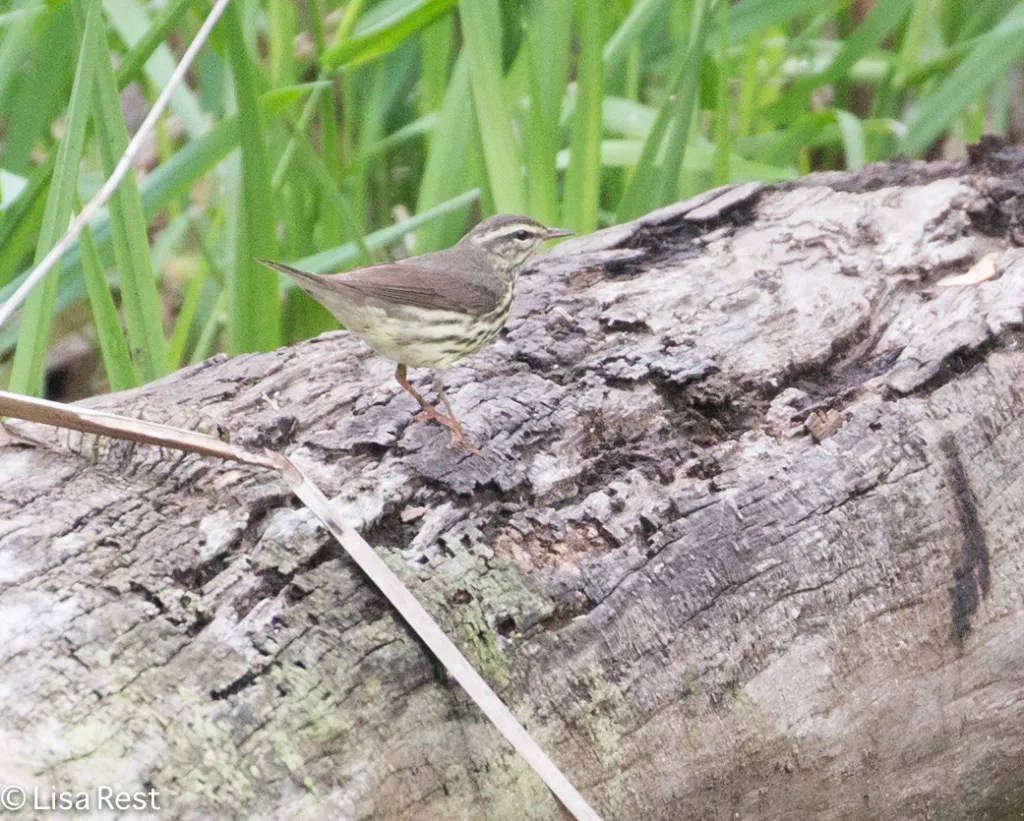
Distantly viewed from the bridge, this was likely the last Northern Waterthrush I saw this spring.

It also may have been the last time I saw a male Orchard Oriole here. Even more frustrating was after I took these photos, he sat still for a while, but for the life of me I could not focus on him so all those photos were useless.

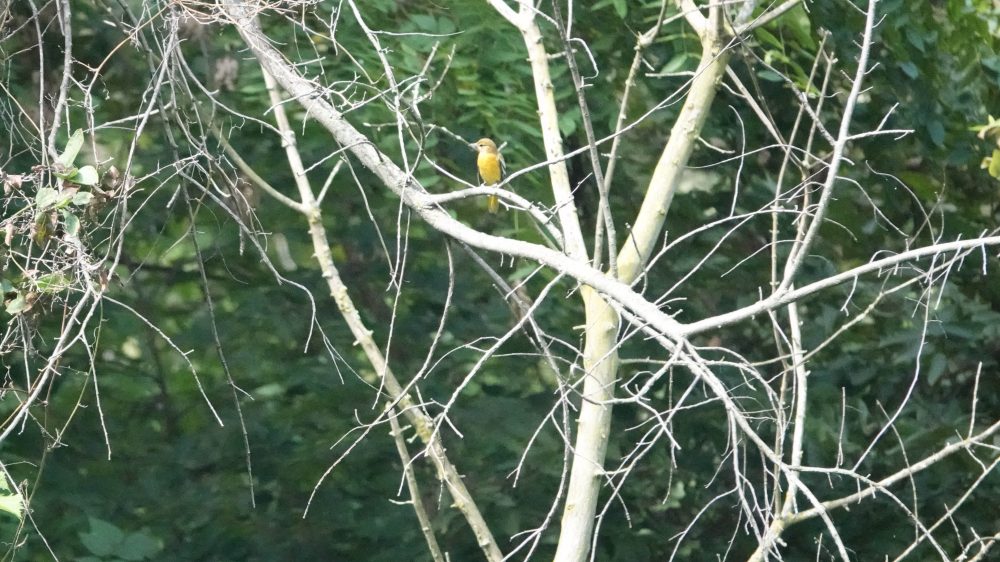
I did manage to capture a female Baltimore Oriole on the move.

That’s it for May 25. I will be back next with more recent photos before I go back in time again. I am looking forward to opening the windows tonight to cool off the house a bit. We are experiencing weather more common in desert locations. It’s hot and dry during the day, with no humidity to hold in the heat overnight. Our drought is now considered serious. But that’s a subject for another day.

Farther Afield

I started writing this post several days ago when it was cold and overcast, which was supposed to give me some extra time to get caught up on things. Between birding, swimming, planting, watering, playing piano and the general maintenance of the home crowd, not to mention sorting through photos every day which usually necessitates a nap or more coffee… I all but ran out of leftovers which means I need to do more cooking soon. The watering routine supplanted my kitchen energy, no pun intended.

We did get a little rain Sunday morning. It wasn’t all that much, but I accepted the gift as gratefully as possible and did not water the new plants. I went back to watering that evening, however. There have been too many forecasts of “possible” rain which didn’t sound too firm to me. More recently, yesterday, we had a very slow, steady, but somewhat soaking rain. I was surprised to find my rain barrel full.

So much for the weather. I took off for a few different locations the last week of May/first week in June and here is somewhat of a report. I went first to the Hebron Trail/Goose Lake Natural Area in McHenry County on May 28 to see some Yellow-headed Blackbirds. Below, a shot of the trail leading to the marshy area and an Indigo Bunting that was in one of those trees.

In the marsh, there are always other breeding birds I expect to see, like Willow Flycatchers.

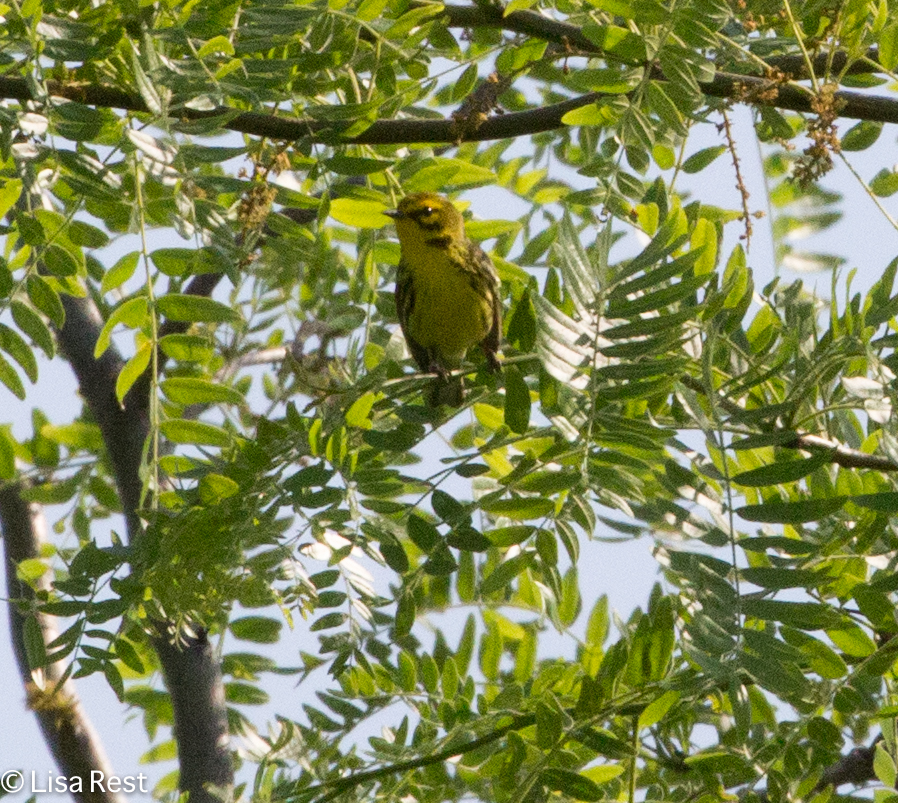
Yellow Warblers are not too bashful there.

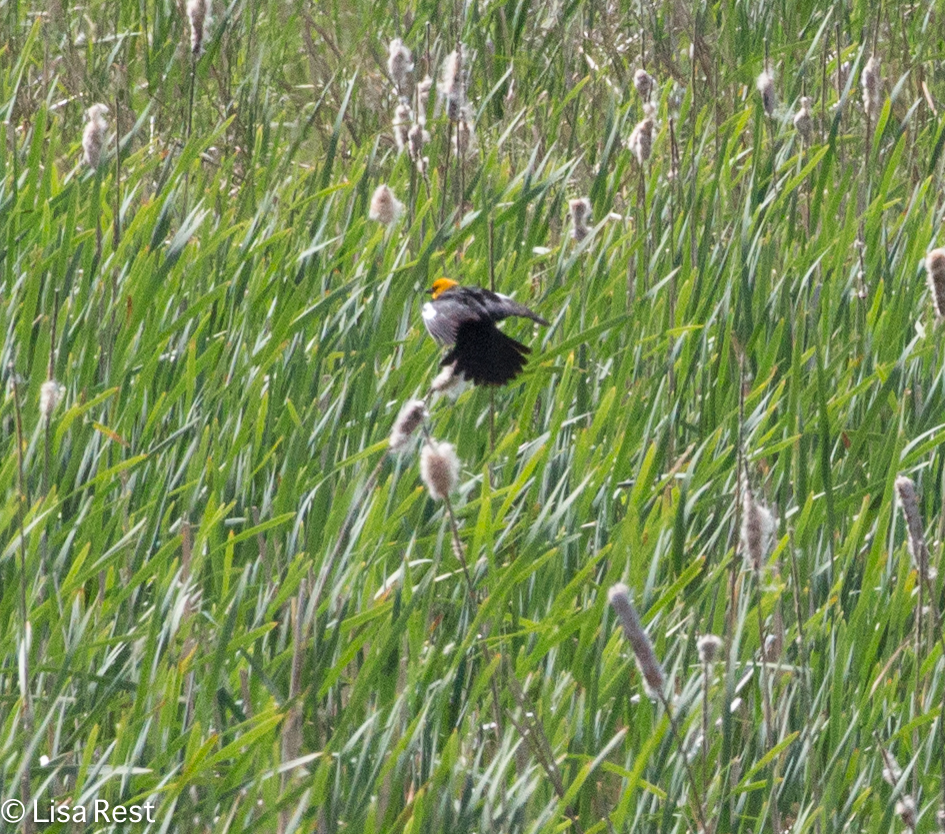
There were several Yellow-headed Blackbirds singing on their territories. They were just barely close enough to get in focus with a 400mm lens. I went back through my photos from previous years’ visits later and determined that the birds were easier to see closer to the observation deck and the trail in late June and mid-July, so I will be going back to try my luck again with these pretty fabulous birds. I should be able to see juveniles and some females in July. It was still worth the trip to see how many of them were on site, and to hear their songs fill the air.

At one point a Sandhill Crane flew over the marsh.

The water level is low, so there were not too many birds in it. I managed to find one Pied-billed Grebe.

I had a close encounter with a demonstrative Gray Catbird.

Hardly any American Robins in this habitat, but I caught one taking off from its perch.

It was nice to see a Black Swallowtail butterfly, even as it was trying to make do with Dames Rocket. I have seen this blooming in several locations this spring. It’s been years since I first noticed it in my yard and started accumulating a list of invasive species.

I have always seen little holes in the path, but this time it became apparent that are homes to Chipmunks.

Even though the Yellow-headed Blackbirds were so far away, I was compelled to attempt too many photos.

More of a challenge, although closer, was capturing a Marsh Wren.

I thought this pair of Mallards looked nice in flight.

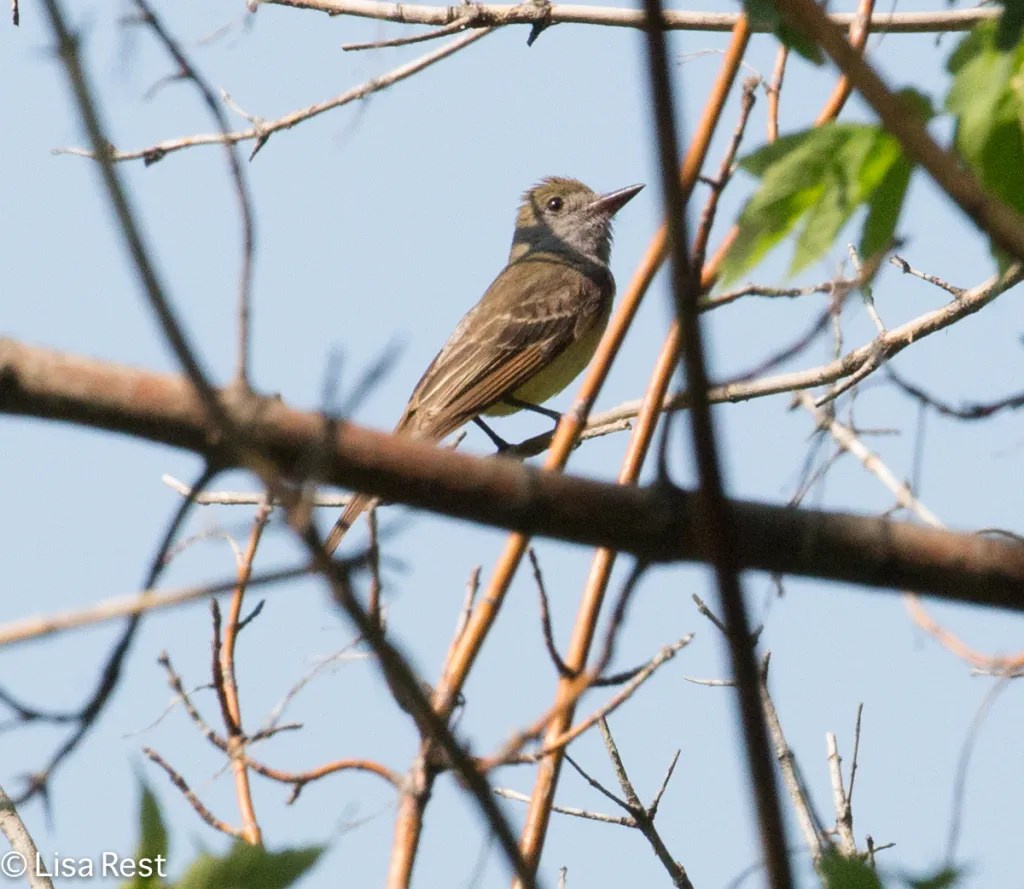
My best subject turned out to be one of two Great-crested Flycatchers in the tree-lined section of the trail.

A few days later, I considered that I missed all the spring migration bird walks with Henry G., but I was curious about one location I had never been to. G.A.R. Woods turns out to be an area south of Thatcher Woods in River Forest. I went there on May 31. It was one of those rather chilly mornings but there was some good woodsy habitat. All the spots where water accumulates were bone dry, but I could imagine them in wetter times. I was a day or two late for most of the migrants Henry reported but was content to see and hear an Acadian Flycatcher which oddly enough had not been on his list.

Before the inundation of Prairie Warbler photos, a word or two about a few other birds I saw at McGinty Slough. Field Sparrows were numerous and easy to see.

There was also a Brown Thrasher at some distance.

And a very nice-looking Eastern Kingbird too.

But the Prairie Warbler was the highlight.

So now that we’ve become all too familiar with the Prairie Warbler…I’ve been so busy I could almost use a vacation from retirement. It’s often hard not to just curl up and take a nap. But I have seen and photographed even more beautiful birds lately, so I will try once more to be back sooner to this page.

The Birds Are Back: 2 – a Weekend Birding the Chicago Portage

Last Saturday morning, I led the first of two Unity Temple Auction bird walks at the Chicago Portage. After the group left, I stayed and found more birds with Bob Smith. I went back again the next day. Both days were cloudy and sometimes even a little drizzly, which did not make for great photographs, but I took too many photos anyway. Spring migration is finally rolling.

Before I go further, I just wanted to share the photograph below that reminds me of a wallpaper pattern. Birds have a natural artistic sense.

Baltimore Oriole Wallpaper

WARNING: This post has too many photographs. You may get dizzy. I certainly did trying to get them all in here. For the sake of expediency I am forsaking any attempt at order. Sort of.

American Redstarts are always a challenge, even in good light.

Below is a first-year male American Redstart.

And then a second year or older male…

There have been a lot of thrushes at the Portage. Below are Swainson’s Thrushes.

I have seen several Gray-cheeked Thrushes too. The unfortunate lack of light didn’t help with the images of the one below.

Northern Waterthrushes, several of which have been present lately, are a different type of New World Warbler. They’re not thrushes. I thought I heard somewhere that they now had their own classification, but they are still in the parulidae family.

Another Northern Waterthrush, down close to the water where they normally forage.

Yellow-rumped Warblers are still around.

Back to the Thrushes. Below are two individual Veerys seen on both days.

Scarlet Tanagers are back. A pair could stay to breed at the Chicago Portage.

Female Scarlet Tanager

Indigo Buntings are back to raise families as well.

My Indigo Bunting friend Tadziu was not available when I led the group through the trails, but he showed up later on Saturday. Below the photos is a video I took of him the Thursday before, which has some of his song.

If you remember my Flicker Mania post from April 15 when Northern Flickers were Everywhere, by contrast, it’s now definitely a challenge to catch a glimpse of one of them.

A busy Northern Flicker

House Wrens fill the air with their chattery songs. Most are staying for the summer.

A House Wren

Tennessee Warblers can also make a lot of noise, but they have been difficult to spot.

A Baltimore Oriole is below, collecting material for her fabulously constructed nest.

This Black-throated Green Warbler almost disappeared into the green.

Blue-gray Gnatcatchers are not easy to spot these days. They’re way up high and maybe even a little harder to hear with their wheezy song.

They were much easier to see just a couple weeks ago.

Another bird that can be heard everywhere but makes a rare appearance – a Warbling Vireo.

I barely caught a glimpse of a female Common Yellowthroat (in the first two photos below) and then discovered I had by chance barely captured the male as well. This is a warbler of open fields and some park-like settings, and is most often found in shrubby habitat. They stay all summer and you might even forget about them were it not for often hearing the male singing his “witchety wichety” song loudly from some hidden location.

Below is an Eastern Wood-Pewee, a flycatcher that normally stays through the summertime at the Portage. It has a lyrical song for a flycatcher that can often be heard from quite far away. If I hear one singing closer, I will have to see if I can record him.

On Sunday I saw the Great-crested Flycatcher below. Ebird tells me I saw my first one this year on May 9.

Empidonax flycatchers are often tricky to identify, especially without accompanying vocalizations. I believe the bird below is a Least Flycatcher, which is also the Least Difficult to ascertain.

Another Swainson’s Thrush is below. I finally heard one singing yesterday.

It was hard to capture a Nashville Warbler those two days.

I have since seen more Magnolia Warblers and I promise to post some better pictures soon.

We still had a Dark-eyed Junco last weekend, which came up rare for such a late date.

Chestnut-sided Warblers have been around for a week or more. I promise better photos to come of this bird too.

Below is one of two Osprey that flew over late Saturday morning.

The Wilson’s Warbler below was kind enough to offer his most reliable field mark, although in better light, I can wax rhapsodic over Wilson’s Warbler Yellow.

Northern Cardinals might be a little puzzled – or bored – by all the fuss over the influx of other brightly-colored birds. They seem less bothered by the camera’s attention lately.

We saw a Beaver swimming in the stream Saturday morning. We also saw a Muskrat later but I didn’t get a respectable photo.

Swallows were busy. There were Northern Rough-winged Swallows… which I saw, incidentally, this morning before it started to rain.

And there were Barn Swallows.

White-crowned Sparrows were easier to see.

I saw my first Blackpoll Warbler last weekend.

One more Indigo Bunting

I promise not to do this again…it’s too hard to organize. But I just had to let loose with these photos before diving into the rest of them. Spring Migration is like the Holy Grail.

I was praying for rain this morning but the forecast was indecisive, so I went to the Portage. It started to rain in earnest about twenty minutes after I got there, so I switched priorities and did my grocery shopping. I will go back out to swim shortly. My new plants are grateful for the rain. And since I didn’t manage to stay up late last night to finish this post, so am I.

Tomorrow is the second auction bird walk and the forecast couldn’t be better. We should have plenty of sunshine which will make it easier to see the birds.

Spring Starts at the Slough

I have been to McGinnis Slough twice this month – on April 8 and this past Sunday, the 23rd. It’s been such an on-again, off-again spring, it’s really hard to imagine, let alone anticipate, what to expect. But I always find a visit to this site full of potential surprises.

It was warm and sunny on April 8, and there were even some dragonflies I could not capture with the camera, but it certainly seemed like spring was imminent. The dominant species in the water – Northern Shovelers, Blue-winged Teal, and American Coots – were still present two weeks later, with a few additions. But the visit on the 23rd was cold and cloudy, which presented some extra challenges.

There are a lot of Northern Shovelers. Their numbers are exceeded perhaps only by the American Coots. But it has been hard to get a close view of them. They were a bit closer on the 23rd, when the light was less forgiving.

But I did manage to capture them in flight on the earlier visit.

I often inadvertently flush the Coots out of the marshy areas as I walk by, but for whatever reason I was able to capture a few of them somewhat closer than usual.

Blue-winged Teal have been everywhere this spring.

I managed to get quite close to a pair of teal nestled by the back end of a Canada Goose. You can’t see the birds very well, but I found the exposure of the preening male’s feathers fascinating.

Two more Blue-winged Teal photos.

I adore Pied-billed Grebes. They always look like they’re smiling, if rather sardonically. I was very close to a couple of them on the earlier visit.

The slough has greened up considerably in the last two weeks.

I managed to grab a few photos of a small group of Bufflehead on the last visit.

Also last Sunday, one Great Blue Heron testing the chilly water.

There were a considerable number of Ring-necked Ducks this last visit, but they were too far away to capture well. This was the best I could do from a distance.

Ring-necked Ducks

The Mallard drake below was likely guarding his nest location.

Red-winged Blackbirds simply own the marsh.

Black-capped Chickadees were enjoying the warm sunshine on my earlier visit.

The obligatory American Robin

I have seen Tree Swallows off and on all month, but mostly on the warmer days.

I always expect to see Wood Ducks here, but they are a bit more secluded right now. In a month or two they should be easier to find hanging out on their favorite fallen log.

Just another reminder that it is nesting season already.

Common Grackle
Blue-winged Teal

It was cold and rainy this morning. I kept arguing with myself about going out for a walk anyway, as soon as the rain stopped. The rain, as miserable as it is with the cold, has not been a downpour. But it has kept me in, and now the day is getting away from me. This afternoon, Linda and I have our likely last rehearsal before we perform in the 2023 Spring Music Festival. The run-through is Friday night and the actual event Saturday evening. It will be our comeback performance after the 2019 SMF.

I have many more observations to share from my other two most-frequently-birded locations, but the balancing act between musical endeavors and spring migration will be a bit more sporadic this week.

Portage Potpourri

It’s time to go back and sift through the summer’s photographs so I can start making room for the always anticipated overload of fall migration. As usual I find I have way too many photos that I had forgotten about. The ones in this short post go all the way back to June 4 and June 9 which don’t even qualify for summer yet, but the breeding birds had already been busy.

So this is a female Indigo Bunting. I love her delicate colors. And below her photo is a male, possibly my friend I have named Tadziu.

One bird I haven’t seen all summer, although they typically breed at the Chicago Portage, is the Yellow Warbler. I expect to see some in the next few weeks during fall migration. If I was seeing them so regularly in June they must have been nearby all summer.

I found this little bird’s photos and had to think for a moment what it was. I’ve concluded (with the help of other photographs online) that it can only be a very young Warbling Vireo.

For a short period of time, Gray Catbirds were making themselves available for photos until they disappeared later like nearly everybody else.

I’m beginning to realize this was an absurd idea because more recent photos are starting to accumulate quickly on my hard drive and I won’t be able to review older ones much longer.

Yes, a Chipmunk

House Wrens have been abundant all summer, but not always easy to see.

And every once in a while, an Eastern Phoebe would pose.

I am grateful for the many times I have seen Eastern Kingbirds.

Red-winged Blackbirds are due to start showing up in huge flocks before they take to their more southern destinations. They have disappeared from their breeding grounds. I suspect they have been busy educating the youngsters about self-reliance and survival.

American Robins are perhaps the most adaptable birds, thriving in and out of the human disturbance.

I was intrigued by the capture below – it looks like a very young Red-winged Blackbird.

Baltimore Orioles have been much harder to see long enough to capture lately.

I saw a Daddy Long Legs only once… and my favorite grass, the Squirrel Tail Grass, doesn’t look like this anymore, indeed, I haven’t noticed it at all lately.

Also well-adapted to us humans are American Goldfinches. They always seem so cheerful.

I don’t know what happened to the Song Sparrows at the Portage. I am not sure if any stayed to raise families.

The White-tailed Deer are making less frequent visits than they were earlier.

Another American Robin

Here are two quick and slightly blurry photos of a Blue-gray Gnatcatcher.

I have never seen this yellow iris before…or since.

Here’s what the cottonwood seeds looked like in the beginning of June.

As if to prove my earlier point about adaptability, one American Robin built a nest on the edge of the shelter in spite of the spikes to deter such activities.

I have so much going on right now I can’t say when or with what I will return. But I figured as long as I started this post a couple days ago I may as well finish it.

We had our first choir rehearsal last night, and we are singing this Sunday. I was a bit surprised at how good it felt to stand together and sing, albeit still masked. And so we take the plunge into another year. And I will have to start getting up earlier – in the dark – as the fall bird walks start again next week.

McGinnis Magic

I went to McGinnis Slough yesterday morning. It’s been on my mind for a week, and since there isn’t a lot of trail on the east side by LaGrange Road, I decided I could manage it with my knee, which I later took to the pool for a therapeutic swim. The Slough, of course, looks more like a bog.

But it was good to be somewhere else for a change and at first I didn’t see very much. There was a nice Eastern Kingbird. This seems to be the bird of the week.

The Rose Mallow is in full bloom. I always look forward to seeing this.

There was a beautiful Great Black Wasp on some Queen Anne’s Lace.

Walking north toward the overlook of the slough, I saw two Eastern Kingbirds in the Elderberry.

And there was an obligatory Rabbit.

There are usually a lot of dragonflies here but it was cool and a bit overcast so I only managed to capture this Blue Dasher Dragonfly and a Blue Fronted Dancer Damselfly, species I have been seeing all summer.

There seemed to be what looked like Evening Primrose all over the place. I used to have some in my yard years ago.

There was virtually nothing to see without a scope over the slough, and I could barely make out seven or eight Great Egrets, but that was a sign of things to come.

As I walked back south along the trail that follows some nearby open water, such as it is, I encountered a few delightful House Finches. They appeared to be juveniles and as curious about me as I was about them.

And then, through the tall grass, I saw a Great Egret perched on top of a branch of a fallen log that I have seen other birds on before.

As I tried to capture the Great Egret clearly through the grass, I noticed something else. Lo and behold, two Trumpeter Swans and their three Cygnets. I saw this configuration last year, but it must have been earlier because the Cygnets were much smaller. It’s good to see these three have survived to this age.

It then became evident that the Wood Ducks were hanging out on their favorite fallen log nearby.

Here’s a closer cropped image of the transforming male in the tree above.

But that’s not all that was going on. There was a Great Blue Heron behind all the ducks.

I was back there for some time, and not terribly far away from the birds, but I guess they felt safe behind all that grass that got in the way of my photos.

Then at some point another Great Blue Heron flew over, squawking somewhat vociferously,

There wasn’t too much to look at in the rest of the open water, but this little group was nice.

2 Mallards and 2 Wood Ducks

On my way out, as I stopped to look at something in a tree, I noticed there were three Great Egrets perched in another tree which reminded me of how this place used to look years ago when there were scores of them.

Needless to say I was restored by my encounter with these birds. And then swimming made it a nearly perfect day as I was able to work on my knee without injuring it further. I’m trying everything. Exercise, different shoes, whatever. It’s encouraging. Then I celebrated by getting my second Covid-19 booster, figuring it was probably a good idea to get it done before choir rehearsals start soon. The booster has left me feeling a little down, but I guess that means I needed it. Who knows? Everything is a gamble these days. Playing fast and loose with an ice pack on the futon.

End of July Tidbits

Here’s what was going on at the Chicago Portage the mornings of July 29 and 31. Pretty much what can be expected mid-summer. Feeding fledglings and molting. A busy time for the birds.

On July 31st there was what appeared to be a family of Eastern Kingbirds.

I didn’t manage to get them all in one photograph but there were four Eastern Kingbirds total.

I can expect to see an American Goldfinch in the duckweed this time of year, and I can never entirely resist documenting its presence.

Blue-gray Gnatcatchers were here and there, if not always easy to see. But then they hardly ever are. The bird in the tiled series looks to be a juvenile.

After barely seeing a Downy Woodpecker out in the open for a few months, it was nice to see this one out and about. It looks to be a young bird as well.

Tadziu the famous Indigo Bunting was busy with his feather upkeep, on a fallen log close to his bridge.

The distant Indigo Bunting below was more disheveled.

A young-looking Marsh Wren was investigating this fallen log.

A young American Robin was curious about the camera attention.

The American Robins below appeared to be sunbathing on the gravel path. I tried not to disturb them for as long as I could.

An juvenile American Robin caught in flight, below.

It’s not often that I catch a Northern Flicker still for a moment.

Below, two Red-bellied Woodpeckers. The first appears to be a juvenile.

The bottomlands near the Des Plaines were flooded both days. A little less on the 31st than the 29th.

My “first” bridge is the southernmost one, and here’s the view I’m getting these days from it.

In the photos below, first a Blue Dasher Dragonfly visible from the bridge on July 31. I saw the turtle covered in duckweed later after I set out on the path after crossing the bridge.

The Hobomok Skipper Butterfly was available for photos on July 29. You can get an idea of how small this creature is by the leaves it’s on.

It seems lately I have been seeing one female Brown-headed Cowbird on every visit. This was her best photograph.

The trees that darken the path over on the north side are such a contrast to the open areas of the preserve. Some are purportedly hundreds of years old.

Here’s another profile of the Eastern Kingbird who was featured at the top of the post.

I was in Riverside yesterday morning and I will have a post soon with what’s going on down by the river there. I had planned to go elsewhere this morning, but I am temporarily catering to the complaints of my right knee which caused me to wear the brace again and venture no farther than the grocery stores. If I can walk well enough tomorrow morning I will go out again.

Summer Passages at the Chicago Portage

Although I’ve been to the Chicago Portage more recently, I’m posting some photographs and a couple recordings from last month that hadn’t made it into posts anywhere near the days I took them. These are some views of likely suspects from visits made on July 6 and July 10. I then plan to be back with two or three subsequent installments after I process four more recent July days’ worth of photographs. Depending on what happens, I could sneak in another location here and there…

For the record, the male Indigo Buntings that were everywhere singing last month are still singing but not as much and they’re less visible than the one below, taken on July 6.

Tadziu the Indigo Bunting was available on July 10 for photographs and additions to his Greatest Hits, but the lighting was poor for the former. However, I feel obligated to share his portrait anyway.

And here are the last recordings I made of my celebrity.

Tadziu with American Robin and House Wren in the background
Tadziu with Northern Cardinal, House Wren and Warbling Vireo

American Goldfinches have been busy in the duckweed.

Perched over the water and then taking off for better prospects, a Green Heron was distantly available on July 10.

Just by chance I happened on an Eastern Towhee family. You have to look at the second photo below to see the juvenile which is somewhat obscured by the female in the first photo. I heard the male Eastern Towhee singing this past Tuesday, but did not see him. It would be nice to see the family again before the end of the summer.

It was still hard to resist photographing the Prairie Coneflower and whatever the second yellow flower is, that I see blooming upon first entering the woods from the south paved trail.

I got lucky on the 10th and managed a few photographs of a Warbling Vireo. They are still around but not as vocal as they were, so these days it’s hard to tell how many might be present.

Another species becoming more visible lately is Blue-Gray Gnatcatcher.

I have barely heard or seen a White-breasted Nuthatch. This one was on the 6th.

Also on July 6th the House Wren below was flying out of my frame.

The Brown-headed Cowbirds were still all over the place too, on July 6.

The Northern Flicker below wasn’t too easy to see, but I was intrigued enough by all the colors on him, popping out from behind the leaves.

Below is an unusually visible Gray Catbird, and below it, an Eastern Wood-Pewee.

And American Robins are always up to something.

I will be back with more composite posts from the Chicago Portage. In another week or two I expect to see more birds, with the added confusion of molting and juvenile plumages.

A Visit to Goose Lake Prairie

On July 9, I went to Goose Lake Prairie for my annual summertime visit. There were not a lot of birds available for viewing, but enough of the usual suspects were present for the most part and I had a good time observing a few individuals.

Song Sparrow

It was hard to find a Dickcissel close enough to the trail until I had walked quite a ways and meandered farther. The bird in the middle photograph below is a female.

The wind sweeping over the prairie made it difficult to get clean recordings, but below is a sample of a Dickcissel song.

Dickcissel

I was stumped by this Meadowlark – and wondered if perhaps it was a Western instead of a more likely Eastern – but I remain stumped and have decided whatever it is, it is a juvenile. I took way too many photographs of it but none have clarified the identification.

I am always happy to see – and hear – Field Sparrows. Unfortunately the only recording I got was very faint and far away.

Field Sparrow

There were plenty of Song Sparrows…but I did not attempt to record any. There was always one singing somewhere.

I was a bit disappointed that the parking lot Killdeer refused to turn around.

This bedraggled looking bird must be a young Indigo Bunting.

Here are some more poses from the Indigo Bunting at the top of the post.

It was a bright, sunny, cloudless day.

There were turtles on the rock in the water by the Cragg Cabin.

A male Northern Cardinal stood out against this background.

There were a lot of Common Yellowthroats but they were quite far away when visible at all.

Common Yellowthroat

Red-winged Blackbirds were predictably present.

Somehow I got lucky with this Black Swallowtail Butterfly.

I would have liked to have at least heard a Sedge Wren, but instead there seemed to be plenty of House Wrens.

The Purple Loosestrife below stood out. Luckily there wasn’t a lot of it but still it’s considered invasive.

There was one Great Egret at the water by Cragg Cabin, but it took flight when I tried to walk by quietly.

I like the colors of this rather distant Cedar Waxwing.

I made it all the way back to the lake, as it were, but the vegetation made it impossible to see the water and when I entered the blind and looked through the dirty cloudy windows, I didn’t see anything in the water.

I will have to try visiting this place a bit more often than once a year. Tomorrow I am getting up very early to go all the way up to the other Goose Lake in McHenry County, where I think they have had more rain and it is a few degrees cooler. I hope to get a better look at the Yellow-headed Blackbirds, but whatever I see, it should be a beautiful morning. The abundance of summer continues.

Inertia and Bald Eagles

It’s been a week. This post has nothing to do with the Fourth – or now, the Fifth – of July except that I realize it’s the first such holiday I have not been compelled to visit Goose Lake Prairie for my annual prairie and Dickcissel fix. I will be going there perhaps in the next week or so now that I have no obligations to a workplace.

I’m going back to photos from the Chicago Portage taken on June 12 and June 18. Just last month, but it already seems like those were slightly cooler days of innocence. Before the loud music from my neighbors’ pool stereo. Before the fireworks. I’ll stop there.

Below is the first time I captured Tadziu, the indomitable Indigo Bunting, on his new perch across his bridge. Also are recordings of his song on both days.

Recording of Tadziu singing on 6/12/22 with Warbling Vireo in background
Tadziu singing on 6/18/22
Looking at Tadziu’s bridge from afar, on 6/18

I captured a Bald Eagle flying over the Portage both days after not having seen one for quite a while.

I still think Brown-headed Cowbird males are good-looking guys.

More Bald Eagle flight photos.

These are not good photographs of a Northern Flicker but perhaps they are interesting in the shadows.

Here’s another Indigo Bunting – not Tadziu – I saw on June 18.

And here’s another Northern Flicker. These photos intrigued me because in the first ones, his tail completely disappears into the tree.

I keep expecting to see flocks of Cedar Waxwings in the mulberry trees, but so far had only barely seen a couple individuals.

12-Spotted Skimmers are relatively common at the Portage.

I haven’t seen Red-bellied Woodpeckers as often as I have heard them, but was able to capture this one at a distance.

Red-winged Blackbirds are not as visible as they were right now, so in good light I try to photograph those I can.

On June 12 I saw this Indigo Bunting and then managed to record his song. You can hear how different it is from Tadziu’s.

Indigo Bunting with Baltimore Oriole answering

I was happy to see a Black-capped Chickadee for a change of pace. It was busy and quiet.

This Ruby-throated Hummingbird was far away but perched so I attempted a couple photos. I hate calling them “shots”…!

Vegetation I haven’t seen or noticed before always attracts my attention. From left to right, Motherwort, a non-native species; Red Clover, also introduced; and galium aparine, known by a plethora of colorful names including Bedstraw, Sticky Willy, Catchweed, Whippy Sticks – now naturalized in the U.S.

Below, perhaps more or less native, allium canadense or Wild Garlic, and Fox Sedge.

There was this beautiful orange fungus on the 12th. I haven’t seen it since, I will have to remember to look for it.

Two tiny insects, what looks like some sort of fly, and a beetle I am too lazy to look up and identify.

I keep photographing this bridge as long as I can still see it through the vegetation, and then a view of the stream overgrown.

Not the clearest photo of a somewhat distant White-breasted Nuthatch but I hadn’t seen one all summer and the two tree barks almost make me dizzy.

One House Wren pondering his next move…

A view of the Des Plaines River from the trail above the bottomlands…

Today is also the 11th anniversary of my blog. And my birthday. I may not be posting as often as usual (albeit I post infrequently enough as it is!) for the next few weeks as I have penciled in – no, engraved in stone – my intention to start working on the book I’ve been meaning to write for the last 20 years. I don’t intend to finish it, but it’s a good time to start: I have no immediate obligations without choir rehearsals during the summer, the weather, whether too hot or stormy, may interfere somewhat with my propensity for morning bird walks, and I don’t know, I just have a feeling that if I start writing it may take me over like the last long writing project I was involved with years ago, and that will be worth doing in and of itself. A long retreat into another corner of my mind. A brief respite from the world’s troubles. Truth in observation. Trying to make sense of it all, but acknowledging when it makes no sense.