A Sneak Preview of Fall Passerine Migration

Last weekend I tagged along with Joann and Steve to two locations in Chicago. Saturday morning we went on an organized walk in Horner Park. Sunday, we visited LaBagh Woods, a place I have been to before, but not for a long time. There were hints of fall passerine migration all around us.

Horner Park is a huge space, the birdiest spots being along a walk that follows the Chicago River. We had a flock of Cedar Waxwings early.

I noticed a pair of European Starlings in the same tree the waxwings had just left. They are not fall migrants per se, but I thought they looked interesting.

Then I spotted a Chestnut-sided Warbler. Unfortunately, it was really hard to get a decent photo as the bird was quite far away.

But soon, there was a lot of excitement about a very bright male Blackburnian Warbler that did not appear to be out of breeding plumage. My clearest shot of this bird did not show his orange breast all that well, but you can use your imagination.

More excitement occurred when we found a Red-breasted Nuthatch. This bird was close enough to see and photograph very well.

A Downy Woodpecker and a White-breasted Nuthatch were trading places in another tree.

I found a Yellow-bellied Flycatcher.

Then later, I found a mysterious bird in my photos. I didn’t report it because neither I nor Merlin had any clear idea what it was. It has a very large beak, too large for a House Finch which was my first thought because it was brown and streaky. But it wasn’t a Rose-breasted Grosbeak. It’s been haunting me for days. Then I started to think maybe it was a juvenile Blue Grosbeak. Here are a couple photos. The bird was distant and lighting wasn’t perfect for detail. But that beak, that profile…

I took note of an Orange Sulphur Butterfly.

There was a female Ruby-throated Hummingbird perched distantly in front of us.

Then I started following a yellow bird that turned out to be another Blackburnian Warbler. This individual is also at the top of the post.

On to LaBagh Woods on Sunday. An Eastern Wood-Pewee was the first bird we saw.

There was a young Gray Catbird nearby,

Then one of several Ruby-throated Hummingbirds we saw that morning started flying around. We saw only females.

A Hairy Woodpecker showed up. Not a migrant, but less frequently seen.

A young-looking American Redstart made a brief appearance.

A Red-bellied Woodpecker is always nice to see.

I thought I saw a Philadelphia Vireo in a vireo cluster, but they all turned out to be Warbling Vireos.

There were several Red-eyed Vireos as well.

We saw a couple Bay-breasted Warblers. Here’s the first one I captured.

We determined the bird in the photos below to be a Yellow-rumped Warbler, based a lot on its undertail. I have to get a “Yellow-rumped” face back in my head as well.

We saw a couple Tennessee Warblers.

Here’s another Bay-breasted Warbler.

I thought this was an interesting look at a Northern Flicker from the back.

We had one or two Nashville Warblers.

Another Red-bellied Woodpecker. This looks like a juvenile.

And we saw another Yellow-bellied Flycatcher.

The Indigo Bunting below appears to be a juvenile.

We caught a glimpse of a Great-crested Flycatcher. I have missed seeing enough of these birds this summer.

Here’s another Tennessee Warbler in too much light.

Tomorrow is August 30, it’s a Saturday, and the start of the Oak Park Migration Bird Walks for this fall season. We will be at Thatcher Woods in River Forest. The event has been publicized so well I almost tend to think we will have more people than birds, but I hope we get to see some migrants and some interesting behavior. The early fall-like weather is a plus,

Sunday at the Chicago Portage

Sunday morning was full of sunshine and the temperatures were warmer than the cold cloudiness of previous days. I decided that a visit to the Chicago Portage was in order and it turned out to be fruitful. I had 39 species on my eBird list. One in particular was the Blue-headed Vireo at the top of the post.

That said, things started out a bit slowly as I stood by the same Box Elder Maple tree as last time, watching for movement. A male Northern Cardinal sat patiently.

Then I barely saw a Warbling Vireo, but they are nearly always elusive, so I settled for a small photos anyway.

I spotted a Pine Warbler.

A Yellow-rumped Warbler appeared and disappeared into the foliage.

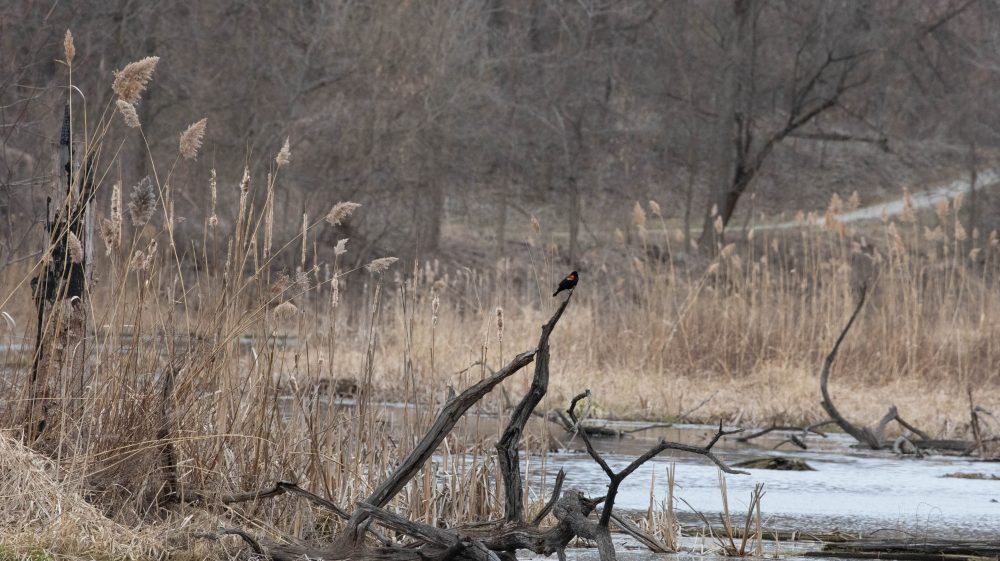
I caught a female Red-winged Blackbird in a furtive moment.

There was only one Blue-winged Teal in the open water, but I later discovered some in the flooded marshy area, although they were too far away and obscured by vegetation to photograph properly. For what it’s worth, there was also a Solitary Sandpiper. So the Blue-winged Teal are still present.

Here’s what I saw later from the paved trail looking out onto the marshy area.

Solitary Sandpiper and Blue-winged Teal in the background

And a close-cropped view of two Blue-winged Teal.

Solitary Sandpiper with Blue-winged Teal

I heard and saw several Blue-gray Gnatcatchers.

Then I was pleasantly surprised to see my first Black-throated Green Warbler of the season, even if I had only obscured views.

It took me a while to find a Yellow Warbler, but I managed to capture one rather distant individual.

The turtles were enjoying the abundant sunshine.

I barely saw an American Kestrel as it flew in the distance.

Here’s another Blue-gray Gnatcatcher.

And I found a Ruby-crowned Kinglet – with just a tiny bit of red in the third photo

One more Blue-gray Gnatcatcher. They will quickly become increasingly difficult to see.

Next, I found a Black-and-White Warbler foraging on a Hackberry Tree.

Then a couple Orange-crowned Warblers appeared. They became more evident in my photo review later.

Another Orange-crowned Warbler.

And another Black-and-white Warbler appeared.

I was quite happy to see a Nashville Warbler.

One more Orange-crowned Warbler. They are sometimes confused with other “drab” warblers, such as the Tennessee Warbler. One definite clue to an Orange-crowned is the yellow undertail coverts. Don’t bother looking for an orange crown…

I took a photo of a nearby Palm Warbler, even as I already feel like I have seen enough of them. They don’t try to hide themselves too well, which probably encourages our tendency to dismiss them, but they are still beautiful.

There was yet another Black-and-White Warbler.

My last Ruby-crowned Kinglet of the morning…

As I started to walk along the paved trail toward Harlem, a male Eastern Bluebird came to see me. I wonder if it was my turquoise windbreaker that attracted him.

I went down to the picnic tables by the water and sat down on the one directly under the tree. As I sat there, a Blue-headed Vireo flew into the branches above me.

A male Red-winged Blackbird displayed close to the shore.

On my way back out on the paved trail, I spotted a Field Sparrow.

And the next-to-last bird I photographed was a male Baltimore Oriole.

I apologize for the photo overload. It’s just been so long since last spring. I went back to the Portage this morning and it was warm, cloudy and windy. My Merlin app heard more warbler species than I saw. But the week is young and more birds will continue to appear. To quote Emily Dickinson, “Hope is the thing with feathers.” Indeed.

Here’s the last bird!

Blue-gray Gnatcatcher

One Day in May

I thought I would be combining photos from a couple days in Riverside, but I took more than enough on May 17. It was perhaps my best spring migration day from the standpoint of seeing some birds I had not seen yet this spring and receiving great cooperation from them. My list totaled 52 species that day, and I spent a little over three hours to see them. Two days earlier on the 15th, I had 57 species – we will have to get caught up with those birds later.

When I crossed the Joliet Avenue bridge, I saw the Mallard hen below with her four ducklings. Later I saw them swimming across the river.

As I started to walk the paved path that runs along the Des Plaines River, I found birds here and there tucked into the trees.

Least Flycatcher
Believe it or not – a Yellow-rumped Warbler
A more recognizable Yellow-rumped Warbler
American Robin

I took the photo of the fisherman below to show how low the river was. Unfortunately, nearly 2 weeks later, it is even lower now. We are experiencing “moderate drought” according to the U.S. Drought Monitor.

I could not resist photographing these Tree Swallows taking a break. I shot the two twice to focus on one and then the other.

I crossed the footbridge and walked into Riverside Lawn. There I encountered an American Redstart singing enthusiastically. The video clip below has a small portion of his song.

For a Redstart, he was relatively easy to capture.

It’s annoying to try and figure out flycatchers that don’t vocalize, but for some reason I decided this one was an Alder Flycatcher.

I never tire of Magnolia Warblers.

This was the first time I saw Cedar Waxwings this spring.

Palm Warblers were everywhere for weeks. Now they are being seen here and there but the sightings are rare. This one didn’t want to be seen at all.

I don’t always find an Indigo Bunting here, so this was a nice encounter.

Gray Catbirds are everywhere.

Scarlet Tanagers were around for maybe a couple weeks. The yellow on the one below is interesting.

Sooner or later a female Red-winged Blackbird strikes an interesting pose.

Common Yellowthroats are frequently heard but rarely seen in areas with more trees, so I was very happy to get a chance to photograph this one.

Another warbler that’s not always easy to see, in part because it tends to stay close to the ground, is the Ovenbird.

Yet another Scarlet Tanager…

And another male American Redstart…

No matter how long I photographed the flycatcher below, it would not turn sideways so I could see its wing bars. I think it’s an Alder Flycatcher.

The thrushes were abundant and lovely to see this spring.

Veery

Then I got lucky enough to see a less-often-seen warbler. This is a male Black-throated Blue Warbler. If I had gotten no other photograph but the first one below, I would still be able to tell what it was from the distinguishing white check mark on the wing. That identifier helps a lot when seeing the female of this species.

It’s easy to take Yellow-rumped Warblers for granted, but I thought this one took an interesting pose.

Yellow-rumped Warbler

Nashville Warblers made themselves available only in part all season.

I caught up with the Ovenbird again later and it posed for me.

More Magnolia Warblers…

Female Scarlet Tanagers are beautiful too. The light on the bird in the first photograph makes it look almost like another species.

The guys are just fabulous. One of those days in Riverside I saw a male Scarlet Tanager appear in a tree right above a couple walking toward me with their dog and I pointed to the tanager. They looked up and saw it. I got a thumbs-up.

Let’s not forget about Mourning Doves. It was a Mourning Dove’s song that got me started with the whole birds-sing-in-key-with-music stuff.

Here’s one more of the Magnolia Warbler that’s at the top of the post.

This appears to be a lovely female Yellow-Rumped Warbler.

And in better light, it was easier to see this Palm Warbler.

The Ring-billed Gull below was putting on a little show on the wall by the Hofmann Dam.

And now for a little vireo review. Red-eyed Vireos are heard more often than seen, with their distinctive question-sounding song. But every once in a while I get to photograph an individual.

And then on occasion I get to see a Warbling Vireo well.

It has taken me days to get through this. I hope it won’t take you that long!

I have been out every day finding more birds, which would be enough to keep me occupied. But now we suddenly have summer weather – the heat of it, anyway – with no rain, and I have new plants in the ground and more coming shortly, so I have added watering the garden in the evening to the daily routine. I bought a new hose that just makes it either to the back or the front of my lot. Even though we had a drought last summer, it was generally cooler, and I managed to get by without watering at all, but that was because of all the established native plants. I am planting new things while preparing for a native garden walk the third week of July.

June will be “Bustin’ Out All Over.”