A Change of Scenery

Versicolored Emerald

Versicolored Emerald

Now that I find myself getting ready for an international trip in a couple weeks (as it gets down to the wire, it prefaces just about every waking thought), I remember never completely finishing going through the Brazil pictures from last year, at least to the point where I could identify every bird often hidden in them. I won’t be going to South America this time, so I won’t see any of these birds, but it feels like a good time to revisit a few images for a virtual change of scenery. Also, we are presently experiencing two days of constant rain in Chicago, so I have given the cameras a rest.

Here is a little video of hummingbirds from last year’s trip. The location is Folha Seca, so popular with the hummers they way outnumbered the tour participants.

On another rainy day, only this time in Brazil last year, the video below was taken at  the porch feeders outside the dining room at the hotel where we stayed in Itatiaia National Park outside of Rio de Janeiro. The bird is a very wet Saffron Toucanet eating fruit and trying to avoid buzzing insects.

The last photo is of a Violet-Capped Woodnymph, taken at Folha Seca. One interesting observation: when I was going through the videos last night on my computer, even though there are hardly any bird sounds that my indoor birds could have recognized, they became immediately attentive and curious, which only indicates to me they hear so much more than we ever will.

Violet-Capped Woodnymph

Violet-Capped Woodnymph

Running Out of Bugs

White-Throated Sparrow, Lurie Garden

White-Throated Sparrow, Lurie Garden

The White-Throated Sparrows and their allies have adjusted their diet to berries and seeds as a result of the drop in temperatures. While I still see them scratching around for bugs buried in the dirt, they are getting hungrier. I started feeding the White-Throated Sparrows at 155 N. Wacker Drive the past week and after a couple days they all came flying over to meet me on Friday.

Here’s a little video of one happy customer.

I was also trying to get footage or whatever you call video output of them getting into little arguments over whose birdseed it was. This video’s a bit longer and not terribly clear, given the light limitations I guess. Anyway I put it on YouTube if you’re curious. Yes, there’s a House Sparrow in there too, looking beaten at his own game.

Last week I managed to get photos of one White-Throated Sparrow eating berries which look just like the berries on the hawthorn tree in my backyard. I am still waiting for someone to discover them.

WT Sparrow with Berries IMG_0098_1WT Sparrow Berry Eater IMG_0106_1WT Sparrow Berry Eater IMG_0101_1

In among all the White-Throated Sparrows every once in a while there is a Song Sparrow or a juvenile White-Crowned Sparrow.

Song Sparrow

Song Sparrow

Juvenile White-Crowned Sparrow

Juvenile White-Crowned Sparrow

Song Sparrow IMG_9858_1

Song Sparrow

Now that we’ve flirted with freezing, it’s warming up a bit again. It will be interesting to see if the fluctuating temperatures cause migrants to linger a bit longer.

Kinglets Rule

Ruby-Crpwned Kinglet

Ruby-Crowned Kinglet

On the way home from Miller Meadow last Sunday, I stopped to explore a very small portion of the Cook County Forest Preserves called White Eagle Woods, of all things. This is a name that would not bother anyone except a birder, in that there is no such thing as a White Eagle, but apparently it’s a common name that has been used for a lot of other things. Whatever the reason, White Eagle Woods is not far from my house, and also not far from the Des Plaines River, so it seemed worth checking out even in the middle of the day.

Golden-Crowned Kinglet on a throne of thorns

Golden-Crowned Kinglet on a throne of thorns

There were not many species of birds present but there were a few cooperative individuals. In particular there were a dozen or more kinglets, mainly Golden-Crowned but also a couple Ruby-Crowned Kinglets as well. The one Ruby-Crowned Kinglet who posed at the top of this post was not showing the feathers for which it is named.

Blue Jay

Blue Jay

And for all the Blue Jays I have heard and caught glimpses of all year, none have been relaxed enough to let me take a picture until this one.

Blue Jay 1I2A3924

For whatever reason he flew down to the curb, where he was at least unobstructed.

Hermit Thrush

Hermit Thrush

Also present on my short visit was a Hermit Thrush, which could not seem to decide whether to be seen or not. So although kinglets outnumbered all the other species at this location, the ubiquity of migrating Hermit Thrushes continues.

Raptor Reminiscence: Hawks on the Move

Turkey Vulture, IBSP

Turkey Vulture, IBSP

Two Sundays ago, I joined a field trip organized through the Evanston North Shore Bird Club to the hawk watch at Illinois Beach State Park (“IBSP”). I have known about the hawk watch for years but never managed to get there until now (it’s an hour-and-a-half drive, which usually discourages me). But it’s a treat to visit IBSP altogether. The expanse of fairly undisturbed habitat along the lakefront is restorative.

IBSP Hawk Watch 1I2A3583

The hawk watch is a special, different kind of bird watching. Basically it’s sitting or standing around and waiting for raptors to fly over. And when the raptors are too far away to identify by field marks, it’s great to have the counters available to help you identify them by shape and flight pattern. Luckily not all the birds were that far away.

Red-Tailed Hawk, IBSP

Red-Tailed Hawk, IBSP

Red-Tailed Hawk, IBSP

Red-Tailed Hawk, IBSP

Northern Harrier, IBSP

Northern Harrier, IBSP

Then this past Sunday I birded much closer to home. My friend Lesa met me at Miller Meadow and we walked around there for a couple hours.

American Kestrel, Miller Meadow

American Kestrel, Miller Meadow

From the beginning, we kept running into this American Kestrel who was hunting the preserve. Eventually we were treated to our own miniature hawk watch. As we started to turn back, we counted a Cooper’s Hawk, four Red-Tailed Hawks, a Northern Harrier, a Golden Eagle and fifty-five Turkey Vultures.

Northern Harrier, Miller Meadow

Northern Harrier, Miller Meadow

Turkey Vultures kettling, Miller Meadow

Turkey Vultures kettling, Miller Meadow

Turkey Vulture, Miller Meadow

Turkey Vulture, Miller Meadow

I did not manage to get pictures of all the birds that flew over but considering that most of the year you feel lucky to see one or two raptors on an outing, seeing so many fly overhead was quite exciting.

Juvenile Black-Crowned Night Heron

Juvenile Black-Crowned Night Heron

Earlier in the day, we also had a migrating juvenile Black-Crowned Night Heron… sometime before the 200 or so Canada Geese that had been feeding in the fields took to the air.

Geese 1I2A3696

Canada Geese

Early Bird Gets Worm

Tasty Bug 1 IMG_9672_1

Wednesday on my way to work, I visited with White-Throated Sparrows at Union Station and 155 N. Wacker. There were at least a dozen or more at each location, making them easy to see and sometimes photograph. The light is always poor, though, early in the morning at 155 N. Wacker because of the building shadows. Even so, sometimes it’s worth the effort.

Tasty Bug 2 IMG_9673_1

So I had this White-Throated Sparrow who was so interested in his worm, he almost forgot about me. Click on the pictures for enlargements.

Tasty Bug 4 IMG_9676_1

Here’s a side view of another White-Throated Sparrow. The individual differences between birds always interest me.

WT Sparrow IMG_9707_1

Later that afternoon at the Lurie Garden, I caught this White-Throated Sparrow contemplating his next move. The garden must seem like heaven for these guys this time of year.

WT Sparrow IMG_9751_1

More sparrows to come.

The Tiny Ones

Winter Wren IMG_9625

I saw very few birds today due in part to a rainy forecast and a meeting at work, but I am happy to report the birds I did see were all alive and well. And they have dictated this post.

Winter Wren IMG_9616

I never tire of Winter Wrens and this morning at 155 North Wacker Drive I had one who was hopping around right in front of me. Darting around quickly, Winter Wrens remind me of field mice.

Winter Wren IMG_9623

Then up on the 46th floor mid-morning, my coworkers drew my attention to three Golden-Crowned Kinglets who were foraging for bugs ion the balcony.

GC Kinglet IMG_9659

The kinglets kept hunting for at least 15 minutes, which was long enough for me to show them off to at least a few interested people. The attorneys all have spiders hanging webs outside their windows, indicating one can make a good living off bugs all the way up there, so I was not surprised to see birds taking advantage of the insect offering.

GC Kinglet IMG_9652

Unfortunately I had to settle for pictures through the window and the blinds, but these tiny jewels were just close enough to photograph anyway.

GC Kinglet IMG_9665_1

GC Kinglet IMG_9648

I wonder if they continued their rooftop forays throughout the city. It’s probably a good strategy, making it easier for them to get their bearings.

Brown Creeper Confusion

Brown Creeper

Brown Creeper

I was late getting in to work this morning.  The birds made me do it.

First, I found a dead Hermit Thrush at 123 N. Wacker, the same building where I found the stunned Hermit Thrush last week. It was windy and chilly this morning, so I should not have been surprised, I suppose, but I hate to see dead birds. What a beautiful bird it was too; could not have been dead long. At any rate, what else to do but pull out one of my trusty paper bags and call Chicago Bird Collision Monitors? They were very busy and my ca;; went straight through to voice mail.

Brown Creeper IMG_9499_1

Then at 155 N. Wacker right near the entrance to the building, which has an enormous glass-walled facade underneath a portico, I found a stunned Brown Creeper. It’s amazing to me how many people walked by and did not even stop to look at this little gem. He was alive and at first having none of me catching him and putting him into a bag, so I stayed with him as he tried to catch a spider. The spider escaped and I tried to edge it back toward the bird but the spider was having none of it. I started emptying my bag to use it as a net, but the creeper was wise to that and started flying up against the big glass wall until he became exhausted. That was when I caught him more easily and, thinking I was going into work and the Bird Collision Monitors were too busy, I took him over to the albeit-not-so-great trees in the mini-park at 155 N. Wacker. He seemed okay with that and he flew to the trunk of the first tree.

I was then in my usual spot checking out the White-Throated Sparrow population and  decided to walk around the back to where there is a bike rack. One White-Throated Sparrow was calling from a bush there. I was then ready to leave, figuring I had seen everybody, when I encountered a stunned Hermit Thrush on the sidewalk. I could not imagine missing him, so he must have just hit the building while I was visiting the sparrow. The thrush was easy to pick up in that state, so I put him in a bag to keep him warm and out of trouble, affixed a paper clip to the top, and called the monitors again. I knew now I was going to stay and wait for help, however long it took.

The monitor taking calls rang me back and said they would send someone right over. Soon Nancy called me and said she was on Wacker Drive in front of the building. I walked over and delivered the two thrushes. One dead, one alive. I watched as she labeled them and made sure she had the correct information for each bird. We chatted a little and I left.

But then I found a Brown Creeper, most likely the same one, splayed on the sidewalk by the windows. I reached down, picked him up, and headed back to Wacker Drive, running north, yelling, “Nancy, Nancy!” When Nancy turned around, I met her with the Brown Creeper. She opened up a little bag to receive him and I reached in with my hand to release him – and he would not let go. He clung on to my warm finger with his tiny foot. I told him he had to leave, that Nancy would take good care of him, and he finally let go with a little prodding from me. I wonder if by then he might have decided his fate was inextricably connected to mine. I trust Nancy got him to a better place where he found his bearings and continued on his journey south.

Here’s a picture of a Brown Creeper I took last week or so, who was not lost.

Brown Creeper IMG_7743_1

And another this afternoon, at Lake Shore East Park.

 Brown Creeper IMG_9574_1

Hermit Thrushes Everywhere

Hermit Thrush IMG_9137_1Whose idea was it to call these friendly guys Hermit Thrushes? Maybe on their breeding and wintering grounds they are reclusive, but in fall migration they are downright gregarious. It may be a safety-in-numbers thing going on, but I have had Hermit Thrushes literally come out to see me day after day this past week.

Hermit Thrush IMG_9073_1

Early in the week on my way into work I found one Hermit Thrush who was definitely not in good shape. That’s him below, seeking solace by my shoe box which I had taken out of my bag so I could extract my cell phone and place a call for his rescue. While we waited for a Chicago Bird Collision Monitor, I took this picture, and then put him inside one a paper bag for the monitor.

Hermit Thrush IMG_8675_1

If you want to do a little more reading on Hermit Thrushes follow this link to the Cornell Lab of Ornithology. I just learned something from it: of all the thrush species we see in migration, Hermit Thrushes are the only ones to live in the U.S. I guess that means however far they migrate, they will just winter somewhere south of us until spring. That also explains to me why they tend to come through later than the other species and also why they seem to be taking their time before moving on.

So here are a couple more pictures of different individuals. They do seem to prefer shady spots.

Hermit Thrush IMG_9145_1

Hermit Thrush IMG_9129_1

Sunday at the Portage

BC Chickadee IMG_8415_1

Black-Capped Chickadee

After two days getting up before 4:00 a.m., it was wonderful sleeping in somewhat Sunday morning before going over to the Portage. I had no expectations, I only wanted to go out and explore. Perhaps that is the best thing about going to a place you know well: you are always primed for surprises. I started walking in slowly around 8:30. Mine was the only car in the parking lot, so I had the entire place to myself. And it was quiet.

Portage IMG_8078_1

I was not surprised to see Wood Ducks, indeed they have been there every time, but it was special to see the young drakes in their new grownup plumage.

Wood Ducks IMG_8162_1

The surprise was seeing two young raccoons behind them.

Wood Ducks and Racoons IMG_8094_1

I managed to get a picture of one.

Raccoon IMG_8168_1

The last few visits to the Portage have been scarce on woodpecker sightings even though I knew they were always there…so it was nice to see this Red-Bellied Woodpecker.

RB WP IMG_8108_1

Through a break in the trees, a Red-Tailed Hawk was visible, perched on a bare limb over the water.

Red-Tailed Hawk

Red-Tailed Hawk

While I was trying to photograph the Magnolia Warbler below…

Magnolia Warbler

Magnolia Warbler

a Winter Wren caught my eye. It’s always a surprise to see a Winter Wren. Especially after I had given up trying to find the Carolina Wren who was singing earlier.

Winter Wren

Winter Wren

Downy Woodpeckers are always plentiful, but this one was busily drilling at eye level.Downy IMG_8488_1

And not all the Gray Catbirds have left.

Gray Catbird IMG_8289_1

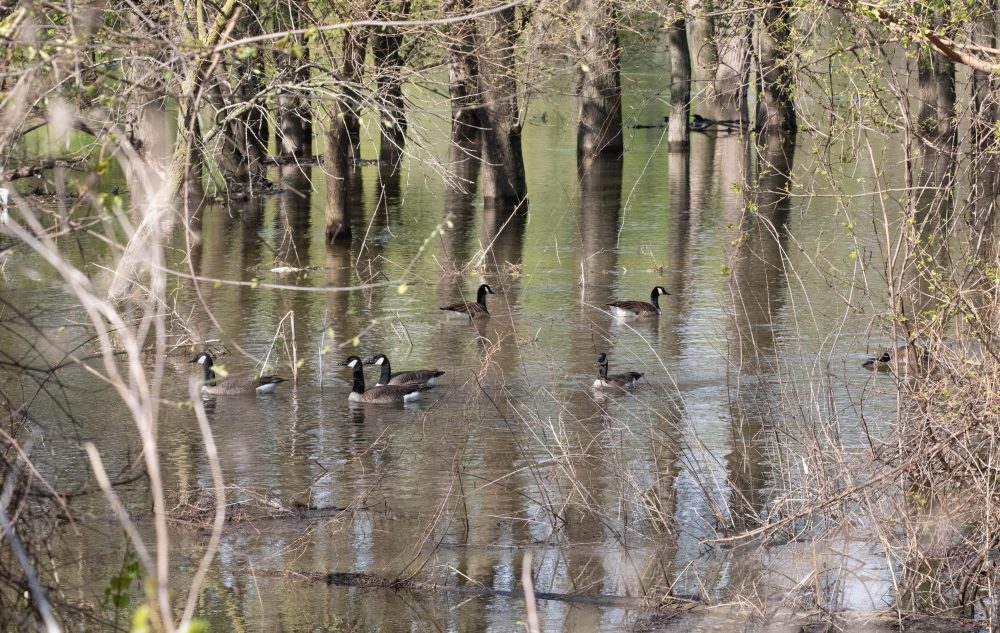
Heavy rainfall the night before filled the bottomland with water.

Portage IMG_8328_1

A lone Canada Goose was by the water near the Wood Ducks, standing on one foot

Goose IMG_8166_1

while many more flew overhead.

Canada Geese IMG_8223_1

The most unusual sighting did not produce great pictures, but there were enough to identify a Northern Parula. My ebird sighting was questioned because I had to add this bird to the list; I did not dare add it until I was sure I had pictorial proof.

N Parula IMG_8438_1

N Parula Warbler IMG_8436_1


There was no shortage of Yellow-Rumped Warblers. Indeed, they were everywhere, although none were as photogenic as the week before. But I caught this one skipping across the duckweed.

Yellow-Rumped IMG_8515_1

The change of seasons renders the Portage a magical place.

Portage IMG_8323_1

Juveniles

Juvenile Sedge Wren, Springbrook Prairie

Juvenile Sedge Wren, Springbrook Prairie

I’m entertaining a quick post here while I still have so many pictures to go through from maybe three weeks, wondering how I will ever do anything with them…as I archive months past onto the external hard drive to leave room for photographs to come on my trip next month.

Over the weekend I encountered two juvenile birds that proved interesting. The first was from Saturday morning, on Joe Suchecki’s DuPage Birding Club walk at Springbrook Prairie. Conditions were not ideal for photographs (birds buried in the grasses at a distance), but this very cooperative juvenile Sedge Wren was only a couple feet away from us, making us wonder if it was his first encounter with people. He had a very much “What do I do now?” look about him.

Juvenile Segde Wren2 1I2A3254

The second bird nearly stumped me when I was going through the pictures until I realized it had to be a juvenile European Starling. I took these at the Chicago Portage yesterday morning. I have seen my share of juvenile Starlings – indeed they used to visit me back in Oak Park on the window ledge, and I always found them fascinating because I could still see their eyes (the adults’ eyes, recessed into black feathers, often seemed to totally disappear). Juvenile Starlings always appeared brown to me, but I have never seen an evenly black and white one – leading me to think that this is a molting bird and/or somewhat melanistic. On the other hand I never saw its back which may have been browner, because I was distracted by something else by the time it left.

Molting Juvenile Starling IMG_8263_1Juvenile Starling IMG_8264_1

Anyway I will try to be back soon with more birds from a very interesting time of year. I love fall, and the weather has just turned abruptly cooler reminding me of it.

Juvenile Starling IMG_8270_1

European Starling

The Starling pictures are coming up darker from some reason – click on them and the bird appears a bit lighter but I may have to come back and fix this later.