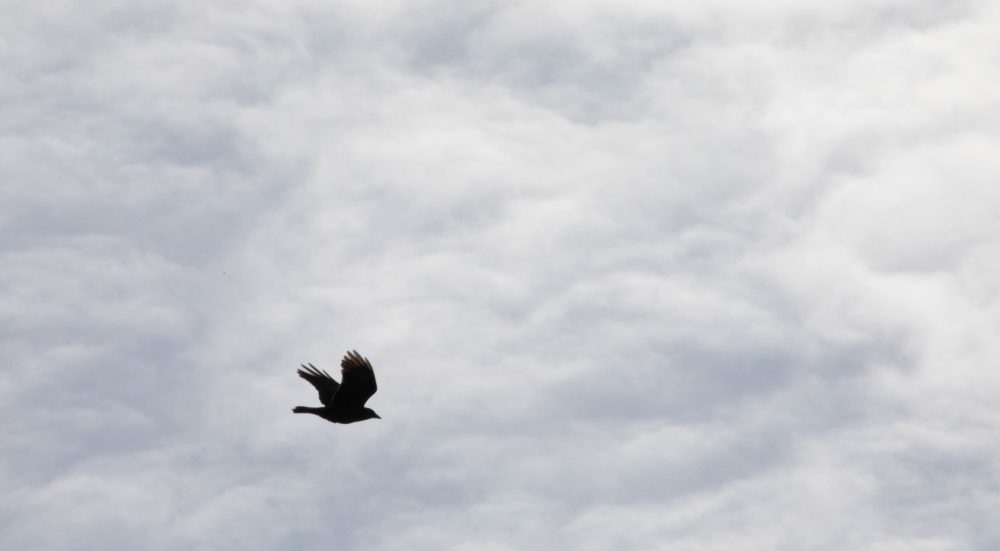
Bathing Crow

We got a little more rain last week, complete with a pleasant drop in temperature on Tuesday, but I wasn’t able to get out to the park for lunch until the following day when it hit 100 degrees again. I walked slowly and sat down on a bench near the tree I’d put peanuts under for the young crows. It seemed like a pretty usual, hot day with nothing much going on, maybe too hot to even take a picture. The grass was noticeably greener from the last time I took pictures, but it’s grass.

Then I noticed some European Starlings bathing in a nice big puddle that was left from the rain the night before. I like to see birds bathing, even Starlings. To see anybody bathing after the prolonged drought and heat was good enough.

I wonder if one young crow was new to the idea though. I personally have never seen a crow bathe. I started taking pictures of this crow when he first stood in the water. I wondered if he’d gone to wash off a peanut or something, which is one way I’ve seen crows use puddles, but he seems to be contemplating his reflection instead.

Or maybe this was the moment of decision about whether to bathe or not, because after he tasted the water, the next thing he did was start bathing in it.

And he was so delighted with himself, he looked right at me as if to say, “yes, it’s as fun as it looks.”

Then he proceeded to bathe again. For the full demonstration, this is how it’s done.

Bend your knees (birds’ knees bend exactly the opposite of the way humans’ do, by the way – do not try this at home). Put your head face down in the water (reminiscent of your first swimming lesson, perhaps).

Down. (“Now put your head in the water.”)

Now start flapping your wings.

Voila!

“Marsh Mallow” at the Slough

Swamp Rose-Mallow

My visit to McGinnis Slough this time found the Swamp Rose-Mallow in bloom. I was able to find three colors of it. They are big, beautiful flowers that stand tall with the reeds.

Unlike last time when I was nearly eaten alive by deer flies, this morning was delightful. It was not yet too hot, there was a gentle breeze, and the sky was partly cloudy which gave a the light a particular density.

Great Egrets

Three weeks ago, I could find only one Great Egret. Today, there had to be maybe 300. If they weren’t in the trees they were fishing all along the banks and in the shallow water.

The Great Blue Herons had increased in number too from three weeks ago. I estimate 175. Here’s one flying over, looking effortless. Egrets, herons and cranes often remind me of ballet dancers defying gravity.

Great Blue Heron

And this time I had a Green Heron that flew up into a tree nearby, after something.

Green Heron

I don’t think he got what he was looking for, he looked frustrated. I’ll take suggestions for a caption for this shot!

A Gift of Marsh Wrens

Marsh Wren

It’s been difficult lately to find balance in my life. Work has taken over most of my waking hours and thoughts, and after I do chores on the weekend, there’s little time left for reflection, let alone nature. Or blogging. The terrible news of the Aurora, Colorado theater shootings and realizing that one of those dead was a blogger on WordPress didn’t make me feel much better. Jessica Ghawi, a/k/a Jessica Redfield, had narrowly escaped a shooter in Toronto of all places last month and she wrote about savoring every day as it could be your last.

So even though I was up too late last night roasting veggies for the week’s meals, I made myself get up this morning at 5:30 a.m. so I could go over to McGinnis Slough and see what had transpired after three weeks of more drought and then one soaking rain.

McGinnis Marsh

The marsh growth has flourished with the drought, and it seems the Marsh Wrens have filled it up to capacity. The very first call I heard when I got out of my car was a Marsh Wren. By the time I had my gear together and made my first stop at the little overlook near the parking lot, Marsh Wrens were chattering and flitting about in the reeds. And then they came out to visit. There is no way I would have been able to stand there and photograph them at that close distance without their safety-in-numbers equation.

The rest of my McGinnis visit will follow in a subsequent post. The heron and egret numbers were phenomenal.

Goose Lake Prairie

Compass Plant

I finally managed to go through the rest of my photographs from my visit to Goose Lake Prairie last weekend. I’d had no particular target species or agenda in mind. I had hoped to maybe see a Grasshopper Sparrow, but I can’t say I even heard one, that was my only disappointment. A bit ironically, I first heard about Goose Lake Prairie on Cornell’s “More Birding By Ear” CDs, for the recorded songs of birds found there.

The most common species last weekend was probably Eastern Meadowlark.They were no longer singing, but they were chattering everywhere.

This parched version of the prairie is different from the last time I visited maybe three years ago. Rattlesnake Master, one of my favorite native prairie plants, seemed to be the only thing that thrived on the hot, dry weather.

The Wild Bergamot was almost spindly.

Wild Bergamot

Song Sparrows were predictably common. And still singing.

Song Sparrow

I heard a few Field Sparrows before I finally saw one.

Field Sparrow

I walked a long way before I finally started hearing Henslow’s Sparrows and then it seemed like they were everywhere. But they were singing hidden in the tall grass, until finally I managed to see and hear one sitting up. They were more cooperative a few weeks ago at Springbrook Prairie, but I don’t think I have ever heard so many of them as I did at Goose Lake Prairie. I simply adore Henslow’s Sparrows. Once gravely endangered, they have been making a real comeback in Illinois, due in large part to prairie restoration.

Henslow’s Sparrow

There were not too many butterflies or dragonflies, maybe just a few of the more common species.

Monarch Butterfly

Common Whitetail

And of course my photographic nemesis, Indigo Bunting, made a brief appearance.

Indigo Bunting

Sometime after hanging out with the Northern Harrier that dominated a previous post, a Turkey Vulture came to take up the slack…

Turkey Vulture

proving that even vultures can be beautiful.

Thirst: Send in the Clouds!

Drought Crow

Visiting the crows all week in the parched park has been an exercise in heat tolerance for all of us.

I have been taking a plastic food container with me to fill up with water from the drinking fountain. The crows know about the water fountain, but they don’t know about plastic containers.

I fear I have destroyed millions of years of inherited distrust of unknown containers and possibly contaminated liquids, by getting the crows to finally drink out of a plastic dish. As much as they trust me, it was not easy to override their inherent caution, which is so inbred and has served them so well for millennia. Perhaps I assumed too much by thinking they were paying attention as I filled up the container with water from the very drinking fountain they frequent. I had to pour a little water out onto the ground to show them that it was indeed water, something they recognize. And then I sat on a park bench and watched, and waited.

White-Wing was the first to sample the water as early as last week, but she was still cautious. However, Friday before an unexpected downpour, it was so hot and dry in the park the birds were doing their equivalent of panting.

And so when White Wing took a sip, she relished it. And the word spread.

The crows were visiting the water I provided. I had crossed a new dimension with them.

And then suddenly the wind picked up, the thunder and lightning started, and the crows scattered. The rain swell, although brief, was enough to soak me thoroughly on my way back to work without an umbrella. I stood under a few buildings here and there but I couldn’t wait out the entire downpour. Such as it was, here was the rain I had been praying for, and it was not possible to scold it for inconvenience. I dried out when I got back to the office. And by the time I got home, I was praying again for rain.

So this afternoon we got lucky again. Briefly, again. The clouds do so much better of a job than I can with the water hose.

rain-splattered sidewalk

With any luck these scattered downpours will become more frequent and we will survive this terrible summer. I don’t miss the mosquitoes but I find myself worrying about the plight of bats and Chimney Swifts, to name a few creatures who must miss them terribly.

And I have to get this gutter fixed!

Northern Harrier

I went to Goose Lake Prairie today, and I will have more to say about it in a future post. But I want to devote this space to a female Northern Harrier who was willing to show off long enough for me to get my camera to cooperate.

I had been walking around on the trails for nearly two hours and was waiting for the visitor’s center to open; I thought I had seen pretty much all I was going to see, when I flushed a Northern Harrier from the grass near the path. It was a juvenile.

Juvenile Northern Harrrier

I watched it fly around and shot a few pictures. At one point there were two harriers in the air, but my pictures were fuzzy and I didn’t think much of them, so I kept walking. I began to hear a lot of Henslow’s Sparrows I could not see. And then, a Harrier came back to distract me.

She had a kill, which looks to be a bird but I cannot identify it.

She swooped and darted and called. I now think she was displaying probably for junior’s benefit and not mine, but I was an inadvertent witness.

What a beautiful bird she was. I felt so lucky to see the show.

Harriers are always exciting to see as they fly low over open fields and they have distinctive markings. That white band on the rump is diagnostic.

Eventually she came to rest on a stump. I took one more picture and thanked her for making my day with her regal beauty.

More about Goose Lake Prairie to follow later this week.

Sunflower Cycle

Sunflowers are blooming early this year. Planted by the birds and squirrels from the seeds spilled from the feeder, they grow tall and, depending on how much rain we’ve had, they can produce huge flowers that weigh them down. But since it’s been very hot and dry, the sunflowers are of a smaller variety. No matter, for they still attract the goldfinches.

Male American Goldfinch

I took the day off to take care of an accumulation of errands around the house that would have decimated a normal weekend’s worth of time. Before I left for my first stop,  I was delighted to be out in the yard when goldfinches were flitting around in the sunflowers. I ran back in the house to get the camera and was rewarded by their stay.

Juvenile American Goldfinch

Even the goldfinches are nesting early this year. I did not expect to see a juvenile so soon.

Sunflower seeds feed the squirrels too. I don’t mind when they eat the spilled seeds on the ground, but keeping them off the feeders is an increasing challenge as the trees start forming a low canopy in my yard. Here’s one of my nemesis Gray Squirrels who likes to raid the feeders.

And here’s the Fox Squirrel who has much better manners and does not seem to be spending all his energy trying to outsmart me.

Fox Squirrel

While I was trying to get pictures of the goldfinches, I caught a Mourning Dove leaving.

Mourning Dove

A female House Sparrow on a bare branch of the ailing Horse Chestnut Tree.

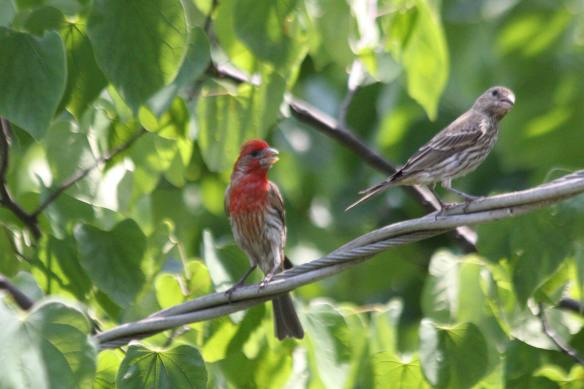
The ubiquitous House Finches are all paired up and they’ve fledged clutches by now. They may be working on a second batch.

The goldfinches still visit the thistle socks too. I will have to fill them up again tomorrow morning.

Summer Sunday

Well, I was writing this post, and just as I added another picture I lost the whole thing, so let me start over. I think I started out by saying I can’t believe it’s July already, although we’ve had July-like weather for weeks.

Trumpeter Swans and a Great Blue Heron

I went to McGinnis Slough early this morning, just to see how the habitat and the birds were faring with the drought and the heat. The water level is so low, the Trumpeter Swans that are usually way over on the far side were in what is now the middle of the slough, so I was able to get some sort of picture even though they were still far away. I think I like the reflection in the water about this shot, and the fact that they had the Great Blue Heron between them.

Barn Swallow

When I first ventured from the parking lot, this juvenile Barn Swallow was waiting to be fed by a parent. Unfortunately I wasn’t fast enough to get that shot as the parent swooped in to drop off a bug and kept going.

Cedar Waxwings

Also found these Cedar Waxwing kids holed up in a nearby tree.

Walking down the mowed path in either direction summoned deer flies, which I was forever swatting. I wished I was a horse with a tail I could switch at them (in which case then I would have called them horse flies). Stopping along the way was prohibited.

Great Blue Herons

I saw easily 30 or more Great Blue Herons, most of them in the water, although these two are in the trees. The only Great Egret I found was in a tree also. Normally when the water level is higher, I have seen what seemed like hundreds of Great Egrets at McGinnis. I suppose that could still happen, summer has a long way to go.

Great Egret

Herring Gull

There were a lot of Caspian Terns but they weren’t close enough for a picture, unlike this Herring Gull.

Marsh Wren

My reward for enduring the heat this morning was getting to see a Marsh Wren singing. I heard at least 10 of these guys in the grasses along the path, but hearing Marsh Wrens is always easier than seeing.

House Wren

I stopped at the Portage on my way home. Here’s a House Wren for comparison.

And now a word of thanks to all who follow this blog! I apologize for not responding immediately to your likes and comments. At the same time, it occurs to me this blog is almost one year old. So I guess my “new year’s” resolution is to try to be a more conscientious blogger.

And to remember to save every draft so I don’t have to start over!