Familiar Haunts

Carolina Wren, Chicago Portage

Carolina Wren, Chicago Portage

I’m trying to conserve energy for my upcoming trip, but beautiful fall weather and an extra hour of sleep were all I needed to get me out of the house yesterday morning. I went to the Chicago Portage and then McGinnis Slough, to witness the change of seasons.

Chicago Portage

Chicago Portage

Canada Geese gathered in groups of six to twenty-four birds, and I counted 126 total. Not a lot by Canada Geese gathering standards perhaps but plenty for a small preserve. I looked for Cackling Geese but there were none mixed in.

Canada Goose, Chicago Portage

Canada Goose, Chicago Portage

We’ve had some substantial amounts of rain the past week, along with cooler temperatures, contributing to the arrival of leaf color almost everywhere but the Portage. It has its own palette.

Portage 1I2A4101

I was lucky early on to see this Carolina Wren who also appears at the top of the post. He was busy with a worm, which explains to me why he’s still around.

Carolina Wren2 1I2A4085

The light was creating interesting reflections wherever there was clearer water.

Portage 1I2A4131-2

Portage Bottomland 1I2A4114-2

After the geese, the most numerous species represented yesterday was White-Throated Sparrow. I am used to seeing a lot of them on the lakefront but have never before seen 50 or more here. I caught one sitting. They were moving in flocks feeding in the ample brush and dried weeds on either side of the water. Song Sparrows, Swamp Sparrows and Fox Sparrows were interspersed with them but I could not single them out for a photo.

WT Sparrow Portage 1I2A4074-2

White-Throated Sparrow

Convinced that I’d seen and heard everybody available at the Portage, I moved on to McGinnis, where the colors were a bit more varied.

McGinnis Slough

McGinnis Slough

Here the species of the day, at least on land, was Yellow-Rumped Warbler. I had brought the scope but forgot the tripod I was supposed to grab on a second trip back to the house before I left, so I was not able to view any distant birds in the water. Not that I could have taken photos anyway. The two Trumpeter Swans who hang out were in the middle of the largest portion of the water instead of hugging the far shore, but they still looked like white blobs in a picture.

Yellow-Rumped Warbler

Yellow-Rumped Warbler

I took advantage of a Ring-Billed Gull who flew over instead.

RBG McGinnis 1I2A4236-2 jpgRBG McGinnis 1I2A4237-2RBG McGinnis 1I2A4239-2

A little autumn color goes a long way as we say goodbye to warmer weather.

Fall Color at McGinnis 1I2A4249

One more Yellow-Rumped Warbler for good measure.

Yellow-Rumped Warbler, McGinnis Slough

Yellow-Rumped Warbler, McGinnis Slough

The Chicago Portage – Mystery Loves Company

Chicago Portage

The Chicago Portage has so much history it’s almost too much to think about. And yet if it wasn’t a historical landmark it probably would have been developed over by now. It’s adjacent to train tracks, the Chicago Metropolitan Water District, and Interstate 55, not to mention Harlem Avenue also known as good old Illinois Route 43. Instead of counting birds lately I find I’ve been keeping track of how many planes fly over while I’m wandering through; the Portage is also right in the flight path of Midway Airport.

But the planes roar overhead and when they’re gone, the remaining traffic noise seems almost benign by comparison. Whatever the ambience, there is still wildlife. I never thought of the duckweed as attractive, but this Canada Goose seems to be wallowing in it.

The pervasive scum lends a pointillist feel to the image of these Mallards below.

While I’m dabbling in impressionism, what about this Red-Breasted Nuthatch searching for hidden treasure in the dead leaves…?

Red-Breasted Nuthatch

A Red-Eyed Vireo came out for the sunlight that traded off with the cloud cover all morning.

Red-Eyed Vireo

There are little story boards displayed in a few places along the trail at the Portage, and I think one of them has a caption, “if these trees could talk.” Sometimes the trees do talk – they creak, sway and moan. What’s left of this tree has an enormous web attached to it, catching debris.

Finally, this Yellow-Bellied Sapsucker might be my favorite “painting” photograph, for the light on the bark and his back.

Yellow-Bellied Sapsucker

Perhaps the attraction I have to the Portage lies in the stark contrast between its cluttered wildness and the manmade mess that surrounds it.

Easter Sunday Birding

This morning was beautifully sunny and clear, although a brisk north wind kept things rather chilly most of the morning. I started out kind of late, around 9:00 a.m., and went to the Chicago Portage to see if anything had changed.

Tree Swallow

There were more Tree Swallows than a couple weeks ago, perhaps a dozen or so. But there were no new birds. I had hoped to see at least a Yellow-Rumped Warbler, and maybe a few different sparrows. Maybe the wind was blowing from the wrong direction to bring in new migrants. I managed to get a few nice photos of the current residents anyway.

A couple Canada Geese got into a disagreement which caused the water to fly.

A Northern Cardinal was singing to the right of the path.

I heard Song Sparrows singing and finally found one.

And of course there were a lot of robins.

Around midday it was much warmer but the wind picked up. I went to McGinnis Slough to see some different birds. There were several species shared between the two locations such as Red-Winged Blackbirds, Black-Capped Chickadees, American Robins, Tree Swallows, House Finches and Mallards. Generally McGinnis has more water birds, although for the most part they are hard to photograph because they are usually too far away.

On the other hand, this Red-Winged Blackbird was more cooperative than the ones at the Portage.

I got lucky with this Great Blue Heron, one of seven I saw fishing in various shallows.

Great Blue Heron

There were perhaps 250-275 American Coots. This one was swimming around with something wrapped around its body. Looks like a water plant pulled up from a dive.

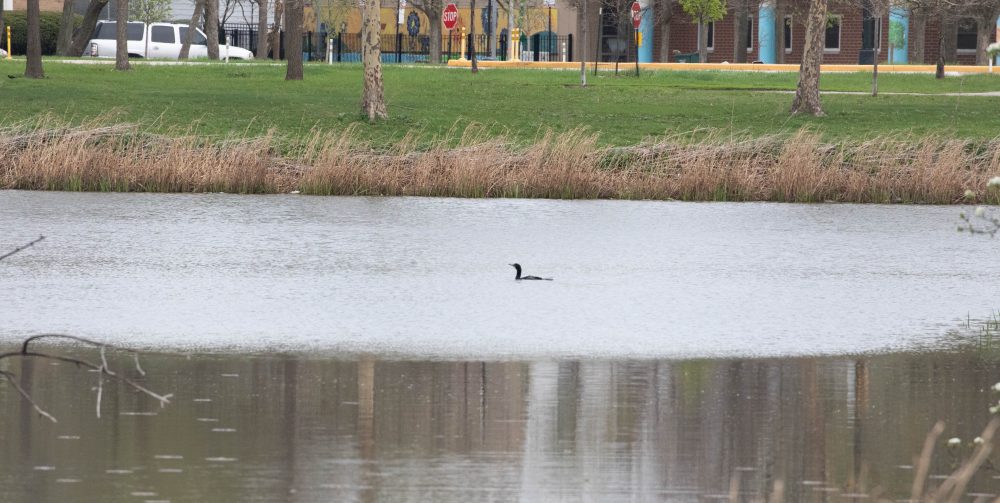
There were 20 or more Pied-Billed Grebes but they were too far away to photograph. As it is this Horned Grebe eating a fish it had caught is barely recognizable.

This might be the year I figure out digiscoping. Or not. There will always be birds too far away.