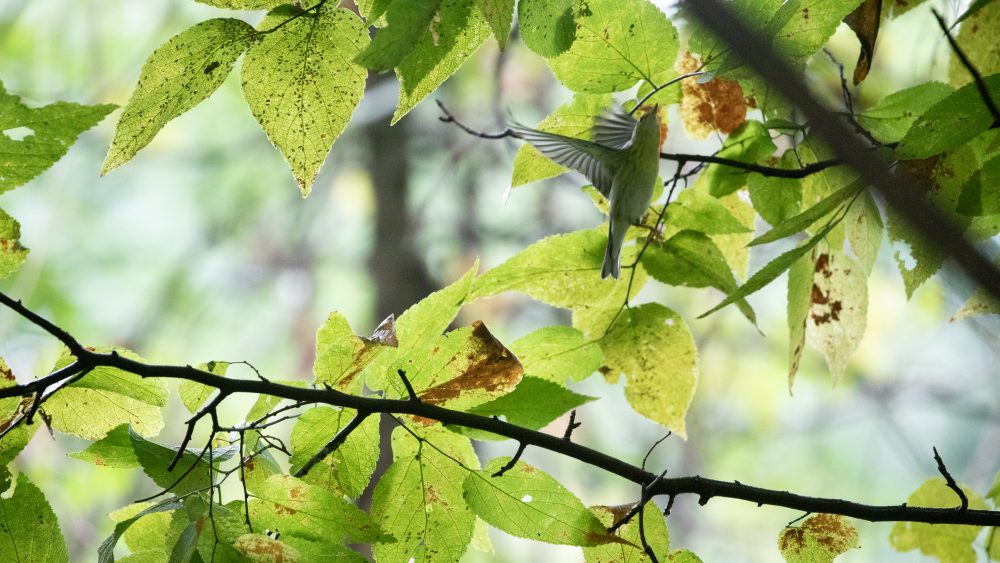
Bird Brains

It may still be hard for some people to get their heads around the idea that birds are pretty smart, especially when the epithet “bird brain” had the connotation of stupidity for so long. The conclusion there, of course, was that size matters, and birds have small brains and therefore are not too smart, or that they behave solely by instinct and have no capacity for reasoning. Ha! is all I have to say to that. I was first attracted to birds by their intelligence. They were smart enough to appreciate the music I was playing, for instance.

While the current theory still leans toward comparative brain size, i.e., the larger the brain case in relationship to the rest of the body, the more “intelligent” the creature, right away making crows, ravens and parrots the geniuses of bird species, I have found finches are quite smart. No doubt Darwin was onto this.

Of course the only way we have to gauge another species’ intelligence is by how it interacts with us, which is pretty one-sided when you think about it. But I’ll admit I don’t have a clue how you figure out what birds are talking about to each other, at least 95% of the time, so it is only when they’re trying to communicate with me or vice versa that I can observe their “intelligence.”

I can already take for granted when I tell a bird something that it will respond to what I’ve said, or to what I’ve thought is more like it, but when a bird tries to tell me something and I try to figure it out – now that’s something. Generally this situation says something about my lack of intelligence. The birds are a lot better at understanding me than I am them.

Photographers Beware

This past week, as I was walking up the hill out of the park to get back to work on my lunch hour, I noticed a man had stopped to take a picture of something in a tree. I don’t think he was photographing birds. A squirrel maybe. Anyway, when he had the shot, he started walking down the incline into the park with his friend, but was immediately accosted by a handful of House Sparrows. Needless to say he was taken aback. While the House Sparrows didn’t attack him, they pretty much were, I suppose you could say, in his face. The men kept walking and so did I, but I know what was going on there. Um, you see, the House Sparrows associate cameras with people who might have food. I wonder how they come to make that assumption… I admit I sometimes feed the House Sparrows, although my primary targets are the crows, and I’m usually not taking pictures of the House Sparrows, although they are the most willing subjects, again because they associate the camera with food. I wish I could run a little Rupert Sheldrake-type experiment to see if House Sparrows do this in any other park besides Daley Bicentennial Plaza. His theory of morphic resonance could be tested here. Basically the idea is there is a collective intelligence and therefore if a group of House Sparrows have learned to associate cameras with food in one place, they might very well do so somewhere else.

Squirrel Evasion

Of course the crows are so smart they have me well-trained. Nevertheless the other park birds have learned to pay attention to the crows when I’m around because it sometimes means a payoff for them. And just like your backyard, the squirrels show up too, and they are a main competitor for peanuts. This week I observed the juvenile crows figuring out how to fake out the squirrels. We all seem to have figured out the squirrels don’t have very good eyesight. I can put a pile of peanuts on the ground and a squirrel will run right past the spot if he didn’t witness the drop. Usually if I throw a peanut to a squirrel it will distract him from a pile of peanuts. In one instance last week, shortly after I had put peanuts down for the crows, a squirrel showed up, and the juvenile crow that was following me around walked away and pretended to be interested in something else until the squirrel left. The same day, the white-winged crow was still more interested in eating his peanuts than stashing them, but when a squirrel tried to take his peanut away, he flew off and stashed his booty.

Cage Etiquette

At home, I have something going on with Ferdinand, the male Society Finch, that has been puzzling me. Friday night is clean-up night and part of the routine is to move all the finch cages away from the windows so I can clean up the papers and the floor underneath them. Ferdinand and Isabella, cage-created birds that they are, think there is nothing more fun in the world than when I put the middle finch cage on the dining room table, swap it out for a clean cage and leave it there so everyone can have their evening snack while I’m cleaning the living room. The other two cages are set aside in the front hallway and are the last things I clean.

Well, last Friday I was very tired and even though I know this routine so well I can do it in my sleep, I made the mistake of thinking it was time to put the first cage back when it was too soon. I corrected myself when I realized I had to hang the curtains first, but Ferdinand seemed to be reacting to my first thought, because he flew over and landed on the floor where the cage was supposed to go. He insistently kept alighting all around the cage area. I got the curtains hung and then moved the first cage back, after which I cleaned the other two as usual, and done with the big chore, I had my evening snack and went to bed.

This week, even though I started the chore a bit late because I was detained half an hour at work, I wasn’t mixed up in my thinking, but Ferdinand seemed to be. He flew over and landed on the floor again, before it was time to move the cage back. He also started flying up to the wand of the vacuum cleaner, as if he wanted me to move it out of the way. What kind of strange game was he playing? After I talked to him, he went back to sit with Isabella on the perch in the cage that was still on the dining room table. When it was finally time to move the cage back, he flew up on top of it and took the “ride” to the corner that way.

I thought about all this the next morning: Ferdinand was trying to tell me something. Perhaps he is trying to be my general contractor. According to his schedule, I should have been putting the cage back a lot earlier than I did. Perhaps Ferdinand thinks I am intelligent enough to try to communicate with because I always pay attention to his song when he sings it. Therefore I must be educatable, however long it takes. Ferdinand wants me to know he knows all about cages and where they go, and as far as he’s concerned once the papers are on the floor the cages should go back. Society Finch indeed. Whose society is this?

I try to run a democracy here, but I am the chief cook and dishwasher.

A Splash of White

I’ve seen this crow around the park off and on all summer and now that he seems to be acquiring his more adult plumage, the white in his wings is all that more dramatic.

Juvenile Crow

You can really see the white in the flight feathers as I just barely managed to catch him here on this cloudy day.

White flight feathers

There was a semi-leucistic Canada Goose with the flock in Butler Field this morning as well.

Partially Leucistic Canada Goose

Lakeside notes

Lake Erie sunrise

Part of me is still in Lakeside, Ohio. The Midwest Birding Symposium which took place there September 15-18 was great fun, filled with a lot of nice people, interesting presentations, and a delightful atmosphere. We went out looking for birds every morning. The Bach A Minor English Suite would not leave me alone as we walked around the trails. As I reviewed the prelude in my head, I noticed my brain would stay stuck on whichever part enhanced the notes the birds were singing.

Not that I was constantly running the experiment, but later Saturday afternoon I was standing in line to ask Louise Zemaitis a question after her excellent presentation on birding by habitat (she had intrigued me when she said she was surprised there were no fish crows in the area; I didn’t even know fish crows were this far north and she told me they are in Pennsylvania, so I live in hope), and there were old big band jazz tunes playing softly in the background after her talk, before the next presentation. I found myself listening to the conversations ahead of me change seamlessly from the key one song was in (G major) to the next song (E-flat major). Both keys share G so it’s not a big stretch but it was fun to listen to the pitch of the voices modulate. Of course I put that away when I actually got to talk to Louise. I’m trying not to be annoying and nerdy about this, but sometimes I wonder if anyone else pays attention to what key anything is in.

When I got home fairly late Sunday night, my birds were silent, pretty much as I had predicted. They get really quiet before I leave, and then when I come home, I get the silent treatment until I settle down into something they can relate to, like running water in the kitchen sink, messing around in the kitchen. Maybe they are on guard until they are sure I’m really back for good. Fabrizio was the first one to break the silence, singing his little song. Then I heard a budgie chirp or two and we were off and running, into the night, cleaning the house. As much of a chore as it is, I like cleaning the birds’ room because it’s so dirty I feel like I’m accomplishing something, but more because I get caught up with the birds and how they’re doing. They know the routine, so the ritual should have reassured anybody who had doubts about whether I was staying home.

Fledgling Crows

Fledgling Crow begging

The Park Crows’ offspring showed up early this year, the first of June to be exact. I am certain in previous years I never saw a youngster before late July or August. I wonder if it has to do with the increased population; perhaps the parents have more support and it’s easier to get the job done. Weather might not affect the city crows so much as there’s a pretty reliable food supply and a lot of available nesting spots.

I managed to get a shaky video of a fledgling crow being weaned. I apologize for my lack of expertise, but I did get great views of the bright red inside of its mouth, which for all practical purposes says “food goes here.”

The juveniles are about the same size as the parents but their plumage is browner and they behave like youngsters. Although they stop their whiny begging, their voices remain higher in pitch for a year or so.

The Crows are relaxed with my presence so it is easier to observe them. Years ago I was lucky if I caught a glimpse of a fledgling; more often than not I would hear it but not see it. I can remember a specific instance when I found juveniles over by the park just north of Buckingham Fountain. I put food down under a tree, and the kids came right over, only to be scolded by their parents and whisked away. I didn’t see them for weeks. I envisioned the adults taking the juveniles off to Crow Training Camp, indoctrinating them to remember their naturally cautious, wary behavior. Now, years later, while I maintain a respectful distance, the crows tolerate my presence, and we are all very quiet about it.

As for the youngsters, I wouldn’t be surprised if my imprint is in their genes. The Crows remain cautious of people they don’t know. Unless they’re making a lot of noise about something they generally go unnoticed, I’m sure.

Fledgling Crow and adult

Getting Into Everything

Paper Towels, the Perfect Nesting Material

Because I suspected my zebra finches really liked the drip from the kitchen faucet I was about to replace, I shot a video clip of a couple little guys bathing before I got the new faucet installed. There was probably a slow drip for a long time, but the past few weeks the drip never stopped so I had to get it fixed. I was collecting dripping water overnight to use for the birds but I couldn’t get it all, filling up more than a half gallon pitcher by morning.

My finches all bathe in a pie-plate bath on top of the middle finch cage, but the zebra finches like to take a bath in my breakfast dishes after they’ve been soaking in the sink all day while I’m at work. The routine when I get home is to open the kitchen door and the zebras call and go sailing right in over my head into the kitchen and sit on the pot rack, waiting for turns dipping their heads in my glass full of water.

In short, anything that exists in the house is fair game for these birds.

Rolled up rug to explore

Playing Music for Birds

In the beginning, when I was still fascinated by the fact that I had found my true co-conspirators in birds, almost anyone I talked to about it, this idea of playing music for birds, told me I should write about my experiences. I was fortunate enough to find a place to publish what I eventually wrote in Ted Rust’s Music For The Love Of It which he published online and also by subscription mailing for several years. The journal was primarily dedicated to the creation of chamber music, and Ted was an avid chamber musician and composer. His instrument was oboe, one of the birds in the orchestra. Although he has stopped publishing, Ted has been good enough to keep his archives alive and the link goes to the issue that carried my first published article.

Somewhere in those endless Google searches for “birds and music” I discovered Beatrice Harrison, a renowned British cellist whose recordings of playing her cello for the nightingales in her garden were broadcast over the BBC, which became known as The Cello and the Nightingales sessions.

I would have loved to have had a conversation with Luis Baptista, the famed ornithologist who had an ear for music and suggested that Mozart’s “Musical Joke” was inspired by his starling. Alas Dr. Baptista died in 2000, just when I was beginning to make my own connections between bird song and the music I was playing. You can listen to an interview with Dr. Baptista on Pulse of the Planet.

David Rothenberg has written the beautiful book, Why Birds Sing, in which he has thoroughly researched the connections between bird song and human music. He was inspired by his experiences of playing his clarinet with birds responding. And if you want to know more about bird song, there is no better introduction than The Singing Life of Birds by Donald Kroodsma, whose writing I first encountered in Living Bird, the quarterly magazine from the Cornell Lab of Ornithology. He wrote with such eloquence about the song of the Winter Wren I had chills down my spine.

I also had a brief correspondence years ago with John Baily, who studied ethnomusicology in Afghanistan for years. He wrote me the Afghans like to bring their caged birds to live music events for the birds to sing along, and that they believe that the birds are singing the many names of God.

As much as I am dismayed by how very few humans pay attention to birds, I am reminded that until I discovered birds personally, I did not acknowledge their existence either in the real world. But there is a lot of information out there, and now that bird intelligence is finally recognized (I suspect the idea of “birdbrain” was perpetuated by some humans who felt outwitted by birds), studies increasingly suggest we have far more in common with the avians than we thought. It was Fernando Nottebohm’s study of canaries and how they change their songs from year to year that caused scientists to reconsider their ideas about the human brain and cell regeneration.

Birds got me to think a lot more about music and how it all started, and how it is that we can share so well the indescribable experience that only music represents. I hear more music now that I’m listening to birds than I ever heard before, and I thought I was a musician. Birds have also taught me a lot about humans, not just by bird-human interactions, but by observing birds behaving among themselves: I am all too often reminded of our own “animal” instincts. But here I go again, straying off topic. I must go back to exploring the tape library where more hidden gems await transference into mp3 files.

Budgie Rap

I like to call them The Blue Brothers

Ah Budgies. People call them “parakeets” in the U.S. but they’re actually descendants of Budgerigars, those little Australian psittacines. I read somewhere that “budgerigar” means “tasty morsel” in Aborigine. So their history with humans is long and precarious. I remember wondering what a budgie was ever since John Lennon wrote a poem about his.

Birds in the parrot family are better known for their ability to talk rather than sing, but I think budgies are more like rap singers. They can whistle and trill at breakneck speed and punctuate with chatter and percussive litte noises. The guys are much more vocal than the girls. Often they soliloquize, singing away to the end of the curtain rod, for instance.

I have not taught any of my budgies to talk. They wouldn’t bother with me anyway. They have plenty to discuss with each other. I am convinced they truly are having conversations, however one-sided they appear to be, and I wish I had a translator, it all goes by so fast. One will talk a blue streak and the intended listener sits rather attentive but still. You can tell when I boy budgie is trying to sing up a girl budgie by his body language, dancing around, hopping on one side or the other of her, nodding his beak toward hers. So when I see a guy budgie paying a lot of attention to an inanimate object I can only imagine he’s practicing for his next encounter.

Recording of Budgie singing with Prelude of Bach’s A Major English Suite

This little clip I’ve attached here of a budgie singing along with the Prelude to the Bach A Major English Suite is mind-blowing when you try to pay attention to it. I can’t think that fast.

Recording: Budgie with Bach C minor Prelude & Fugue from Book I, Well-Tempered Clavier

Also a little C minor Prelude and Fugue, a budgie is busy. When I grow weary of whatever I’m trying to learn, I revert to the Well-Tempered Clavier. Keep in mind this is probably only one bird, sounding like ten.

Hidalgo and Spice-Finch Song

Recording of Hidalgo with Mozart

Spice Finch is the common caged-bird-trade name for lonchura punctulata, better known in the field by their ornithological common names of Scaly-Breasted Munia or Nutmeg Mannikin. When I went to find my two original zebra finches, I fell in love with two of these dark brown beauties sharing cage space in the pet shop and decided I had to have them too. They were to be named Hidalgo and Sofia. Only Sofia turned out to be Sam. The sexes are virtually identical and perhaps the best way to tell them apart is to observe them for a while for behavioral cues. The males tend to sing, although not necessarily in the pet shop. Still, that should be simple enough to tell the boys from the girls.

Scaly-Breasted Munias

Three Spice Finches

But therein lies part of the problem: Spice Finch song is practically inaudible. Their call notes are distinct and easily heard above the fray, but the song is definitely not intended to be broadcast all over the neighborhood. When I did finally manage to get a couple of females for these guys, I observed song etiquette first-hand. You can see a spice finch singing easier than you can hear him. The singing male will often get right next to his intended and start singing sweetly, a rendition of his song intended just for her ears. Sometimes another male wants to hear him so he gets on the other side of the singer and leans in to listen. No countersinging going on here.

By Spice Finch standards, then, I guess Hidalgo was a loud mouth, because he was frequently pretty audible. This was way back before I had a huge flock. At the time of this recording, Hidalgo’s competition for airspace came down to one somewhat sickly male budgie and a couple zebra finches. And Sam, who didn’t sing all that much.

The recording attached to the link is in three parts. I was apparently really butchering a Mozart sonata in B-flat on this particular day, but the repetitive practicing in the first movement triggered some urge in Hidalgo to sing along a few times. That’s the first clip, and then there’s a short version of his entire song which follows the end of the Adagio. The song starts out high, “peepeepeepee” sound that drops down about an octave, goes up and down again, then goes to a clacking sound, trills, and finishes with an almost human sounding “Mwah mwah” in two descending notes. It’s quite an intricate matter. It’s fascinating to watch a Spice Finch sing too, because he moves his upper and lower mandibles constantly as if he’s carving sound in the air, strutting his inaudible stuff. I also found a little bit of Hidalgo as I reached the end of the third movement and tacked that on too, so you can hear him come in.

I will eventually find more recordings of Hidalgo in his element and share them with you. Sadly he became very ill after a year or two, and I have never had another spice finch male equal him musically. When the day comes that I no longer have budgies and zebra finches, I could be tempted to launch my own study of spice finch song.

Crows in the Park

In addition to my experiences with Elvis and JoJo, I knew crows had a reputation for being of superior intelligence. Whether it was the Japanese crows who waited until the traffic lights turned red to put walnuts under cars’ tires, flew to a perch and waited for traffic to start up again so the cars would crack the nuts for them, or the Caledonian crow that figured out how to make a tool out of a stick, crows were a brainy bunch.

Before West Nile virus reached Chicago, the crows in the lakefront parks were numerous and they tended to ignore me. As I sat there hanging out with the pigeons and house sparrows, every once in a while a crow might show up out of curiosity, but it always hung back. I imagine I started bringing hot dogs every once in a while to see if that would do the trick. But if I threw something at them it scared them away. I tended not to throw food at birds anyway, but since the crows were on the perimeter it seemed the only way to reach them. And if it was summertime the gulls got all the hot dogs. A single gull can wipe out a quarter pound of hot dogs in less than 10 seconds, storing it all in its gullet.

Of course the crows had a plan for me. The way I remember, it took me four years to get their trust. The way they remember it, they had to convince me that if I wanted to feed them, I should quit feeding the pigeons, starlings and house sparrows. This coincided with the fact that I was becoming more interested in other birds, including the migrant species that visited twice a year. My study of pigeons, starlings and house sparrows, all the “invasive” species, was complete enough. I followed the crows’ advice and began feeding them exclusively. The usual fare was hot dogs and peanuts. In the winter sometimes I made them peanut butter oatmeal raisin cookies, which I call the Birdz Cookies, although they’ve become a people favorite too.

In 2002 there were only a few crows left after West Nile virus had killed so many, and I felt terribly sorry for them. Crows have quite an elaborate social structure, and it was the equivalent of losing your tribe. (Kevin McGowan of Cornell University has done a tremendous amount of study about crow society.) In the dead of winter I sought out the remaining crows, fed them and spent time with them, just letting them know, as I had with JoJo, that I cared. It proved to be the big bonding moment, I guess. The crows adopted me.

I would go to the park and search for crows. Sometimes they were easy to find, other times they eluded me. Often they would sit quietly waiting for me to stumble upon them in a tree. They were still checking me out and it was a long time of “getting to know you.”

I was still thinking music should be part of the bargain, but I couldn’t carry my piano or even a guitar downtown to play music for the crows or the other birds. At one point I bought a couple of recorders with the idea that I would learn how to play them and serenade the birds. It never happened. Invariably when I paid attention, the birds were in key with my inner soundtrack, but it still wasn’t the same as playing for them. I did start singing last year, “There is nothing like a crow” to the music of “There Is Nothing Like a Dame” from South Pacific. “There is nothing like a crow. Nothing in the world. I think all of you should know, there’s not anything like a crow” or some such thing. I could start singing and the crows would show up. But now they’re looking for me anyway, I don’t try to find them anymore.

There were always adjustments to be made. For instance, in the late spring and summer, the lakefront is full of Ring-Billed Gulls and they outnumber the crows, so I had to be careful where I fed the crows. It seemed to be a mutual decision, that I would put their food down under a leafy tree, close to other trees where there was less open space, since gulls by nature preferred to be out in the open. I honestly do not remember thinking this myself, it was like an epiphany that came from the crows, it seemed to be their suggestion. This is only a problem when I have hot dogs or cookies. The gulls’ beaks are unable to deal with peanuts in the shell. They will pick them up and put them right back down again.

The crows always recognize me, without fail, and they can pick me out of a crowd. (John Marzluff of Washington University has done experiments that verify this phenomenon). I cannot count the times I have been walking on the street during rush hour and a crow will call out. I’ll look up and there it is, either flying over, or perched somewhere above the intersection where I’m standing. I have to stop and laugh. I know they’re probably just saying hi to the Food Lady but I like to think the crows consider me an honorary crow or they can somehow see my Inner Crow.

I don’t exactly encourage the crows to be tame, but they know I like intimacy, and so they oblige to whatever degree feels comfortable to them. I don’t push it. Often they volunteer. A crow typically will fly right over my head and past my ear before landing on a branch, or on the ground, right in front of me. There were two young crows on the lakefront last winter that followed me around like dogs, always flying ahead a little bit and landing not far from me. I’d leave a trail of peanuts and we’d walk the length of Monroe Harbor in this fashion. I know I will never get as close to any of them as I did to JoJo, but I think my experiences with her have helped me converse in some kind of crow “lingo.”

It’s difficult to sum up a decade of crow experiences here, so I will revisit this subject from time to time. Suffice it to say that I have developed a relationship with these incredibly clever birds and I treasure it. I willingly acknowledge they are much smarter than I am. They have trained me well. I would never think of showing up in the park without something for them to eat. I call it paying my Crow Tax. But it’s a small price to pay for the experience of getting to know these fascinating creatures, and to somehow, on some level, inhabit their world.

Zebra Finch Songs

Fabrizio’s Song

Recording of Fabrizio, Take One

I have found recordings over the last few days of some of my zebra finch’s songs. When I heard my first zebra finch, Fabrizio, sing, it didn’t sound like much of a song to me and I thought to myself, how do those who research zebra finch song stand the sound of a zebra finch? It’s nasal, sharp and somewhat tinny. My thought was researchers could find better sounding candidates. But now that I’ve been through several generations, I see the advantage to studying zebra finches: they’re incredibly prolific.

Indeed the intricacies of Fabrizio’s song and its legacy for subsequent generations did not surface until long after he and Serafina started reproducing. His first male offspring, Facondo, did not have a very memorable song and I was still not prepared to listen. But subsequent males began to intrigue me, and then I began to keep track of each bird’s song. To memorize the song and put the right song with the right bird, I gave each bird an Italian name that fit his song.

An interesting thing about zebra finch song, once you get used to the sound of it, is it’s syncopation. The rhythms they produce are pronounced and intricate.

So I learned to appreciate Fabrizio’s song through his progeny. I wrote down their songs as each one matured. Then one day I realized I had never written down Fabrizio’s song. I was sitting on the couch with my staff paper on the coffee table and a pen, and just as I started to write, Fabrizio landed right on the coffee table with an emphatic thump, and started singing loudly. He wanted to get my attention, and to remind me that I always got the first phrase of his song incorrectly (as I sometimes sing a bird’s song after he does, as I’m wandering through the house). I thanked Fabrizio for the correction and wrote his song down as he sang it, and tried to never make that mistake again.

So here’s Fabrizio singing his own song (the picture below is Fabrizio in his prime), and I’ve also added Adolfo and Vincenzo. The recordings are excerpts with the birds singing and the other links are to their songs written out as music. Enjoy! More to come in future posts.

Recording of Adolfo

Adolfo’s Song

Recording of Vincenzo

Vincenzo’s Song