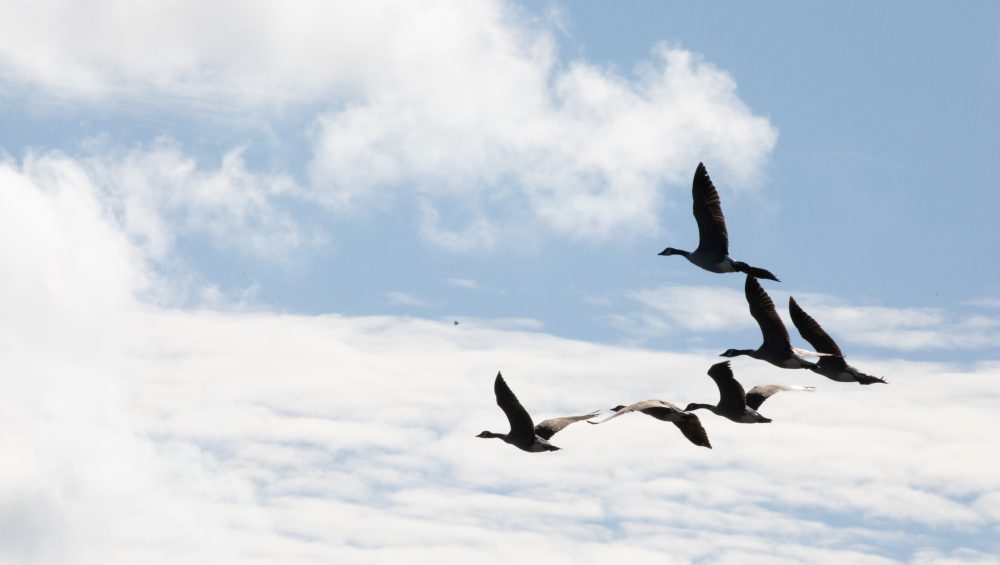
Music isn’t just for the birds

The first day of the Memorial Day weekend was so temperate, I was able to open all the windows. So when the birds and I got around to practicing the prelude to the G Minor English Suite by J.S. Bach, apparently we were audible to creatures with good ears. A dog joined in from across the street, and it was in key with the music. You can hear a little sample right here. The birds had plenty of input too.

Acadian Flycatcher

Defiant in face of the horrible heat of the next two days, I got up early to go birding. On Memorial Day, I went to Montrose Harbor, finally giving in to a birding hot spot on the (sorry) hottest day of the year. It was quite windy as well. While I did not see too many birds. I got a few nice pictures. There were a lot of flycatchers, and the one above turned out to be an Acadian.

Baltimore Oriole

This was the best I could get of a Baltimore Oriole with all the leaf cover.

Cedar Waxwing

Well-shaded, birds sought refuge from the heat in the “Magic Hedge.”

While on the beach, I caught a Northern Rough-Winged Swallow taking a preening break.

Northern Rough-Winged Swallow

And although Montrose Beach often has more exotic shorebird species, Memorial Day brought me only good looks at one Kildeer.

Killdeer

He’s still a pretty bird.

Killdeer

I’ll be back sometime next week, hopefully with more pictures from somewhere I’ve never been (don’t you love the mystery?). And yes, the AP now approves this usage of the word “hopefully.” While I have always inwardly cringed, I like to reassure myself with the knowledge that hardly any of the words still used after 300 years have the same meanings today, and I am just as guilty as anyone of going with the flow…

Winter music

It’s been an interesting week. I went to the lakefront Wednesday morning because it was the only day of guaranteed sunshine, before the snowstorm. It was cold but clear, making for a dramatic sunrise.

The reflection of the sun on the water in the harbor made interesting patterns…

as the ice floes started to settle in.

I startled some Common Mergansers hanging out in the open water.

But did not seem to bother this female fishing close to shore.

By Thursday afternoon when I looked out from the 42nd floor onto the lakefront there was only a rugged sheet of ice (sorry, no picture).

The Snow came on Friday, about 8 inches of it by Saturday morning, making the weekend a winter wonderland. This male cardinal caught me taking pictures of him through the porch window yesterday.

Male Northern Cardinal

I had all the feeders out and the yard was a very popular place. I counted 30 House Finches. Unfortunately by the time I went out in the yard everyone left, except for this sleeping female House Sparrow on the wire.

sleeping Female House Sparrow

Today there was no sunlight so I stayed indoors, eventually focusing on this Mourning Dove.

Mourning Dove on the feeder pole

The female cardinal was in the yard today. I finally managed to capture her here.

Female Northern Cardinal

And now for your listening pleasure, I’ve gone back in taped time to about nine or ten years ago when I was learning the Mozart K 333 in B-flat Major. First, a little sample of Hidalgo the Spice Finch coming in exactly in time with the music, not exactly on his first try but very quickly on his second, as he knows what’s coming (toward the end of a few bars in the first movement).

And then if you’re game for a longer recording, I was practicing the Adagio, which starts off with a lot of zebra finch calls, then Fabrizio, the granddaddy, who is barely singing these days, so it’s nice to hear him when he was young and feisty. He is joined briefly by his first hatched male offspring, Facondo, whose name means something like “squeaky” in Italian, if I can believe the translation I got trying to make up the word-name. At the time I didn’t realize these guys were actually singing complex songs. If you can stand to listen to the entire fumbled adagio with the repeats you’ll also hear some bright spice finch whistles, a little spice finch singing, and toward the end some trills from the male budgie of record (I can’t say for sure if Zeke had come on board yet but I think this might be him); he’s very trilly indeed. And the whole thing ends with one “mwa mwa” from Hidalgo. It was a very lively session, when at the time I had only a few birds. I played piano a lot earlier in those days, too. Now I don’t get around to practicing on the weekends until noon; by then half the birds are napping.

Obsession in A Minor

Increasingly over the last month, every waking moment of my life, my inner soundtrack has been overtaken by the prelude to the A minor English Suite by Johann Sebastian Bach. Invariably some passage is running through my head, and because it goes in and out of A minor into E minor and G major, C major and a few other places, it has a way of fitting in with everything. But now that I have it almost completely memorized, I am in a state of torture bordering euphoria. It is impossible to describe the excitement that builds while playing it. I am partial to the key of A Minor, anyway, as if I was born into it. I favored composing in A minor and I suspect Bach did too because he comes up with more interesting conversations, although that might be said of any of his minor key efforts.

This prelude is really somewhat of a two-part invention. The right hand makes a statement and the left hand answers. It’s ongoing banter back and forth. Although I am right-handed I try to pay equal attention to my left hand because there’s just as much going on there. I think one thing that made Glenn Gould’s Bach playing sound so unique was the fact that he was left-handed. I like to think if I try to listen to both voices, maybe somewhere in my head I have room for the birds too.

This is the second of the English Suites. The first was the A Major and it has taken me forever to wade through. I still struggle with the A Major: there are parts I like, but the “Doubles” in particular I find boring and am at a loss as to how to bring life to them. I don’t generally have this problem with Bach, but I suppose even he ran out of steam every now and then. So it was with eager anticipation that I moved on to the A minor. My ultimate goal is to learn all the English Suites. Part of my lifelong project which I started over 10 years ago: to learn all the Bach keyboard music. I probably won’t accomplish it but it’s a nice thought.

The birds have been enthusiastic about this suite, and I don’t know if it’s because they’re reading my enthusiasm or if they actually like A minor better too. Here’s a budgie who was keeping time with the upbeats in part of the prelude a few days ago. I couldn’t believe my ears when I first heard this.

The best part of the four-day holiday weekend has been time to play every day. I miss this so much I am afraid to admit it to myself. But my “normal” workday schedule doesn’t allow time to play every day. Sometimes it’s hard not to sit and cry “What’s wrong with this picture?” since my normal state of being is to play music…for birds. I have to say my birds are good sports. Today was what my mother used to call “glismal.” It rained or looked like rain all day and never got bright enough inside the house to feel like doing much of anything, but the birds woke came alive when I sat down to play and they participated for most of it.

I wonder if they don’t know the music better than I do as they listen to classical music on the radio all day. I have seen the surprised look on their faces every once in a while when something comes on the radio that we’ve practiced a lot. It’s a double take experience: she’s not playing, where’s the music coming from? So they must be paying attention!

The birds were most vocal today in the Bourree as I was reading through it. Here’s a little excerpt of the Zebra Finches calling back and forth. Or maybe they’re laughing at me…

We’ll check back with the birds in a month or two or three when I might be lucky enough to have the entire A minor English Suite in my fingers, and see what they have to say about it then.

Ravel’s “Jeux D’eau”

As I go through tapes looking for more examples of birds singing with music, I often wade through a lot of old material. Whole boxes exist of practice sessions devoted to a particular piece of music. Such has been with the Ravel, which took a long time to learn playing only an hour here and there on the weekend. Actually the Ravel isn’t all that old – I still have some of it in my fingers, but I refuse to play it anymore. I had to move on. At some point soon, it will be impossible to play, as is the Goldberg, and I will look back on it and wonder how I ever managed to get through it.

Learning the Ravel was a challenge. It probably would have helped had I been 30 years younger with better technique, but I did not let these failings discourage me. For some reason the birds seemed to tolerate my pain reading through it. My sight-reading is such that I never read “through” – rather, I had to figure out a section, memorize it, and move on to the next chunk: a building-block process. In any event, the birds didn’t find much to sing along with, except for the budgies whose vocalizations move as rapidly as Ravel’s notes, so perhaps they were less silenced by the tendency to quickly abandon affiliation with a key. Not atonal by any means, but still a little too modern for a bird with a set song to chime in.

The music was a gift from the same person who left me to the birds. His mother was a pianist, and she had never managed to complete the piece. From her notations on some of the obscure notes in the higher register, I know she didn’t exactly read through it either. Such careful, slow going is not without setbacks, however. Long after I thought I’d figured out the notes, at least, I heard someone play it on the radio, and discovered one critical chord was absolutely wrong! I was off one note, which changed the whole feel of the piece. I had to practice that out of my fingers and ears for a week or two.

After listening to a lot of false starts, surprised to find a I’d made it through the whole thing, so that’s why it’s here.

Also a surprise, the picture below. I thought I came back with no pictures yesterday from the clouds and wind, but this shot of a juvenile Bald Eagle turned out rather impressionistic.

Juvenile Bald Eagle, Hennepin-Hopper Wildlife Area

A Return to In-Keyness


waterfall in Peru...


What does it mean? What is the significance of the birds singing in key with human music, with people unwittingly responding the same way, talking in the key of the music in the background, or of the music ringing in their ears after a performance? It’s not hard for me to imagine the vibrations left by the instruments still wafting in the air. Is it just a natural phenomenon, a matter of course, something to be taken for granted, or is there some significance to it? Is there perhaps something right in front of our eyes, or our ears, or our entire beings, that we are missing by ignoring it? We certainly ignore a lot of things that we take for granted. Heaven knows we’re too busy to waste time reflecting on or paying attention to natural phenomena when we have work to do, dinner to cook, phone calls to make and receive, social networks to attend. To try to slow down your day long enough to listen, or to look, fully with the senses you were born with, is the equivalent of an altered state. Why is this? It seems to me we shouldn’t have to be unusual, deranged or distracted to pay attention.

                When I began to think about everything or everyone being in key, naturally, without having to do anything except be alive and present, it was tempting to make analogies to universal language, harmony (which connotes peace), and all those symbols that give hope to a chaotic existence. I wondered about the mechanics of it: if baby birds are born begging in key, what about human babies? If there is music at birth, is the child’s first cry in key with it?

The flip side suggests that where there is discord, perhaps we are then out of tune. In any range of the spectrum, from a simple argument to acts of aggression, will we still automatically be in key because we have no control over it, or in the alternative, will the friction render us out of key?

The next conclusion is that there must be some way to measure, on a cellular level, the effect music has on our well-being. If you’re skeptical about musical vibrations on a minute level, listen to a recording of the sounds made by yeast.  If exposure to noise rearranges our molecules enough to cause us harm, what of the opposite effect? There are plenty of proponents of music therapy. Can this be measured? Are there better ways to treat more illnesses with music than we know? Is the act of playing music or singing restorative? Music used to be a much bigger part of our lives than it is now, people participated more often than being passive recipients of music. On the bright side, due to enhanced methods of communication, we are now being exposed to other musics more often than those we consider our own, as “world music” becomes popular. Is there any way that sharing music can become a metaphor for peaceful coexistence?

I will return to this subject from time to time because it fascinates me, but I also tend to veer off in divergent directions. I cannot stay up all night so I will leave you with this thought: whether you realize it or not, music is all around us and within us, even in silence, as John Cage was so apt to point out.

Back to the wild

Immature American Robin

I’ve been trying to go through some of the older tapes, recorded when I was still able to play for wild birds. But it is the wild birds that beckon, making it hard to sit for hours at the computer when fall migration is underway outside, and the weather has been beautiful the last two days, so I have been out in the forest preserves searching for migrants. I was hearing the invention from the Bach A Minor English Suite in my head yesterday and every bird I listened to seemed to be in key with it. However this morning I was less aware of any particular musical background, perhaps due to the weather change; we had dropped 10 degrees or more. And the chill winds were keeping the birds from singing too; I don’t remember hearing much more than chip notes today.

One thing recording the birds has done for my playing, such as it is, is it taught me how to listen. I don’t know why it’s so difficult to listen, or pay attention, to yourself when you’re playing, but it often seems you might as well be doing something else. I don’t think I heard half of what I was playing until I started taping the practice sessions. Then it became impossible to not listen back to my playing as well as the singing of the birds. Usually I’m listening for a painful faux pas, to the point where I can often anticipate it, but I have also gained a lot of insight into a piece and where I wanted to go with it. And because I was doing all this with the purpose of listening to the birds and not obsessing about my playing, I’d like to think I could approach listening with a more open mind, if you will, rather than with the crippling criticism of a perfectionist. I imagine the birds have given me license to play imperfectly but as musically as possible. I would like to play as sweetly as they sound.

In the attached recording the birds are unfortunately a bit far away. This is Mozart’s C Major Sonata K 309, and a robin starts singing toward the end of the Adagio and into the third movement, and he sounds rather ethereal. The hardest thing about playing music for birds is that I want to listen to them instead of to what I’m playing. So listening has become a circular dilemma after all.