The Tiny Ones

Winter Wren IMG_9625

I saw very few birds today due in part to a rainy forecast and a meeting at work, but I am happy to report the birds I did see were all alive and well. And they have dictated this post.

Winter Wren IMG_9616

I never tire of Winter Wrens and this morning at 155 North Wacker Drive I had one who was hopping around right in front of me. Darting around quickly, Winter Wrens remind me of field mice.

Winter Wren IMG_9623

Then up on the 46th floor mid-morning, my coworkers drew my attention to three Golden-Crowned Kinglets who were foraging for bugs ion the balcony.

GC Kinglet IMG_9659

The kinglets kept hunting for at least 15 minutes, which was long enough for me to show them off to at least a few interested people. The attorneys all have spiders hanging webs outside their windows, indicating one can make a good living off bugs all the way up there, so I was not surprised to see birds taking advantage of the insect offering.

GC Kinglet IMG_9652

Unfortunately I had to settle for pictures through the window and the blinds, but these tiny jewels were just close enough to photograph anyway.

GC Kinglet IMG_9665_1

GC Kinglet IMG_9648

I wonder if they continued their rooftop forays throughout the city. It’s probably a good strategy, making it easier for them to get their bearings.

Brown Creeper Confusion

Brown Creeper

Brown Creeper

I was late getting in to work this morning.  The birds made me do it.

First, I found a dead Hermit Thrush at 123 N. Wacker, the same building where I found the stunned Hermit Thrush last week. It was windy and chilly this morning, so I should not have been surprised, I suppose, but I hate to see dead birds. What a beautiful bird it was too; could not have been dead long. At any rate, what else to do but pull out one of my trusty paper bags and call Chicago Bird Collision Monitors? They were very busy and my ca;; went straight through to voice mail.

Brown Creeper IMG_9499_1

Then at 155 N. Wacker right near the entrance to the building, which has an enormous glass-walled facade underneath a portico, I found a stunned Brown Creeper. It’s amazing to me how many people walked by and did not even stop to look at this little gem. He was alive and at first having none of me catching him and putting him into a bag, so I stayed with him as he tried to catch a spider. The spider escaped and I tried to edge it back toward the bird but the spider was having none of it. I started emptying my bag to use it as a net, but the creeper was wise to that and started flying up against the big glass wall until he became exhausted. That was when I caught him more easily and, thinking I was going into work and the Bird Collision Monitors were too busy, I took him over to the albeit-not-so-great trees in the mini-park at 155 N. Wacker. He seemed okay with that and he flew to the trunk of the first tree.

I was then in my usual spot checking out the White-Throated Sparrow population and  decided to walk around the back to where there is a bike rack. One White-Throated Sparrow was calling from a bush there. I was then ready to leave, figuring I had seen everybody, when I encountered a stunned Hermit Thrush on the sidewalk. I could not imagine missing him, so he must have just hit the building while I was visiting the sparrow. The thrush was easy to pick up in that state, so I put him in a bag to keep him warm and out of trouble, affixed a paper clip to the top, and called the monitors again. I knew now I was going to stay and wait for help, however long it took.

The monitor taking calls rang me back and said they would send someone right over. Soon Nancy called me and said she was on Wacker Drive in front of the building. I walked over and delivered the two thrushes. One dead, one alive. I watched as she labeled them and made sure she had the correct information for each bird. We chatted a little and I left.

But then I found a Brown Creeper, most likely the same one, splayed on the sidewalk by the windows. I reached down, picked him up, and headed back to Wacker Drive, running north, yelling, “Nancy, Nancy!” When Nancy turned around, I met her with the Brown Creeper. She opened up a little bag to receive him and I reached in with my hand to release him – and he would not let go. He clung on to my warm finger with his tiny foot. I told him he had to leave, that Nancy would take good care of him, and he finally let go with a little prodding from me. I wonder if by then he might have decided his fate was inextricably connected to mine. I trust Nancy got him to a better place where he found his bearings and continued on his journey south.

Here’s a picture of a Brown Creeper I took last week or so, who was not lost.

Brown Creeper IMG_7743_1

And another this afternoon, at Lake Shore East Park.

 Brown Creeper IMG_9574_1

Hermit Thrushes Everywhere

Hermit Thrush IMG_9137_1Whose idea was it to call these friendly guys Hermit Thrushes? Maybe on their breeding and wintering grounds they are reclusive, but in fall migration they are downright gregarious. It may be a safety-in-numbers thing going on, but I have had Hermit Thrushes literally come out to see me day after day this past week.

Hermit Thrush IMG_9073_1

Early in the week on my way into work I found one Hermit Thrush who was definitely not in good shape. That’s him below, seeking solace by my shoe box which I had taken out of my bag so I could extract my cell phone and place a call for his rescue. While we waited for a Chicago Bird Collision Monitor, I took this picture, and then put him inside one a paper bag for the monitor.

Hermit Thrush IMG_8675_1

If you want to do a little more reading on Hermit Thrushes follow this link to the Cornell Lab of Ornithology. I just learned something from it: of all the thrush species we see in migration, Hermit Thrushes are the only ones to live in the U.S. I guess that means however far they migrate, they will just winter somewhere south of us until spring. That also explains to me why they tend to come through later than the other species and also why they seem to be taking their time before moving on.

So here are a couple more pictures of different individuals. They do seem to prefer shady spots.

Hermit Thrush IMG_9145_1

Hermit Thrush IMG_9129_1

Flesh, Feathers and Bone

Juvenile Yellow-Bellied Sapsucker

Juvenile Yellow-Bellied Sapsucker

Tuesday afternoon while I was taking pictures of this Yellow-Bellied Sapsucker at Lake Shore East Park, so thrilled that I was seeing it with two or three others flitting about in the trees that surround the children’s enclosed play area, a woman stopped to pull her little dog away from something it was interested in. I looked down shocked to see a very dead Lincoln’s Sparrow the sapsuckers had distracted me from. (I picked it up and put it in my bag to get it off the sidewalk, but it was too late in the day to call the collision monitors. It’s now at home in the freezer. Hard to say what caused its death, but its head flopped about as if its neck was broken.)

Then Wednesday morning on the way in I found a dead sapsucker on the sidewalk by 155 North Wacker. I called the collision monitors but they were frantically busy – I was afraid they might not come by the building for another corpse. There were a lot of birds reported on the lakefront that morning, so no doubt there were injured birds that required more attention than dead ones. I hate the carnage that accompanies migration, but this was a reminder that I should be carrying brown paper lunch bags with me again, it’s the only fitting thing to carry a dead bird in. Or a live one that needs assistance, for that matter.

As it turned out, all is well. Wednesday late afternoon a bird collision monitor called me at my work number and I went down and delivered the dead sapsucker. She gave me a special paper bag with instructions and a paper clip to fold it and keep it closed, should I find any more birds on the way home. As it turns out, I have been carrying paper bags with me two days now and have found no more corpses or birds in distress. But I remain prepared.

I then stopped at the security desk to find out if they had given the flicker from the balcony on the 46th floor to the bird collision monitor the day before and when the guard suddenly remembered it, she said “the pretty bird” with emphasis. Yes indeed. And I am impressed with the diligence of the Chicago Bird Collision Monitors team.

Here are pictures of some live birds! Two species that have been numerous in the lakefront parks this past week. Hermit Thrushes – I have yet to figure out why they are called hermits – are always curious whenever I pay attention to them – they run right out to see who’s calling.

Hermit Thrush IMG_7562

Hermit Thrush

Except when they’re busy eating berries off the trees…

Hermit Thrush2 IMG_7591

Hermit Thrush

And White-Throated Sparrows are increasingly everywhere. Every once in a while a youngster breaks into a little subsong. Never too early to practice for next spring.

WT Sparrow IMG_7318_1

White-Throated Sparrow

These little visitors seem to adapt well to the city space.

White-Throated Sparrow IMG_7517

White-Throated Sparrow

Return of the Yellow-Rumpeds

Yellow-Rumped Warbler

Yellow-Rumped Warbler, Lyman Woods

Our migrations always seem to be punctuated by the arrival of Yellow-Rumped Warblers. In the spring, their arrival in great numbers signifies the beginning of the end of spring warbler migration. It is much the same in the fall. So while I was delighted this weekend to see them easily because of their numbers, I could not help but think that the warbler numbers would be dwindling, and fall would give way to other species.

"Meadow" Rump

“Meadow” Rump

Yesterday there were perhaps 30 or more Yellow-Rumped Warblers foraging in and around the meadow at Lyman Woods in Downers Grove.

Yellow-Rumped Warbler, Chicago Portage

Yellow-Rumped Warbler, Chicago Portage

Today I went first to Ottawa Trail Woods where I saw virtually none of them, unlike spring. By the time I got to the Portage, there were only a few Yellow-Rumpeds hanging out with some American Goldfinches. But when I circled back around to the south bridge before I left, there were perhaps 20 or more foraging in the duckweed-covered shallows with as many American Robins.

Yellow Rump Portage 1I2A3050

I have many other bird photographs from this weekend but I have to get some sleep, so I am limiting myself to the Yellow-Rumped Warblers for this post.

Yellow-Rump Portage 1I2A3053

I am surprised by this particular setting, which I didn’t realize at the time I took the pictures, I was so busy following the bird’s movements. But the duckweed background, branches and sparse leaves strike me as very shibui.

Yellow-Rump Portage 1I2A3064

A Few Fall Warblers

Bay-Breasted Warbler

Bay-Breasted Warbler

If the Osprey from my last post and a few other interesting water-oriented birds had not kept me occupied on Sunday, I might have been gone before these warblers came to life. Indeed I had turned back when the sun came out from behind the clouds around 11:00 a.m., which is usually when everything starts to slow down. Enter the Chickadees, Redstarts, and these few characters.

Bay-Breasted Warbler

Bay-Breasted Warbler

The Ovenbird below was a little too far away.

Ovenbird

Ovenbird

But the female Magnolia Warbler spent a moment or two preening before seeming to ask me just what it was I found so interesting about her.

Female Magnolia Warbler

Female Magnolia Warbler

The weather is suddenly beastly hot, but I am hopeful the cool front predicted for the end of the week will bring a few more tropical jewels my way.

Hummingbird Moth Migration

Hummer Moth IMG_0335_1

White-Lined Sphynx Moth

Last week for two days in a row in downtown Chicago, I saw Hummingbird Moths, also known as Sphynx Moths, with the first one being on my way to work Thursday morning in the flowering plants at 100 South Wacker Drive. Now that fall warbler migration has begun I have had my camera ready. But I think even if I had to stop and put the lens on the body, this moth would still have waited for me. It seemed to respond to attention.

Hummer Moth IMG_0293_1

If you know the name of this plant please tell me: it’s installed everywhere which makes me think it’s rather common and very hardy.

When I got to 155 N. Wacker Drive a few minutes later, I did manage to see a Nashville Warbler out in the open. I had a female Mourning Warbler too but she was not so cooperative.

Nashville Warbler

Nashville Warbler

Later in the afternoon, at Lake Shore East Park, I was hearing birds but not seeing them, so I started imitating some call notes and this Blackburnian Warbler emerged to check me out.

Blackburnian Warbler

Blackburnian Warbler

Also had a brief encounter with a Swainson’s Thrush.

Swainson's Thrush

Swainson’s Thrush

Few and far between are Monarch Butterflies. I can remember only a few years ago seeing scores of them at a time and now I am lucky to see one. I would like to see this species recover; I hope it’s not too late.

Monarch Butterfly

Monarch Butterfly

On the way back to work, at the Aon Center, was another hummer moth.

Hummer Moth IMG_0367_1

This one was a bit easier to capture. Click on the pictures for an enlarged view. I think the eyes are fascinating.

Hummer Moth IMG_0375_1

Indeed these moths look to me like some kind of magical made-up creatures that belong in a Pixar movie.

Hummer Moth IMG_0373_1

Not that I’ve ever watched one. I’d rather see the real thing.

Sandhill Crane Migration

Sandhill Cranes at Jasper-Pulaski IMG_7735_1

Taking a break from the Brazil photo project, I went with friends yesterday to Jasper-Pulaski Fish and Wildlife Area in Indiana to witness the annual fall Sandhill Crane migration/gathering at their staging area. Reports were of 28,000 birds present yesterday. I don’t know how you count 28,000 birds, but there were an awful lot.

Sandhill Cranes IMG_7717_1

The weather was an additional perk this year: unlike previous visits, I could stand outside and watch the entire dusk display without feeling any pressure to run back to a warm vehicle. Memories of this event in previous years always conjures up visions of dealing with extreme cold. But yesterday it was almost 70 degrees Fahrenheit. It seemed almost sacrilege to be so comfortable.

Sandhills IMG_7752_1

It was cloudy but hard to complain. I think the cranes were enjoying the mild temperatures too.

Sandhills IMG_7753_1

An Abundance of Swainson’s Thrushes

Swainson’s Thrush, LaBagh Woods

Every migration season is different, and if one species dominates this fall migration in Chicago, it has been Swainson’s Thrushes – I have seen them everywhere, almost every day, and this has been going on the entire month of September.

In the forest preserves I have counted so many they have sometimes seemed to outnumber the Robins. The second most numerous species in the preserves has perhaps been Northern Waterthrushes. But I have seen Swainson’s even in downtown Chicago.

155 N. Wacker

It has gotten to the point where I have stopped taking pictures of the Swainson’s Thrushes because it’s unnecessary just to document their presence. But then every once in a while there have been models that were hard to resist.

Today at LaBagh Woods, the Robins and the Swainson’s Thrushes were foraging from rocky shoals in the Chicago River.

Thrushes in the Chicago River

Redstart Reverie

American Redstart

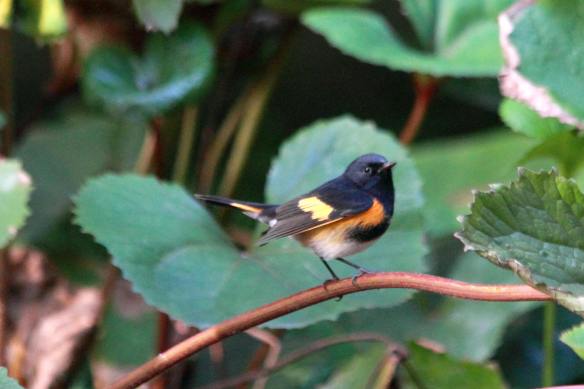
The latest star appearing at 155 N. Wacker Drive is an adult male American Redstart. I started seeing his brethren a week and a half ago, later than the females and immatures. And like his kin, he has eluded my gaze and the camera lens, much as I expected.

This morning I got to his selected green space a little earlier than usual. It was windy and dark in the shade of other buildings; the sun wasn’t making much of an appearance yet, and I wondered what good it would do me with the days getting shorter. Then I heard the redstart’s chip note, so I knew he was around, but I didn’t see him for several minutes, and then when I did it was only the suggestion he made by quickly rustling a few leaves.

After I’d been waiting patiently for about ten minutes, as if to taunt me, he suddenly landed right in front of me on the ground and left just as quickly! I was too slow with the camera. I consoled myself with the thought that it wouldn’t have been a very spectacular shot anyway on that dull background.

I had been standing around for about 20 minutes now. The only other bird I saw at the corner this morning was a Swainson’s Thrush. There might have been another warbler, but I could not see it clearly enough. I practiced my imitation of the Redstart’s chip note, until I could wait no longer.

I checked my watch for the last time, and then said to the redstart, wherever he was, that it was time for me to leave. Now was his last chance if he wanted his picture taken. So what did he do?

He flew into the plants right in front of me, and posed for about 15 shots. I don’t know why, but he suddenly seemed intrigued by the whole affair.

Did he see his beautiful reflection in my camera lens? Did he feel my admiration for his colorful self through the viewfinder? Or did he finally decide to have a word with me since I’d been paying attention to the thought of him for so long, while scores of other humans passed by not noticing him?

Whatever it was, we bonded in that moment or two. And I got enough good vibes off the encounter to carry me through the entire week.