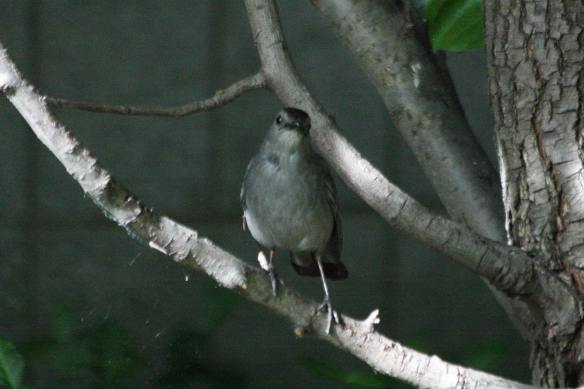
An Abundance of Swainson’s Thrushes

Swainson’s Thrush, LaBagh Woods

Every migration season is different, and if one species dominates this fall migration in Chicago, it has been Swainson’s Thrushes – I have seen them everywhere, almost every day, and this has been going on the entire month of September.

In the forest preserves I have counted so many they have sometimes seemed to outnumber the Robins. The second most numerous species in the preserves has perhaps been Northern Waterthrushes. But I have seen Swainson’s even in downtown Chicago.

155 N. Wacker

It has gotten to the point where I have stopped taking pictures of the Swainson’s Thrushes because it’s unnecessary just to document their presence. But then every once in a while there have been models that were hard to resist.

Today at LaBagh Woods, the Robins and the Swainson’s Thrushes were foraging from rocky shoals in the Chicago River.

Thrushes in the Chicago River

Redstart Reverie

American Redstart

The latest star appearing at 155 N. Wacker Drive is an adult male American Redstart. I started seeing his brethren a week and a half ago, later than the females and immatures. And like his kin, he has eluded my gaze and the camera lens, much as I expected.

This morning I got to his selected green space a little earlier than usual. It was windy and dark in the shade of other buildings; the sun wasn’t making much of an appearance yet, and I wondered what good it would do me with the days getting shorter. Then I heard the redstart’s chip note, so I knew he was around, but I didn’t see him for several minutes, and then when I did it was only the suggestion he made by quickly rustling a few leaves.

After I’d been waiting patiently for about ten minutes, as if to taunt me, he suddenly landed right in front of me on the ground and left just as quickly! I was too slow with the camera. I consoled myself with the thought that it wouldn’t have been a very spectacular shot anyway on that dull background.

I had been standing around for about 20 minutes now. The only other bird I saw at the corner this morning was a Swainson’s Thrush. There might have been another warbler, but I could not see it clearly enough. I practiced my imitation of the Redstart’s chip note, until I could wait no longer.

I checked my watch for the last time, and then said to the redstart, wherever he was, that it was time for me to leave. Now was his last chance if he wanted his picture taken. So what did he do?

He flew into the plants right in front of me, and posed for about 15 shots. I don’t know why, but he suddenly seemed intrigued by the whole affair.
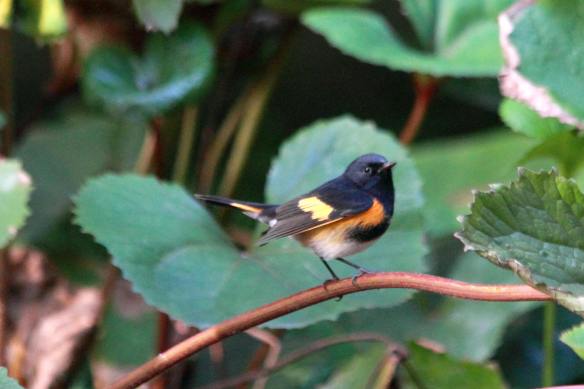
Did he see his beautiful reflection in my camera lens? Did he feel my admiration for his colorful self through the viewfinder? Or did he finally decide to have a word with me since I’d been paying attention to the thought of him for so long, while scores of other humans passed by not noticing him?

Whatever it was, we bonded in that moment or two. And I got enough good vibes off the encounter to carry me through the entire week.

Migration Madness

Eastern Wood-Pewee

I don’t chase birds, and it seems I have had fewer opportunities than I’d like lately to search for birds even in the most convenient places. So I try to make the most out of the chances I do get.

Wilson’s Warbler

Tuesday morning on the way back to work from the Labor Day weekend, I saw this Wilson’s Warbler at 155 N. Wacker.

American Redstart

The warblers in particular have been scarce in the city parks, if not in the “hot spots,” but I don’t like going back into the city on the weekend after migrating to and from it all week, so today I decided to get to the Chicago Portage early and then go to Palos.

Outside of American Redstarts at the Portage, I had a Connecticut Warbler and a male Black-Throated Blue, but neither of them wanted their pictures taken.

I got a little luckier at Palos, which holds a large area of contiguous forest preserves in southern Cook County. I parked in the south Swallow Cliff lot and took off on the yellow trail. I had looked it up before I went and knew it formed a continuous loop through several forest preserve areas. The entire loop is more than 8 miles. Without realizing the consequences of such a hike, I embarked upon the trek.

Blue Jay

The slowest part of my walk was in the beginning. There were Blue Jays and Eastern Wood=Pewees everywhere. I tend not to think of Blue Jays as migrants, but of course they are. To my delight, several jays sang over the course of my walk, and I always had to stop and listen. Not one song matched another.

Chestnut-Sided Warbler

It took quite a while to hit pockets of warblers and when I did it was sometimes difficult to identify them all. I didn’t get many pictures of them, but this Chestnut-Sided Warbler was most cooperative.

The Yellow Trail is frequented by runners, cyclists and horseback riders. Not necessarily the ideal birdwatching situation. But I got used to it after a while and figured the birds were pretty used to it too.

Red-Bellied Woodpecker

I’m pretty tired and sore from the trek. I know I will be sore tomorrow, but my four plus miles of walking to the train and back are less strenuous than today’s workout. It was good to see some birds.

Eastern Wood-Pewee

Urban Gray Catbird

Gray Catbird

Yesterday morning on my way into work I stopped at 155 N. Wacker Drive in downtown Chicago to see if any new birds had blown in with the winds that were downing tree limbs in my neighborhood the night before. My friend of the past couple weeks, one of the two or three Gray Catbirds that’s been hanging out in this little patch of park, immediately came out to greet me.

So while there was bright sunshine except when he perched in a low branch of one of the trees against the building, I decided to take his picture. He almost seemed to demand it. Perhaps he was even a bit irritated with me for coming to look for other birds. Why should I need to look for other birds, if I could see him?

Mind you, I don’t feed this bird, I only acknowledge his presence. He trots out to greet me every morning when I stop to see if he’s still around. There is a connection here, and I don’t claim to understand it, but I think it’s a wonderful thing. It must have something to do with the way in which I notice him. I recognize him, and he recognizes me, and it’s a lot like the person you see on the train every day, smile and nod at, even if you never exchange words. Whatever this bird is up to in this park, he’s enjoying the bugs and I’m enjoying seeing him hunt for them.

I am a bit puzzled by the length of his stay, because Gray Catbirds breed in the savannah areas of the forest preserves around Chicago and more rural areas, and I can’t help but think he’s made himself at home. Wouldn’t it be something to have Gray Catbirds breeding in downtown Chicago!

Anyway, I thought I’d see if I could get a better picture of his gorgeous undertail coverts and he obliged. Then it seemed like almost every picture I took, he was showing off.

Don’t forget to get a picture of my beautiful black crown!

I talk to him, but he’s silent. He hasn’t sung or said a word. I am used to hearing Catbirds in the “wild” and usually, if they’re not singing, they at least let you know they’re watching you by uttering their characteristic “meow”-like vocalization. Maybe that’s why this Catbird likes me. He knows I know who he is without him having to tell me.