Winter in Chicago, then and now

Aside

This has been the warmest La Nina ever, and I have to wonder if this hasn’t been the warmest January in Chicago. Of course it’s early yet. Last year on January 13 we had snow and the lake had a think layer of ice on it.

Snowcrow 01-13-2011

Lake birds, 01-13-2011

But the prediction this coming Friday is for above-normal temperatures to continue.

The lakefront sunrise Wednesday morning was earlier, the days are getting ever so slightly longer.

The crows, of course, were in attendance.

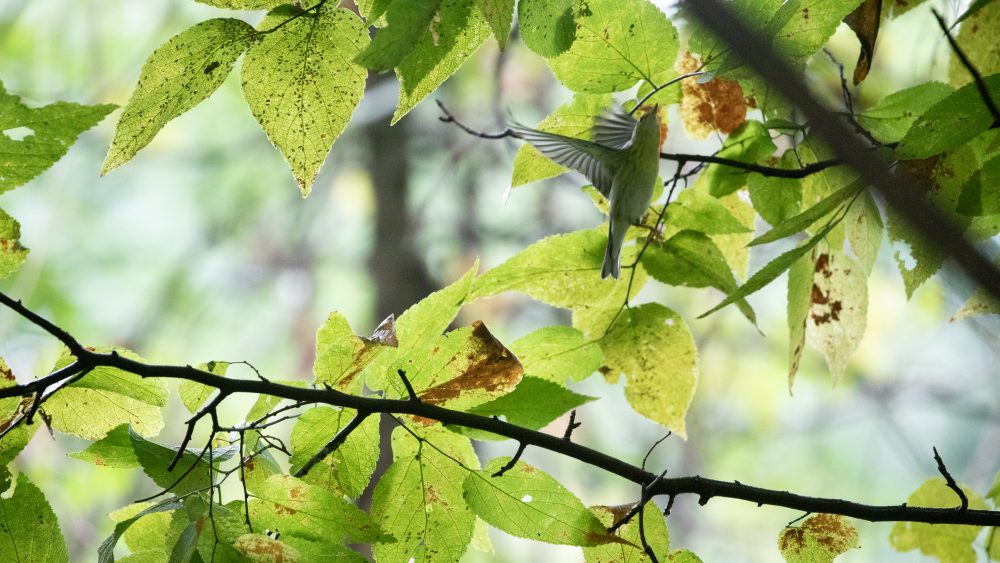
A now very famous Black-Throated Blue Warbler hanging out by the bicycle rental at Millennium Park…

has been sipping sap from the trees the Sapsuckers have drilled into.

The Sapsuckers themselves are late to leave.

Yellow-Bellied Sapsucker

There was also a Cooper’s Hawk at Millennium Park that morning, and I annoyed him enough by taking his picture. He eventually moved on, leaving the warbler safe.

I woke up this morning with the prelude to the Bach A minor English Suite playing in my head. Only the purest silence eventually makes me aware. There was a little frost last night, but by the time I left the house it had melted off. I went to the Chicago Portage to see what exists. The tangled web of bare trees and dried vegetation offered winter views. All quiet, asleep, but potential lurks in that dormancy.

I did not get pictures of all 11 species that I saw. The first bird was a flyover Mallard duck. A little later I heard a constant sound that resembled a murmuring quack, or perhaps it was a squirrel sound. It turned out to be a Downy Woodpecker pecking away at the dried stems of Phragmites that grow by the water. I can’t imagine if the stems harbor dead bugs or some other delicacy but the Downy was persistent, until he flew up into the tree and gave me this nice photograph, one of several.

There were Mourning Doves sitting quietly in a tree.

Music in my head at the Portage was Albeniz, since I recently decided to revive the few pieces I once knew. The birds complied and remained in C#.

Female Northern Cardinal

On the path ahead there were several cardinals and goldfinches foraging.

American Goldfinches

It has been so warm, lichens are growing on this dead log.

I left the Portage and went to the grocery store, where by this time my head was playing the Tango by Albeniz which is in D major. I only remember this because the woman in line behind me thanked me for giving her my “tickets” – there’s some kind of promotion going on that I don’t have time for – and our conversation was in D. What would she think if I told her I had made her talk to me in the key of the music playing in my head? Was it worth the tickets I gave her?

I saw a Junco at the Portage but didn’t get a picture of one until I got home. This one is through the porch window.

Dark-Eyed Junco

Later this evening I counted 23 Mourning Doves under my feeder. It was too dark to take a picture, but I counted them three times to be sure. I had thought they were in decline because I wasn’t seeing them. I have never seen that many in my yard, ever! The new feeder must be doing a good job.

With a little luck I’ll have some musical excerpts coming up soon. So you won’t have to try so hard to hear the music playing in my head…

Obsession in A Minor

Increasingly over the last month, every waking moment of my life, my inner soundtrack has been overtaken by the prelude to the A minor English Suite by Johann Sebastian Bach. Invariably some passage is running through my head, and because it goes in and out of A minor into E minor and G major, C major and a few other places, it has a way of fitting in with everything. But now that I have it almost completely memorized, I am in a state of torture bordering euphoria. It is impossible to describe the excitement that builds while playing it. I am partial to the key of A Minor, anyway, as if I was born into it. I favored composing in A minor and I suspect Bach did too because he comes up with more interesting conversations, although that might be said of any of his minor key efforts.

This prelude is really somewhat of a two-part invention. The right hand makes a statement and the left hand answers. It’s ongoing banter back and forth. Although I am right-handed I try to pay equal attention to my left hand because there’s just as much going on there. I think one thing that made Glenn Gould’s Bach playing sound so unique was the fact that he was left-handed. I like to think if I try to listen to both voices, maybe somewhere in my head I have room for the birds too.

This is the second of the English Suites. The first was the A Major and it has taken me forever to wade through. I still struggle with the A Major: there are parts I like, but the “Doubles” in particular I find boring and am at a loss as to how to bring life to them. I don’t generally have this problem with Bach, but I suppose even he ran out of steam every now and then. So it was with eager anticipation that I moved on to the A minor. My ultimate goal is to learn all the English Suites. Part of my lifelong project which I started over 10 years ago: to learn all the Bach keyboard music. I probably won’t accomplish it but it’s a nice thought.

The birds have been enthusiastic about this suite, and I don’t know if it’s because they’re reading my enthusiasm or if they actually like A minor better too. Here’s a budgie who was keeping time with the upbeats in part of the prelude a few days ago. I couldn’t believe my ears when I first heard this.

The best part of the four-day holiday weekend has been time to play every day. I miss this so much I am afraid to admit it to myself. But my “normal” workday schedule doesn’t allow time to play every day. Sometimes it’s hard not to sit and cry “What’s wrong with this picture?” since my normal state of being is to play music…for birds. I have to say my birds are good sports. Today was what my mother used to call “glismal.” It rained or looked like rain all day and never got bright enough inside the house to feel like doing much of anything, but the birds woke came alive when I sat down to play and they participated for most of it.

I wonder if they don’t know the music better than I do as they listen to classical music on the radio all day. I have seen the surprised look on their faces every once in a while when something comes on the radio that we’ve practiced a lot. It’s a double take experience: she’s not playing, where’s the music coming from? So they must be paying attention!

The birds were most vocal today in the Bourree as I was reading through it. Here’s a little excerpt of the Zebra Finches calling back and forth. Or maybe they’re laughing at me…

We’ll check back with the birds in a month or two or three when I might be lucky enough to have the entire A minor English Suite in my fingers, and see what they have to say about it then.

The Original Budgie

On my way to Wherever this weekend I grabbed a couple older tapes to listen to in the car, just to see what was going on at the time. No, I’m not kidding, my car is that old. And the tape player is on the fritz but every once in a while if I’m not going too fast I can listen to a tape if I crank the volume all the way up.

I had previously labeled the tapes notable for the vocalizations of the original male budgie Pete, a beautiful little green and yellow guy, the adopted bird who came with Blanche. When these recordings were made, I had only the two budgies, Pete and Blanche, maybe five or eight (by then) zebra finches, Fabrizio and Serafina being the originals, and the two original Spice Finches, Hidalgo and Sam, and Jules and Sophia, the two females I got when Sam turned out to be a male. I wasn’t sure of Jules so I gave her a name that could go either way. But that’s another story for a later post.

Hidalgo, the Caruso of Spice Finches, was on both tapes, and it’s probably his fault that I wasn’t listening to Pete the budgie when I played them in the car. I wonder if perhaps I have heard so many budgies since him I don’t have an ear for listening anymore. But when I listened back through headphones while trying to make clips from these tapes, I realized he sounds entirely different from the budgies that have all grown up in the house and are related to Zeke, the gray-blue budgie who still lives.

I play a little game with myself sometimes, when I’m in the kitchen and a budgie flies in, I don’t turn around to see who it is before I try to guess based on the sound of the patter. I’m right about 99% of the time, and I don’t know how I do it. If you asked me to tell you the difference between one budgie’s song and another’s, I couldn’t do it. But something in the pattern must be different enough that I recognize it, albeit unconsciously. Such is the thing with Pete’s song. The sounds are familiar, but the cadence is different. And I remember distinctly that after he died and Blanche was left alone, she sat around and sang his songs as if to recreate his presence, a fitting eulogy for her old friend. That was before she gave me the “If you think I’m going to sit here alone and be amused by these finches laying eggs and having babies, you’ve got another thing coming” ultimatum, which sent me to the pet store for Another Budgie.

So this clip has a couple of solos by Hidalgo and then Pete is singing with an almost passable version of the Adagio to Mozart’s C Major Sonata K 310, until I flub the very end of it. There are contributions from a zebra finch or two. I suspect the zebra finch songs have gained differentiation and complexity over the years. I’m sorry I did not keep a detailed family tree; I don’t think I was aware I was running an experiment until years after it started. I know I didn’t pay attention to the zebra finch songs until long after I noticed they were all different. I hope after I identify all the zebra finch songs I can make more sense out of their progression.

At any rate it seems I was still practicing the Goldberg, and it had to have been a once-a-week run-through at the time, so a haphazard rendition of the aria and the first few variations appears here until the phone rings. I did go back to playing but it was hard for us all to get back in the groove after the interruption; in particular we lost Pete. Here Pete adds constant comment and Hidalgo throws in his two cents among several zebra finch vocals. Note how Hidalgo always sings his long “mwah mwah” notes in key with the music.

Ravel’s “Jeux D’eau”

As I go through tapes looking for more examples of birds singing with music, I often wade through a lot of old material. Whole boxes exist of practice sessions devoted to a particular piece of music. Such has been with the Ravel, which took a long time to learn playing only an hour here and there on the weekend. Actually the Ravel isn’t all that old – I still have some of it in my fingers, but I refuse to play it anymore. I had to move on. At some point soon, it will be impossible to play, as is the Goldberg, and I will look back on it and wonder how I ever managed to get through it.

Learning the Ravel was a challenge. It probably would have helped had I been 30 years younger with better technique, but I did not let these failings discourage me. For some reason the birds seemed to tolerate my pain reading through it. My sight-reading is such that I never read “through” – rather, I had to figure out a section, memorize it, and move on to the next chunk: a building-block process. In any event, the birds didn’t find much to sing along with, except for the budgies whose vocalizations move as rapidly as Ravel’s notes, so perhaps they were less silenced by the tendency to quickly abandon affiliation with a key. Not atonal by any means, but still a little too modern for a bird with a set song to chime in.

The music was a gift from the same person who left me to the birds. His mother was a pianist, and she had never managed to complete the piece. From her notations on some of the obscure notes in the higher register, I know she didn’t exactly read through it either. Such careful, slow going is not without setbacks, however. Long after I thought I’d figured out the notes, at least, I heard someone play it on the radio, and discovered one critical chord was absolutely wrong! I was off one note, which changed the whole feel of the piece. I had to practice that out of my fingers and ears for a week or two.

After listening to a lot of false starts, surprised to find a I’d made it through the whole thing, so that’s why it’s here.

Also a surprise, the picture below. I thought I came back with no pictures yesterday from the clouds and wind, but this shot of a juvenile Bald Eagle turned out rather impressionistic.

Juvenile Bald Eagle, Hennepin-Hopper Wildlife Area

Zebra Finch Song: Zorro

Zorro the Zebra Finch is the only one of my little guys who got his name by association with another finch, and not by the character of his song. Indeed his song eluded me for a long time, until maybe about a year ago I started to get the gist of it. I’m sure he’s honed it down and it has matured over time, but I also think like acquiring a taste for a new style of music, I was paying more attention to it.

Zorro was a solo finch in that he had no siblings, so for company he started hanging out with his Aunt Zelda. I don’t know if she was really his aunt, but she was probably old enough to be. Zelda was the only female Zebra Finch I ever named outside of Serafina who was the original hen, because after that the females all started to look the same, had no distinguishing vocalizations, and I had no way to keep them straight, so the girls remained anonymous. But Zelda stood apart because of the skin disease or whatever it was that caused all the feathers on her head to finally disappear. Her condition made her kind of a loner and she probably had other symptoms as well that I couldn’t see or diagnose, as I kept expecting her to die. But she was a hearty little soul who outlived my expectations and she showered attention on the little guy I started calling Zorro. He was faithful to her and hung with her as he grew up, defending her in her final days.

Zelda the Zebra Finch

Maybe one consequence of Zorro’s hanging out with Zelda was that it affected his song development. For the longest time his song sounded immature to me, like a little subsong that never grew up, or stuttered. Upon first listening you might think he still sounds that way, but I have been able to detect more of a pattern to it, and there seems to be a little hurried musical phrase that rushes into the chorus which he then repeats over and over. It’s not easy to write out. “Ta ta TA ta, ta-TAH, ta ta TA ta, ta-TAH” is the rhythm I hear. I have absolutely no idea what I could have named this bird if I had to come up with a name based on his song!

What’s interesting to me about this excerpt is that while Zorro is singing along with the Bach in the prelude, he pauses when the key varies from C major, waits and comes back in when it’s in C. He gets impatient though in the fugue and starts singing when it’s not in C, so I don’t think C is the only key he can sing in, but it was the one he had decided upon to convey his mood.

Many more individual Zebra Finch males’ songs will come as I ferret them out of the tapes.

Aria to the Goldberg

In a rare moment of organization, I labeled part of a tape on which I found this recording of the Aria of the Goldberg Variations and the first variation as made on May 9, 2001. There’s no significance to the date other than the fact that I wrote it down. I would have been able to tell from the quality of the recording and the background noise (a leaf blower was prominent on the first part of the tape) that it was recorded back at my old apartment. So the sound quality isn’t superb. But there’s a few nice singers.

There’s a House Finch singing right off the top, and then a White-Throated Sparrow seems to be trying out his song here and there throughout the rest of the aria and the first variation. At the end of the first variation, a chorus of House Sparrows cheers. At least they sound cheery.

I found this House Finch picture while I was waiting to make the MP3 file.

Male House Finch

And a picture of a White-Throated Sparrow taken in the spring, when he’s more likely to be singing.

White-Throated Sparrow

Listening back to the Goldberg I’m reminded of the first time I saw Vladimir Feltsman play it at Symphony Center. Not because I sound anything like him, but how much easier it was to play the first variation after observing his fingering.

Back to the “chorus” at the end. Here’s a picture of a House Sparrow. These birds are maligned and disrespected in this country for their uncanny ability to live better among us than the native species. But it was their welcoming attitude toward me that got me started observing birds, and I can’t totally write them off. You can learn a lot about bird behavior, and maybe even human behavior, if you hang out with these guys for a while. They are the ultimate opportunists.

Male House Sparrow

Songs of the Prairie

Springbrook Prairie landscape

I went to Springbrook Prairie this morning to join a birdwalk but I must have pulled into the wrong parking lot. Having come a long way I was not discouraged; rather, I assembled all my gear and started my own hunt for fall migrants. It was a beautiful, crisp, clear fall day early, turning warmer later.

There were lots of White-Crowned Sparrows, and I heard several singing.

White-Crowned Sparrows

I heard another bird song I am not familiar with – five even-pitch, even-beat notes and one more note a fourth above the others. It reminded me of the Mozart sonata I am relearning. I don’t think I want to go through all the sonatas again but after hearing myself playing Mozart on old tapes I decided letting a little Mozart back into my life wouldn’t hurt, break up the Bach a little. Anyway, whatever this bird was singing matches the second half of the third movement of Mozart’s first C major sonata. There has been some speculation that Mozart got the idea for his “Musical Joke” from his pet starling, but I wouldn’t be surprised if he got a few more ideas from wild birds.

Eastern Meadowlark

And then a little later I heard Eastern Meadowlarks singing. There were perhaps a dozen, but they kept flying by so quickly I could not catch a picture until one landed in a bush. I started singing back to one of them and he sang back to me – I wasn’t trying to imitate his sound, just the notes. So even though he was “countersinging” with me I don’t think it was out of competition, but sheer fun trading licks with an inexperienced human like me.

Just when I thought I’d heard all the Meadowlark songs I was going to, one bird turned the song upside down and the four notes matched exactly the first four notes ot Debussy’s “Golliwog’s Cakewalk” which is a piece I played when I was a child. Don’t you know I was stuck with that in my head for the next couple hours.

A few birds who weren’t singing posed for me.

Juvenile Goldfinch

Purple Finch

Ironically, the only Song Sparrow I heard singing was a juvenile who really messed up his song. But he’ll get it right by spring, I’m sure.

Song Sparrow

A Return to In-Keyness


waterfall in Peru...


What does it mean? What is the significance of the birds singing in key with human music, with people unwittingly responding the same way, talking in the key of the music in the background, or of the music ringing in their ears after a performance? It’s not hard for me to imagine the vibrations left by the instruments still wafting in the air. Is it just a natural phenomenon, a matter of course, something to be taken for granted, or is there some significance to it? Is there perhaps something right in front of our eyes, or our ears, or our entire beings, that we are missing by ignoring it? We certainly ignore a lot of things that we take for granted. Heaven knows we’re too busy to waste time reflecting on or paying attention to natural phenomena when we have work to do, dinner to cook, phone calls to make and receive, social networks to attend. To try to slow down your day long enough to listen, or to look, fully with the senses you were born with, is the equivalent of an altered state. Why is this? It seems to me we shouldn’t have to be unusual, deranged or distracted to pay attention.

                When I began to think about everything or everyone being in key, naturally, without having to do anything except be alive and present, it was tempting to make analogies to universal language, harmony (which connotes peace), and all those symbols that give hope to a chaotic existence. I wondered about the mechanics of it: if baby birds are born begging in key, what about human babies? If there is music at birth, is the child’s first cry in key with it?

The flip side suggests that where there is discord, perhaps we are then out of tune. In any range of the spectrum, from a simple argument to acts of aggression, will we still automatically be in key because we have no control over it, or in the alternative, will the friction render us out of key?

The next conclusion is that there must be some way to measure, on a cellular level, the effect music has on our well-being. If you’re skeptical about musical vibrations on a minute level, listen to a recording of the sounds made by yeast.  If exposure to noise rearranges our molecules enough to cause us harm, what of the opposite effect? There are plenty of proponents of music therapy. Can this be measured? Are there better ways to treat more illnesses with music than we know? Is the act of playing music or singing restorative? Music used to be a much bigger part of our lives than it is now, people participated more often than being passive recipients of music. On the bright side, due to enhanced methods of communication, we are now being exposed to other musics more often than those we consider our own, as “world music” becomes popular. Is there any way that sharing music can become a metaphor for peaceful coexistence?

I will return to this subject from time to time because it fascinates me, but I also tend to veer off in divergent directions. I cannot stay up all night so I will leave you with this thought: whether you realize it or not, music is all around us and within us, even in silence, as John Cage was so apt to point out.

Back to the wild

Immature American Robin

I’ve been trying to go through some of the older tapes, recorded when I was still able to play for wild birds. But it is the wild birds that beckon, making it hard to sit for hours at the computer when fall migration is underway outside, and the weather has been beautiful the last two days, so I have been out in the forest preserves searching for migrants. I was hearing the invention from the Bach A Minor English Suite in my head yesterday and every bird I listened to seemed to be in key with it. However this morning I was less aware of any particular musical background, perhaps due to the weather change; we had dropped 10 degrees or more. And the chill winds were keeping the birds from singing too; I don’t remember hearing much more than chip notes today.

One thing recording the birds has done for my playing, such as it is, is it taught me how to listen. I don’t know why it’s so difficult to listen, or pay attention, to yourself when you’re playing, but it often seems you might as well be doing something else. I don’t think I heard half of what I was playing until I started taping the practice sessions. Then it became impossible to not listen back to my playing as well as the singing of the birds. Usually I’m listening for a painful faux pas, to the point where I can often anticipate it, but I have also gained a lot of insight into a piece and where I wanted to go with it. And because I was doing all this with the purpose of listening to the birds and not obsessing about my playing, I’d like to think I could approach listening with a more open mind, if you will, rather than with the crippling criticism of a perfectionist. I imagine the birds have given me license to play imperfectly but as musically as possible. I would like to play as sweetly as they sound.

In the attached recording the birds are unfortunately a bit far away. This is Mozart’s C Major Sonata K 309, and a robin starts singing toward the end of the Adagio and into the third movement, and he sounds rather ethereal. The hardest thing about playing music for birds is that I want to listen to them instead of to what I’m playing. So listening has become a circular dilemma after all.

More Spice Finch song from Hidalgo

Recording of Hidalgo Solo – Spice Finch Song

Recording of Hidalgo and Mozart K 330

While trying to boil down excerpts of Hidalgo’s song, Hidalgo being my once-upon-a-time loud, if there is such a thing, singing Spice Finch a/k/a Scaly-Breasted Munia or Nutmeg Mannikin, two of the current Spice Finches were messing around on the floor outside the door of the room where I’ve got the tape to MP3 operation happening. It’s unusual behavior for them to be on the floor, period, so I can only imagine that as faint as the sound was coming through my headphones, they heard a distant Spice Finch calling or singing somewhere and were determined to find this bird. I have never played back a recording of the birds to themselves because it seems like a dirty trick; I don’t want them to get confused, or worse yet, maybe go through the same horror that strikes us humans: “I don’t sound like that!” Or get hip to the idea that I’m recording them and shut up altogether. Although sometimes I get the opposite vibe from them, that they like to show off, and as soon as I turn on the tape recorder they start vocalizing.

I’ve attached two recordings. One is of Hidalgo pretty much solo singing his entire song a couple times, so you can get the gist of it. There is a zebra finch who comes in, and then a budgie flies by, but if you listen carefully you can hear the song with the little “mwa, mwa” refrain at the end. This might be the only audible recording of a Spice Finch singing on the Internet. And then the second recording has him singing in key, of course, along with the Mozart Piano Sonata in C Major, K 330, such as I was practicing it that day. He seemed to like the second half of the Allegro and he sings pretty much (along with a couple zebra finches) in the Andante Cantabile.

A Spice Finch, possibly Hidalgo