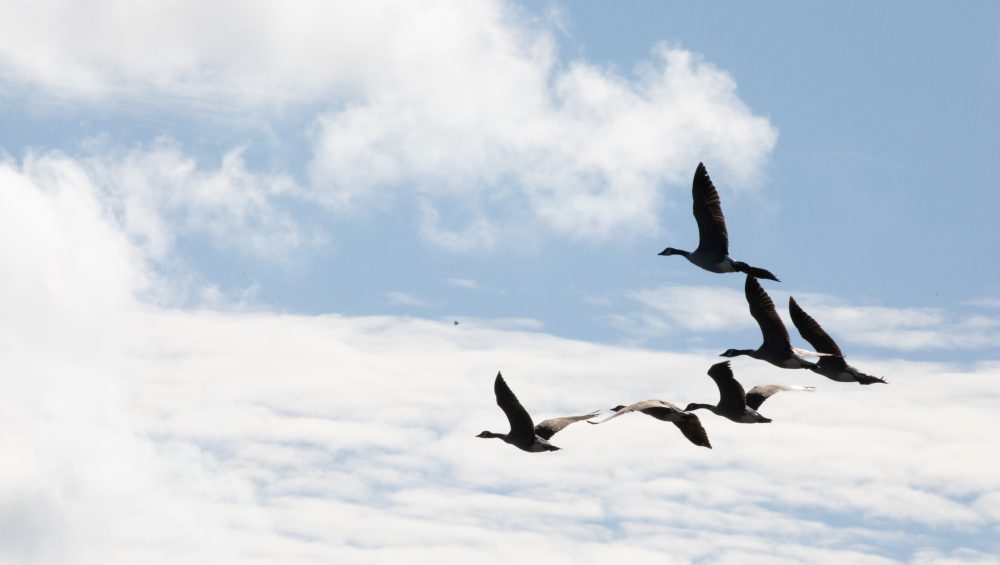
Sometimes birds are named to describe what they look like, and the male Black-Throated Green Warbler is one of them. This is the time of year when a lot of birds don’t look like they did in the spring, but I could not have confused this fellow with anyone else. I was lucky enough to spend time with him this morning shortly before I had to head into work. I’d been walking around looking for migrants almost an hour and a half, and then he appeared, almost at eye level.
I got to thinking later about how it was when I first discovered birds and they began to let me into their secret world. I had never noticed them before, and suddenly, they were everywhere, unidentified. And because no one else seemed to be paying attention to them, I felt as if I had the key to a secret society.
Now I think about it: how many absolutely gorgeous birds there are on earth that we hardly ever see? Indeed, there are species yet undiscovered. And even when they do show up, how often do we really get to see them well? I’m not too interested in just checking a bird off my list. I want to feel as if we shared a mutual encounter. And that was how it was with this bird. I was special again: graced by his presence, by the moment just between us. No other birds, no other humans. It’s as if I, too, became magical, momentarily protected by his invisible shield. I don’t know what it’s like to be a Black-Throated Green Warbler. But for a moment I inhabited the same space on the planet with one.
Later this afternoon when I went out again, I encountered the same bird in the same location and let him be. But elsewhere in the park, I found another male, and managed to get a picture of him. You can see the “green” he is named for.
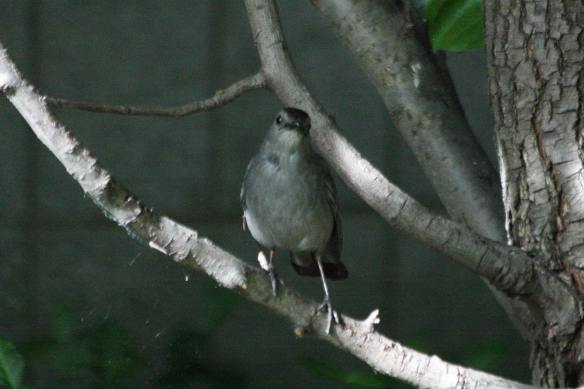
Yesterday morning on my way into work I stopped at 155 N. Wacker Drive in downtown Chicago to see if any new birds had blown in with the winds that were downing tree limbs in my neighborhood the night before. My friend of the past couple weeks, one of the two or three Gray Catbirds that’s been hanging out in this little patch of park, immediately came out to greet me.
So while there was bright sunshine except when he perched in a low branch of one of the trees against the building, I decided to take his picture. He almost seemed to demand it. Perhaps he was even a bit irritated with me for coming to look for other birds. Why should I need to look for other birds, if I could see him?
Mind you, I don’t feed this bird, I only acknowledge his presence. He trots out to greet me every morning when I stop to see if he’s still around. There is a connection here, and I don’t claim to understand it, but I think it’s a wonderful thing. It must have something to do with the way in which I notice him. I recognize him, and he recognizes me, and it’s a lot like the person you see on the train every day, smile and nod at, even if you never exchange words. Whatever this bird is up to in this park, he’s enjoying the bugs and I’m enjoying seeing him hunt for them.
I am a bit puzzled by the length of his stay, because Gray Catbirds breed in the savannah areas of the forest preserves around Chicago and more rural areas, and I can’t help but think he’s made himself at home. Wouldn’t it be something to have Gray Catbirds breeding in downtown Chicago!
Anyway, I thought I’d see if I could get a better picture of his gorgeous undertail coverts and he obliged. Then it seemed like almost every picture I took, he was showing off.
Don’t forget to get a picture of my beautiful black crown!
I talk to him, but he’s silent. He hasn’t sung or said a word. I am used to hearing Catbirds in the “wild” and usually, if they’re not singing, they at least let you know they’re watching you by uttering their characteristic “meow”-like vocalization. Maybe that’s why this Catbird likes me. He knows I know who he is without him having to tell me.
It may still be hard for some people to get their heads around the idea that birds are pretty smart, especially when the epithet “bird brain” had the connotation of stupidity for so long. The conclusion there, of course, was that size matters, and birds have small brains and therefore are not too smart, or that they behave solely by instinct and have no capacity for reasoning. Ha! is all I have to say to that. I was first attracted to birds by their intelligence. They were smart enough to appreciate the music I was playing, for instance.
While the current theory still leans toward comparative brain size, i.e., the larger the brain case in relationship to the rest of the body, the more “intelligent” the creature, right away making crows, ravens and parrots the geniuses of bird species, I have found finches are quite smart. No doubt Darwin was onto this.
Of course the only way we have to gauge another species’ intelligence is by how it interacts with us, which is pretty one-sided when you think about it. But I’ll admit I don’t have a clue how you figure out what birds are talking about to each other, at least 95% of the time, so it is only when they’re trying to communicate with me or vice versa that I can observe their “intelligence.”
I can already take for granted when I tell a bird something that it will respond to what I’ve said, or to what I’ve thought is more like it, but when a bird tries to tell me something and I try to figure it out – now that’s something. Generally this situation says something about my lack of intelligence. The birds are a lot better at understanding me than I am them.
Photographers Beware
This past week, as I was walking up the hill out of the park to get back to work on my lunch hour, I noticed a man had stopped to take a picture of something in a tree. I don’t think he was photographing birds. A squirrel maybe. Anyway, when he had the shot, he started walking down the incline into the park with his friend, but was immediately accosted by a handful of House Sparrows. Needless to say he was taken aback. While the House Sparrows didn’t attack him, they pretty much were, I suppose you could say, in his face. The men kept walking and so did I, but I know what was going on there. Um, you see, the House Sparrows associate cameras with people who might have food. I wonder how they come to make that assumption… I admit I sometimes feed the House Sparrows, although my primary targets are the crows, and I’m usually not taking pictures of the House Sparrows, although they are the most willing subjects, again because they associate the camera with food. I wish I could run a little Rupert Sheldrake-type experiment to see if House Sparrows do this in any other park besides Daley Bicentennial Plaza. His theory of morphic resonance could be tested here. Basically the idea is there is a collective intelligence and therefore if a group of House Sparrows have learned to associate cameras with food in one place, they might very well do so somewhere else.
Squirrel Evasion
Of course the crows are so smart they have me well-trained. Nevertheless the other park birds have learned to pay attention to the crows when I’m around because it sometimes means a payoff for them. And just like your backyard, the squirrels show up too, and they are a main competitor for peanuts. This week I observed the juvenile crows figuring out how to fake out the squirrels. We all seem to have figured out the squirrels don’t have very good eyesight. I can put a pile of peanuts on the ground and a squirrel will run right past the spot if he didn’t witness the drop. Usually if I throw a peanut to a squirrel it will distract him from a pile of peanuts. In one instance last week, shortly after I had put peanuts down for the crows, a squirrel showed up, and the juvenile crow that was following me around walked away and pretended to be interested in something else until the squirrel left. The same day, the white-winged crow was still more interested in eating his peanuts than stashing them, but when a squirrel tried to take his peanut away, he flew off and stashed his booty.
Cage Etiquette
At home, I have something going on with Ferdinand, the male Society Finch, that has been puzzling me. Friday night is clean-up night and part of the routine is to move all the finch cages away from the windows so I can clean up the papers and the floor underneath them. Ferdinand and Isabella, cage-created birds that they are, think there is nothing more fun in the world than when I put the middle finch cage on the dining room table, swap it out for a clean cage and leave it there so everyone can have their evening snack while I’m cleaning the living room. The other two cages are set aside in the front hallway and are the last things I clean.
Well, last Friday I was very tired and even though I know this routine so well I can do it in my sleep, I made the mistake of thinking it was time to put the first cage back when it was too soon. I corrected myself when I realized I had to hang the curtains first, but Ferdinand seemed to be reacting to my first thought, because he flew over and landed on the floor where the cage was supposed to go. He insistently kept alighting all around the cage area. I got the curtains hung and then moved the first cage back, after which I cleaned the other two as usual, and done with the big chore, I had my evening snack and went to bed.
This week, even though I started the chore a bit late because I was detained half an hour at work, I wasn’t mixed up in my thinking, but Ferdinand seemed to be. He flew over and landed on the floor again, before it was time to move the cage back. He also started flying up to the wand of the vacuum cleaner, as if he wanted me to move it out of the way. What kind of strange game was he playing? After I talked to him, he went back to sit with Isabella on the perch in the cage that was still on the dining room table. When it was finally time to move the cage back, he flew up on top of it and took the “ride” to the corner that way.
I thought about all this the next morning: Ferdinand was trying to tell me something. Perhaps he is trying to be my general contractor. According to his schedule, I should have been putting the cage back a lot earlier than I did. Perhaps Ferdinand thinks I am intelligent enough to try to communicate with because I always pay attention to his song when he sings it. Therefore I must be educatable, however long it takes. Ferdinand wants me to know he knows all about cages and where they go, and as far as he’s concerned once the papers are on the floor the cages should go back. Society Finch indeed. Whose society is this?
I try to run a democracy here, but I am the chief cook and dishwasher.
Gregorio is back in fine form, and I managed to take a short video of him this morning as he was singing in the environs of the dining room. He’s more than a little self-conscious, however. Even though the camera is small, the birds still detect the attention being paid to them and depending on the species and the level of domestication, they tolerate the attention to a certain degree. For instance, the spice finches are most sensitive to my attention and they scatter almost immediately.
There’s this phenomenon of having the feeling that someone is staring at the back of your head, and it makes you turn around to see who’s watching you. I think birds have this sense to the nth degree. They have developed and nurtured this awareness over the millennia, the reason being that their survival depends on it. Rupert Sheldrake has written about the feeling, and says photographers have said they suspect animals they photograph in the wild are aware of their attention. My experience behind the lens concurs, but I think these photographers are talking about taking pictures from behind a blind.
I connect with my birds telepathically because I know them intimately, but I also think a similar aura occurs now and then with strange birds in the wild. When I am able to cross the threshold between the bird’s caution and avoidance of my attention to the bird’s curiosity about my interest in it, then a different type of communication occurs. But at the outset, even my indoor crowd, as well as they know me, respond with suspicion when I single out any one of them: it’s ingrained in their makeup. Often one bird’s alert response is enough to make all the birds nervous. These feelings are also ingrained, if to a lesser degree, in our makeup too.
When I got home last Sunday night, after unpacking just enough, the birds were all chattering busily as usual, welcoming me, I guess. At some point doing my chores, I stopped for a moment and remembered Gregorio, but before I could say his name he started singing an extra long version of his song, repeating and repeating, “Gregorio, Gregorio, Gregorio…” I could have had no better welcome.
I haven’t dared write about Gregorio’s trials until I was sure of a happy ending.
Backtrack a few weeks before I went to Ohio: on a beautiful Saturday I was out working in the yard. After a couple hours I went back in the house. There, in the kitchen sink, was a fallen moth trap with a bird stuck in it. A zebra finch male, to be exact. I was horrified, and I felt terrible, because I should have known better than to put moth traps in the kitchen. But I had been getting so tired of the Indian flour moths, I stuck a couple traps on top of the crowded little shelves that jut out over the sink, thinking the birds were too busy elsewhere to get into it, or just relaxed with the thought that the birds have lived in the house for so long with few mishaps, I stopped paying attention to the fact that just in the past few days the zebra finches were starting to explore regions they had ignored for ages.
Zebra Finches on top of the kitchen cupboard
I was just too distracted, lackadaisical, thoughtless to make the connection.
and checking out the inside...
So there he was, my little finch, alive but very still, stuck in the trap, having lost a lot of feathers due to struggling with the adhesive. I reached in and pulled him out as gently as possible. A few of his remaining secondary feathers were stuck together so I washed him gently under warm running water and dried him in a towel. What to do with him? I couldn’t release him, because he wouldn’t be able to fly around high enough to reach the middle door of any one of the finch cages, which is essential if a bird is going to eat in this house. The only solution was to incarcerate him temporarily. And he would have to grow some feathers before my trip, because I didn’t want to add yet another cage to the burden for my bird care person. I had no idea how long it would take for him to grow back his feathers. Right now all I could be concerned about was his survival. (By the way, I could not bring myself to take pictures of him in his worst state.)
I put him inside one of the finch cages temporarily and closed the door while I went down to the basement to find the infirmary. It’s a dumb little cage that I picked up years ago for not a lot of money, and whenever I have a bird to isolate from the rest, I use it. I started thinking about preparing an extra little breakfast tray every morning. I found a water dish and a few accoutrements to make the cage as homey as possible. I knew he would hate being confined, but there was no other option.
When I had the cage ready, I stuck my little bald creature inside and started to look for a place to put the cage, out of the way, perhaps, in the dining room. No, no, no! was the reaction I got from my little prisoner. He vehemently objected to being away from the action, hopping up and down and throwing himself against the sides of the cage, so I set him on top of the coffee table in the middle of the living room, where he could see and hear all the other birds and vice versa. Looking back, I realize that was already a good indicator that he was going to fight his predicament and overcome it.
It wasn’t until maybe the middle of the next day that I figured out it was Gregorio, when I had taken inventory of the other male zebra finch’s songs and he was the only one not singing. Poor little Gregorio. I felt even worse: the past week almost every tape I listened to, Gregorio was singing on it, and I thought I had grown tired of hearing him. Now I didn’t know if I’d ever hear him sing again.
The first few days were extremely awkward. A couple times he hopped out of the cage past my hand when the door was open while I was changing this or that other dish, only to flop down to the floor, where I’d catch him easily. Once he was a little harder to catch, underneath the butcher block island in the kitchen, but I scooted him out and picked him up. He finally got the idea that he couldn’t fly and became somewhat resigned to his fate. I was afraid he wasn’t eating well either, seeming to eat only spray millet, and I lectured him about eating better if he wanted to grow back his feathers. Eat your vegetables! I have a feeling spray millet is like dessert for birds, but even if that was all he was eating I didn’t have the resolve to remove it from the cage to force him to eat something else. It must have been comfort food too.
I don’t think it was quite a week when I heard him vocalize for the first time. He wasn’t singing yet but he was calling. That was encouraging. He was growing little fluffy feathers around his head. I couldn’t tell what was happening with his other feathers; he had lost most of his primaries and secondaries on one wing, and I knew he had a lot of contour feathers to grow back as well. Then one afternoon when I was sitting writing on the futon, his cage right next to me on the coffee table, he sang a little. “Gregorio, Gregorio.” I knew he was on the mend!
A few days before I wanted to release him, calculating his release date was going be five days before I left for Ohio, I had his cage perched on the kitchen counter where I took him every morning and evening to clean and refill things, and I explained I wanted to make sure he could fly high enough to get into a finch cage to eat and that was why he was still locked up. As if to challenge my protective caution, he flung himself all the way up to the top of his little cage. Look at me, I can fly this high, I can reach the cage door. Patience, my little man, patience. It’s only a few days, and we’ll let you out.
Gregorio was eating more of his food, and the fuzz on his head was filling in. Saturday came, and I set him up with his breakfast just in case he had to return to the cage. I put the cage on the coffee table and opened the door. Within seconds he was out. He first tried flying all the way up to a curtain rod and fell down to the floor, disgusted he didn’t make it. But as soon as I thought he might be able to break up his flight into stages, he did exactly that, landing on top of a cage, and then eventually making his way to the curtain rod. You know what they say about great minds thinking alike…
Gregorio upon release
It wasn’t until then that I took a few pictures of him.
bald but brave
When I saw him eating spray millet inside a cage, I knew he was going to be all right.
Gregorio inside a regular finch cage
One time I looked up and he was snuggling with a Society Finch. Another time I saw him paired up with another male zebra finch, which is how it’s gotten to be in this house with only one female zebra finch left, so the guys choose partners, not for sex but for companionship, and it’s really a nice thing to see. I hadn’t been worried about the other birds picking on him, but it was yet another reason to incarcerate him until he got back on his wings.
Well here we are now and I barely recognize him. He still looks a little flat-headed and his tail feathers are a little stiff, but he’s zipping around with all the other birds, up to his old mischievous ways, and needless to say I don’t have any moth traps anywhere the birds can get to.
All the while as I was writing this Gregorio was singing his song. He knows I’m writing about him, and I’m sure he’s trying to add his two cents. He just started up again. Gregorio, Gregor, Gregorio, Gregor…
In addition to my experiences with Elvis and JoJo, I knew crows had a reputation for being of superior intelligence. Whether it was the Japanese crows who waited until the traffic lights turned red to put walnuts under cars’ tires, flew to a perch and waited for traffic to start up again so the cars would crack the nuts for them, or the Caledonian crow that figured out how to make a tool out of a stick, crows were a brainy bunch.
Before West Nile virus reached Chicago, the crows in the lakefront parks were numerous and they tended to ignore me. As I sat there hanging out with the pigeons and house sparrows, every once in a while a crow might show up out of curiosity, but it always hung back. I imagine I started bringing hot dogs every once in a while to see if that would do the trick. But if I threw something at them it scared them away. I tended not to throw food at birds anyway, but since the crows were on the perimeter it seemed the only way to reach them. And if it was summertime the gulls got all the hot dogs. A single gull can wipe out a quarter pound of hot dogs in less than 10 seconds, storing it all in its gullet.
Of course the crows had a plan for me. The way I remember, it took me four years to get their trust. The way they remember it, they had to convince me that if I wanted to feed them, I should quit feeding the pigeons, starlings and house sparrows. This coincided with the fact that I was becoming more interested in other birds, including the migrant species that visited twice a year. My study of pigeons, starlings and house sparrows, all the “invasive” species, was complete enough. I followed the crows’ advice and began feeding them exclusively. The usual fare was hot dogs and peanuts. In the winter sometimes I made them peanut butter oatmeal raisin cookies, which I call the Birdz Cookies, although they’ve become a people favorite too.
In 2002 there were only a few crows left after West Nile virus had killed so many, and I felt terribly sorry for them. Crows have quite an elaborate social structure, and it was the equivalent of losing your tribe. (Kevin McGowan of Cornell University has done a tremendous amount of study about crow society.) In the dead of winter I sought out the remaining crows, fed them and spent time with them, just letting them know, as I had with JoJo, that I cared. It proved to be the big bonding moment, I guess. The crows adopted me.
I would go to the park and search for crows. Sometimes they were easy to find, other times they eluded me. Often they would sit quietly waiting for me to stumble upon them in a tree. They were still checking me out and it was a long time of “getting to know you.”
I was still thinking music should be part of the bargain, but I couldn’t carry my piano or even a guitar downtown to play music for the crows or the other birds. At one point I bought a couple of recorders with the idea that I would learn how to play them and serenade the birds. It never happened. Invariably when I paid attention, the birds were in key with my inner soundtrack, but it still wasn’t the same as playing for them. I did start singing last year, “There is nothing like a crow” to the music of “There Is Nothing Like a Dame” from South Pacific. “There is nothing like a crow. Nothing in the world. I think all of you should know, there’s not anything like a crow” or some such thing. I could start singing and the crows would show up. But now they’re looking for me anyway, I don’t try to find them anymore.
There were always adjustments to be made. For instance, in the late spring and summer, the lakefront is full of Ring-Billed Gulls and they outnumber the crows, so I had to be careful where I fed the crows. It seemed to be a mutual decision, that I would put their food down under a leafy tree, close to other trees where there was less open space, since gulls by nature preferred to be out in the open. I honestly do not remember thinking this myself, it was like an epiphany that came from the crows, it seemed to be their suggestion. This is only a problem when I have hot dogs or cookies. The gulls’ beaks are unable to deal with peanuts in the shell. They will pick them up and put them right back down again.
The crows always recognize me, without fail, and they can pick me out of a crowd. (John Marzluff of Washington University has done experiments that verify this phenomenon). I cannot count the times I have been walking on the street during rush hour and a crow will call out. I’ll look up and there it is, either flying over, or perched somewhere above the intersection where I’m standing. I have to stop and laugh. I know they’re probably just saying hi to the Food Lady but I like to think the crows consider me an honorary crow or they can somehow see my Inner Crow.
I don’t exactly encourage the crows to be tame, but they know I like intimacy, and so they oblige to whatever degree feels comfortable to them. I don’t push it. Often they volunteer. A crow typically will fly right over my head and past my ear before landing on a branch, or on the ground, right in front of me. There were two young crows on the lakefront last winter that followed me around like dogs, always flying ahead a little bit and landing not far from me. I’d leave a trail of peanuts and we’d walk the length of Monroe Harbor in this fashion. I know I will never get as close to any of them as I did to JoJo, but I think my experiences with her have helped me converse in some kind of crow “lingo.”
It’s difficult to sum up a decade of crow experiences here, so I will revisit this subject from time to time. Suffice it to say that I have developed a relationship with these incredibly clever birds and I treasure it. I willingly acknowledge they are much smarter than I am. They have trained me well. I would never think of showing up in the park without something for them to eat. I call it paying my Crow Tax. But it’s a small price to pay for the experience of getting to know these fascinating creatures, and to somehow, on some level, inhabit their world.
I met JoJo the Crow for the first time after a bird walk at Thatcher Woods in River Forest, Illinois years ago. She lived in a cage inside the adjacent Trailside Museum. JoJo’s claim to fame was that she talked. There was another crow in the same room with her and I think he talked a little too, but not as much. It must have been around the time I moved from the apartment to the house, because I missed my contact with Elvis and I hadn’t made connections with my new neighborhood crows yet. I craved a crow connection, even if it was with a caged bird. I went back to see JoJo sometime later. She was alone the second time.
JoJo’s main vocabulary consisted of “HUH-lo” and a phrase that sounded to me like, “What’s wrong?” although the people who cared for her insisted she was saying “What’s up?” Quite a while later I talked to someone who had been trying to find out JoJo’s story. Apparently she was originally cared for by a woman who spoke French to her, and she was saying “Bon soir.” That made more sense, seeing as how JoJo could not reproduce the consonants, only the vowel sounds.
JoJo liked women more than men, I suppose because she had been cared for by a woman. She didn’t care for kids at all and would start braying noisily – it wasn’t a caw but her own voice of disapproval – when there were kids in the museum. Those of us who got close to her found she liked to have her beak stroked. She would poke her beak through the rungs of the cage and sit patiently while you softly slid your index finger down it. Sometimes she practically fell asleep, she was so content, the nictitating membranes closing over her eyes. It amazed me how trusting she was.
After I had found a way to fit JoJo into my routine, I would visit her on the weekends as often as possible. We talked, and she tried to look into my eyes often with both of hers, facing me, her head bent down low. I scratched her head a little too. Then I started bringing her treats, knowing perfectly well that it was forbidden, but I couldn’t see too much harm in a peanut or two. So our little secret would not become too apparent if a caretaker came in to check up on her, I broke up the meat of the peanut with my fingernails and fed her little tidbits through her cage. She often drooled in anticipation, and then ever so gently took the tiny pieces of peanut from my fingers. I’m sure I was aware of how lethal her beak could be, but she taught me that it could also be a tool of love as well. Beaks are wonderful things–the equivalent of our hands to birds; beaks can do everything except, perhaps, play piano.
Once I got careless. JoJo was on the bottom of her cage poking around her food, which often consisted of hard-boiled egg, unshelled peanuts, and raw hamburger meat. I stuck my little finger through the opening in the cage bottom and after a few seconds, she grabbed it, hard. I tried not to take it too personally, although my feelings were hurt as much as my surprised finger. I tried to pretend it was a joke on her part when I finally got my finger back, but she had reminded me of two things: never to take her beak for granted, and never to take her welcome for granted either. The bottom of the cage was her space and she wasn’t sharing it. When she hopped up onto her branch perch, only then she was ready to receive company.
But perhaps the most instructive thing about this lesson was how she reacted every time I told people about it when they stopped in to visit the museum and noticed me talking to her. JoJo would listen intently as I recounted the story and she almost seemed to smile with satisfaction when I got to the part where she grabbed my pinky. I thought later that her experience of hearing me tell the story was probably like mine years earlier when I was in Italy with my friend Linda who was fluent in Italian, and I listened as she told her Italian friends about something that we had done earlier. I knew what she was talking about but I could not understand the words.
As she got older, JoJo had trouble with her feet from being stuck in a cage all her life. From time to time her keepers would medicate her feet and wrap them up in colorful gauze dressings. I knew JoJo was mortified by this. Look at my feet with this stupid red, green or purple stuff on them. I stayed longer during those visits, I talked to her and tried to calm her down while she tugged and fidgeted at her dressings. I also felt bad for her because no crows were coming by to visit her anymore outside the museum window; West Nile virus had taken its toll. Crows are social creatures and I knew JoJo looked forward to my visits because I spent time with her. Once I had a wild, random thought because we had bonded so well. I asked her if she was my mother, who had died years earlier. JoJo looked deeply into my eyes, and if I believed such things occur, she could have been saying “Yes I am.”
One day as I was driving to visit JoJo, I was thinking I had never heard her caw like a regular crow. I wondered if perhaps she had forgotten how to caw, or there was no one to caw to, or both. I parked, got out of my car, walked up the path to the museum, and opened the door to the little reception area. The moment I stepped inside, I heard a loud “Caw, caw, caw.” It was JoJo. Telling me, of course she could caw, she knew perfectly well how to caw. I laughed and went up the steps into her room. She regained her composure, dipped her head in customary fashion and said, “HUH-lo.” “Bon soir.”
I saw JoJo for the last time perhaps a week or so before she was no longer “on display.” Her feet had been getting worse and I knew it was only a matter of time before she would be gone. I missed her terribly, but I knew the interspecies friendship we shared gave us both good memories. And I am sure my experience with JoJo laid the groundwork for my friendship with the Grant Park crows. I’ll write about my mind-reading adventures with them next.
The leap from wondering how to relate to creatures with dot-like eyes on the sides of their heads to starting to see birds as thinking, feeling beings who were not only paying attention to my every move but were reading my thoughts as well was probably a gradual process. Certain examples come to mind.
Back in the apartment, a mourning dove started coming to the window often, and he was different from the rest. Doves are usually silent, but he made little kvetching noises as he fed. In retrospect I realize he was not well. Around this time, the windows were wide open and when something startled the doves, they would all fly into the room, turn around at the wall and fly back out with acute precision. On one of these flights, the little dove in question did not make it; instead, he landed on the floor and crawled under the radiator. I realized with a bit of panic that I would have to pick him up and put him out, and I had never held a bird before. Not knowing what to expect, I got down on my knees and reached for him. He edged away but really didn’t put up much resistance and soon I was holding a soft, fluffy beating heart that weighed barely a few ounces.
I put him on the window sill and he sat there, undoubtedly terrified. The standard mourning dove defense is to sit so still to blend into the background and you won’t notice them. But that wasn’t going to work; he had to leave. I sort of shoed him off the ledge, he flew home, and I named him Fidel.
The weather turned colder and one day Fidel came inside and started walking around across the floor. I asked him where he was going but he pretty much ignored me as if he knew all along what he was up to. Soon he had wandered out into the hallway. I thought to myself, I can’t have a wild bird walking around in my apartment! I sat still for a while, calling him. until I finally got up and found him sitting in the bathroom by the radiator where it was quite warm. When I tried to get him to come out, he flew up to the shower curtain rod and looked down at me. I did not have a net and I was not going to chase him around the apartment. I went back into the room and sat down at the piano, thinking if I started playing, he might come back out on his own. I played a while, nothing happened. I started calling him, Fidel, Fidel, come back out, you can’t stay in there. After a while, Fidel came walking back into the room. I kept telling him he had to leave. I hated to kick him out, but I had no capacity to care for wild birds. And one thing I liked about entertaining the wild birds was that they always went home at night. Somehow I convinced Fidel it was time to go home and he left. I know he didn’t understand my words, but he heard my thoughts.
Later on, I was gone for a weekend and came up the back stairs to find a dove, dead, outside on top of the back door frame. I knew it had to be Fidel. Poor bird was probably trying to come back in where it was warm. He had decided my apartment was a safe place. I felt terrible to lose him.
Not feeling quite like Dr. Doolittle, I began to accept that the birds at least paid attention when I talked to them, even if I wasn’t sure we were exactly conversing. It still seemed to be a one-way conversation.
Then I wanted to get to know Elvis the Crow better. He had sat in the elm tree out on the street facing the window for at least half a year, watching birds come and go, before that one day when he finally came to the window and hovered for a peanut. Crows are very cautious creatures, but once they make decisions, they stick. I told my friend Robin about the crow and she said her sister had a crow named Ernie she fed all the time, and that she had seen crows take pancakes and stack them up in neat little piles before taking off with them. She also talked of scrambled eggs and pizza and I said I’m not going to put all that food out for a crow. She thought a minute and said, they love hot dogs.
Hot dogs? Really. Well, I supposed I could buy a pound of hot dogs and cut them up and see what happened. The day I came home from the store with the hot dogs, I looked out my kitchen window and Elvis was sitting on the roof peak directly across, staring at me. Maybe a crow’s stares are special because they have larger, rounder eyes that look more like a mammalian eye that I can relate to. But somehow I knew immediately that Elvis was telling me, I know you have hot dogs. The communication now was going both ways. I was getting this information from him, and he was telling me he knew what I was up to. The question then was, where to put hot dogs. I didn’t want to put them on the window sill. I thought smelly, messy, and what if the other birds knock them down to the ground? My neighbors were pretty tolerant but this would never fly.
So I thought to put a few hot dogs, cut up, on the back porch steps leading up to my apartment. Within minutes, Elvis showed up. Eventually he was bringing his mate, Elvira, too. The starlings caught wind of it as well, but they were messy eaters, unfortunately. The crows quickly removed their booty to stash elsewhere, so the hot dogs were gone and no longer my problem!
Elvis and I became fast friends. Some time after Elvira started showing up with him, one morning, about 100 crows flew over my roof. I had the feeling Elvis had invited them to check out his neighborhood. He had carved out his territory, and one of the highlights was the lady who played music in the window and put hot dogs out on the porch. About a year later Elvis and Elvira showed up with Elfin, their first offspring. That was pretty exciting stuff. I had my own crow family. And I have been fascinated by crows ever since. More crow stories to come.