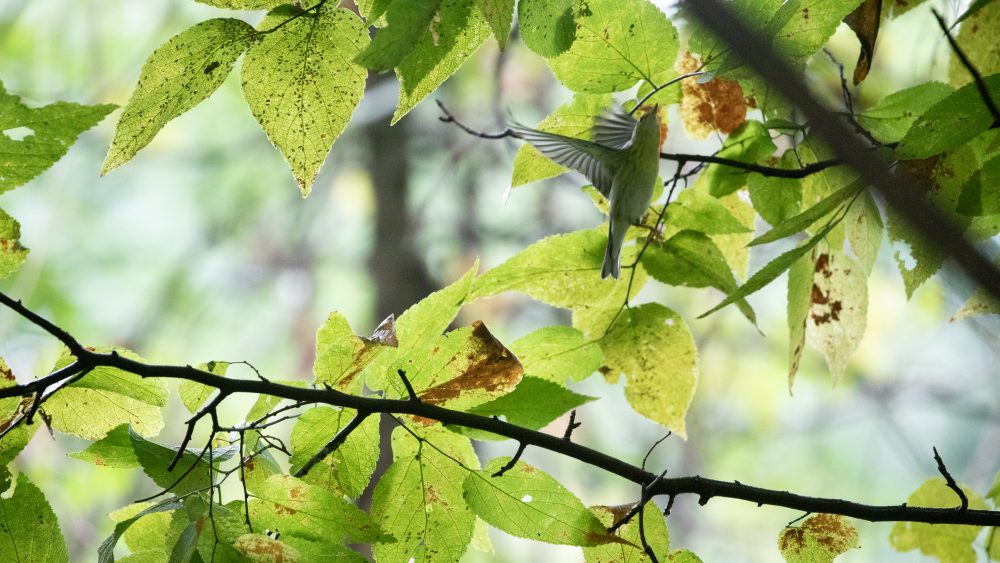
Why are birds attracted to music?

Recording Aria of Goldberg Variations with Cardinal

 Attached is an excerpt of the Aria to Bach’s Goldberg Variations with a Northern Cardinal singing. There’s also a House Finch and a bit of what sounds like a juvenile White-Throated Sparrow in there too, and Chimney Swifts twittering up high.

Birds are not the only creatures attracted to music. You may have a cat or dog that likes to sit under the piano while you play, or at your feet with your guitar or whatever your instrument. You may have figured out your house plants grow better with classical music in the background. Maybe your tropical fish swim like they’re dancing when there’s music playing.

Birds are the most obviously musical creatures to us. Those that are called songbirds do just that – they sing. But their other vocalizations are often musical to our ears as well. Songbirds don’t hear the same range of tones that we do: they tend to hear higher pitches than we can but they won’t hear lower pitches as well. But it’s hard to imagine our hearing surpassing that of the birds, because they seem to be so acutely aware of every sound.

When I first realized birds were listening to me play, I thought I could relate to them by imagining how they were listening. I remember thinking that if I had been walking by while someone was playing music with the window open on the third floor of an apartment, I would have had to stop and listen. Yet no human being as far as I know ever did. The humans weren’t listening to birds either, though, and until I was made aware of birds I wasn’t listening either. Admittedly something happened to me when I started listening to the birds. I became more aware of all sounds. Noise became noisier to me. And the slightest sounds of wind rustling leaves of trees or the proverbial pin dropping were more noticeable as well.

If everything a songbird utters has a musical tone to it, I’d like to think its orientation to life is like being in a constant opera. Or maybe it’s more like a human tone language in that the meaning depends a lot on the pitch. Either way, I suspect music is a natural state-of-being for a songbird.

Not all music, of course, is going to interest birds in the same way, they have their tastes too. My birds at home are definitely put off by Messiaen, who wrote out the songs of birds and put them into his music. There are two things operating here: first of all, human instruments imitating bird songs don’t sound exactly like birds, and the birds know that. When I imitate one of my birds’ songs by playing it on the piano, I get stone silence. They react more favorably if I sing it or whistle it, much as I can get wild birds to countersing with my incompetent whistles. Also, I have found my birds relate better to baroque or romantic music, anything preceding 20th Century atonal music, I suppose because they like to know what key they’re supposed to be thinking in. Can’t blame them for that. They’ll talk over loud or keyless music but they won’t blend in, harmonize or sing along with it.

So I hope you enjoy the cardinal, he’s singing quite nicely on this recording.

What’s up with the “in-keyness”?

I already thought it was interesting the birds were listening to me play and participating, but when I realized they were in key with the music it made me stop and think. Birds seemed to be pretty autonomous, so why were they choosing to sing in key with the music I was playing? Or were they somehow compelled to be in key with it, not by choice? I tried to find out if anyone had noticed this or written about it somewhere but came up empty. There were studies proving that birds had absolute pitch. Oh good, I had been feeling as if the avians and I had something in common besides our love of music. But no studies of birds singing in key with music. I started thinking maybe this was pretty obvious, like your face has a nose in the middle, to a native musician close to nature, but wondered if anyone in the so-called civilized world had ever considered it a phenomenon. So I started writing scientists about it. I got some courteous responses but nobody really wanted to believe that I could tell them the birds were in key with the music. After all, I have no credentials but my ears. I’m not an ornithologist or a musicologist. I’m just an annoyingly curious woman with a discerning ear.

So I decided to lay low and just keep taping the birds as I practiced, soon becoming more interested in their responses than the pitches, taking for granted that they were always in key. What came to pass over time was that listening to the birds was making me more aware of everything I heard. I caught myself listening to the music in my head again, I had a soundtrack, usually going over whatever it was I was learning at the time. But sometimes the music in my head was not in the key it was written. I had transposed it, and it did not feel natural to “play” it in the right key. What was going on here? Why did I feel as if I had to transpose?

Or I’d wake up in the morning with music in my head and become aware of the robin singing outside my window who was in the same key as the music in my head. Were we telecommunicating or were we both getting our sense of pitch from somewhere else?

Then I’d be having a conversation with someone, maybe a complete stranger, just exchanging a few words, and realizing after we spoke that we were in the key of the music in my head. This was getting to be weird!

I paid attention for a while to the music in my head, whatever it was, right before I got off the train, because I knew there were always three crows by the station in the late afternoon on my way home. Wouldn’t you know they were cawing in the key of the music in my head?

Searching for more practical applications of this experiment, I became aware of the music in the locker room at the gym and, listening to the conversations of women around me, realized they were speaking in the key of the background music. Then somewhere along the line I decided to pay attention to the underlying tone of the conversations as people left Orchestra Hall after a Chicago Symphony concert. Sure enough, everyone was speaking in the key of the last chord the orchestra played.

Going back to the birds, I knew they weren’t always singing. They had songs, but they also had calls, albeit their conversations sound more musical to our ears than our own do to ours. But the birds were reacting to music the same way we do. We have to. What is music but a series of vibrations? Our in-keyness and the birds’ as well is a visceral, physical response that we cannot control.

So maybe I have an explanation for the determination of the mourning dove who sat and listened carefully to the aria of the Goldberg, just waiting for his chance to sing along. He knew somewhere in there, the vibrations were coming up and they would be right in his key, give or take a half step in either direction; he was capable of transposing too. I named him Primo Columbo. He had a hen named Prima, and they produced a son, Secondo, who eventually came to sing with his father. Oh but I forgot, mourning doves don’t learn their songs, science tells us they are born with their song ingrained within them. Well, when I find that tape of Primo and Secondo singing together, I’ll put it up here. Even if Secondo already knew the tune, it sure sounded like he was getting a few tips from his dad.

How I started playing music for birds

Recording made 7-5-2011, Bach A Major English Suite excerpts

When I went back to playing piano years ago, I never dreamed I’d be playing music for birds. But the birds were listening. This blog will be about my discoveries from sharing music with birds and all they have taught me. It’s an ongoing project: I’m still learning music and from my association with birds.

It all started when I renting an apartment on the third floor of an old six flat. I had not played for years, and I couldn’t play music for my own enjoyment because my expectations were too high: I had no technique, had forgotten how to read music, and I wanted to sound like a concert pianist. Yet I had talked myself into playing again purely for physical reasons; I was losing strength in my hands to arthritis.

The first frustrating time I sat down to play I could remember only the prelude to Bach’s B-flat major Partita, and it seemed like a place to start. I turned on my Fender Rhodes piano, leftover from almost 8 years on the road playing Top 40, and started to play. The window must have been open, because I recall a Mourning Dove landing on the sill. He started to sing along. I was horrified and shut the window on him. I don’t think he gave up that easily, he was back on the sill on the other side of the closed window.

Fast forward a few weeks, months, I began learning the Partita again, and the music was beginning to call to me. Now that I was starting to play, I wanted to share the music. Music is not meant to be played in a vacuum, it is an expression to be experienced by others. I bought a tape recorder so I could make tapes and send them to friends. But that soon became a lonely, frustrating business, driven by the impossible quest for perfection. I couldn’t balance my joy in being able to make music again with what I perceived to be other people’s expectations of it.

The next step was to find another musician through Classical Music Lovers Exchange; we carried on a whirlwind long-distance affair for nine months that he cancelled, but he left me with the idea that the birds were singing along with the music. I might have been peripherally aware of this, and left with nothing but his pronouncement, I decided to check it out myself; after all, if they were singing along, they must have been listening, so I would play for the birds.

I had no idea who was in the chorus. In the true spirit of adventure, I put things I thought birds might eat out on the window ledge to draw them in. And in they came. House Sparrows, European Starlings, Mourning Doves, Northern Cardinals, House Finches, Blue Jays, even Dark-Eyed Juncos and eventually an American Crow I named Elvis.

Once I got used to the birds, it was like being in heaven to play for them. They became the ultimate audience, because they were drawn to the music, and they participated in it.

Inspired by Vladimir Feltsman’s rendition of The Goldberg Variations which he played in recital in Chicago’s Orchestra Hall, filling in for an ailing Rosalyn Tureck, I decided to learn the Goldberg. It was while practicing the opening aria that a Mourning Dove–possibly the same one I had shut the window on a couple years before!–started singing, intent on being able to sing along with the piano. But I knew his song to be in C. The Goldberg was in G, at least most of the time. It was difficult to listen to the bird and play at the same time but I had the sense he was singing in key with the music. I got some microphones and started taping the birds singing along with my piano practice. On playback, it turned out the birds were always in key with the music.

I have been taping my piano practice with bird accompaniment ever since. I have a lot more to say about all this and it will take me many posts as I go through hundreds of tapes, journals, correspondences.

Warning: This is not about my piano playing, it is about the birds singing along with it, so I ask you to please pardon the mistakes and stumblings. The birds also have a tendency to talk or sing a lot more when I’m first figuring out something, I suppose because the newness of it (after hearing the same thing over and over again for weeks) intrigues them. Unfortunately this means I will put listeners through the excruciating first readings and stumblings on my part.

I have inserted excerpts from a recording made this morning. We’re learning Bach’s A major English Suite presently. The birds in the background (and if one lands on a microphone, in the foreground) live with me in my house.  I am no longer equipped to play for wild birds (although I will be going through the old tapes to find some remarkable examples). The indoor crowd consists of Budgies, Zebra Finches, Scaly-Breasted or Spotted Munias commonly known as “Spice Finches”, and a couple of Society Finches. The Budgies are rappers. The Zebra Finch males each have distinctive songs, and they sound a bit  like little nasal tin horns. The song of the Spice Finch is too soft to be heard over all the other birds, but I do have recordings from the first Spice Finch somewhere when there was less competition and I will be posting when I find; the Spice Finches do have musical whistling calls, however. The female Society Finch sounds like a turning ratchet, the male whistles and sings loudly when inspired to do so. I’m still learning the tape-to-MP3 program so this may sound a bit disorganized.

And it’s not all going to be Bach, there’s Mozart (thanks to the birds’ encouragement, I trekked through all the piano sonatas), some Brahms, Ravel, Schumann and probably more.